10 Movies That Would Make Better TV Shows
Some stories need a little more room to breath.
It’s been remarked on so many times that it’s practically a truism… but we’re living in a golden age of television.
For fifty years or more, the acknowledged best stories of two generations have been told in the cinema. Further back than that it was the novel, taking over from the theatre as the perfect storytelling exponent. Before then, epic poetry and the dying gasps of the oral tradition.
But this is the 21st century, the age of digital consumption. More and more, the grandiose, expensive display of cinema seems an extravagance, with new, more personal ways of consuming content seemingly popping up every other year. What people want isn’t empty spectacle, but a good story, well told - and preferably, easily streamed or downloaded to a tablet or a phone.
The wheel has spun 180 degrees: TV stars used to dream of graduating to the silver screen but now, having a fêted cable drama on your résumé is better than any number of mid level indie movies.
And increasingly, more and more movies are being made into TV shows when it used to be far more common the other way around. Recently, From Dusk Till Dawn, Fargo, The Evil Dead, and now Rush Hour and Lethal Weapon have all been recast and reborn as new takes on themselves on TV.
There are a plethora of movies past and present that would make better television shows than feature films. Let me show you what I mean - and here be spoilers...
10. Unbreakable (2000)

Over sixteen years ago, writer/director M. Night Shyamalan was hot off The Sixth Sense, the second highest grossing movie of 1999, a film that earned six Oscar nominations in 2000 - three personally, Best Picture, Best Director and Best Original Screenplay. He was only twenty-nine years old.
Unbreakable arrived seven months or so later: the eagerly anticipated new film from this young auteur everyone was raving about. Its low key, intense atmosphere - and a career best performance from Bruce Willis - gathered it plenty of fans, but the age of the superhero movie had only just begun, and people simply didn’t know what to make of it.
There was no flash, no panache… just dramatic, evocative storytelling. Unbreakable dealt with the origin tale of one David Dunn, the sole survivor of a horrendous train crash who slowly discovers that he possesses superhuman powers. There was little in the way of traditional heroics, no costume and no grandiose codename. No one really knew what to expect from a superhero movie in November 2000, but this certainly wasn’t it.
Today, the superhero movie is ubiquitous. Marvel and DC (and their fans online) have resumed their neverending battle for the hearts, minds and wallets of the public, while smaller superhero movies jostle for the change left in everyone’s pockets. Broadsheet film critics bemoan the stranglehold that the subgenre has on the blockbuster, while fans clamour for more.
There’s never been a better time for a return to Shyamalan’s sober, resonant take on the superhero… and with the rise of television as a the go-to medium for weighty, nuanced drama, and the measured pace that this story requires, TV is certainly the way to go.
Recasting would be necessary, of course: but with online streaming platforms and cable channels competing to see who can produce the highest quality programming, there are any number of avenues for Shyamalan to choose to expand Unbreakable’s narrative.
There’s another problem, of course: the notoriety of the property’s creator. In 2016, Shyamalan no longer the celebrated rookie auteur on the block, but a byword for schlocky hackery on a truly hateable scale. However, although his films have been panned for years, they’ve all made money. Hopefully his reputation wouldn’t prevent him from bringing a cable-standard Unbreakable to the small screen.
9. Jumper (2008)

Doug Liman’s science-fiction action movie of eight years ago made its money back at the box office, but not sufficiently to lead immediately to a sequel. Reviews were less positive - the consensus appeared to be that the narrative was poorly paced, feeling rushed and incoherent, with a disappointing ending.
That pacing might have been a stylistic choice, of course. After all, the movie was about men and women with the power to teleport instantly from place to place - the Jumpers of the title. Hunted by religious extremists convinced that their power was blasphemous (“only God should have the power to be everywhere”), the film follows David and his attempts to live the life of Riley by stealing an inordinate amount of money every so often.
The movie never makes it clear why some people can teleport but most can’t, or how Samuel L. Jackson’s Paladins know how to confine a Jumper in the first place. In the books, it’s made clear that Jumping is a learnable ability, but the only people that really exhibit it are the protagonist, his girlfriend and, later, their daughter - in the film, David meets up with a more militant and violent Jumper with as much of a hard-on for killing Paladins as they have for killing Jumpers.
So much of this mythology needed more space to be unpacked, but Liman seems determined to keep that breakneck speed going throughout. Liman’s movie includes plenty of elements not present in the books, many of which are excellent ideas that he doesn’t have time to flesh out.
Jumper clocks in at eighty-eight minutes, positively anorexic by the standards of modern popcorn movies - some restructuring and a little light and shade would have helped considerably.
That’s the kind of thing that television manages far more successfully than films; the open-ended conclusion is one that would have worked far better on TV, too.
8. Brick (2005)

Rian Johnson’s directorial debut is a dense, intriguing film noir. Protagonist Brendan, a solitary misfit, investigates the whereabouts of his ex-girlfriend Emily, who’s fallen in with the wrong crowd. He’s a taciturn, brooding type who’s beaten up a lot, but gives as good as he gets - the perfect noir hero, in fact.
The twist? All the action takes place in and around high school. Brendan and Emily are teenagers. It would have been far easier to run the plot as a kind of knowing spoof on the genre, and it’s to his eternal credit that Johnson decided to play it completely straight.
But making the right decision to serve the story has a knock-on effect on the vibe of the film. Bruised and inscrutable, Brick feels sparse and claustrophobic despite the amount of dialogue-heavy scenes and the open-plan Californian setting. The elliptical narrative, so important in noir, is complicated further by the decision to include impenetrable slang that only properly becomes clear on a second viewing.
That’s an issue that a season of television could have fixed, giving the story space to breath. Not only that, but Brendan’s infiltration of local drug lord The Pin’s operation, vital to the plot, feels rushed and contrived in the context of the film. Brendan’s a ferociously compelling character, but he’s not exactly likeable: whatever the opposite of a silver tongue is, that’s what he’s got.
In the end, Brick feels like nothing so much as a season of True Detective, squeezed into a two hour movie. Resonant and resolutely odd, Johnson’s film could have made more of an impact had it been developed as a cable television show instead.
7. Event Horizon (1997)

An unfairly maligned sci-fi horror with an absolutely gorgeous high concept (the experimental faster-than-light drive bolted onto the missing spaceship Event Horizon is supposed to generate an artificial singularity to connect two points in space, but sends the craft to Hell instead), Paul W.S. Anderson’s Event Horizon deserved a lot better than the reception it received.
Partly, it was the marriage of the science fiction and horror genres. Whereas films like Alien simply set a monster movie on a spacecraft (it could have been a submarine for all the difference it would have made), Anderson made a conscious effort to merge the two, delivering a speculative explanation for a normally supernatural event.
That was a brave move, but not one supported by the studio. Given six weeks to rush a workable cut into cinemas, the rough cut that Anderson was able to show executives was unfinished, overlong and far gorier than they’d anticipated. In came the scissors: and so the cut that arrived at theatres wasn’t the version of the film that the director had planned to screen.
And it wasn’t just the more graphic scenes: whole scenes expanding upon character relationships and the central premise of the film were cut.
That excised footage doesn’t exist in a saleable form any longer, so a director’s cut is impossible. What’s left is what many horror fans consider to be a flawed masterpiece, certainly Anderson’s best work. You can see what was intended, and the jaw-droppingly nasty moments that are left hint at the kind of harrowing movie we’ve lost to the cutting room floor.
And that story can still be told. Back in 1997, we didn’t have a cable TV industry in America primed and ready to tell stories like this… but we do now. Whether a remake or a sequel, Event Horizon could easily be brought to full, gruesome life in a manner similar to American Horror Story.
You could even expand on the premise: imagine the blueprints for the ship’s gravity drive reengineered for use as a terrestrial transport system: an initially incredibly expensive portal to… somewhere else, unwittingly opening with every cargo shipment, foreign dignitary, billionaire potentate or celebrity jetsetter.
Set the new event horizon of Hell on Earth, over a dozen terrifying episodes, and tell the story free from studio interference.
6. Sin City (2005)

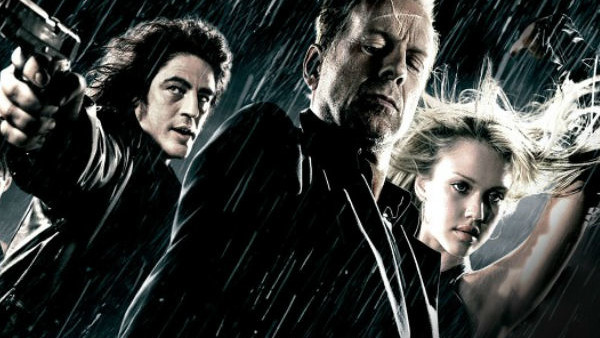
A bit of a no-brainer, this: after all, Frank Miller and Robert Rodriguez’ Sin City, adapted from Miller’s own extraordinarily hyperreal noir tour de force, was composed of several smaller stories vaguely linked together by location and tone.
Sin City comprises three significant ‘yarns’ from Miller’s Basin City: the first, eponymous story featuring granite hardman Marv’s attempts to avenge the death of his friend (renamed The Hard Goodbye in later printings); The Big Fat Kill, detailing Sin City maverick P.I. Dwight McCarthy; and That Yellow Bastard, a tale of sacrifice and hard knocks starring doomed cop John Hartigan. All three yarns were bookended by both parts of The Customer Is Always Right, a short story taken from the Booze, Broads & Bullets anthology.
That’s the format of pretty much all of Miller’s Sin City yarns: novella length stories featuring many of the same characters in the same grim noir setting intersecting and dovetailing together. If that’s not perfectly framed for a television series, I don’t know what is.
While the Sin City movie (and to a lesser extent, the inferior sequel A Dame To Kill For) were fascinating exercises in translating the comic books to the big screen, there’s nothing in the resulting movies that couldn’t equally well have been conveyed to the small screen.
In fact the films - each longer than they probably needed to be - actually suffer by requiring so much of Miller’s trademark over-the-top hardboiled machismo to be experienced on screen in one sitting.
Adapting the series for television would have solved that problem without losing anything in terms of pacing or storytelling, and allowed for the possibility of new Sin City yarns to be debuted on the show, perhaps even by guest writers.
5. Push (2009)

The story of psychics with specific abilities and tribal nicknames describing what they’re able to do - Pushers control minds, Movers are telekinetic, Watchers can see the future, etc etc - Push told a fairly generic story of government conspiracy and genetic experimentation.
That’s a story that works far better in a longer, more expansive form. Having to set up the additional mythology of the Pushers et al only complicated matters.
Like Jumper, Push was an attempt to introduce a superhero style milieu to cinema that was a self-contained universe, using no previously established characters from the Marvel or DC universes.
And that became part of the problem. Unlike the slight, sketchy Jumper, Push was difficult to follow simply because it was overstuffed: less than two hours devoted to introducing a whole universe of characters, situations and concepts. At least with a movie like Iron Man or Man Of Steel, it was only necessary to tell one hero’s origin story - Push simply tried to set up far too much in far too short a space of time.
A television series on network TV in this day and age wouldn’t necessarily need to be too expensive, given the psychic (and therefore mostly invisible) source of the characters’ powers. With the right casting and a coherent vision for the plotting of the season, Push could have been the Heroes that actually worked.
4. Night Watch (2004)

Timur Bekmambetov’s urban fantasy epic (adapted from the novel by Sergei Lukyanenko) pits light versus dark in a modern day magical setting: magicians, vampires, witches and all that wonderful faery tale gubbins, anchored by an almost Kafkaesque, existentially bleak working class setting.
Bekmambetov’s film, and its sequel Day Watch (2006) are gripping, fascinating works of epic fantasy with a rich, detailed mythology and history. A dozen years or so ago, television simply wasn’t prepared to handle such a property. In 2016, however (and post Game Of Thrones) television is uniquely equipped to do so.
It’s been long enough now that a complete remake would certainly be possible - or a sequel TV series could be drafted based on Lukyanenko’s other books. In point of fact, Bekmambetov’s follow-up film Day Watch is based upon the second half of Lukyanenko’s first novel Night Watch - so a putative television series could be created that drew on the novels Day Watch, Twilight Watch, Final Watch and New Watch, respectively.
Well, apparently a TV series has been teased for a decade but never come to pass. Coming off like a proletariat Matrix with Lord Of The Rings’ back story, a Night Watch show could potentially feature the best of all possible worlds: superhero style set pieces, a sweeping fantasy-style backdrop, perfectly pitched drama on the level of The Wire or Mad Men… it’d be the legendary gift that keeps on giving.
3. Watchmen (2009)

For decades, Alan Moore’s seminal Watchmen comic book was considered unfilmable - not necessarily because of the content (although that would always have presented a problem to some degree) but because of the tone, the complexity and the sheer importance of the work.
Widely regarded as one of the greatest comic book series of all time, Watchmen couldn’t just be optioned and made into a half decent cash-in popcorn flick, as Fox did with the Fantastic Four and Columbia did with Ghost Rider. It’s the War & Peace of superhero comics, written by arguably the greatest comics writer who ever lived.
That’s why it took so long to be made in the first place, languishing in development hell for twenty years before rights hassles, filmmaking technology, a decent script and the money all came together in 2006, and shooting began in the autumn of 2007.
The resulting movie, released in early 2009, was an achievement no matter which way you look at it. Director Zack Snyder had steered as close to the original books as possible, especially in terms of the production and costume design. What changes were made were undertaken with the best of intentions, and in some cases still worked very well, and even Snyder’s insistence on his trademark hyperreal slow motion fight scenes didn’t ruin everything.
It was Watchmen… but it wasn’t. So much of the subtext was lost in the necessity to stick to the bare bones of the plot. After all, this was a movie two hours and forty-three minutes long as it was, and the director’s cut was over three hours long.
But even with some judicious trimming, it wasn’t enough. Critics applauded the effort, but generally, reviewers unfamiliar with the comic book considered Watchmen a bore, too faithful to the comic to be entertaining for a casual audience. Meanwhile, the hardcore fans bemoaned the elements left out.
Later home media editions restored the director’s cut footage, then added further cut material to nudge Snyder’s labour of love as close to Moore’s original as possible. But this is a feature film, traditionally designed to be seen in a single sitting. For all Snyder’s hard work, the critics were right - and so was Terry Gilliam, formerly attached as director, who had famously bailed out of the project declaring that the property should be made a five-part miniseries, not a single motion picture.
It’s debatable whether funding would have been available for such a project back in 2006/2007 - but if it was available today, HBO or Netflix would dump a giant alien squid in Times Square for the privilege of bringing a Watchmen TV show to the small screen. Expanded to fit the parameters of a cable TV show, designed to be seen in bite sized chunks, Watchmen could have found an obsessed audience on television far easier than at the cinema.
2. Saw (2004)

James Wan’s psychological horror was a lovely little slice of nasty when it was released around Halloween a dozen years ago - and since then, it’s become a franchise, a movie being released at the same time every year until, by 2010, seven Saw movies had been hacked into existence.
The unique selling point of the franchise wasn’t the death trap scenarios, or even Jigsaw himself, the man responsible for kidnapping people and placing them in said scenarios. No - John ‘Jigsaw’ Kramer dies at the climax of Saw III, and this isn’t the kind of franchise where zombie versions of the villain come back from the dead.
The real star of the Saw movies is the labyrinthine plot - because all seven films are just chapters in a single story, often told in a nonlinear fashion, flashbacks and concurrent action taking place in different movies, all telling different parts of the story. For example the events of Saw III and Saw IV, released in cinemas twelve months apart, take place at the same time.
Considering the franchise’s roots as a horror flick in the much-maligned torture porn style, the Saw franchise’s purposeful rehabilitation into a compelling, even innovative narrative is brilliantly done.
The problem is that, just as with Watchmen, the result is a project that demands to be watched in manageable chunks, but that is instead presented to audiences in unmanageable chunks of ninety minutes or more.
The Saw franchise would have made a phenomenal cable television show, and would have been recognised more for the artistic achievement it is had it not been reduced to feature films churned out to cinemas once a year on Halloween to make a quick buck or two.
1. He Never Died (2015)

The story of Jack, a depressive, taciturn misanthrope just trying to get by on a day to day basis who finds his past won’t stay dead and buried, He Never Died is a breath of fresh air: a low budget genre flick that doesn’t disappoint, that relies on a dry, inventive and witty script and note perfect performances to sell itself.
It helps that the high concept for the film is solid, and kept in the background for the most part, teasing out information and cryptic hints as to who or what Jack is and what the deal is with all the eating people. Oh, that’s right: Jack’s a cannibal, unkillable and ridiculously strong, who’s been around for millennia.
Jason Krawczyk’s brilliant, darkly comic horror was only properly released in spring of this year, but if any film needs to be adapted to the small screen, it’s this. It’s sharp, funny and oddly touching, and it showcases a first lead role for punk rock icon and renaissance dude Henry Rollins, after a sporadic movie career covering more than two decades.
If anyone was born to play the part of Jack - weary, antisocial and withdrawn from human contact - it’s Rollins. He’s not that guy, but he knows exactly how to tap into the parts of himself that are, and he’s ideal in the role, given pitch perfect support from Kate Greenhouse, playing a waitress that Jack may or may not have found a connection with… that is, until she’s caught up in his problems.
The murky secrets of Jack’s long and tortured past seem to range from committing medieval genocide to working with small time criminal enterprises to pay the rent. He’s killed thousands in his time, and is haunted by a mysterious silent stranger that only he can see, who could be Death or the Devil himself...
Make no mistake about it, this is a really great movie - and it’d make an even better TV series. Krawczyk has reportedly sketched out a first season as he shops the movie around as a de facto pilot: with centuries upon centuries of history and secrets galore locked up behind that thousand yard stare, this is a character around which any story can be told, preferably with the same deadpan approach as the film takes to the premise.
And if you’ve seen the film and think there’s little room for expansion, then I’m afraid you don’t know Jack… and that’s the point.