10 Movies They Didn't Know How To End
Written into a corner.

If you've ever tried to write a movie for yourself, you'll surely appreciate that it's no picnic. Making everything slot together in a way that's satisfying, entertaining, smart and well-paced is incredibly challenging, so it's little surprise how many movies fail to keep it together.
It's never more frustrating, though, when a movie boasts a great concept and gets so, so many things right, but struggles when it comes to the most important part - the climax.
These 10 films, each enormously intriguing in their own right, found their respective screenwriters scrambling to write themselves out of a corner and leave the audience with a satisfying ending.
And though in most cases the ending doesn't fully derail the film, it's consistently a low-point across these movies, demonstrating that a killer set-up isn't enough - you need to know where to take it.
In some of these films the solutions are infuriatingly obvious, while in others, it's clear why the writers agonised so much over how to wrap things up...
10. The Wolverine
James Mangold's The Wolverine was conceived as an apology of sorts for 2009's critically panned solo outing X-Men Origins: Wolverine, and you know what? For about 70% of its run-time, it's a pretty good movie.
The first two acts of the film manage to balance character drama with satisfying action, but the finale disappointingly veers into the overly silly, CGI-fuelled shenanigans the previous solo movie was so widely criticised for.
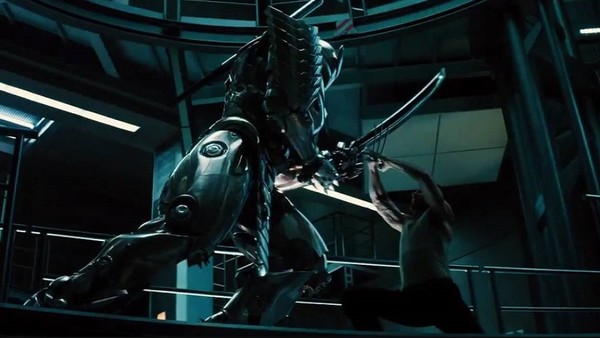
It all goes down the tubes when Logan (Hugh Jackman) is forced to battle the Silver Samurai, piloted by none other than his crusty old pal Ichiro Yashida (Haruhiko Yamanouchi) in an attempt to steal Logan's healing factor.
The fight itself is uninteresting and overly reliant on visual effects, and the Ichiro reveal is ultimately more comical than surprising.
This is definitely a case where a less-bombastic, more personal fight scene would've resulted in a far more effective and satisfying battle, as what we got basically played like someone scrawled it on a napkin the night before shooting.
9. Alien: Covenant

Alien: Covenant is by no means a great movie, but it does do a solid job of positioning malevolent android David (Michael Fassbender) as the new antagonist of the franchise, while serving up some brutal death scenes.
The less said about the dum-dum characters, admittedly, the better.
But after fans complained that Prometheus wasn't enough like Alien - in that it didn't feature a single xenomorph - Scott decided to "remedy" this...by shoehorning some traditional xenomorphs into the final 20 minutes of the movie.
Up until that point, the movie's characters had been fending off a vicious new proto-xenomorph, and after the last of these creatures is killed, the focus appears to shift towards David being Covenant's ultimate antagonist.
But of course, the final half-hour of the movie gives the heroes not one but two classic xenomorphs to fight off out of nowhere, before arriving at the hilariously predictable closing twist that, yes, David has assumed the identity of the team's android, Walter.
Again, Covenant is plenty flawed throughout, but needlessly resorting to schlock-filled nostalgia for its final battle was a creatively bankrupt move if there ever was one.
The writers clearly knew they had to build to a finale that cemented David's villainy, but didn't really know how to fill in the blinks. When in doubt, xenomorphs!
8. Wonder Woman

Wonder Woman does so, so many things right, giving the iconic superhero one hell of a character-driven origin story aided by sharp direction, great production design, solid performances and memorable action sequences.
And for most of the film's run-time, it feels like Patty Jenkins was set to subvert the DCEU's typical CGI-slathered third-act nonsense, but sadly, that's exactly where she decided to go.
In the apparent finale, Diana (Gal Gadot) battles the evil General Ludendorff (Danny Huston), believing him to be the God of War, Ares. However, even once she kills him, she's horrified that his death doesn't stop the war.
This honestly would've been a perfectly fine end-point for the film. After all, it's already pretty close to the two-hour mark at this point, and in addition to serving as a potent commentary on man's self-destructive nature, it would've been a major turning point in Diana's character.
But of course, the movie drags on for another half-hour as Patrick Morgan (David Thewlis) reveals himself to be the real Ares and we get an ugly, overdone, unintentionally daft CGI battle.
With a little narrative restructuring, Steve Trevor's (Chris Pine) could still be the emotional lynch-pin of the third act while erasing the lame Ares fight entirely.
Ludendorff was plenty villain for this movie, and adding a janky digital final boss made the film feel unexpectedly Zack Snyder-like.
7. The Matrix Revolutions

This could really apply to both of the Wachowskis' Matrix sequels, which while visually dazzling and jam-packed with awesome action, had no idea how to reach a satisfying climax.
This is especially true of the final entry into the trilogy, The Matrix Revolutions, which built up to a tectonic mega-brawl between Neo (Keanu Reeves) and Agent Smith (Hugo Weaving), and still couldn't give fans a compelling send-off.
As a whole, it feels like the Wachowskis visualised the ridiculous, Dragonball Z-inspired final battle and then reverse-engineered the rest of Revolutions from that concept.
The battle itself, while undeniably silly, is at least creative and technically ambitious, and really should've led to a pretty straight-forward conclusion where The Matrix is purged of Smith.
Perhaps seeing this as too "neat", the Wachowskis instead gave fans an obtuse and anti-climactic ending where, after Smith is destroyed, Neo's code is returned to the source - whatever that means - and the precise nature of his (non)existence is left infuriatingly ambiguous.
Granted, it can't have been easy to come up with a gratifying ending to a pop-culture monolith of this sort, but despite the series' technical complexity, a simpler ending clearly would've sufficed.
Audiences don't always need their expectations subverted, and an unsurprising ending that works is better than an unexpected one that frustrates.
6. War Of The Worlds (2005)

It's no secret that H.G. Wells' 1898 novel on which this film is based ends on one of the most famous anti-climaxes in pop-culture history, with the alien invaders eventually succumbing to the "hostile" nature of Earth's atmosphere.
And it's fair to say that Steven Spielberg couldn't find a way to rectify this for contemporary audiences in his otherwise pretty decent 2005 adaptation, with the director himself eventually admitting that he couldn't figure out how to end the film and wasn't satisfied with how it concluded.
But beyond its non-event of an ending, there's also the infuriating, inconceivable survival of protagonist Ray's (Tom Cruise) idiot son Robbie (Justin Chatwin).
Mid-way through the movie, Robbie runs off into the battle and a gigantic explosion engulfs the area...but he miraculously shows up in Boston at the end of the film with no believable explanation for his survival.
Even for a sentimentalist like Spielberg, this came off extraordinarily hokey and implausible.
Given the movie's relatively grim tone, Robbie dying for real wouldn't have been outside the realm of possibility, while subverting Wells' original ending with something a little more satisfying for the blockbuster crowd probably would've been the smart call also.
5. Bad Boys II
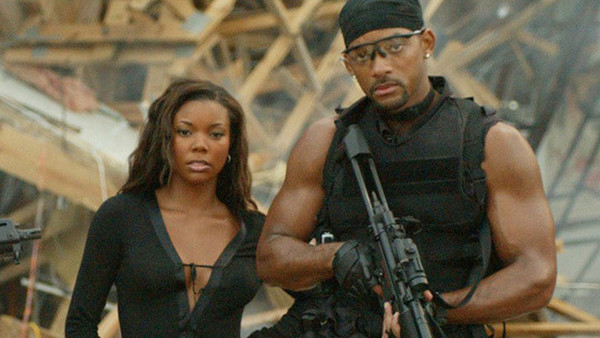
Bad Boys II just might be the most Michael Bay movie that Michael Bay has ever made: it's visually stunning, brutally violent, obnoxiously childish, blatantly sexist and racist...and about 30 minutes too long.
The film seems set to climax with an epic raid on the mansion of Cuban drug lord Johnny Tapia (Jordi Mollà), but once this oddly curtailed set-piece is concluded, Tapia escapes and kidnaps Marcus' (Martin Lawrence) sister, Syd (Gabrielle Union), taking her to Cuba.
Now what's basically a second climax to the movie unfolds, where Marcus and Mike (Will Smith) raid Tapia's Cuban compound and the action finally resolves at a minefield outside Guanatanamo Bay (yes, really).
Clearly Bay had a lot of ideas for staging action sequences, but in the interest of efficiency it would've made sense to combine these two set-pieces into a single finale, moving Syd's kidnapping up to before the initial mansion raid. If Syd really even needed to be kidnapped at all, that is.
Instead, Bad Boys II's third act is almost exhausting in its excessiveness, as though Bay wasn't quite sure he'd given audiences enough bang for their buck yet. You had, Michael, you had.
4. Now You See Me

Now You See Me is one of those infuriating movies that has a killer premise, a great cast and plenty of neat ideas, but no idea how to deliver on the follow-through.
A gang of magicians (known as the Four Horsemen) who use their talents to rob banks should make for a pretty great movie, and indeed, large sections of the film are deliciously entertaining.
But the screenwriters clearly felt the pressure to deliver one final sleight-of-hand, the results of which were...unconvincing to say the least.
At the end of the film, it's revealed that FBI Agent Dylan Rhodes (Mark Ruffalo) was in fact the secret fifth member of the Horsemen and the real mastermind behind their activities.
Furthermore, his father was a famed magician who died while performing a trick, and his convoluted scheme throughout the film was ultimately an act of revenge against everyone responsible.
This clumsy ending couldn't be more counter to the clever tricks deployed throughout the rest of the movie, and really brings the whole thing down a fair few notches. The film needed one final "gotcha!" for sure, but this ain't it, Chief.
3. Speed

The Keanu Reeves-starring action-thriller classic Speed is one of the greatest high-concept movies of all time, boasting an impossibly creative and intriguing premise - a commuter bus is rigged with explosives which will detonate if it drops below 50 miles per hour.
Yet as ludicrously entertaining as the film is, it also hits a bit of a roadblock deep into the third act.
With the bomb-on-bus scenario resolved at the 90-minute mark, the film needlessly continues for almost another half-hour as Jack Traven (Reeves) hunts down bomb-maker villain Howard Payne (Dennis Hopper).
This over-egged climax was not actually part of Graham Yost's original script, which took place entirely on the bus. But Fox refused to green-light the film without a re-write which added more exterior action to the film, believing that audiences wouldn't want to watch a movie set solely on a bus.
Switching the action to a manhunt that concludes on a subway train was entirely studio-mandated, and though it's still pretty entertaining, the movie really felt like it was done once the bus was evacuated. Whether Payne was caught or not, the concept the film was sold to audiences on was over.
Given that Speed's script was still being worked on mere days before shooting started - with the help of Joss Whedon, who punched up most of the dialogue - it's honestly pretty surprising the end result turned out as well as it did.
2. Glass

M. Night Shyamalan's long-awaited finale to his unexpected superhero trilogy ended in the most flatly disappointing, anti-climactic fashion earlier this year, that's for sure.
Glass was touted as the epic final showdown between the heroic David Dunn aka The Overseer (Bruce Willis), split-personality monster Kevin Wendell Crumb aka The Horde (James McAvoy) and genius supervillain Elijah Price aka Mr. Glass (Samuel L. Jackson).
And though the film builds solidly enough to its inevitable final fight, only the fate of Mr. Glass himself is particularly satisfying, dying after having most of the bones in his body broken by The Horde.
The Horde is meanwhile shot dead by a sniper in largely unceremonious fashion, but the kicker? Dunn, our illustrious hero, is drowned in a puddle by an anonymous goon working for Dr. Ellie Staple (Sarah Paulson), a member of a secret society suppressing the existence of superhumans.
The surviving relatives and friends of the three characters are then left to upload video footage of their superhuman actions to YouTube for the world to see, and that's...basically it.
Granted, this isn't exactly a new problem for Shyamalan - he's brilliant with elemental concepts, but when it comes to delivering a satisfying climax, he so often botches it with excessive attempts to surprise the audience, whether it makes sense or not.
Shyamalan recently admitted that the bad reviews for Glass made him cry, but when you off your hero in the most unsatisfying manner possible, what the hell do you expect?
1. Law Abiding Citizen

Law Abiding Citizen is one of the finest guilty pleasure films of the last decade, a deliciously trashy thriller about a genius engineer, Clyde Shelton (Gerard Butler), who seeks to avenge his murdered family by brutally killing both the perpetrators and those who failed him in the criminal justice system.
Think Death Wish but with more nifty gadgets and the Conservative outrage turned up to 11. This film is wild.
And though Shelton's vengeful behaviour quickly gets wildly out of hand, thanks to Butler's deliciously scenery-chewing performance, he's easily the most charismatic and likeable character in the entire film.
This makes the ending rather awkward, then, as Jamie Foxx's charisma vacuum of a "hero" Nick Rice, a lawyer concerned more with his win-loss record than actual justice, tricks Shelton by hiding his own bomb in his jail cell, killing him.
Given that the film made Shelton so easy to root for, even as he plans to blow up City Hall, having the arrogant tosspot lawyer outsmart him seems implausible at best and deeply unsatisfying at worst. The audience wanted Shelton to win, dammit.
Rumours have persisted in the decade since the film's release that Jamie Foxx forced the ending to be changed so that his character prevailed, though there's still no confirmation on that.
Given how much of an ass-pull the actual ending feels like, though, it's incredibly easy to believe.
Clearly, it should've ended with Shelton escaping jail and Rice making an earnest attempt to fix the legal system, with the fear of Shelton being ready to strike if he goes back to his corrupt ways.