10 Movies Which Oddly Predicted Real Life Tech

Which Woody Allen movie do you think made it onto this list?

When it comes to real world and movie technology it's easy for it to exist in some blurred parallel universe floating between the two - tech which inhabits the fictional realms of cinema is every bit as influenced by the cutting edge technology in development in reality, and vice versa. It's hardly surprising that this is the case - clearly the design heads at corporations such as Apple or defense research contractors such as Darpa, keep a keen eye on science fiction to get new ideas about not only how tech should look but also how it should function. Similarly, production designers working in Hollywood ensure that they keep on top of current trends to give the gadgets on screen the best appearance possible, Not all technology in science fiction movies are likely to wind up in the real world - time machines and warp drive spacecrafts remain a pipe dream to this day (although recent research suggests that the latter may become a reality sooner than we realise) - but a surprising amount of gadgets which have featured in movies in the past have broken free from their fictional and theoretical origins and made it into reality. The following list takes a closer look at ten prescient movies featuring technology which has made the trip from screen to reality. The countdown to consumer hoverboards has finally begun.

10. The Hitchhiker's Guide To The Galaxy
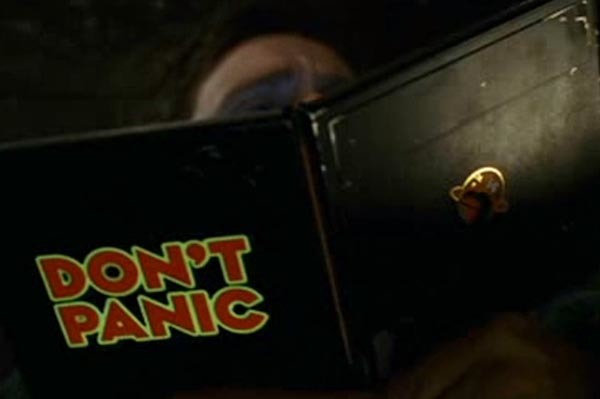
The film adaptation of Douglas Adams's hilarious The Hitchhiker's Guide To The Galaxy isn't the first movie which springs to mind when thinking of tech-oriented science fiction. Adams was as much preoccupied with bigger philosophical and social themes as he was with the possibilities future technologies might open up. Still, in addition to the geeky jokes (Adams was leagues ahead of The Big Bang Theory when it came to appealing to nerd humour), The Hitchhiker's Guide To The Galaxy predicted a resource full of information that would be updated until the end of time - if that isn't a description of Wikipedia then what is? Beyond this, the famous Don't Panic book featured in the story is remarkably similar in concept to Kindle and other similar ebook-reading devices. €œIt€™s a sort of electronic book,€ Ford Prefect tells Arthur. Indeed.

9. Short Circuit

The latest film from Neil Blomkamp immediately struck audiences over a certain age as incredibly familiar - the story of a law enforcement robot who is reprogrammed by an Asian scientist to learn and perform good acts could have been lifted directly from a synopsis for Short Circuit. Long before Blomkamp introduced the world to Chappie John Badham introduced science fiction fans to another loveable robot, Number 5. Whereas Chappie was designed for policing, Number 5 was originally created by the fictional NOVA Laboratories for use in the military before being whisked away by a more compassionate scientist. Nearly thirty years after the release of Short Circuit and military robots are very much a reality, with defense research organization DARPA heavily invested in the manufacturing of killing machines. Whether or not they go as far as Terminator-style cyborgs remains to be seen. https://www.youtube.com/watch?v=cj83dL72cvg

8. Destination Moon

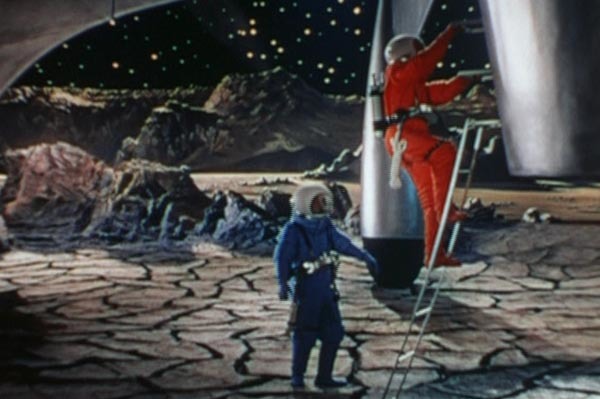
The post-World War 2 era was a time when science fiction at the movies really started to take off - before the war sc-fi films were incredibly rare things, but with the advent of nuclear weaponry, V-2 rockets and other rapid advances in technology the genre suddenly became incredibly popular. While filtering through the thousands of poor-to-average science fiction movies of the 50s can be something of a drain, sometimes one comes along which eerily predicted future events. Destination Moon centres around the dangers of space exploration, particularly America's first efforts to launch an expedition to the moon. Shot in 1950, Destination Moon might not be the most sophisticated science fiction movie of the decade, but its focus on the topic of mankind landing on the moon nearly 20 years before the actual event shows a remarkable amount of prescience.

7. Sleeper

Probably the last filmmaker you'd expect to feature on a list of movies which predicted future technology is Woody Allen - his films are almost always focused around characters who inhabit the contemporary world, as far removed from the trappings of science fiction as you can get. Still, his one foray into sci-fi satire, Sleeper, does serve up plenty of jokes and sight gags lampooning both the science fiction genre and the theories of futurists while somehow managing to predict a truly life-saving piece of technology into the bargain: Allen plays a doctor, who in one scene uses a robot to assist him performing surgery. While naturally the computer in Sleepers assists by way of offering verbal analysis and suggestions, today computers and robots are sometimes utilised directly in the surgery itself, remote-controlled by surgeons. Avoid this video if you're at all squeamish. https://www.youtube.com/watch?v=wQnKG2J4lZA

6. Face/Off

John Woo is the kind of director who likes to bludgeon the audience over the head with a metaphorical hammer - loud, action-packed and replete with over the top characters, his movies are the cinematic equivalent of a shock and awe military campaign. Expecting anything remotely plausible in movies which feature such excessive gunplay is usually a waste of time, and yet as it happens it is the most outlandish technological feat in all of his films which has actually made it into the real world. When audiences first watch Nicolas Cage and John Travolta trade faces in Face/Off the premise was taken at face value (forgive the pun) - it was an excuse to see the actors ham it up pretending to be one another. Fast forward to the present day and the human face transplant is no longer a product of Woo's wild imagination but a very real procedure which people have actually undergone. Whether or not any of them opted to go for the Cage or Travolta look is highly unlikely. https://www.youtube.com/watch?v=ZDakDW9K2yE

5. Total Recall

As we enter the top 5 entries of this list of movies which predicted future technology we come to the first of the films adapted from the literary works of one of the greatest science fiction writers of all time, Philip K. Dick. Dick wrote hundreds of short stories and dozens of novels, and all of them were rich with possible predictions for a future earth. Total Recall, directed by Paul Verhoeven and starring Arnold Schwarzenegger as a man who gets caught up in a villainous plot to deprive the people of Mars their air, is one of the best Philip Dick movie adaptations (it's certainly far more entertaining than the recent remake). An early action chase sequence features technology which will be rolling out commercially in the real world very soon: driverless cars. Total Recall also managed to predict full body scanners at transportation terminals - although the real life body scanners found in airports around the world don't look anywhere near as cool as the skeleton-revealing scanner Arnie smashes his way through to avoid a hail of bullets. https://www.youtube.com/watch?v=FVgA-eqtj8U

4. 2001: A Space Odyssey

Another legendary science fiction author who had his pulse on the future of technology was Arthur C. Clarke. While his novels might not have been as action-packed and exciting as Philip K. Dick's they appealed to millions of sci-fi geeks around the world, not least Stanley Kubrick. Kubrick's adaptation of Clarke's 2001: A Space Odyssey is something of a benchmark when it comes to science fiction movies - you only have to look at the constant comparisons between this and Christopher Nolan's Interstellar to see just how much significance it still has. The number of ways in which 2001 (or should that be Arthur C. Clarke?) predicted the future of technology is impressive, to say the least. From space stations orbiting the planet earth through to space tourism, in-seat screens for entertainment, videophone booths, touchscreens and chess-playing computers, 2001 is a movie literally crammed to the rafters with tech predictions which have all transpired in the years since its release. https://www.youtube.com/watch?v=N-1gzo3Pyvo

3. Blade Runner

Predicting the future of technology isn't the only thing Philip K Dick's stories were good for - they also pointed towards other changes in society which have since come to pass. Before Paul Verhoeven depicted body scanners and driverless cars in Total Recall, Ridley Scott introduced the world to some other concepts in his adaptation of Do Androids Dream Of Electric Sheep?, Blade Runner. The huge digital-style billboards might have looked futuristic when the film was released in the early 80s but visit any thriving metropolis today and the sight is fairly common, while the four year lifespan of the Replicants sounds remarkably familiar to anyone who is used to upgrading their gadgets regularly. The "Voight-Kampff" machine used to test replicants by measuring empathetic responses has also emerged in the modern world - albeit with different functionality - in tech like IBM's Watson device, capable of beating human opponents on the gameshow Jeopardy.

2. Minority Report

Of course, when it comes to Philip K. Dick literary adaptations which hit the predictive nail on the head, presenting on screen a long list of technology with which we're all now more than familiar with, the top prize goes to Steven Spielberg's Minority Report. Much of Minority Report's technology is now practically ubiquitous around the world - touch screen technology, targeted advertising and facial recognition tech are all things most of us have encountered at some point or another. If you're especially wealthy then you might already enjoy the experience of living in a voice-activated home, while the driverless cars also predicted in Total Recall are on their way. Amazingly, the crime prediction technology of Minority Report is also something law enforcement officials currently have access to. Perhaps unsurprisingly this doesn't involve the use of precognitive humans - instead, the system uses analytical methods combined with algorithms to determine crime "hot spots" based on the collected data. https://www.youtube.com/watch?v=wi7Pbm6tHws

1. Back To The Future: Part II

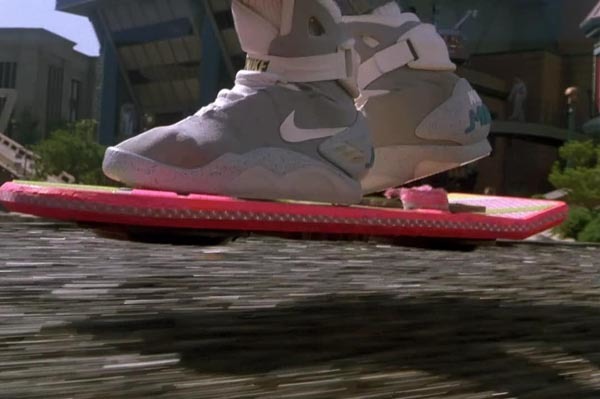
While Minority Report's technological predictions might lean more towards the sinister police surveillance state applications which were a common theme of Philip K. Dick's science fiction writing, few would argue that the gadgets and gizmos featured in Back To The Future Part II wouldn't be welcome in the real world. Back To The Future II might seem a little outdated when it comes to fax machines installed in bathrooms (does anyone still fax anything these days?), but the automated gas station and the unmanned drone (dispatched in the film by USA Today to cover a news story) are certainly relevant to the modern world. Likewise, in the age of Google glasses and Occulus Rift the visor worn by Marty Jnr. comes pretty close to current trends relating to wearable tech. Best of all - by a thousand miles - was the prediction that we'll be riding on hoverboards in the year 2015. Okay, so we've not quite reached the stage yet where people are casually gliding down the street a few inches off the ground, but thanks to the tech bods at Hendo hoverboard shennanigans is only a matter of time... https://www.youtube.com/watch?v=m5xse0Abulc What other movies have predicted real life technology? Why not let us know about them in the comments below?

Contributor
Contributor

Andrew Dilks hasn't written a bio just yet, but if they had... it would appear here.