10 Movies Which Unwittingly Inspired Real-Life Crimes
The issue of copycat crimes inspired by cinema is an ongoing one that has been with us for decades and it doesn't look as if it will go away any time soon. Unfortunately, it is not uncommon for an individual to see an act take place in a film and to then emulate it in real life. Filmmakers don't set out to make films that are going to inspire people to commit awful and atrocious acts, but do they have a moral responsibility to their audience?
Copycat crimes relating to a particular film will usually damage the film heavily. The most obvious example of this is A Clockwork Orange, which was pulled from distribution in the UK after the film began to get heavily misinterpreted and crimes based on acts that took place in the happened at a scary frequency.
Sometimes, it is just the case of mentally unstable individuals seeing a particular film and acting upon a random event they see in it, but filmmakers do have a moral responsibility to their audience, particularly in the case of portraying violence as there is a fine line between examining violent behaviour and glamourising violence.
10. The Town
Ben Affleck's Boston set crime thriller features a number of scintillating set pieces, most notably when he and his criminal crew dress up as nuns, and wielding some heavy firepower rob a bank for hundreds of thousands of dollars. Because it's the movies, robbing a bank is made to look cleaner, easier and more lucrative than it actually is, but that didn't stop a couple from Illinois from attempting to emulate Affleck and co...

Wearing nuns clothing and covering their faces with nightmarish masks like the crew in the film, Navahcia Edwards, 25 and her fiancé stormed a Chicago bank heavily armed and walked away with over $100,000. No shots were fired during the robbery and nobody was injured or hurt, which is actually a pleasant surprise. The couple were eventually caught and sentenced.
9. Fight Club

David Fincher's fearsome adaptation of Chuck Palahniuk's insanely popular novel has spurred people to set up 'fight clubs' of their own, with many being founded across America. Fight Club also seemed to inspire a large number of teenagers to set up their own forms of fight club at school and have fights on the grounds, but these were quickly suppressed by the authorities.
On the more dangerous side of things, a lot of people were inspired by the anti-capitalist message of the film and went about imitating the acts of Tyler Durden. One such imitator was Kyle Shaw who set off a homemade bomb created from fireworks and set it off outside a Starbucks, an infamous symbol of corporate America.
Shaw was said to be planning his own Project Mayhem, the group set up in the film by Tyler Durden to bring down corporate America. Shaw plotted to mimic the events of the film and was a noted obsessive fan of both the book and film, making the association clear.
8. The Program

In the early 90's movie, The Program, the main character lies down in the middle of a busy freeway as an act of bravado and to demonstrate just how 'manly' he is. As there always seems to be, some idiots decided to emulate his behaviour in a grand act of stupidity. One such account featured a young man convincing his friend that it was a good idea for the two of them to dress in dark clothes and go and lie at night on a busy Philadelphia highway.
As expected, this didn't end well as they were both hit by a truck that didn't see them. One of them was lucky to escape with his life, the other not so much and similar incidents were reported nationwide in the aftermath of the release of the movie. Police chief George Moyer sums their actions up accordingly: "In the movies, you jump out of a window and walk away, but in real life, we pick up the pieces."
7. Magnum Force
A drain cleaning agent is something supposed to be poured down a drain. It saves many hours of hard, labouring work on your hands and knees and is a useful household tool. However, when poured down a human being's throat, the results are quite different. This is exactly what Clint Eastwood does in Magnum Force and what follows looks expectedly painful and distressing.

As a result of seeing Magnum Force, William Andrews and Dale Selby Pierre wanted to use the method during an armed robbery of a hi-fi store in Utah. The Hi-Fi murders are particularly vile and the use of the drain agent did not work like it did in the movie where Margaret Avery's prostitute dies instantly. Three people died as a result of Andrews and Pierre's action and they were both eventually a victim to capitol punishment.
6. Scream

The character of Ghostface is one of the most famous creations of modern horror cinema and his mask has become one of the most popular and recognisable across the world. Even though the film is a satire of the slasher genre, Wes Craven's horror has inspired a series of grisly murders.
One of said murders involved a man who stabbed his neighbour over 30 times whilst dressed in full Ghostface attire. Another, more strange case was that of two teenage boys in England who believed that the film was sending a message to them, telling them to kill their friend. The boys lured their friend to a quiet area and subsequently attacked him and left him to die. He miraculously survived the ordeal, and is a stark reminder of the strange power films can hold over people.
5. The Matrix

The Matrix doesn't initially seem like a movie that would inspire people to commit crime, but the Wachowski's revolutionary sci-fi has been an inspiration for several killers. Rather than any of the high octane violence, it was the philosophical themes of the movie that became associated with a multitude of murders. One particular instance involved a woman who killed her landlady, believed herself to be in the matrix.
Her logic appeared to be that the person she killed wasn't a real person and like something in a dream. She was eventually judged insane by a court. The Matrix also became tied up with the 2002 Washington sniper attacks as both John Allen Muhammad and Lee Boyd Malvo, the perpetrators of the attack were said to be fascinated and obsessed with the movie and Muhammad reportedly rambled about characters from the film during his incarceration.
4. Taxi Driver

Martin Scorsese's violent and psychologically imposing masterpiece initially became infamous for it's casting of an underage Jodie Foster as a teenage prostitute, but it would reach whole new levels of infamy with the attempted assassination of President Ronald Reagan in 1981. The man who tried to assassinate Reagan was John Hinckley Jr, who believed that Travis Bickle was talking to him when he tried to assassinate a politician to get a woman's affection.

Hinckley was a fantasist and psychologically damaged and upon seeing the film, he delved further more into his imaginary world and eventually decided to try and kill one of the most powerful men on the planet to impress Jodie Foster. Hinckley wounded the president, but failed to kill him and after a series of trials he was eventually found insane and has been under psychiatric care ever since.
3. A Clockwork Orange
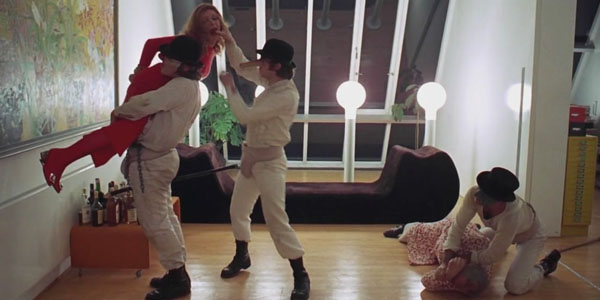
The story of A Clockwork Orange is as infamous as any in film and the backlash was so fierce that Stanley Kubrick voluntarily withdrew it from distribution in the UK because of threats to him and his family. There are numerous cases of copycat crimes in regards to A Clockwork Orange such as a gang of young boys beating a homeless man to death, mirroring an early scene from the film.
More notoriously, a girl was gang-raped by a group of men who were singing "Singin' in the Rain" whilst committing the act, imitating the actions of Alex and his droogs in A Clockwork Orange's most infamous scene. The association to these crimes hurt the film and Kubrick massively and the film remained banned and locked away until the great director's death in 1999.
2. Child's Play Series

The premise of Child's Play was always going to cause a furore upon release as mixing children and violence is never the best idea, but I doubt the makers of the Child's Play series quite imagined just what a controversy they would end up in. Child's Play became particularly infamous in the UK for a couple of particularly shocking murders. In the case of Suzanne Capper, a 16 year-old girl who was kidnapped, tortured and murdered by six people, her tragic death was linked to Child's Play because during the horrific torture, the perpetrators played a recording of one of them saying "I'm Chucky, wanna play?" over and over again. This led to a huge crackdown on violent films and new legislation was put in place.

Creator Tom Holland was forced to defend his creation repeatedly and he only came under more fire when the tabloid press made links between Child's Play 3 and the horrific murder of James Bulger. The killers of James Bulger were said to have copied a scene from the film where Chucky splashes one of his victims with blue paint, though it was later found out that neither murderer had watched the film. Child's Play was also mentioned in association with the Port Arthur massacre, as the perpetrator was said to have been obsessed with the demonic doll.
1. Natural Born Killers

There are very few films in the history of American cinema that have become as infamous as Oliver Stone's Natural Born Killers. Natural Born Killers wasn't just accused of inspiring one isolated crime but a very long list of grisly murders, the most famous of which would be the Columbine High School Massacre. In a rare scenario, the perpetrators of a crime have directly attributed their actions to the film, completely misunderstanding the use of violence within the film. Natural Born Killers is itself based on the real life story of Charles Starkweather and Caril Fugate, who in the 50's went on a killing spree across the American mid-west.

A unique alleged copycat crime in regards to Natural Born Killers is that of the murder of William Savage by Sarah Edmondson and Benjamin Darras. Not because of the actual act itself, but the subsequent court case brought about by victim Patty Byers who was shot by the pair but survived. Byers brought a lawsuit against Oliver Stone and Time Warner accusing them of inciting violence with the film and there being a direct correlation between the film and the acts of her shooters. The case was eventually dismissed, but it is still a clear reminder of the powers that film possesses and how they can unwittingly influence unstable individuals to commit heinous acts.