10 Opening Movie Scenes That Wanted To Make You Uncomfortable
These scenes were tailor-made to leave you squirming.

Generally speaking, most movies want to grab the audience's attention from the very first scene, whether bamboozling them with an awesome action scene, introducing them to the protagonist in a concise way, or revealing a surprise dramatic nugget which sets up the story.
But sometimes filmmakers will eschew this conventional wisdom in favour of just making everybody watching feel extremely uncomfortable about the whole experience.
These 10 films, from a multitude of genres, all hedged their bets on maintaining the audience's attention through a series of shocking, disturbing, unsettling, and otherwise bone-chilling moments that certainly set the tone for the rest of the movie.
From card-carrying horror films to mainstream studio comedies, these movies all dared to leave the audience feeling off from the very start, such that anybody still watching couldn't really complain about the transgressive places the story went from here.
It's little surprise, then, that the majority of these films are relatively polarising, dividing audiences firmly down the middle from their unnerving opening scene onwards and, in some cases, never really letting up.
In the very least, they let you know what they were about right away...
10. God Bless America

Bobcat Goldthwait's black comedy God Bless America begins as it means to go on, by aggressively provoking the audience on their standards of taste and what they're able to consider funny.
Joel Murray stars as Frank Murdoch, a middle-aged man who has lost his patience with America's descent into stupidity, and so decides to take matters into his own hands in the most ultimate way possible.
The film kicks off with Frank complaining about his neighbours, a couple who keep him awake with their loud TV, inane banter, and relentlessly screaming baby. Despite his repeated requests for them to mind their noise levels due to his migraines and insomnia, they don't listen.
Frank then states a desire to kill them, at which point the scene shifts to him breaking into their apartment with a shotgun and blasting the boyfriend dead.
The girlfriend then begs him to stop, even lifting her own baby in front of her face as a shield, and when she then throws the baby into the air, Frank opens fire, decorating the room - and both himself and the mother - with the baby's bloody remains.
After a moment of gleeful celebration, though, the scene shifts back to Frank in bed, still being kept awake by the screaming baby.
The scene was a fantasy, but all the same, showing a baby getting shotgunned into red paste in the first two minutes of a movie is certainly a way to weed out the pearl-clutchers.
9. Midsommar

If you were worried that Ari Aster's second feature would struggle to match his stunning directorial debut Hereditary, he proved in Midsommar's traumatic opening sequence that this wouldn't be the case.
The film opens with our protagonist, Dani (Florence Pugh), leaving a voicemail for her parents that she received a concerning e-mail from her mentally ill sister, Terri (Klaudia Csányi).
A distraught Dani then calls her boyfriend Christian (Jack Raynor) for support, though he brushes off her worries and insists that her sister is surely fine.
But that's sadly not the case - she calls him back moments later screaming in grief, as it's revealed that Terri has not only committed suicide by carbon monoxide poisoning, but has also taken their parents with her.
And Aster certainly makes us share Dani's trauma: the visual of firefighters breaking into Dani's parents' home, and especially the sight of Terri's lifeless face with a tube duct-taped to her mouth, is one that few watching will ever forget.
This is without getting into Dani's anguished wails after learning the news, which much like Toni Collette's grief-stricken breakdown in Hereditary, are so ugly and unpleasant as to feel brutally real. This isn't "Hollywood crying."
It certainly set a tone of pervading dread for the two-plus hours to come.
8. There's Something About Mary
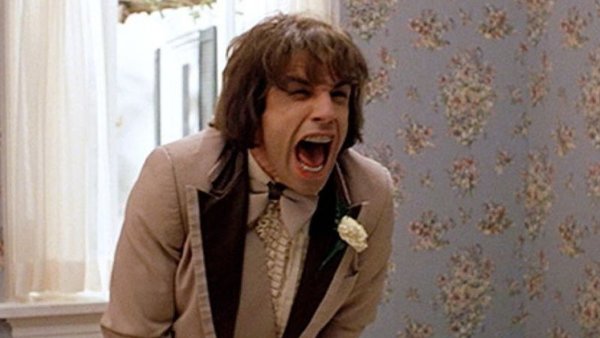
There's Something About Mary boasts one of the most infamously cringe-inducing opening set-pieces in the history of mainstream Hollywood comedy - a penile injury gag so viscerally unnerving you needn't have a penis to develop sympathy pains.
In a traumatic and surprisingly lengthy opening sequence which sets up the rest of the movie, high-schooler Ted Stroehmann (Ben Stiller) is preparing to go to prom with the girl of his dreams, Mary Jensen (Cameron Diaz).
He heads to the bathroom in Mary's house to pee, but after getting distracted, ends up trapping his balls in his trouser zipper.
An excruciating sequence follows as Mary's parents enter the bathroom to try and help a panicking Ted out, and before long, the police and fire department are also on the scene lending their "expertise."
After a cop pulls the zipper down, we smash cut to Ted being removed from the house on a gurney by paramedics, all while the entire neighbourhood looks on. And somehow worst of all, Ted never got the opportunity to take Mary to prom.
Few comedies would have the self-confidence to invest in such a prolonged setup and payoff for a gag, but in the case of There's Something About Mary, it left viewers the world over feeling as queasy as they were amused.
7. The Killing Of A Sacred Deer

Yorgos Lanthimos' expertly crafted thriller The Killing of a Sacred Deer revolves around a cardiac surgeon, Steven (Colin Farrell), who befriends a teenage boy, Martin (Barry Keoghan), with an unexpected connection to his past.
And in typically left-field fashion, Lanthimos opens his film by immediately establishing Steven's line of work in the most discomforting and confronting way imaginable.
The first shot of the film is a close-up glimpse of a beating human heart in the middle of surgery, as Lanthimos' camera slowly glides upwards while surgeons continue the operation.
After what feels like an eternity - in reality it's about 90 seconds - the shot finally ends, and the movie's title appears.
As human beings with beating hearts, we all have an innate biological aversion to seeing our insides on the outside, and Lanthimos exploits this fact so perfectly.
And if you at least soothed yourself with the belief that Lanthimos simply used an incredibly lifelike prop to execute the scene, during an appearance on Hot Ones Colin Farrell confirmed that Lanthimos actually filmed a real quadruple bypass.
More to the point, Farrell himself was also in attendance, and called the experience of watching the surgery "very intense" and "upsetting."
6. Shame
In the hands of a less-astute and considerate filmmaker, one can imagine sex addiction drama Shame striking a very different chord indeed, where a warts-and-all examination of compulsive sexuality becomes titillating and even exploitative.
Yet right from Shame's opening scene, director Steve McQueen ensures to drain all possible appeal from the film's frank depiction of sex, reimagining these encounters as the soulless, passionless transactions of a man driven by the sheer need to do it.
Shame's stunningly ominous nine-minute opening presents a montage of sex-addicted protagonist Brandon (an Oscar-worthy Michael Fassbender) as he goes about his daily routine.
He wakes up, commutes to work, leers at women on the train, has sex with sex workers back at his apartment, aggressively pleasures himself in the shower, and ignores voicemail messages from his concerned sister, Sissy (Carey Mulligan).
The scene culminates in a wordless exchange between Brandon and an attractive woman he's been making eyes with on the train to work.
She's receptive at first before becoming uncomfortable at the situation, flashing her engagement ring, and then disappearing into the crowd while Brandon chases after her in vain.
It's a brilliantly effective sequence in both confirming Brandon's predatory nature and also how little genuine pleasure he seems to derive from sex: it is simply a compulsion.
McQueen impressively makes Brandon's sex-filled life seem hollow and ugly, a tone which follows through for the rest of the film.
5. I Saw The Devil

Kim Jee-woon's 2010 thriller I Saw the Devil offers up one of the most mesmerisingly disturbing opening sequences of all time, even for the standards of a serial killer movie.
The film begins with a pregnant woman, Jang Joo-yun (Oh San-ha), waiting for a tow truck in the snow after getting a flat tire.
She soon encounters a man, Jang Kyung-chul (Choi Min-sik), who promises to change the tire, and when she rebuffs him, he responds by smashing her car window and bludgeoning her unconscious with a hammer.
The scene then shifts to Joo-yun waking up naked in serial killer Kyung-chul's lair, covered in a plastic sheet. She watches as Kyung-chul prepares her for dismemberment, while he comments that her soft skin will make her easy to chop up.
Joo-yun desperately begs him to spare her, explaining that she's pregnant, only for Kyung-chul to remorselessly decapitate her with a hatchet seconds later.
We're then forced to watch as he dismembers the rest of her body, cleans up the scene, and scatters her body parts, only for a boy to soon enough discover one of Joo-yun's ears in a field.
It's easy to imagine a Hollywood version of this opening being far more restrained and "tasteful," yet Kim Jee-woon refuses to shy away from his antagonist's sociopathic, detached brutality.
It's incredibly upsetting to watch, and ensures we're just as keen to see the killer get his just desserts as Joo-yun's vengeful fiancee, Kim Soo-hyun (Lee Byung-hun).
Like Soo-hyun, though, we're likely to reconsider that position by film's end.
4. Vox Lux

The trailers for Brady Corbet's 2018 film Vox Lux primarily sold it as a drama about a troubled pop star, Celeste (Natalie Portman), while largely ignoring its incredibly jolting and disturbing opening scene - and, in a cynical marketing sense, with good reason.
Before we get to the pop star portion of the movie, it begins with a 2000-set prologue in which a young Celeste (Raffey Cassidy) is at school when an active shooter assaults the campus.
The boy guns down Celeste's teacher, and informs Celeste that he's already killed lots of other people around the school.
Celeste nevertheless speaks calmly to him, trying to talk him down from causing any more harm, but just as it seems like she's succeeded, Celeste is shot in the shoulder.
When a SWAT team enters the classroom moments later, we see that the shooter has gunned down the entire class before turning the gun on himself.
Celeste is ultimately one of the few surviving victims, but for a film marketed primarily as an oddball drama about an eccentric artist, nobody expected it to kick off with something so brutal.
That Corbet films it with such brilliantly clinical detachment just makes it that much more chilling.
3. Widows

Steve McQueen's tightly-wound thriller Widows opens not with a fraught shootout - well not immediately - but a decidedly more unexpected sight.
The first minute of Widows is nothing more than a shot of our protagonist, Veronica (Viola Davis), passionately making out with her husband Harry (Liam Neeson).
Another way to put it might be that Neeson is basically devouring Davis' face, and rather than cut away once their relationship has been established, McQueen lingers on it for an amount of time clearly intended to make the viewer uncomfortable.
It's such an intimate moment, captured with such dispassionate objectivity by McQueen's stationary camera, that it feels like we're intruding on an intensely private moment.
Beyond that, it's pretty much the polar opposite of what we expect from a screen kiss involving two bonafide A-listers: it's not tasteful and restrained, but sloppy in a way that feels considerably more real rather than staged for the camera.
One suspects that McQueen also intentionally chose to linger on the kiss because it's between a white man and Black woman, given that there's still a depressing lack of interracial romance in Hollywood.
By opening his film with this image, he immediately gave us something unexpected in several ways, while also prodding any bigots who happened to be watching.
2. Kids

Larry Clark's extremely controversial 1995 drama Kids follows a group of New York teenagers as they explore their burgeoning sexuality, and Clark throws viewers right in the deep end from the very first scene.
This scene involves a boy, Telly (Leo Fitzpatrick), coercing a 12-year-old girl into having sex with him.
The girl makes it abundantly clear that she's not all that sure about it, but as an older, more experienced partner, Telly easily manages to pressure her into agreeing.
Clark then lingers on the scene as the pair have sex, and while the girl complains about the pain of losing her virginity, we're subjected to a skin-crawling voiceover from Telly, who details how much he loves having sex with virginal girls.
The crushing sense of reality to the scene, that this is precisely how older boys take advantage of young girls, lends it a stomach-churning quality.
And much like Widows, it feels offputtingly intimate, accentuated by Clark's unvarnished visual style which grants the scene an even greater air of docu-style authenticity.
1. Irréversible

Like just about every Gaspar Noé movie, Irréversible doesn't pretend to be anything than it isn't from the opening bell, kicking off with a bewildering opening titles sequence filled with flashing, colourful credits played in reverse to discordant choral music.
The film's 20-minute opening sequence - which, with its scenes being shown in reverse order, is actually the ending - involves two men, Marcus (Vincent Cassel) and Pierre (Albert Dupontel), entering a gay BDSM club in search of a psychopath called Le Tenia.
Beyond the sheer bewilderment of the sequence being broken up into small scenes which play out in reverse order, Noé employs intentionally unsettling sound and imagery to increase the audience's sense of dread.
During their trip through the club, the camera continually spins around in disorientating fashion, while the sound of the club is "enhanced" by low-frequency background noise intended to induce anxiety and even nausea in some viewers.
And to top it all off, this sequence climaxes with Pierre beating who he thinks is Le Tenia to death with a fire extinguisher - an exchange which Noé lingers on in grotesquely grisly detail.
If you're still with Noé and his story at this point, he's got you, but understandably it proved enough for many - even at its Cannes Film Festival premiere, where a reported 250 people walked out and two-dozen required medical attention from fainting.
So, mission accomplished?