There are few things in cinema that can conjure up emotion more efficiently than the death of a dog. There's something undeniably saddening about watching a loyal, caring and ultimately innocent creature die on-screen, and it's considerably worse when it's an animal that is so synonymous with companionship. To make matters worse, Hollywood routinely provides us with unfalteringly saccharine portrayals of these animals, so that what we see on screen is often so imbued with pre-fabricated charm and adoration that it becomes impossible to ignore their presence. Whether we know they're coming or not, doggie deaths never fail to tug at the heartstrings. They provide us with cinematic moments that are as enduring as they are provocative, hauling us out of sheer cinematic contentment and sobering us up with an elusive mix of deeply felt guilt and abject sorrow. Of course, simply cramming a dog into a film for the sake of killing the poor mutt off isn't enough to plunge audiences into a pit of grief and despair; these canine companions always serve a purpose beyond providing directors with emotional fodder. Dogs come to symbolise the core themes of the films they appear in, they provide characters with essential personality traits and reflect ideas brought up by the plot. In this respect, the death of a dog comes to represent the loss of something in any given film, and it's because of this that dog deaths in cinema are always so arresting. Please note: there are spoilers ahead.
10. I Am Legend
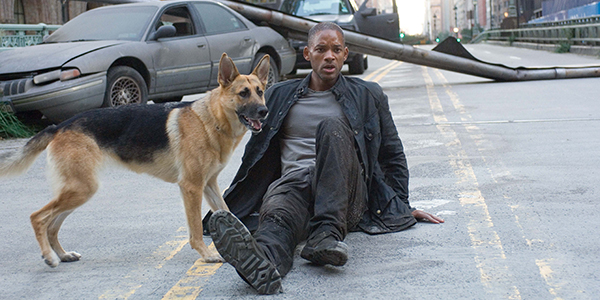
As the third feature film adaptation of Richard Matheson's 1954 novel (of the same name), I Am Legend tells the story of Robert Neville (Will Smith), a US Army virologist and supposedly the last human still alive on earth after a man-made virus decimated the global population and infected the remaining survivors, transforming them into highly-aggressive savages. Neville is immune to the virus and spends each day searching through the ruins of Manhattan for supplies, survivors and crucially, a cure. Thankfully, Neville isn't totally alone in this eerie dystopia; he has his faithful german shepherd, Sam, to accompany him in his quest to cure mankind. Unfortunately for Sam, dogs are only immune to the airborne strains of the virus, and so the bites Sam receives when she valiantly steps in to save Neville from a pack of infected dogs are enough to seal her fate. Neville attempts to cure his dog, but she eventually turns as he's holding her, forcing Neville to strangle her there and then. Will Smith's performance here is impeccable, and it truly adds to the sense of loss and isolation that runs throughout the film, after all, Sam's departure leaves Neville completely alone in an incredibly hostile world.
9. Quill: The Life Of A Guide Dog
One problem that consistently crops up with films about dogs is that film-makers are often so preoccupied with making their particular hound outstanding or extraordinary that they fail to simply portray the animal as it really is. By doing this, countless films lose sight of what makes these animals important to us; honest depictions of dog ownership are few and far between. Quill: The Life of a Guide Dog sits comfortably on the side of sentimentality without straying into the sanguine. This Japanese gem chronicles the life of a guide dog, Quill, from his tumultuous youth, being constantly between homes and in training, to his years as a working dog, before finally following him to his deathbed. The film never fails to capture the subtle emotive discourse that takes place between the owner and his pet, and the positive impact that Quill has on his vulnerable owner, Mitsuru Watanabe, is truly touching. Director, Yoichi Sai, answers any questions audiences might have about guide dogs, broadening our understanding of both Watanabe and Quill in the process. Even in Quill's last moments, Sai avoids any attempt to wean emotion out of the scene beyond what is inherently there. There is no manipulation of the dog; all we get is a heartfelt performance from the humans that surround him. It's a poignant reminder of how much their short lives affects ours that hits home purely because we believe in Quill the dog, rather than Quill the CGI-enhanced wunderhund.
8. The Royal Tenenbaums
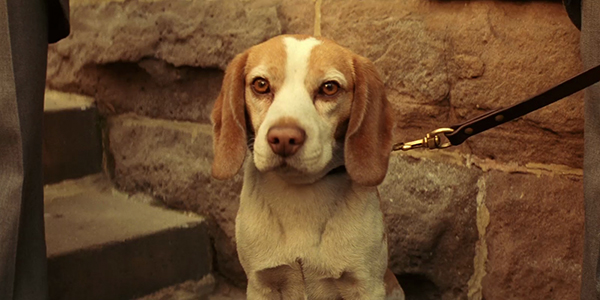
Wes Anderson films rarely spring to mind when one thinks of sentimental doggie departures: he's had them shot, drugged, abandoned, mangled and smacked with nary a tear shed in the process. Yet, when a convertible mows down the family beagle, Buckley, an unmistakable air of sadness permeates even the typically deadpan exterior of The Royal Tenenbaums. Buckley's death is not shown and we only learn of it through a few fleeting mentions but it's precisely because of this that the death stands out. Through the death of Buckley, the audience is reminded of how easily death and adversity can come to all creatures big and small. Moreover, Buckley's death reflects how important dogs really are to some of us. Of the three characters imperilled by the careening car, it's the two children who are saved; concern for Buckley is shrugged off multiple times. Yes, it's cynical, but the sombre undercurrent that Buckley's death puts in motion gives rise to a quietly affecting moment that's impossible to ignore.
7. Tyrannosaur
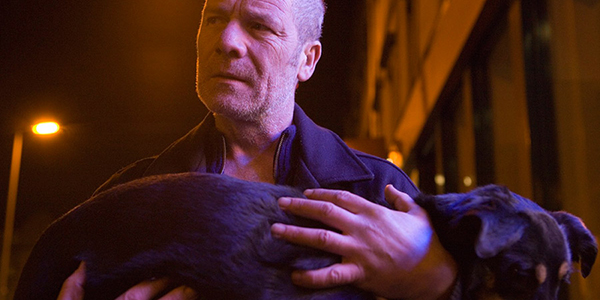
Often the death of a dog comes at the end of the film, once the audience is given the chance to associate the animal with something profound or beautiful. This is not the case with Paddy Considine's brilliant British drama, Tyrannosaur. In the film's very first scene our protagonist, Joseph (Peter Mullan), exits a building after losing a bet and proceeds to take his anger out on his dog. Joseph kicks the poor animal with such force that he has to carry it home, where soon after it dies. It's a scene which deliberately exploits the intrinsic innocence of the dog, but that doesn't make it any easier to stomach. The death sets the tone for the film, but it also plays a key role in the characterisation of Joseph. He's a character that's driven by anger, yet he is by no means remorseless a sense of regret, compassion and sadness pervades Joseph's brutish exterior. It's an incredibly cold moment that immediately unsettles the viewer; the sombre tone it creates can be felt long after the credits have rolled.
6. All Dogs Go To Heaven
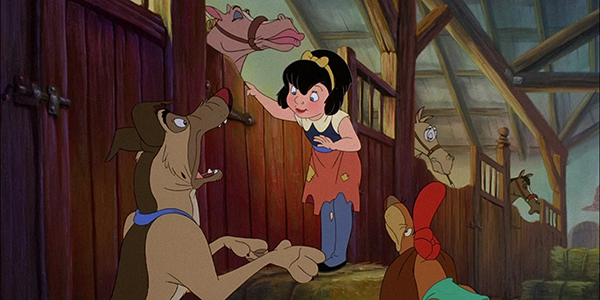
All Dogs Go to Heaven is quite a ridiculous film in all truth; after all, this is Don Bluth's animated adventure about a singing, smoking, drinking ghost dog with the voice of Burt Reynolds. It's a charismatic little picture, bursting with colour and packing a buoyant array of characters that are brought to life with a particularly exuberant animation style. Our canine protagonist, Charlie (Burt Reynolds), is offed by his partner and fellow professional criminal, Carface (Vic Tayback). Charlie refuses the pearly gates in order to exact some semblance of revenge on Carface, becoming professionally involved with an orphan girl, Anne-Marie, who can talk to animals. Charlie might be a tad immoral, but he learns to value friendship over all else when he unselfishly gives up his own life to save Anne-Marie. The animators do a fantastic job, infusing Charlie with a diverse range of expressions that highlight his newfound empathy, so while watching him make that sacrifice is quite upsetting, it's brilliantly underlined by a sense of redemption. Of course this is a kids film, so naturally Charlie is allowed into heaven for his good deed and everything ends happily ever after.
5. Turner & Hooch
It's easy to deride a buddy cop-dog movie where a french mastiff teaches a young Tom Hanks how to be one of the guys, but Turner & Hooch has got a heart of gold to make up for its flagrant silliness.
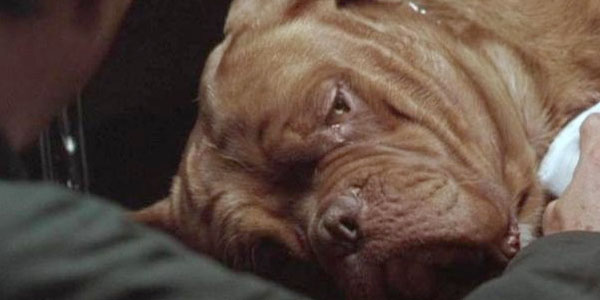
An obsessively tidy police investigator, Scott Turner (Tom Hanks), finds himself caring for a boisterous and particularly slobbery french mastiff, Hooch, who may be the only witness to his owners murder. Naturally the two don't get along at first, but they learn to love each other as the film progresses so that towards the end of the film Turner is more laid back and Hooch is slightly more obedient.
The two manage to track down the crooks responsible for the murder, stumbling across a drug-smuggling operation in the process, the final bust goes awry and Hooch bravely leaps into the fray, saving Turner but receiving a fatal gunshot wound for his efforts. Turner rushes Hooch to a vet, only to find that nothing can be done for him.
Hanks, who lends some much needed acting muscle to the production, performs Turners emotional breakdown wonderfully. Turner and Hooch worked so well together that you'd be forgiven for thinking that their story would have a happy ending. Instead we get a stirring send-off worthy of one of cinema's finest pooches.
4. Marley & Me
Marley & Me is a fairly passable family film about a young couple starting out in life with all the usual trappings: new jobs, a roof over their heads, plans for children and of course a dog. The young couple in question are John and Jennifer Grogan, played brightly by Owen Wilson and Jennifer Aniston respectively.
The film does an excellent job of placing the dog, Marley, at the centre of everything. While the film relies too heavily on cinematic tropes and the sentimentality of it is at times overbearing, Marley & Me understands what dogs are too their owners, and how integral they are to their families.
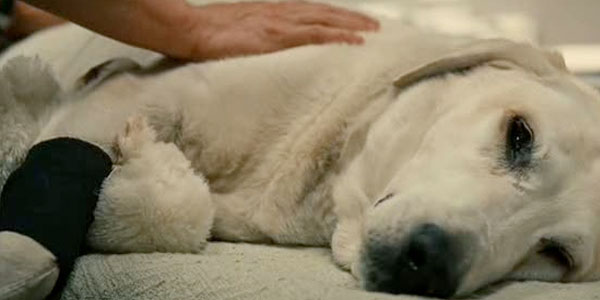
All of this makes Marley's gradual descent into ill health all the more devastating. To watch Marley change from a rambunctious puppy into an ageing dog before he's finally put down is a sobering experience, especially if you've experienced something similar.
3. Old Yeller
Old Yeller is the quintessential pet tragedy film. Set on a homestead in post-Civil War Texas, Old Yeller is a simple story about a boy and his dog.
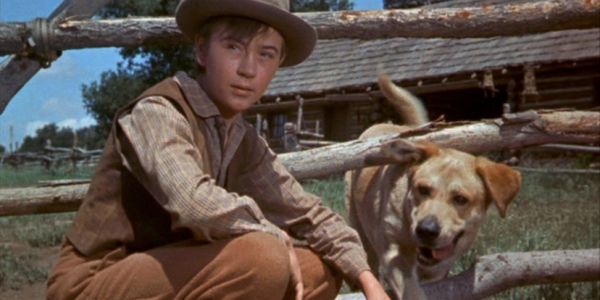
Old Yeller, a stray dog with a penchant for thieving, is at first shunned by adolescent Travis (Tommy Kirk), who is the interim man of the family while his father is away. After fighting off a black bear, which was about to attack Travis' younger brother, Old Yeller is accepted by Travis and the two form a relationship that is founded as much upon Old Yeller's charm as it is his practical worth. One night, a rabid wolf attacks the family. Old Yeller holds off the wolf but is bitten in process Travis is forced to accept his dogs fate and shoots Old Yeller when it becomes clear that he has contracted rabies.
There's no doubting that the film's ending has been spoiled for all but the most reclusive of potential viewers, but that doesn't make it any easier to cope with when it finally comes. It's an undeniably tragic event, but director Robert Stevenson makes sure that there's a worthwhile message about the facts of life and death behind it all.
2. Where The Red Fern Grows
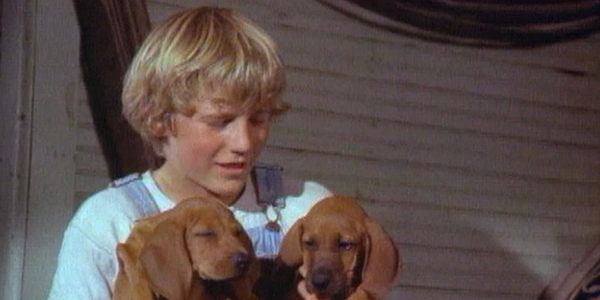
Where the Red Fern Grows is an overtly sentimental coming-of-age film about a boy and his two Redbone Coonhounds, Old Dan and Little Ann.
After working tirelessly to save up enough money to buy the dogs, our protagonist, Billy (Stewart Petersen), sets about training them to hunt Raccoons. Through their adventures, Billy learns various life lessons, growing wiser over the course of the film.
Alas, the brave Old Dan finds himself on the wrong side of a Mountain Lion, which fatally wounds him. Worse still, the more intelligent dog, Little Ann, is so profoundly traumatised by the death of her companion that she practically gives up on life, eventually dying on top of Old Dans grave.
Despite the remarkable similarities to Old Yeller, Where the Red Fern Grows is a decent film in its own right; the loss of two hardy canines more than makes up for any lack of originality.
1. Tracks
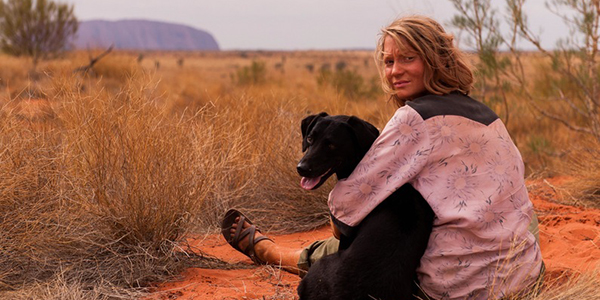
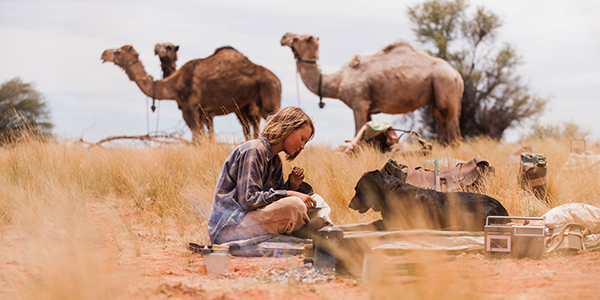
Tracks is John Curran's beautiful retelling of Robyn Davidson's famous 1,700-mile trek across the Australian outback, from Alice Springs to the Indian Ocean. The movie is utterly engrossing thanks largely to Mia Wasikowska's outstanding turn as Davidson and Curran's methodical direction.
However, Davidson didn't embark upon the journey completely alone, she had four camels and her faithful black dog, Diggity, to keep her company throughout her exploits.
As Davidson walks further into the abyssal expanse that is the Australian outback, her companions become increasingly essential to her sanity. One night, Davidson awakes to find that Diggity has wandered off. She goes off in search of Diggity, only to find that some lazily discarded chemicals have poisoned the hapless dog.
Diggity is confused, agitated and clearly sick, but its the frantic direction and Wasikowskas distressing performance that makes this scene so difficult to watch. A single gunshot cuts through the tension with enough potency to bring even the greatest of doggie cynics to tears.
It's a scene that is both poignant and emotional now that Davidson has lost her beloved companion she is more alone than ever.