10 Perfectly Weird David Bowie Movie Performances

The films that had us all believing the strangest things, and loving the alien...

Following the legendary David Bowie€™s tragic, unexpected passing this week, there€™s been tribute after tribute, in print and online: about his incredible music, about his influence on popular culture, about the effect he€™s had on so many of us, and the huge, impossible space he leaves behind. One thing that hasn€™t been getting so much love is his creative output as an actor. There€™s a negative association with rock stars and acting that€™s been going on for decades, ever since the unholy trinity of Sting, Madonna and Prince assaulted the silver screen with their vanity projects and failed attempts at Hollywood stardom, and kickstarted the kvetching from an avalanche of critics. Bowie€™s always been a little different, though. You could legitimately use that phrase about anything Bowie-related, but his acting choices in particular have often fallen victim to accusations that he indulged in eccentricity for its own sake. Let€™s clear this up now: yes, Bowie€™s defining attribute as an actor is his weirdness, but that€™s not your mate in the pub€™s version of the word - meaning anyone who wears a scarf indoors and/or drinks halves. Bowie€™s screen personae meshed seamlessly with his stage personae. He projected an exotic aura, unearthly, uncanny, adapting that alien aspect to whatever project engaged his interest at the time€ and of course, the eerie effect of those eyes didn€™t hurt. Bowie would play the perennial outsider, a man on a different plane, sometimes androgynous or fey, other times otherworldly and distant. He€™d come across better in some roles than others, but that€™s a description that holds true for the majority of working actors. If Hollywood is a menagerie, Bowie€™s always been a breed apart: a cryptozoological curiosity, the only one of his kind.

10. John Blaylock - The Hunger (1983)
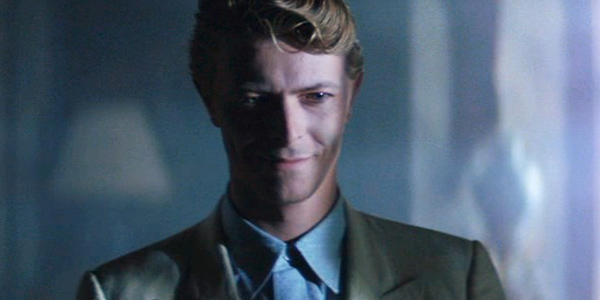
The late Tony Scott€™s penchant for onscreen flash and sizzle is foregrounded here in the advertising director€™s feature debut, a sophisticated modern vampire tale. The Hunger looks and sounds fantastic€ whether the conspicuous motif on ideas of consumption and the consumer succeeds in delivering substance over style is another matter. Bowie plays John, the unsuspecting victim of his lover Miriam, an ageless and probably alien predator who takes a lover in every era, offering them eternal life but keeping the truth of that life from them: as second generation monsters, they have a shelf life, and will begin degenerating rapidly after a few centuries. John realises his eventual fate once he notices he€™s begun to age, but by then it€™s far too late€ he will join Miriam€™s other decayed lovers, left to rot. Bowie is understated, cold but charming and debonair, and there€™s an element of pathos to his condition, as John discovers that far from being an immortal equal to his lover, he€™s just another victim, consumed by her as much as the people they€™ve murdered together over the years. Despite this, he remains distant: the reality of his situation doesn€™t render him any more human than he was at the outset of the film. John isn€™t interested in regaining his lost humanity, only his lost youth.

9. Malthazard - Arthur And The Invisibles (2007)
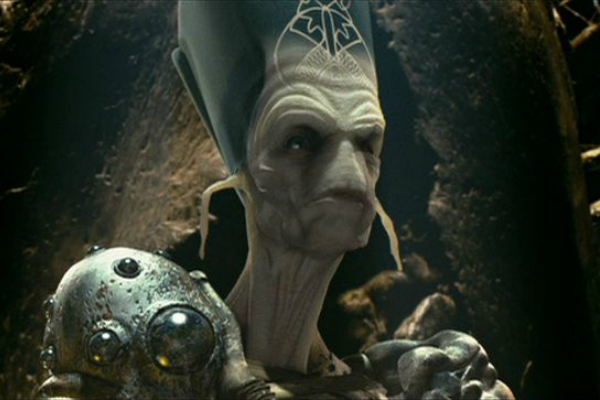
Bowie€™s having fun here in this charming, underrated animated fantasy from Luc Besson, playing the twisted ruler of dark forces in the miniature kingdom of the Minimoys (each the size of a tooth). Malthazard is a former Minimoy knight, the most charismatic and brave in all the kingdom, who commanded a force to range out into the wastelands to find his people a new source of water. When he returns victorious but traumatised from his trials, the sole survivor, his people have forgotten him, and society has changed: courageous knights are no longer necessary in this new egalitarian Minimoy kingdom, and Malthazard finds himself irrelevant and cast aside. That's all fuel for a Disney-villain-style transformation into a warped, scarred version of himself, the general of legions of sinister warriors. https://www.youtube.com/watch?v=MBiN6QYK1vU Bowie is creepily compelling throughout, in a kind of cracked, ugly, kids redux of his superior Goblin King of two decades earlier. Where Jareth is a fantasy figure though, Malthazard has more in common with Rowling€™s Voldemort: a wracked, exiled, haunted figure whose name must never be mentioned (he€™s referred to as €˜M€™, or €˜Evil M€™), poisoned and poisonous. Incidentally, if you€™re going to seek out Arthur And The Invisibles, it€™s recommended that you find the European or UK version of the movie - some of the running time was snipped to cater to American audiences, and whoever wielded the scissors left some important plot and character beats on the cutting room floor.

8. Special Agent Phillip Jeffries - Twin Peaks: Fire Walk With Me (1992)

In Twin Peaks: Fire Walk With Me, the even more cultish feature length prequel to the cult hit television series Twin Peaks, nightmare imagery takes the place of traditional narrative. Taking place before Laura Palmer€™s death, the film follows her last days alongside Special Agent Dale Cooper€™s assignment to find missing agents who€™d been sent to investigate other murdered girls. Agent Phillip Jeffries (Bowie) vanished two years ago, and yet suddenly reappears in the Philadelphia FBI branch office. CCTV feeds begin to haemorrage ghostly images, as he desperately tries to tell his former colleagues what he€™s seen and experienced. Only he can€™t: Jeffries is trapped in the nightmare logic of the Black Lodge, and the narrative he€™s trying to describe is utterly alien to them. As he speaks, ghostly images of the Red Room and its demonic inhabitants appear to us. Agent Jeffries has been away too long... https://www.youtube.com/watch?v=3nSqDMqCJQw Staggering, incoherent and lost in another plane of existence, Bowie€™s casting is pretty much pitch perfect in a scene that features the film€™s director David Lynch as the hard-of-hearing FBI regional chief, who glimpses more of the supernatural underbelly of the world than he€™s letting on. When Agent Jeffries disappears in mid-sentence, it becomes apparent that he€™s not returned at all: he€™s only been haunting them for a little while. Bowie's part was larger in the first edit, but fell to the cutting room floor... however, those deleted scenes (which are fantastic) are available on the Twin Peaks: The Entire Mystery set, released on blu-ray in 2014.

7. Jack Sikora - Il Mio West/Gunslinger's Revenge (1999)
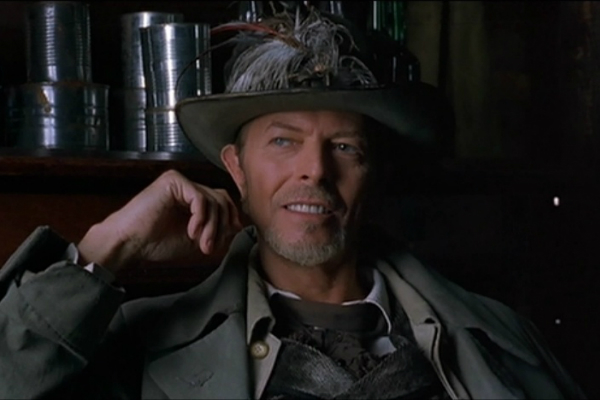
This strange Italian Western co-stars Harvey Keitel as a formerly notorious gunfighter, Johnny Lowen, who has decided to retire and live out the remainder of his life in peace, in the company of his estranged family, none of whom are pleased to see him. Why? Well, he wasn€™t the best of fathers€ but it€™s probably more to do with the fact that his life of violence isn€™t through with him, even if he€™s through with it. Just shy of an hour in, that life comes back to haunt him in the devilish shape of appalling killer Jack Sikora (Bowie), a psychopath with a six gun and a small posse of likeminded crazies. Sikora is on a mission to push Lowen into duelling him, and willing to hurt or kill anyone else around him to make that happen. I said this was a strange film: the abrupt shift in tone from gentle family-centred narrative to brittle Wild West violence isn€™t just a function of the plot. The second that Bowie turns up on screen the entire style of the movie takes a sidestep to the left. The production value hikes up a notch; the art direction changes tack; the camera follows him and his quirks and tics around like a lovesick teenager, and with good reason. His presence in the film in this role is probably director Giovanni Veronesi€™s best chance at making a decent profit. Some have taken issue with Bowie€™s elaborately southern-fried accent in this film, but let€™s not forget that, as an Italian movie dubbed into English, accents are very much a moveable feast. More than that, though - the voice and mannerisms feel like a conscious choice on Bowie€™s part, as though Sikora himself is playing a part, sadistically hamming it up for the benefit of the terrified audience around him. Proof positive comes when Sikora sings an off-kilter version of The Battle Hymn Of The Republic to unnerve the townsfolk: legendary singer Bowie plays him tone deaf.

6. Pontius Pilate - The Last Temptation Of Christ (1988)
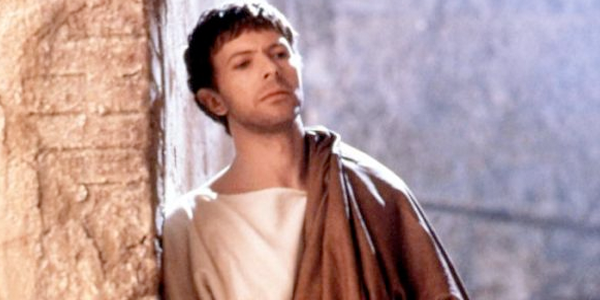
No matter what area of the arts he dabbled in, you could always rely on Bowie to bring his redoubtable intellect to bear as well as his more impulsively creative tendencies. As an actor, he could easily coast on that hypnotic, glinting charisma that lurked in the traces of every smile: but he preferred to work a little harder than that. His small role as consummate politician Pontius Pilate in Scorcese€™s idiosyncratic take on the last years of the life of Jesus Christ is a perfect example of this. Pilate has been played as an incompetent, as a guilt-ridden good man, as a bellicose civil servant, as a vainglorious militant, as a mordant cynic, as a cold, indifferent nobleman, and more. Bowie€™s Pilate, on the other hand, is a wryly intelligent utilitarian who intuitively grasps the implication offered by Willem Dafoe€™s wearily idealistic Christ: that he intends to change hearts and minds, and that this very ordinary radicalism is actually more dangerous to Rome than the firebrand zealotry of the men that claimed the title of revolutionary. Where other versions of Pontius Pilate felt cornered into condemning Jesus to death, or found some brutish pleasure in doing so, Bowie€™s iteration of the man had him make a conscious, unfettered choice to sentence an innocent man to death as a political measure, to remove the demagogue as a focal point for Jewish dissidence. https://www.youtube.com/watch?v=w5hvHu8gHUc Bowie is a model of restrained, world-weary melancholy here - Pilate is clearly tempted to pour scorn on what he considers to be backward superstition and fanaticism, but restrains himself out of compassion for Christ and the position he's in. Regardless, Jesus is sent to Golgotha. It€™s the right thing for Rome.

5. Nikola Tesla - The Prestige (2006)

Bowie keeps the theatricality close to his chest playing the idiosyncratic genius Nikola Tesla in Christopher Nolan€™s movie about obsession, misdirection and the suspension of disbelief. Subtle and unobtrusive in his scenes with Hugh Jackman and Andy Serkis, allowing the former to carry the weight of the drama and the latter to lighten the tone with droll one-liners, he imbues his Tesla with a preoccupied gravitas that, after the fact, seems perfect. This, after all, is a man constantly thinking, constantly inventing new ways of doing new things, the closest thing to a true magician that exists in the film. Nolan has confirmed that this was precisely the reason that Bowie was cast in the movie:
"I was looking for someone the audience would instantly believe was capable of extraordinary things, and it felt like any movie star in that role would be distracting. David Bowie has this amazing charisma that made him exactly right for it€€
He goes on to say that Bowie initially refused the role, but that he couldn€™t think of anyone else who could pull it off, and actually took the step of calling him to persuade him personally. The scene in which Tesla tries to gently persuade Angier out of doing what he€™s doing, recognising a fellow obsessive when he sees one, is a beautiful piece of understated acting, his regret in the face of Angier€™s adamancy a tangible thing. https://www.youtube.com/watch?v=88_6SQKuTHk

4. Andy Warhol - Basquiat (1996)
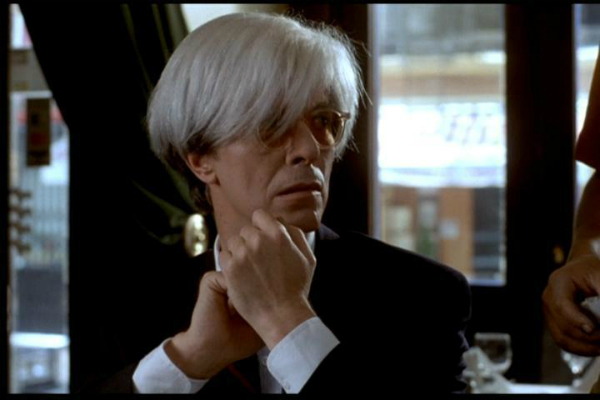
Bizarrely, while enjoying the fruits of the endlessly creative third act of his musical career, Bowie played Warhol. That€™s two of the world€™s greatest pop culture and artistic icons; it€™s the high culture equivalent of Lady Gaga playing Princess Di. You could call it utterly peculiar and you could call it completely appropriate and you€™d be right both times. Julian Schnabel€™s lyrical tribute to the graffiti artist Jean-Michel Basquiat came at a time when Bowie was entering a reflective middle-age, having absorbed himself in the esoterica of electronic music for the past few years after a period subsumed in facile pop and stadium rock. He plays Warhol beautifully (in one of the artist€™s own wigs), taking on tics and vocal mannerisms that clearly came from personal observation, not the cultural lexicon. https://www.youtube.com/watch?v=tG1QMIhmnC0 But this isn€™t Pilate, or Tesla. This is one of the most recognisable men in the world, being played by one of the most recognisable men in the world. There€™s no way of hiding that, and never could be, so instead Bowie embraces it. Just as there was a deliberately arch, knowing element to the casting, so there is to the subsequent performance: alien playing alien, artist playing artist, Bowie acknowledging his creative debt to Warhol as he represented his artistic sentiment on screen, nearly a decade after his death.

3. Major Jack 'Strafer' Celliers - Merry Christmas, Mr. Lawrence (1983)
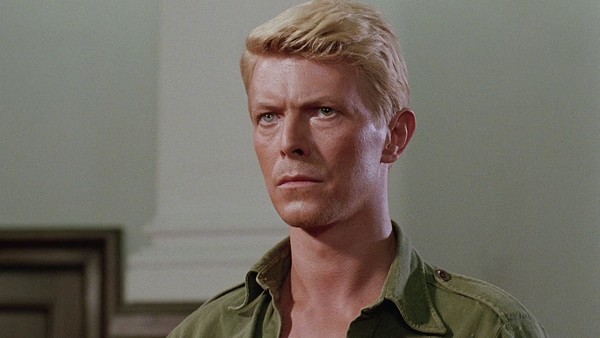
Nagisa ”shima's wonderful character-driven drama set in a Japanese World War II prisoner-of-war camp was released in the same year as The Hunger, but couldn€™t be more different. Bowie plays €˜Strafer€™ Jack Celliers, a New Zealand soldier who develops an unspoken culturally and socially forbidden bond with the camp commander, Captain Yonoi. Like the rest of the prisoners, Celliers is grubby, tousled and sweat-streaked throughout, completely at odds with Bowie€™s urbane, perfectly coiffed vampire wannabe in The Hunger. Celliers is a man of some reputation in the camp (and even outside) because of his skill as a soldier, hs uncompromising integrity and his strength of character, hence the nickname €˜strafer€™. However, these are also qualities that the rigid, honourable disciplinarian Yonoi admires. Bowie plays a sardonic, tough-as-nails firebrand in this film, the kind of role you€™d expect from Clint Eastwood a decade earlier, or Bruce Willis a decade later. Neither of those men could have given Celliers the fey, unbalanced edge he has throughout, and it€™s doubtful that either man could have so delicately put over Celliers€™ conflicted feelings towards Yonoi. The narrative€™s climactic scene is almost unbearably fraught, as the tension between the two comes to a head on the parade ground. In that moment, Celliers is untouchable, practically angelic, as he steps between Yonoi and a man about to be executed. https://www.youtube.com/watch?v=QXK6FrhNTos After that performance of tightly wound, feral machismo, the sudden return of Bowie€™s otherworldly aspect with this Christlike affect to it is riveting, unforgettable. Just for that one moment he seems to belong to a different, higher order to the other soldiers littering the muddy parade ground. Then the moment is gone, and the ugliness of the setting reasserts itself. Celliers is done for€ but Yonoi won€™t forget, and neither do we.

2. Thomas Jerome Newton - The Man Who Fell To Earth (1976)
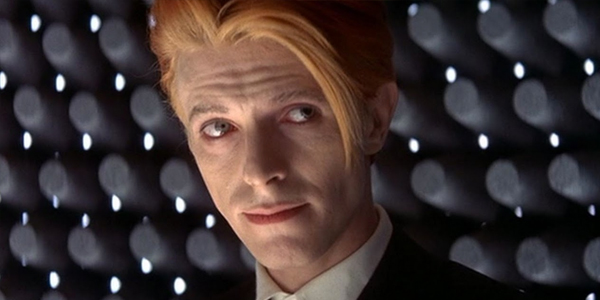
For many, this is Bowie€™s signature role, taken from the mid-seventies period that music aficionados usually determine represents his finest, most immutable body of work. No role typified Bowie€™s alien aspect so much as the first€ the one where he played a genuine extraterrestrial. Nic Roeg€™s bizarre, odd little drama casts Bowie as €˜Thomas Jerome Newton€™, an alien on Earth to bring water back to his home planet, stricken by a terrible drought. Yet, for all the science-fiction trappings of the film, this is a film about losing oneself, the process of the stripping away of innocence. Using information culled from his own society€™s technology, Newton intends to make an extraordinary amount of money with which to finance the return trip to save his wife and children. But the further he pursues this process of incorporating himself into the economy and the culture of America, the further he drifts from the goals that drove him to do so. Nic Roeg wanted someone who didn€™t appear to be an actor, who had that otherworldly affect I€™ve talked about. Unafraid of Bowie€™s lack of experience (he€™d coaxed an equally unforgettable performance from Mick Jagger in€ well, Performance), Roeg delivered a typically dislocated, non-linear and surreal film in which Bowie perfectly portrays the dissociation caused by immersing yourself in something that isn€™t you, and losing that sense of yourself in the process. Bowie had felt something similar after becoming a rock star, achieving the fame he€™d sought for years, and the isolation and dissonance that came with it. The Man Who Fell To Earth would come to represent the pinnacle of his career as an actor for cineasts and Bowiephiles the world over. However, for the rest of the world, there would be another film that would perfectly represent Bowie on film...

1. Jareth, The Goblin King - Labyrinth (1986)

You remind me of the babe... And, of course, it€™s Labyrinth. Bowie€™s performance in this film can€™t be divorced from the film itself. Over the thirty years (thirty years!) since its release, a lot of people have ribbed him for the fright wig and those tights - tights so tight that they make a photo finish look like a long distance relationship - but they forget. Jareth is a teenage girl€™s prototypical sexual fantasy, a cobbled together creation concocted from the heroine€™s stories and her dolls, and from dim, unrealised feelings for her mother€™s boyfriend, also played by Bowie (check out the pictures in her scrapbook). This, of course, is a Jim Henson movie: he was originally looking at making the Goblin King a puppet, before he hit on the idea of appropriating the exoticism (and eroticism) of a mainstream pop star for the part. Bowie€™s outfit, wig and makeup allow him to blend seamlessly into the production design of the film itself, despite being the only other real actor in the fantasy part of the film aside from fifteen-year-old Jennifer Connelly, playing the protagonist Sarah. It€™s vital that she, the interloper, sticks out like a sore thumb€ it€™s vital he does not. As a result, this is the only film in Bowie€™s entire output as an actor in which his uncanny looks and arch, alien qualities don€™t render him an outsider figure. On the contrary: his character is the King of the fantasy land that Sarah finds herself in, although you always get the impression that he doesn€™t really want to be. As Jareth, Bowie is a multisexual terror, an unsettling wet dream given form, and clearly hopelessly smitten with Sarah, who plays the white knight in this faery tale, come to rescue a helpless loved one. She€™s both fascinated with the Goblin King and terrified of him, and that€™s something you could also say about half the girls (and no doubt, many of the boys) who€™ve watched Labyrinth over the last three decades. Knowingly echoing this facet of the film, Bowie€™s €˜you remind me of the babe€™ riff is stolen from Cary Grant in The Batchelor And The Bobby-Soxer, a film about a teenager€™s inappropriate crush on an older man. https://www.youtube.com/watch?v=FmgmXgoBZFo It€™s fair to say that Bowie€™s Goblin King holds a similar confused and confusing place in the coalescing adolescent mind as Carrie Fisher did when she put on a gold bikini for George Lucas in Return Of The Jedi in 1983. However, this is a family film in which he plays the outrageous pantomime villain... so he€™s also able to be menacing, callous and archly funny in equal measure. And the songs are all his, of course. Musically, even eighties Bowie is better than almost every other pop artist there€™s ever been. Rest in power, Goblin King. Which is your favourite movie performance by David Bowie? Share your picks below in the comments thread.

Contributor
Contributor

Professional writer, punk werewolf and nesting place for starfish. Obsessed with squid, spirals and story. I publish short weird fiction online at desincarne.com, and tweet nonsense under the name Jack The Bodiless. You can follow me all you like, just don't touch my stuff.