10 Potentially Racist Undertones In Family Films You Never Noticed

No one's labelling anyone a racist, but there's no denying that these films contain potentially offensive themes...
Children's books are reportedly the ones that require the most drafts; whilst you can insinuate anything and get away with it in Fifty Shades of Grey, you have to be an awful lot more cautious when approaching subjects in Postman Pat: it's obvious that you have to be on your best behaviour when writing for children, so why don't more film directors realise this? "With great power comes great responsibility," seems a fitting and suitably epic quotation; if you're targeting a movie at the masses, it has to appeal to both kids and adults equally, and not alienate either. So how can shockingly racist subtext make it into family films? It's one thing to imply sex, or drop a joke for the parents in the audience, but potentially racist depictions can ruin Hollywood's biggest successes. How does that kind of imagery even sneak its way into the film without the director realising that his movie could possibly offend a whole section of his audience? Here are ten examples of movies with racist undertones; no one's labelling anyone a racist, but there's no denying that these films contain potentially offensive themes...

10. Ace Ventura: When Nature Calls

The first Ace Ventura film was a surprise hit. It helped launch Jim Carrey, made megabucks at the box office, and spawned a sequel; Ace Ventura: When Nature Calls was just as huge, but attracted its fair share of criticism. Set in the fictional African country of Nibia, a British representative enlists Ace's help in finding a sacred white bat, to stop two tribes - the Wachati and the Wachootoo - from declaring war on one another. Whilst it's fairly uncomfortable as it is that a white man's being given the task of sorting out the Africans' squabble, Ventura only exacerbates things; there's one scene where he's told not to stand on an altar, but as soon as everyone's backs are turned, he's dancing on it. Whilst it's passed off as a bit of fun, When Nature Calls doesn't seem to have qualms about portraying Africans as bat-worshipping, spear-throwing, war-mongerers, and even less worry about its protagonist mocking them. It's a franchise that Jim Carrey owes a lot to, but he surely wants to forget about this film.

9. The Aristocats

Disney films traditionally attract a lot of flack when it comes to racial stereotyping; it doesn't even stop at racial minorities, as even us Brits are portrayed in the same, old, stereotypical light. One of the more awkward portrayals in Disney though, is the representation of Asian - particularly Chinese - characters. The Aristocats boasts an assortment of jazz-playing felines, from a Russian double-bass player to an acoustic guitarist, but perhaps the most memorable member of the band is Shun Gon, a Siamese cat who plays the piano with his chopsticks, talking in what we're supposed to believe is Mandarin. It's a similar story in Lady and the Tramp; two Siamese cats appear from a basket, shaking their heads from side to side like charmed snakes before singing "We are Siamese if you please", to the tune of Chopsticks. A terribly slapdash, racist stereotype.

8. Back To The Future

It's been mentioned before that Back to the Future is unintentionally racist. And whilst Robert Zemeckis might not have realised the consequences of Marty's time travel exploits, there's no denying that the evidence is there. When Marty McFly travels back to 1955, his main goal - aside from making sure his parents still fall in love - is not to interfere with history. It's a simple instruction from Doc Brown, and yet Marty manages to give Goldie Wilson the idea to become mayor, and he gives Marvin Berry a brand new rock and roll sound to show to his cousin. You don't need a history degree to know that altering these two aspects of culture in 1955 would've had a huge influence on both rock and roll and the Civil Rights movement. And they were both suggested by a white man. It's an honest enough mistake, nitpicking some would say, and it doesn't make Robert Zemeckis a racist. But come on, you've heard of the Butterfly effect haven't you, Robert? No wonder Marty was more careful when he went back to the Wild West.

7. Aladdin

It would be so easy to compile a list of racist moments solely from Disney films, and Aladdin is another big-name example that's managed to offend thousands. Considering they're meant to be from the Middle East, both Aladdin and Princess Jasmine are extremely caucasian; Aladdin's Hollywood looks were based on Tom Cruise, while the princess was said to be modelled on Jennifer Connolly. Villainous Jafar, alternately, is given more Arabic features, and despite the film seemingly turning the Middle East into a mystical and beautiful metropolis, the line, "It's barbaric, but hey, it's home" still managed to make it into the film's first song. It could've been worse though, as one lyric about chopping off ears was thankfully cut, after a protest from The American-Arab Anti-Discrimination Committee (ADC). Because whilst it's understandable to make your baddie feel as intimidating as possible, it's unacceptable to draw on an entire race just to make that point.

6. Transformers: Revenge Of The Fallen

A much more recent film, you'd think that director Michael Bay and executive producer Steven Spielberg would know better when it came to not offending their audience. The sequel to the hugely popular Transformers movie, Revenge Of The Fallen features two token black-guy robots, Skids and Mudflap. Both are given ape-like features, and both speak in a street-like dialogue; one of them has a gold tooth, and neither of them can read. It's blatant stereotyping, heightened only by black actor Reno Wilson voicing Mudflap, and unsurprisingly they didn't make an appearance in the follow-up, Transformers: Dark of the Moon. Michael Bay defended them though, calling them "good clean fun", and admitting that they were aimed at children of the audience. The film still grossed over a billion dollars, despite some dodgy characterisation.

5. The Jungle Book

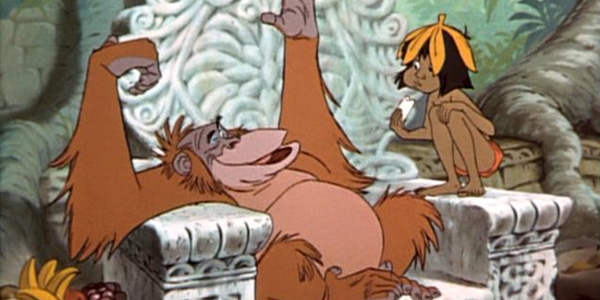
Whilst Mudflap was actually voiced by a black actor, a lot of ethnic characters in Disney aren't. In The Jungle Book, King Louie is depicted as the non-white character of the film, but voiced by white actor Louis Prima; Disney apparently considered Louis Armstrong for the part though. King Louis isn't a bad character; he kidnaps Mowgli, sure, but he's not the actual villain of the piece. The bone of contention that lies with King Louis is that he's the only animal in the jungle without a British accent - he jazz scats and talks gibberish - and he sings about how he wants to be just like other men, and not just a monkey. He's also shown to be incredibly stupid, falling for Baloo the bear's ridiculous ape disguise, and he's more animalistic than most other characters in the film when he sees a "lady" he's attracted to. It's particularly clumsy, but it really doesn't help that Louis Prima has what many believe is an altogether more African-American accent.

4. Indiana Jones And The Temple Of Doom

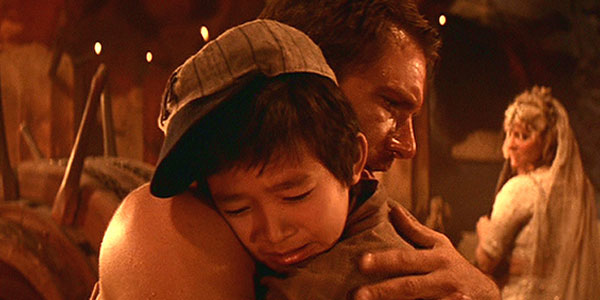
As with many trilogies, such as the aforementioned Back to the Future, it's the first and third Indiana Jones films that are the most revered (let's pretend that fourth one didn't happen, yeah?). It's a not surprise really though, given how much of Temple of Doom is an offensive mess; not only is Jones's child sidekick a Chinese stereotype, the film centres itself around the need for a white hero in an Indian community. The dinner scene doesn't actually contain Indian cuisine, it's just intended to make the country's customs look disgusting to an American audience, and Kali isn't a god of the underworld either, she's the Goddess of Energy. Even the Indian government found the script racist, denying Spielberg and his team entry into the country to film. Spielberg would later claim the movie was "too dark"; fortunately though, he was referring to the themes of the movie, and not delivering another racist slur.

3. Dumbo

Whilst The Jungle Book made some dangerous parallels that could offend African-American culture, it just about managed to stay subtle enough as not to cause too much of an uproar. Dumbo on the other hand, contains some of the most blatantly racist material that has ever graced a Disney film. Again, there was a song for the ethnic minority, as the tent-pitchers in Dumbo all chanted, "Keep on working, stop that shirking, pull that rope, you hairy ape!" These characters are black, but not even given faces, and if that's not offensive enough for you, try the black crows, who are depicted as lazy, jive-speaking and cigar-smoking. Coincidence? One of them calls himself Jim Crow. Walt Disney comes under a fair share of criticism for his racism, misogyny and anti-semitism, and Dumbo is one of his defining works when it comes to offence. Despite this, the film holds a 97% rating on Rotten Tomatoes.

2. Star Wars: Episode 1 - The Phantom Menace

It's offensive enough that The Phantom Menace wasted so much promise - it was expected to be the tempestuous upbringing of one of cinema's greatest villains - but Jar Jar Binks takes the blockbuster to new lows. Sure, he's easily the most annoying character in the whole franchise. But the fact that he's obviously the light relief, the idiot amongst Jedi Masters, doesn't couple too well with his Caribbean accent. George Lucas hit back though, claiming that critics were, "basing a whole issue of racism on an accent, an accent that they don't understand. Therefore if they don't understand it, it must be bad." Along with the accent though - provided by black actor Ahmed Best - Jar Jar has rather long ears that look suspiciously like dreadlocks. The character was hugely disliked by Star Wars fanatics, and luckily didn't make another appearance in the prequels.

1. Avatar

Surely racism in film isn't that prevalent in 2009, is it? Despite being the highest-grossing film of all time, Avatar is no exception to bumbling race depictions. The movie's famous Na'vi are a primitive race; non-white actors Zoe Saldana and Laz Alonso play two of the main tribespeople of the race, while all humans are the film are depicted as white. US marine Jake Sully becomes the hero of the tribe, who are according to some critics, seem incapable of fighting the humans before he arrives; they wear East African jewellry to reinforce the stereotypes, and are an often childlike species. Director James Cameron claimed though that Avatar, "asks us to open our eyes and truly see others, respecting them even though they are different, in the hope that we may find a way to prevent conflict and live more harmoniously on this world. I hardly think that is a racist message." Which films do you think have racist subtexts? Do you think these are intentionally racist or unfortunate? Comment below!

Contributor
Contributor

Mark White hasn't written a bio just yet, but if they had... it would appear here.