10 Recent Westerns That Prove The Genre Isn't Dead
 I love Westerns. I love that they intrinsically carry messages of hope, possibility and freedom, that they contain within them a deep sense of myth for a time when a country was arguably at its most fascinating. Even more than that, I love that, when you see a grizzled, sun-bothered stranger wander into town with menace in his eye and a Colt in his hand, you know it's on. Even more than that, when the gathering townsfolk see that man, THEY know it's on. The Western has been declared dead so many times before now it's difficult to keep track. Sure, this isn't the Western's 50s or 60s heyday, but the genre is still alive; despite so often being referred to as 'dead,' last decade had itself some outstanding Western joints, including The Assassination of Jesse James, There Will Be Blood, Seraphim Falls, Open Range, Brokeback Mountain, The Proposition, neo-Western No Country For Old Men and TV's Deadwood. But this new decade has already thrown up a few new gems - not all of them in the movies - to add to the list. Here are ten of them.
10. The Lone Ranger (2013)
 Were stars Johnny Depp and Armie Hammer and producer Jerry Bruckheimer right when they theorised that critics trashed The Lone Ranger for its budget rather than its content, writing their reviews months in advance? Well, it doesn't really matter now, as The Lone Ranger died harder than John Dillinger at the box office, making only $250 million, a figure which is considered high everywhere in the world, except in the movies. The Lone Ranger has problems - it is unnecessarily lengthy, and Armie Hammer doesn't make the most engaging lead - but it makes the other grave and portentous blockbusters of 2013 look like they all need to chill out and watch some Bake-Off. The Lone Ranger has fun in its own way, and features grand spectacle after grand spectacle, with absurdist humour and stuntwork harking back to the silent era. The inclusion of Depp's Tonto as an unreliable narrator, an old man telling the Lone Ranger story to a young fan, also adds a layer to the film - is he embellishing? Is the story invented, just his way to perpetuate the myth of the Lone Ranger? It even puts producers in the clear for that Depp-as-Native American casting choice - the man may not be Comanche at all, but just an actor for a travelling show. The Lone Ranger is an enormous picture with a light heart, and nowhere near as bad as you've heard. Try the opening runaway train set-piece, it's delicious.
9. Dead Man's Burden (2013)
 On a budget that wouldn't cover a week of The Lone Ranger's catering, Jared Moshe's Dead Man's Burden is still a mightily effective Western. Wade McCurry returns to his New Mexico home after his father dies, after years living away post-Civil War. There resides the only family he has left - his sister Martha - and her new husband Heck. Only we see Martha gun down their father in the film's opening scene, yet it seems she's set on pulling the wool over Wade's eyes for reasons unknown. And it doesn't sit right that Wade has been away so long in the first place... Beginning as an attractive mystery, the film's source of power is in its silences, the sprawling, lawless landscape both beautifully still and quietly unsettling - a perfect evocation of the Old West. Amidst the gorgeous cinematography sits themes of betrayal, greed and the scarring effects of war; the Civil War is long over here, but still people are dying for it. Making something out of very little, Dead Man's Burden proves that, even if the funding pool for Westerns ever dried up completely, the genre could still continue.
8. Rango (2011)
 The second team-up between Johnny Depp and Gore Verbinski on this list, the fact that Rango is the first non-Pixar film to win the Best Animated Feature Oscar since 2006 should give an indication of its quality. Set against painterly backdrops, but with an offbeat humour that doesn't come from anywhere in this universe, Rango is the film that would probably happen if John Lasseter and the Pixar brain-trust took a meeting whilst tripping absolute balls. See, Rango is about a lizard who wants to be an actor that finds himself in an existential crisis when he gets lost in the desert, searching for the meaning of life but instead finding an old dusty town modelled on every Western ever, only populated by talking owls and rodents that ride wild boars like horses. Then the lizard becomes sheriff. With unapologetic allusions to all the Western tropes ever conceived, and with references to films like Chinatown and Fear and Loathing in Las Vegas, Rango is an affectionate tribute to the Western, and to the American desert, a beautifully-realised piece of animation as well as a frequently hilarious comedy.
7. Peaky Blinders (2013)
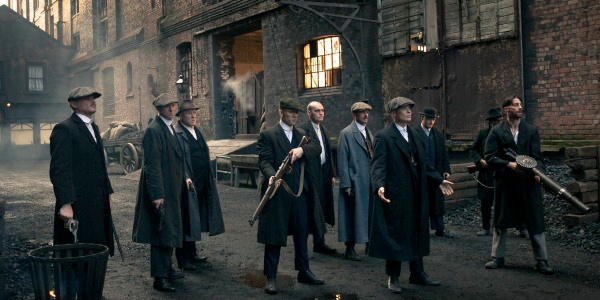 The beauty of the Western is that it's always managed to adapt new surroundings; John Hillcoat and Nick Cave's 'Western' The Proposition was actually set in Australia. And it's actually the work of Hillcoat and in particular Cave that can be felt most obviously in the Birmingham-set TV drama Peaky Blinders. Civil War veterans are replaced by haunted WWI vets, and American accents are replaced by a Brummie twang, but all the other Western signifiers are here: as a thriving, lawless town full of warring outlaws (including a dead-eyed Cillian Murphy) is dragged into the 20th century, the old ways are threatened by the new lawman in town (a terrifically menacing Sam Neill). As for those Hillcoat and Cave references: Peaky Blinders is filled with ruthless violence, amoral characters working on both sides of the law and a feeling of nauseating dread, while even music from The Proposition, The Assassination of Jesse James and Cave's own band The Bad Seeds acts as the soundtrack, as if the influence wasn't already obvious enough. Only four episodes in, this already feels like a classic of Western television.
6. Meek's Cutoff (2011)
 What happens when a minimalist indie filmmaker with a penchant for no easy answers sets out to make a Western about life on the trail? Meek's Cutoff happens. Economic to the point that the film literally doesn't have an ending (the finale intentionally feels like the penultimate rather than climactic scene, and leaves many questions unanswered), Kelly Reichardt's Meek's Cutoff has more in common with existentialist Westerns of the 1960s, while still incorporating some 70s-style revisionism and modern indie naturalism. Like Monte Hellman's The Shooting, Meek's Cutoff is interested in pitting its characters against the endless landscape, seeing how long it is before they begin to seem insignificant in the frame. And there's a lot of that: no-one has walked as unrelentingly through a desert while saying nothing of real note since Matt Damon and Casey Affleck pretentioused their way through Gus van Sant's Gerry. But Meek's Cutoff is very different, special, a film that you'll feel getting under your skin from the moment the group of settlers ruthlessly discuss killing their guide for getting them lost.
5. Sweetgrass (2011)
 It's not often you see a Western in which the cowboys take a break from mindless killing and instead do their goddamn job for a change, but Sweetgrass is an exception. A documentary about a group of shepherds dragging a giant cloud of sheep through Montana's Beartooth Mountains - them being one of the last groups of their kind to do so - Sweetgrass is also an exception in that it's one of the few Western narrative docs out there. Concerned with the business of shepherding, Sweetgrass could have been an insular tale with narrow potential interest. But it's actually a quiet, universal look at animal nature and the life cycle, and the film's hypnotic long takes are captivating, the green, snow-capped Montana vistas a gorgeous natural backdrop. Like so many Westerns, the feeling of hope and possibility is constantly at the fore, even if the task at hand is occasionally arduous and desperate; Sweetgrass offers a glance at life in the slow lane, so far away from dizzying city normality, and the feeling is liberating.
4. True Grit (2011)
 With a hit rate as high as the brothers Coen's, it wasn't surprising that their adaptation of classic Charles Portis novel True Grit arrived as another great among their astoundingly near-faultless filmography. With sharp dialogue (while that sounds Coen-esque, the brothers show little desire to tinker with Portis's original dialogue), finely-tuned performances and a scene with a man wearing a bear, True Grit is an enjoyably intimate example of the Western. Location work is sprawling, but extended conversation scenes and a focus on character almost make it feel like theatre. Jeff Bridges, as a more-iconic-than-John-Wayne Rooster Cogburn, looks like a man that's been force-fed gin for a year then left in a drain to die - he's a lived-in, barely breathing wreck of a tired old Marshal, a perfect late-career role for Bridges. Yet Cogburn is not the highlight he was in the original 1969 True Grit, which has been accepted as a classic even though it's awful. That's because there is no real highlight here; this is a Coen brothers Western, and as a result the entire film, down to each minor character, is a joy.
3. Red Dead Redemption (2010)
 Red Dead Redemption isn't just the best Western game of all time, but one of the best video games full-stop. Playing as John Marston, you live through every Western fantasy that every red-blooded male has surely ever had, and all to a bitchin' original guitar score. In terms of environment design, characterisation and story, it's a work of art. If the Western is dead on film, it certainly hasn't died in the gaming world; if anything, it's only in the early stages. Red Dead Redemption also trumps Rockstar's other big open world game, GTA, in some departments: instead of a constant, lingering sense of nihilism, Red Dead Redemption has a soul, lamenting the lost simplicity of the Old West and with a conflicted protagonist torn between what's right and what's smart. Like a great, elegiac Peckinpah film, Red Dead Redemption is ruthless, darkly funny but not without moments of beauty.
2. Django Unchained (2012)
If anyone is going to give the Western a pop makeover then send it into cinemas looking as fresh as John Wayne did back in his Stagecoach days, it's Quentin Tarantino. Taking all his favourite Westerns - The Great Silence, Mandingo and Blazing Saddles are among the ridiculously mismatched reference points - then confining them to a blender, Tarantino poured audiences the resulting rick, thick glass of Western entertainment with Django Unchained. It's too long, it's morally confusing (a cartoonish Spaghetti Western set against the backdrop of slavery? Score!), but damn if Django Unchained isn't enormously satisfying, a classic revenge tale populated by cool antiheroes and eloquent Tarantino-esque villain types so flamboyant they may as well be dancing their way through the picture.1. Heaven's Gate (1980; re-released 2013)
 A cheat, but there's a very good reason Heaven's Gate is here. After Heaven's Gate's original financial and critical nuking in 1980, the amount of Westerns made and released by the big studios slumped. The amount of Westerns on release full-stop took a huge nosedive, if 1970s revisionism hadn't already almost left the genre for dead, by draining it of all the fun John Ford and Sergio Leone had spent all those years trying to put in. What the not-inexpensive restoration and re-release of Heaven's Gate means, what the critical re-evaluation means (critical response in 2013 was highly positive, as opposed to the alarmingly negative contemporaneous reaction), is that it's time to forgive the Western that supposedly killed Westerns. 2013 was a new beginning for Heaven's Gate, and perhaps for Westerns on the whole. Heaven's Gate's rightful reputation as one of the classics of the genre began in earnest from 2013 onward.