10 Scariest Opening Sci-Fi Movie Scenes Ever
Sci-fi and horror can often be interchangeable - and both have the capacity to scare.
Science Fiction and Horror are two genres that share a lot in common and, on occasion, can be interchangeable. Both use narratives to address larger thematic issues at heart - be them ethical, moral or psychological. Both often involve the fantastic, dabbling in matters and planes of understanding beyond the human mind and both involve a degree of suspension of disbelief. When thrust into such a universe, the audience is asked to take a leap of faith with the filmmaker, excepting the ground rules set and witness them invert, bend and ultimately climax in catastrophe or success.
And both can be downright terrifying. There's a reason video stores of the 90s often combined the genres in aisle shelves beyond conserving space. While it may be easy to put Halloween firmly under the "horror" banner" at your local Blockbuster, it may be a little more difficult to place something like Alien. There's plenty of space stuff, but Roger Ebert famously described it as a "haunted house in a spaceship." So its genre placement is a little more ambiguous.
There have been some truly terrifying sci-fi films, usually starting with a bang that immediately thrusts viewers into the action, letting its technical speak unfold through the narrative.
Here are the ones that gave us a jolt right out of the park.
10. Cube

Director Vincezno Natali's directorial debut has followed his career throughout, each film putting its audience in a state of vague confusion and discordance before unveiling the thrust of the story. Cube opens with a Kafka-esque situation, as a bald man in what appears to be some sort of prison outfit awakes in an empty room, a hatch on each of the four walls. It's clear he's uncertain of his surroundings, or even how he got there, so he persists through one of the hatches to explore.
What happens next is fairly infamous, to the extent that noted hack director Paul W.S. Anderson has blatantly ripped it off more than once throughout the Resident Evil franchise. As he cautiously walks forward, a wall of thread-thin, sharp wire flies through him. His body falls to many small pieces in the shape of the title after remaining still for a moment. It's not only jarring, but it sets up the rest of the film - where characters are tasked to find an escape route of booby-trapped rooms - all cubes housed within a larger cube.
That there's no explanation for their entrapment - some sort of twisted variation on the Stanford Prison experiment, a perverse torture dome for billionaires or worse - only adds to the dread set
9. The Mist

It's argumentative about just where Frank Darabont's adaptation of Stephen King's novella falls genre-wise, but a solid one can be made that there are plenty of elements of science fiction incorporated in what is mostly an allegory for religious zealotry. After a jolting opening in which a tree crashes through the window of artist David Drayton (Thomas Jane), he's forced to go to the grocery store with his son and a contemptuous neighbour for supplies as a strange fog gathers over the lake. Within minutes of shopping, alarms ring and a man runs in the store in a panic, followed by a wave of the menacing fog.
Turns out there are creatures hidden through the fog - unspeakable, rarely fully revealed horrors that attack and brutally strip flesh, limbs and other appendages from the stranded gaggle of shoppers.
There's no official explanation for their appearance, and the ultimate conflict in the film is a showdown between blind faith and human logic, but one army officer does explain the beasts are interdimensional beings that escaped through a portal at a nearby army base.
More Lovecraftian terror than outright sci-fi, The Mist is a deeply cynical work, heightened by Darabont's handheld shooting style he incorporated from his previous work on The Wire.
8. Invasion Of The Body Snatchers (1978)

Invasion of the Body Snatchers is on a shortlist of films that can always be remade, its story repurposed to represent the social and political mores of the time. And with every generation since the 1956 adaptation, we've seen a new interpretation, each with a new setting.
1978, arguably the best, is easily the most frightening, and the opening scene less about abrupt shock or terror, but an atmosphere-setting, paranoiac's fever dream that only intensifies until the thrilling conclusion. As the credits role, we witness the alien species - just globs of translucent gel floating through space - quietly invade San Francisco. They land on plantlife and insidiously start to grow stems. Soon, a teacher on a field trip casually picks on from a leaf.
But the invasion, unbeknownst to her, has already begun. A nun walking past her gives her a knowing look and a priest (an uncredited Robert Duvall) sits silently on a swingset, knowing that it's just begun.
Donald Sutherland's health inspector starts to investigate the duplicate bodies later in the film, wandering through the crowded city as more and more faces watch him, the soundtrack pulsating like an alien heartbeat.
7. The Twilight Zone: The Movie

The film adaptation of Rod Serling's The Twilight Zone is a series of vignettes, each handled by a different filmmaker. They all range in tone, from Joe Dante's cartoonish adaptation of "It's a Good Life" to Steven Spielberg's overly sentimental "Kick the Can" to the best: George Miller's smake of the famous William Shatner-starring episode "Nightmare at 20,000 Feet."
But each individual short mostly hold their own well (Spielberg's is the most disappointing). And the cold open is fantastic.
It's unlikely anyone would expect Dan Aykroyd's name on a list like this (unless we were talking about Nothing But Trouble), but alas, he and comedian Albert Brooks are driving down a dark, winding road late at night. Brooks starts to play little games, speeding up and turning off the headlights, scarring his passenger.
Then he pulls over, Aykroyd asking him, "Wanna see something really scary?"
Turning his head away from the camera, he returns as a hideous monster, eating Brooks as the infamous narration begins and the titles role. It's scary, it's funny, and it sets the perfect tone for a film that jumps from laughter to abject terror.
So well-executed, the scare is even called back at the film's end.
6. Quarantine

Found footage films are a difficult feat to pull off. Just getting the audience to suspend their disbelief long enough for them to stop shouting "Just drop the camera and run, idiot" is hard enough, and there are other challenges the subgenre presents itself. The lamest example is Matt Reeves' Cloverfield, in which Hud, the cameraman who suddenly has a suspiciously good eye, explains his desire to keep filming.
"People are gonna wanna know, you know?" he says. "How it all went down."
Screw you, Hud.
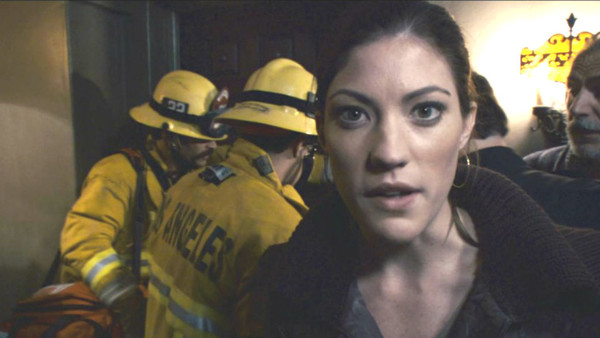
Though essentially a shot-for-shot remake of the Spanish-language film [Rec], Quarantine still manages to pack a punch and adds one element that is absent in the original. While coving a night-in-the-life story of a local firefighting station, reporter Angela Vidal (Jennifer Carpenter) is thrust in the middle of a 911 call at a run-down apartment complex. Things seem status quo, until a body suddenly drops into the lobby and all hell breaks loose.
Soon, the survivors are locked in, surrounded by military officers ordered to shoot any who try to escape on sight as zombie-esque creatures tear through the tenements. [Rec]'s brief, vague explanation has no basis in science, but faith. It turns out one of the residents was an agent of the Vatican investigating the transference of demonic possession.
Quarantine grounds its reasoning in the science fiction realm, with newsclippings hinting at a doomsday cult and a break-in and a chemical weapons lab.
Either film is worth the watch.
5. Mimic

It's understandable that Gullermo Del Toro was disappointed with the results of his first English language film, Mimic. Arguments on the set between he and producer Bob Weinstein were frequent, and the visionary helmer wasn't allowed a final cut until a DVD release years later, adding six minutes of footage he couldn't include in the theatrical.
Despite all that and Del Toro's best efforts, the movie is a fairly derivative, standard monster movie script with little innovation. There's nothing really fresh, but the plot is at least somewhat intriguing. After a brief introduction explaining a new virus is being spread by cockroaches, killing children en masse, entomologist Susan Tyler (Mira Sorvino) finds a solution: starve them to death.
Three years later, however, the new species of cockroach has, as Jeff Goldblum says, found a way, using its ability to mimic its prey (in this case, appearing like a figure in a trenchcoat) before attacking. They're enormous, wreaking havoc in the New York subway.
It's to Del Toro's credit that the film is scary at all, never more than during the opening attack on an unwitting priest. He's suddenly snatched away by an unknown assailaint, the only witness an autistic child who can't express what happened verbally. It later breaks horror movie taboos, killing young children.
4. Re-Animator

Notorious white supremacist and horror writer H.P. Lovecraft hated Mary Shelley's Frankenstein and had trouble keeping it to himself. Almost on a lark, he set about creating his own character who obsesses over re-animating the dead. Herbert West, Re-Animator was meant as parody.
Thankfully, director Stuart Gordon was in on the joke, adapting the stories into Re-Animator. Most of the film is tongue-in-cheek, over-the-top violence. Even little touches, like a poster for The Talking Heads during a sex scene, becomes significantly funnier upon rewatching it, and star Jeffrey Combs has since become a quirky icon for horror aficionados.
That said, the opening scene is no joke. It lets viewers know two things: first, this is going to be a violent ride, and second, it's probably going to push a few boundaries. The film begins at the University Zurich, thundering outside, a man in a labcoat screaming in agony. As authorities burst in the locked office door, the doctor's blood-covered face spasms, his eyes bulging before exploding out of his head.
"You killed him," a nurse says.
"No," replies West. "I gave him life."
Cue the rip-off of the Psycho theme. Cue one of the most entertaining horror films of the decade.
3. From Beyond

From Beyond, Gordon's second and not final foray into Lovecraft's oeuvre, is very much the opposite of his comical Re-Animator. It takes the science and thematic terror much more seriously. You know your movie is Freudian when a character literally bites off the third eye of a monstrous rape creature.
Combs returns, this time as Dr. Crawford Tillinghast, who along with partner Dr. Pretorious have invented The Resonator, a device that allows the mind to see beyond what it can normally perceive by activating the Pineal gland. Within moments of turning it on, strange, interdimensional beings float in view of the doctors. They immediately turn aggressive, taking bites out of the scientists.
Tillinghast is locked up in a mental institution after Pretorious is found decapitated, but psychologist Kathryn McMichaels (Re-Animator alum Barbara Crampton) starts to find his outrageous story credible after a CT scan reveals his pineal gland is enlarged. Reluctantly, he returns to the Resonator with McMichals and a decective (Dawn of the Dead's Ken Foree).
The opening kill scene is hectic and nausea -inducing enough. Things only get worse from there.
2. The Void

2016's The Void is a peculiar entry here, with great creature effects that were largely crowfunded by indiegogo and a small budget and release. It received critical acclaim, and any fans of 80s horror were awash with joy at something new but still familiar was finally in theatres again.
Like the best sci-fi/horror with Lovecraftian elements, The Void throws its audience into the unknown almost instantaneously and refuses to let up. Two people flee a farmhouse, with one escaping, the other shot and doused in gasoline before being burned alive. The survivor is rushed to a nearby hospital run by a skeleton crew of nurses and a few doctors, only to learn quickly they're surrounded by robed members of a cult determined to keep them inside. It isn't long into the film before a nurse is in a trance, brutally murdering a patient, her face flayed of flesh.
Tentacles grow, bodies are mutilated and transformed and answers are vague at best, but it's the kind of nostalgic throwback audiences were craving.
1. Quatermass And The Pit

John Carpenter has made no secret of his love for the Nigel Kneale scientist character Quatermass and his exploits, often editing his own films under the psuedonymn John Quatermass. Carpenter even solicited a script from Kneale for Halloween III: Season of the Witch, though little of his product ever made it to screen (the atmosphere and plot, however, aren't that far a cry from Quatermass 2).
Quatermass and the Pit, the best of the films, is a bit of a slow burn sci-fi, but its first encounter with the antagonists is not without tension. While expanding a metro line, workers uncover what appears to be a martian UFO. A hole opens in the ship, revealing three-legged insectoid beasts.
There are plenty of more interesting conflicts at the heart of Quatermass, namely science vs. military reaction to invasion, but once the threat is made clear, the terror is there. The beasts are at least 5 million years old and very, very dead. They are, in fact, ghosts of martian intent on colonizing Earth with their spirits in our bodies.
It's much more of a heady fear than anything else on this list, but the implications - including a kind of racial purge and propoganda - is infinitely more terrifying.