10 Sci-Fi Movies With Frightening Attention-To-Detail

10. Serenity
 One of the all-time key mistakes that so many sci-fi movies make is allowing there to be sound in space, when of course, space is a vacuum, which doesn't allow sound to travel through it. Often sci-fi films, such as Star Wars, for instance, will deliberately disregard this scientific principle in the quest for an exhilarating set-piece - because a silent gun-fight likely wouldn't have worked back in the 70s - yet Joss Whedon's TV show Firefly, and the subsequent movie, Serenity, deliberately aimed to avoid this where possible. If something exploded in space, generally it did so silently. In fact, Serenity is a movie that pretty much has an answer for everything; the final battle actually features sound despite being set in space, and this is because the fight occurs in a planet's upper atmosphere, meaning that there would be sufficient air for the sound to travel through. A-ha! I bet you cynics hadn't thought of that one!
9. Minority Report
 Minority Report is a great movie that takes place in the mid-21st century, when the police can stop crimes ahead of time, using three precognisant humans to figure out what's going to happen. Though this premise is, of course, not at all rooted in scientific fact, Steven Spielberg's sci-fi classic is far more plausible as far as its depiction of future tech is concerned. In an effort to appear more authentic, Spielberg approached many scientists to help assemble this future, for the retina scanner interfaces already exist, and the billboards that can identify your face and target ads to you are currently being developed in Japan. As for the film's crime prediction gimmick, that is (in a sense) also an actuality; in Memphis, Tennessee, an $11 billion project called Blue CRUSH, which collates various crime statistics to help streamline law enforcement, has seen serious crime curbed by 31%. Though the film dabbles in the outlandish, it is also keen to draw from authentic science fact for the most part.
8. Alien
 I know what you're thinking; how can Ridley Scott's Alien have an even remote sense of attention-to-detail when it's clearly rooted in fantasy? Well, you're wrong; even discounting the realistic implementation of suspended animation to keep the occupants of the Nostromo alive, it's the depiction of the Xenomorph that's unexpectedly authentic in its depiction of a creature's life cycle. We see the Xeno begin life as an egg, before hatching as a facehugger, and then bursting from the chest of whichever host it has attached itself to, beginning life as the form of which it is best recognised. Though many sci-fi films will introduce an alien with physiology that's "just because", the Xeno's life cycle matches that of countless parasites and insects found in nature, making the creature's behaviour seem all that more realistic and believable in spite of its uncharacteristic appearance. Of course, it's absurd that the Xeno can grow so big so fast, but if one can suspend their disbelief for this portion - given that it occurs largely to move the plot forward quicker - then the biological aspects of the creature are clearly well-studied.
7. Eternal Sunshine of the Spotless Mind
 Eternal Sunshine of the Spotless Mind is a masterful sci-fi drama from Michel Gondry, which revolves around Joel (Jim Carrey), a man who discovers that his ex-girlfriend Clementine (Kate Winslet) has had the painful memories of their relationship erased, and he opts to have the same procedure performed. During the surgery, Joel realises he wants to keep hold of these memories, no matter what pain they cause, making for one of the most brilliantly surreal films in the history of cinema. Though it would be absurd to claim that the procedure depicted is in any way close to something we are capable of, Gondry's methodology actually makes a lot of sense, given the scientific belief of the compartmentalisation of memories, with facts and cherised life memories being distinctly separate in the brain. Given the very precise nature of the memories erased, it makes sense that the movie depicts them as linked through a neural network, and while this tech could be centuries away (optimistically speaking), it would probably be targeted in just such a way and is theoretically plausible. Charlie Kaufman could have written the movie without any scientific explanation whatsoever and it still would have been great, yet boldly, he opts to have a go, and it totally works.
6. The Andromeda Strain
 The Andromeda Strain is a pulsing, paranoic thriller based on Michael Critchton's 1969 sci-fi novel, revolving around a group of scientists who are attempting to put an end to a virus that kills humans with an aggressive efficiency. To prove the level of scientific commitment to the film - which some have argued borders on the mundane and laborious - David Kirby, a postdoctoral researcher in science and technology studies at Cornell University decided to chime in, declaring that, "there is a scene where they are trying to figure out how big the microbe is that they are dealing with. From modern eyes, it ends up being a very slow, boring scene, but that is because it is realistic". Though the film has only a modest critical reception and is lambasted by most critics for being too drawn-out, it is admirably clinical in its depiction of a virus and the various means of putting a stop to it. As Kirby said, "the science in it is accurate. They are experimenting, but it doesn't make for very gripping cinema." The ins-and-outs of biology may not make for exhilarating cinema, but there's no doubt those who found the geekiness appealing.
5. Oblivion
 Though Joseph Kosinski's Oblivion was marked out by critics as borrowing from many prior sci-fi films, it also broached a number of contemporary scientific concerns that suggest there's more here than just pretty visuals and a cracking score from M83. Director Kosinsk threw himself totally into the project, enlisting a group of 12 scientists from JPL (NASA's Jet Propulsion Laboratory) to research the film's ideas heavily before shooting began. The result? A timely, thought-provoking sci-fi with that asks much of its audience. For one, the film features many drone machines which act out of accordance, placing the heroes in danger, and given the contemporary reliance on Predator drones in modern warfare, does their stability (or potential lack thereof) not seem like a pressing concern? Other than this, the film also broaches themes of off-world colonisation - the moon Titan has been seen as one of the stronger candidates for a space colony - cloning and underground settlements, well-finessed subjects that are all likely to become far more vocal, plausible talking points in the coming decades.
4. Finding Nemo
 Though it might not strictly be sci-fi, it is about science, and even if Pixar is a company renowned for its attention to detail and visual acuity, I doubt many would have expected them to explore marine biology in quite such extensive terms. Pixar decided to ensure that the physical movements of each fish were realistic to their actual counterpart, right down to how their fins move through water (there are a number of ways). A testament to Pixar's level of commitment to their subject, they even designed a new animation system which they named "transblurrency", an animation algorithm to authentically replicate the way light hits a Jellyfish. Pixar could have rested on their laurels and probably have made just as much money (at considerably less cost to themselves), but this is just proof of their dedication and ingenuity.
3. Gattaca
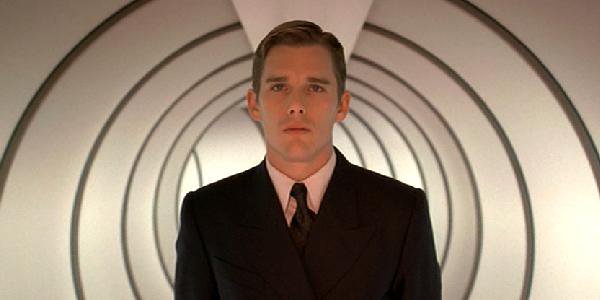 Andrew Niccol may not have been up to much in recent years, but in the late 1990s, he was the guy to go to for intelligent, thought-provoking sci-fi. Gattaca takes place in a world where most babies are produced by in-vitro fertilisation, allowing genetic disorders to be weeded out, while those babies conceived by regular means are referred to as "invalids", and one such invalid is Vincent (Ethan Hawke), who is denied his dream to become an astronaut because of genetic discrimination against him for a heart defect. Niccol's film is deeply satirical, predicting a future in which our biological data will trump all other personal attributes such as manner, job experience and so on; the film broaches the idea of genetic determinism, that in this world, genes are what determines your wealth and success. Though we're far away from that becoming a reality, we have already seen the seeds sewn; healthcare patients with a genetic predisposition to certain illnesses can be rejected care or be charged enormous premiums, putting them at a severe disadvantage to others. Eerily prescient, the message seems to be that though genetic exploration can save lives and prevent illness, we must be sure not to use it as the be all and end all judgement of a human being.
2. Primer
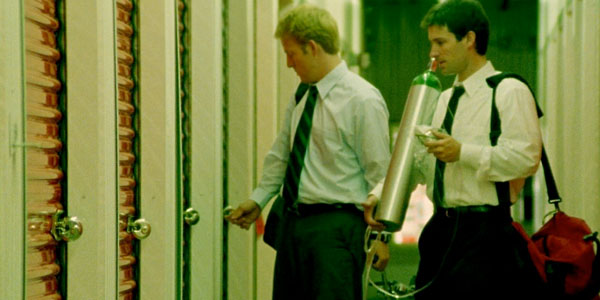 Primer is without question one of the most challenging and fascinating sci-fi films ever made, and certainly one that benefits from at least two or three watches. It's as close to an authentic movie about time travel as we're going to get, largely because it eschews flashy laser beams and an epic score in favour of a totally grounded, down-to-Earth examination of a man discovering the ability to time travel. This lends the film a curious relatability even as actor-director-writer-and-so-on Shane Carruth rattles off the technical jargon in a manner that suggests he doesn't really want you to get it. What's perhaps most brilliant and sharply-observed about the film is that, if someone ever were to discover time travel, it probably wouldn't be by way of a slick, silver, smoky gadget, but probably a mess of wires and components. This raw quality lends Primer a more authentic feel, as does Carruth's often beguiling dedication to precise technical dialogues.
1. 2001: A Space Odyssey
 Stanley Kubrick's unforgettable sci-fi masterpiece owes a lot to renowned author Arthur C. Clarke, who collaborated on the screenplay as a technical adviser. From the lack of sound in space to the food the crew eats and more ambitious aspects like sticky gravity shoes and artificial gravity, it is all either scientifically accurate or highly scientifically plausible. In addition to this, general technological advancements such as flat-screen TVs, voice-operated computers and tablet-type computers are depicted in varying degrees throughout the film, making this easily the most stunningly accurate and prescient sci-fi movie ever made. It is astronomer Carl Sagan who also helped Kubrick make one of the most crucial decisions on his picture, to keep the aliens at bay and merely imply their presence rather than depict them as humanoid-esque creatures. It could have turned a very good movie into a very goofy one in two seconds flat. Which authentic sci-fi movie do you love the most? Let us know in the comments below. OBLIVION blasts onto Blu-ray and DVD, both with UltraViolet, on 19TH August 2013, available to buy now.