10 Scrapped Movie Scenes Better Than What We Got
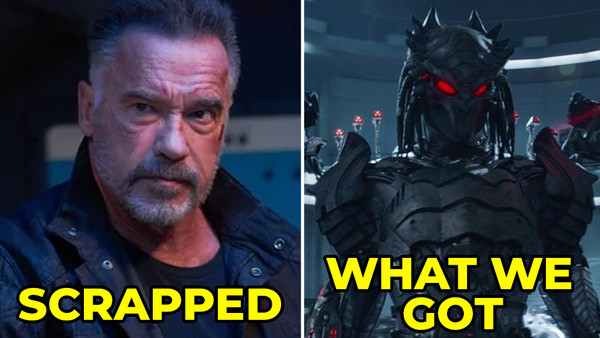
The Predator almost ended with Dutch's return.
No matter how confident a filmmaker's vision might be, making any movie is a collaborative and iterative process, where things don't always go according to plan and, sometimes, entire scenes need to be thrown out, often at the last minute.
But sometimes these decisions ultimately aren't what's best for the final movie, motivated either by a greedy studio putting pressure on a director to deliver something different, or frustrating logistical issues which prevent the original planned scene from coming together.
Whatever the reason, these 10 movies all switched out fascinating planned scenes for massively inferior ones, be they underwhelming endings, less-impactful fight scenes, or even subtle plot adjustments that had huge implications for the rest of the film.
These scenes were either never shot or released to the public, serving simply as tantalising teases for what could've been if circumstances were different.
Would they have saved bad movies? Absolutely not, but in every case, whether a good movie or not, these endings sure would've elevated the experience...
10. Darkseid Arrives - Justice League

It's no secret that Justice League was a big 'ol mess, and honestly probably the most publicly sloppy Hollywood production of the last decade-or-so.
Its biggest issue above all else is the creative push-and-pull between so many disparate visions: on one hand there's Zack Snyder's dark, operatic spectacle, on the other there's Joss Whedon's broader, wittier approach, and somewhere in the middle is Warner Bros. desperately trying to figure out what audiences actually want to see.
One of the most surprising things about Justice League is how self-contained it ultimately ends up being.
After Batman v Superman was widely - and justifiably - pilloried for feeling like a coming attractions reel for future DCEU movies, Justice League barely makes any effort at all to set up a sequel, beyond bringing Superman (Henry Cavill) back into the fold and establishing the existence of the titular team.
Steppenwolf (Ciaran Hinds) is defeated, we get a brief post-credits tease of Lex Luthor (Jesse Eisenberg) and Deathstroke (Joe Manganiello) and...that's it.
And though Snyder's original vision for the film was likely messier than what we ended up with, it certainly didn't want for bold, viscerally intriguing ideas.
Above all else, the end of the film was supposed to have Steppenwolf attempt to lure Superman to his side with an extended vision of the "Knightmare" from Batman v Superman, giving audiences their first glimpse of the Thanos-like big bad Darkseid in the process.
Further still, Steppenwolf wouldn't be destroyed by his own Parademons, but upon arriving back at his home planet Apokolips would be murdered by Darkseid, and the cliffhanger ending would see the supervillain heading to Earth to fight the Justice League himself.
In the very least, this would've provided a compelling link back to the Knightmare sequence and actually given audiences something vaguely compelling to look forward to. Instead, it ended on a forgettable shoulder shrug.
9. Skynet Wins - Terminator Salvation

Terminator Salvation's ending is, even for the standards of the Terminator franchise, totally ridiculous.
After John Connor (Christian Bale) is mortally wounded during an encounter with a T-800, his life is saved by human-cyborg hybrid Marcus Wright (Sam Worthington), who volunteers his own heart to be transplanted into Connor's body. Roll credits.
But a far darker and more interesting ending was originally conceived, in which John actually dies, yet in order to keep the myth of the resistance leader alive, his skin would be grafted onto Marcus, effectively making the figurehead of the resistance a Terminator. Irony!
But it gets much better: the final scene in the film would see all of the main characters - namely John's wife Kate (Bryce Dallas Howard) and Kyle Reese (Anton Yelchin) - brought into a room to meet cyborg-John, only for his eyes to flicker red and him murder everyone in the room, with some latent Skynet programming kicking in.
Even accepting the shock value of having Skynet score a decisive, unambiguous win, the added irony of Connor - or Connor's likeness, at least - causing the downfall of the resistance is just too damn delicious.
But of course, this isn't the sort of ending that franchises are built on, and though the ending had fierce support from Christian Bale himself, it was eventually scrapped for being "too dark" - aka not conducive to franchise longevity.
8. All The Other Colonists Die - Passengers

Sci-fi drama Passengers is unquestionably one of the most disappointing films of the last few years, squandering a tantalising premise on style-over-substance thrills and a tone-deaf execution.
The central conceit sees engineer Jim Preston woken up from stasis onboard a spaceship 90 years too early due to a malfunction, and in order to avoid living the rest of his life alone, he awakens the hottest fellow passenger he can find, Aurora Lane (Jennifer Lawrence), without ever explaining this to her.
Though the film does engage with the obvious ethical minefield of Jim's actions, this issue is ultimately brushed under the carpet in favour of a Titanic-in-space romance that feels a little too close to Stockholm syndrome to be truly comfortable.
But Jon Spaihts' original script took a far more delicate and considered approach to this dynamic, by placing a greater focus on the spaceship's dysfunction and delivering a third act bombshell where the other 5,000 sleeping colonists end up ejected into space, killed in an instant.
This would immediately alter the morality of Jim's actions, because while him saving Aurora's life would undeniably be an inadvertent act of his desperate loneliness, it makes it much harder to argue that the end result is purely creepy. It's the reason she's still breathing, after all.
Would Passengers still be a divisive and problematic movie with this alternate third act? Probably, but it'd certainly be more interesting than what we ended up with - not to mention more effective as both a tragedy and a romance.
7. Pinhead Joins The Party - Freddy Vs. Jason

The inherent problem with "vs." movies is that neither rights-holder wants their IP to lose, and so these films typically always end with a cop-out "no contest" finale, where there's no outright winner or they simply end up joining forces to battle a bigger foe.
That was certainly the case with 2003's enjoyably daft Freddy vs. Jason, which ended with Jason (Ken Kirzinger) emerging from Camp Crystal Lake holding Freddy's (Robert Englund) decapitated head.
But of course, Freddy winks at the camera mere moments before the end credits roll, indicating the battle is far from over.
The film's ending went through numerous iterations, perhaps the most tantalising of which would've seen Freddy and Jason's fight interrupted with the pair being strung up by chains.
At that moment, Pinhead (Doug Bradley) emerges from the shadows and quips, "Now, gentlemen, what seems to be the problem?"
While this ending wouldn't have provided any additional closure to the titular battle - quite the opposite, in fact - it would've been one hell of a set-up for a potential sequel, which despite Freddy vs. Jason's commercial success curiously never happened.
6. The Original Cap Vs. Winter Soldier Fight - Captain America: The Winter Soldier

The street fight between Steve Rogers (Chris Evans) and The Winter Soldier (Sebastian Stan) in Captain America: The Winter Soldier is one of the MCU's most-celebrated action scenes to date.
Yet despite its stripped down intensity, it also suffers from sloppy editing and overly busy direction, making it tough to fully savour the clear effort that's been put into the silky smooth fight choreography.
However, the scene's choreographers recently uploaded a "previz" version of the fight (see below), with two stunt performers acting out the scene in a warehouse, the results of which are decidedly tighter and more fluid than what made it into the final film.
Granted, it's far easier to control shooting conditions indoors, but even so, there's a night-and-day difference between the bracingly intense original sequence and the rougher, less visually coherent final product.
5. Kim Jong-Un's Head Explodes - The Interview

Seth Rogen and James Franco's controversial comedy The Interview is honestly more memorable for the geo-political nightmare surrounding its release than the actual movie itself.
However, few will forget that it concludes with an oafish caricature of North Korean despot Kim Jong-un (Randall Park) being blown up by a missile fired at his helicopter, set to Katy Perry's "Firework," no less.
But as revealed during the infamous Sony Pictures e-mail hack shortly before The Interview's release, the original version of the scene was actually far more violent, with Kim Jong-un's head exploding in gory slow-motion, whereas in the final version of the scene the gore is concealed by a wave of fire.
Directors Rogen and Evan Goldberg lobbied hard to keep the original death scene in the final cut, and understandably so.
In a movie primarily concerned with mocking Kim Jong-un, it felt cowardly for Sony to start clutching their pearls and draw the line at an exploding CGI head.
Nevertheless, the studio held firm, and despite hope from Rogen that the uncut scene would end up released at some point, it sadly seems confined to a more secure Sony server.
4. Bane's Origin Story - The Dark Knight Rises

Anyone who knows much at all about Christopher Nolan will be aware that he doesn't "do" deleted scenes, or rather, he never makes cut material available on home video after-the-fact, his opinion being that the theatrical cut is always his director's cut.
This has created an aura of intrigue surrounding various unreleased scenes shot for his movies, specifically his beloved Dark Knight saga. In particular, there was a major subplot for The Dark Knight Rises' villain Bane (Tom Hardy) which was shot but ultimately abandoned.
The film's costume designer Lindy Hemming revealed that Nolan shot an extended flashback sequence which depicted the back injury which gave Bane his distinctive back scar, him subsequently building a more primitive version of his famous face mask, and also learning to fight off prisoners in the Pit.
The idea, apparently, was to have Bane's genesis reflect that of Batman's, yet at some point Nolan clearly decided to ditch it, perhaps because the film was already running dangerously close to three hours.
Instead, we got a fairly piecemeal backstory for Bane that's largely in service of an hilariously predictable plot twist where Talia al Ghul (Marion Cotillard) is revealed to be the real criminal mastermind, and Bane a mere smitten puppy.
Honestly, it probably would've been tidier to just scrap the Talia plot entirely and double down on Bane, rather than stonewalling most of his origin story behind a silly plot twist most fans saw coming a mile away.
3. The Original Russia-Set Climax - World War Z

Blockbuster zombie flick World War Z was another deeply troubled production that, impressively, managed to crawl out of the hole and score broadly positive reviews while grossing $540 million worldwide.
However, almost the entire third act of the movie was re-shot after protagonist Gerry (Brad Pitt) leaves Jerusalem.
The finale sees Gerry heading to the World Health Organisation HQ in Wales, where he discovers a solution to evade the zombies, and the movie ends on a semi-hopeful note that humanity can now fight back against the zombie horde.
But the original third act sounded so much more interesting than this oddly low-key climax, with Gerry heading to Russia after leaving Israel, having his phone confiscated and being drafted into the Russian armed service.
Some time later, Gerry is now a bearded, grizzled zombie-killing badass, and learns that the zombies cannot survive in the bleak Russian climate, allowing Russian forces to easily kill them.
After getting his phone back, he calls his wife Karin (Mireille Enos), who immediately hangs up. Gerry is then called back by a U.S. Navy Seal (Matthew Fox), who informs him that Karin has shacked up with him in order to survive, and advises him to move on and start a new life.
The final implication is that Gerry will be heading back to the U.S. to retrieve his wife.
Though this ending would require some tact to work - after all, haven't enough blockbusters used women as trophies for the male heroes? - it's a damn sight more interesting than what we ended up with, and would also lend further context to Matthew Fox's bizarrely piecemeal role in the final cut of the film.
Brad Pitt with a giant beard slaying zombies, or walking through some hallways in a bland government building? It's no contest.
2. Dutch Returns - The Predator

Shane Black's The Predator just might be last year's most disappointing movie. Despite having the terrific Black as writer-director, a talented and diverse cast, a huge budget and an R-rating, it was a tonal car crash with some incredibly silly ideas about the future of the franchise.
Even more baffling than that head-scratching weaponised autism subplot was the film's ending, which reveals that the rogue benevolent Predator left behind a weapon to help humanity fend off any further alien interlopers, dubbed the "Predator Killer."
Hilariously, the weapon turns out to be a ridiculous Iron Man-esque armoured suit, kitted out with a comical number of mounted weapons, ending the movie with a tone-deaf thud.
But numerous far cooler ideas were considered during production. Black actually shot an alternate ending where the Predator Killer was revealed to be none other than Newt and Ripley from Aliens, with their faces obscured by masks.
Yet far more logical was an ending that sadly wasn't even filmed. Black and co-writer Fred Dekker initially wrote a stinger cameo for original Predator protagonist Dutch (Arnold Schwarzenegger), who would show up in a chopper chomping a cigar and tell the surviving characters, "Come with me if you want to live."
But understandably, Arnie was turned off by the small size of the role and the dubious possibility of a sequel, and passed. But if Black and Fox had their ducks in a row, this would've ended the movie on one hell of a bang.
1. The Car Graveyard - Cars

It's fair to say that Cars isn't one of Pixar's best movies, but it's still a beautifully animated family romp, albeit one which very nearly flirted with themes a little more daring and adventurous.
Animatics were completed for a scene just after Lightning McQueen (Owen Wilson) gets separated from his big rig pal Mack and ends up at Radiator Springs.
While trying to get back on the Interstate and find Mack, Lightning finds himself hurtling through a dense forest area, which appears to be a car "graveyard," packed with the "corpses" of other cars as well as a ghost-like car with tree branches for arms which tries to grab Lightning.
Pixar has never been one to shy away from challenging material riffing on the impermanence of everything, so it's a massive shame they removed this genuinely creepy and atmospheric scene before animators could get to work on it.
Instead, Lightning's journey to Radiator Springs is decidedly less arduous in the final film, with any scrap of boundary-pushing creativity disappearing into the ether.
Check out the animatic for yourself at 3:53 in the below clip: