10 Terrible Movies That Still Managed To Break The Box Office
Proving once and for all that artistry and popularity don't go hand in hand.

The supposed strength of markets lies in their ability to weed out a bad product, allowing quality and buying power to work together in a system where competitors battle to bring ever-better goods to we humble consumers. Or so goes the capitalist adage.
In reality, it's often a race to the bottom -- and the world of cinema is no different. For many years, the film industry has been big business, run on a model that prioritises returns over creativity, revenues over artistry, dollars over... well, you get the picture. This system has shot out many, many films that have made hella bank despite their sub-par quality. In some cases there's a rhyme and reason why a film does so well despite its compromising viewing experience; in others, it's pretty much a matter of good advertising and dumb luck.
For each film herein, the Rotten Tomatoes score is rotten and the picture in question has brought in at least 5x what it cost to make. Oh, and there's only one pick from each series...
10. The Da Vinci Code

Rotten Tomatoes Score: 25%
Back in 2006, Ron Howard took on the seemingly straightforward task of adapting Dan Brown's bestselling mystery novel The Da Vinci Code for the big screen. With Tom Hanks on board as art and symbology professor Robert Langdon, and a supporting cast of greats including Audrey Tautou, Ian McKellen and Jean Reno, it looked like a sure thing. And it was, if only from a financial perspective.
The high-pace, inter-country chase - which sees Langdon access the mysteries of Leonardo Da Vinci's paintings and inventions - may work on the page, but it didn't translate as smoothly to the screen. The energy and the talent are there, but the overlong film highlights the sparseness of Brown's story and the tenuous, often tedious nature of the central mystery's essential connections.
Nonetheless, the film raked in $760 million against a $125 million budget. Riding high on the book's name recognition, The Da Vinci Code attracted viewers from a wide spectrum, but satisfied few of them - and even fewer critics.
9. Saw 3D

Rotten Tomatoes Score: 9%
The so-called final chapter of the poorly planned, continuously retconned and terribly uneven Saw series was always going to be a big event. Indeed, the seventh Saw promised to tie together the cat-and-mouse through-line from the previous franchise entries, determine the fate of the rogue Detective Hoffman (Costas Mandylor) and spill all the additional secrets we hadn't yet seen.
Cashing in on the resurgence of three-dimensional cinema tech initiated by James Cameron's Avatar the year before, Saw 3D was shot entirely in RealD 3D, offering viewers an up-close and personal look at the gore the films had made their name on. These elements in combination with inflated 3D ticket prices made an absolute killing, turning over $136 million at the box office against a $17 million budget.
Unfortunately, director Kevin Greutert was no Jim Cameron. Saw 3D's effects were obvious, the blood looked fake, and the story was, in all frankness, silly and dumb even by Saw standards. Critics annihilated it and audiences forgot it, but the money has enabled Twisted Pictures to make three more Saw films since at the time of writing.
8. Cocktail

Rotten Tomatoes Score: 9%
Tom Cruise is the bartender every woman wishes she was with, and every man wishes he was. At least, that was the gambit of Roger Donaldson's Cocktail, a film that sees Cruise's Brian Flanagan ditch business school to shake martinis and live out the hollow dream of tending bars around the world and eventually owning his own joint.
On the face of it, there is neither anything egregiously wrong with Cocktail, nor outstandingly wonderful. Yet, the film has the dual honour-dishonour of being both a cultural touchstone referenced by other media for decades to come, and an absolute disaster. As a film, it is flat, it's shallow and it can't hold a candle to other similar efforts from the late-'80s. Oh, and it was also disavowed by pretty much everyone involved in the years following.
But none of that matters, because it made the big bucks. Working with a surprisingly high $20 million budget - given this was the '80s, Cruise was not the star he is today, and the film is mostly shot in cheap and down-to-earth locations - it made a significant return, picking up a cool $171 million at the box office.
7. Shrek The Third

Rotten Tomatoes Score: 42%
By all accounts, Shrek the Third should have been a roaring success. The first film broke ground with a unique (at that time) blend of adult humour within a children's movie setting, rehashing the fairytale world for the millennial generation. The second doubled down on this, refining its animation, bringing in a larger cast of characters (all with famous voices) and going to town on contemporary culture in the process.
Sadly, however, the people in charge of the third entry in the endlessly memeable franchise reckoned that audiences came for pop culture references and body humour alone. Shrek 3 is a watering down of the canon, with weaker characters, strained Shrek-Donkey banter and cheap laughs throughout.
Despite the serious quality concerns and lack of innovation involved in utilising its $160 million budget ($10 million more than its predecessor), it still made an eye-watering $813 million, which, while less than Shrek 2's $935 million, was still enough to secure Shrek's place as a big and small-screen mainstay for the remainder of the noughties.
6. Alvin And The Chipmunks: The Squeakquel

Rotten Tomatoes Score: 21%
Nobody could ever accuse Alvin and the Chipmunks of being a quality property, originating as it does from a 1950s music industry ploy to sell more records to children. Nevertheless, the brand has enjoyed success across the decades since, and in 2007 made it into the big-time with a CGI/live-action adaptation that introduced the critters to a whole new generation of youngsters.
Enter the, uhh, Squeakquel. If the first film in the franchise was based on a desire to make money and sell toys, the second film perfected this notion, scouring away anything vaguely interesting or inspired and getting out the other side in 88 minutes flat. To their shame, Zachary Levi, Jason Lee and David Cross continued to put their faces on this series of diminishing returns, and only gradually stepped away through two further sequels.
But it's not difficult to see why they stuck around - the films were short, easy shoots and a $70 million budget meant they could all get plenty of the spoils. But what sustained the Squeakquel and its successors most was not the famous faces, but the $443 million box office - a number that had almost halved by the time the series called it quits in 2015.
5. The Devil Inside

Rotten Tomatoes Score: 6%
When William Brent Bell (of recent Orphan: First Kill fame) was making found footage supernatural horror The Devil Inside, it had all the trappings of an indie super-hit. Produced on a budget of just $1 million, the film follows Isabella (Fernanda Andrade) as she investigates the motives behind her mother Maria's (Suzan Crowley) murder of three people, via interviews and exorcisms at a hospital for the criminally insane where she attempts to save Maria's soul while fighting off her literal demons.
The trailer was tense, and it seemed Bell was making best use of all the hallmark subversions and camera tricks of the found footage genre. And yet, when it came down to it, the film fell flat on its face. The Devil Inside is not just bad, it's not scary - the death knell for any horror film whose premise is built purely on tension. And that's not to mention the abrupt and unresolved ending, which left plenty feeling cheated.
But no matter how cheated we felt, the money was already out of our pockets and in the filmmakers' coffers - all $101 million of it, which is not bad at all considering how little it cost to make.
4. The Smurfs
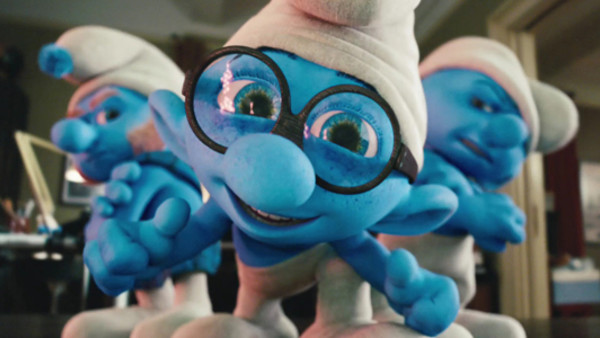
Rotten Tomatoes Score: 21%
Much like Alvin and the Chipmunks, The Smurfs isn't exactly prestige cinema. However, the series - about tiny little blue people who live in the toadstool-topped and aptly named Smurf Village - has slightly more elevated origins in the medium of comic books.
The 2011 CG/live-action adaptation brings the Smurfs (voiced by a cast including Jonathan Winters, Alan Cumming and Katy Perry) to Manhattan, where they spend their time enacting mild shenanigans and evading capture by the evil wizard Gargamel (Hank Azaria). Anything set in New York tends to put bums on cinema seats, and Raja Gosnell's goofy romp was no different, bringing in some $563 million's worth of punters on a $110 million budget.
Needless to say though, the film is terrible. The dialogue, humour and action are all aimed at the youngest possible audience, with nothing for anyone in double digits to care about. Add to this Sony's flaccid, pre Spider-Verse animation and predictable plotting, and it should be no surprise that this series was aborted after a sequel, rebooted, and then banished to TV, where it belonged from the start.
3. The Twilight Saga: New Moon

Rotten Tomatoes Score: 29%
Stephenie Meyer's Twilight series arrived at the perfect time, intersecting with the emo and scene movement and evoking the PG fantasies of high-school girls the world over via the glittery, love-struck vampire heartthrob Edward Cullen. Sexy, sultry vampires were in, and true creatures of the night could go begging.
Of course, adaptations were big money in the late noughties, and 2008's Twilight put Robert Pattinson's face to Edward's name, making the collective fantasy all the more real. The film wasn't Shakespeare, but it had some indie credentials that included having Catherine Hardwicke behind the lens, and it did serious numbers.
Unfortunately for everyone, the next novel to be adapted - New Moon - was essentially money-spinning filler that treaded water and introduced some necessary additional characters before the more serious business of subsequent releases got underway. Perhaps recognising this, Hardwicke jumped ship, and The Golden Compass's Chris Weitz steered the film into a creative iceberg, producing one of the most lacklustre sequels ever committed to celluloid.
The $50 million budget was primarily used to make the film aesthetically pleasing, without consideration for the plot. Despite this, teens and tweens piled in with $711 million of their parents hard-earned dollars and made it an overwhelming success.
2. Transformers: Dark Of The Moon

Rotten Tomatoes Score: 35%
Michael Bay's robot mash-a-thon Transformers series has been little more than a co-branding opportunity from the start. Even forgetting the fact that these films are based on a line of toys, there's still the endless product placement and stream of new characters in each film designed solely to sell merch and junk food and cars and basically anything else you can think of. Come on - there are even Oreo vending machine and Mountain Dew truck Transformers.
The third instalment to the franchise, 2011's Transformers: Dark of the Moon, didn't really do anything too egregious, but rather continued the holding pattern of the first two, with a seemingly eternal struggle between the Autobots and Decepticons translating as a balancing act between keeping just enough of viewers' attention and attracting ever-more of that sweet, sweet branding money.
Despite having $195 million to spend on the production and a fairly cost-efficient cast (most of whom were, at least at that time, riding the bottom of the A-list), the CG is the visual equivalent of white noise, offering nothing the eye can linger on or the brain can process.
Never mind that, though. Dark of the Moon raked in a box office total of $1.124 billion, making it one of the highest-grossing films of all time -- and surely the very worst with that accolade.
1. Fifty Shades Of Grey

Rotten Tomatoes Score: 25%
EL James is not, at heart or in practice, a writer, but a fanfiction blogger who woke up one day to find the entire world was reading her toilet Tweets. Written on a Blackberry phone and inspired by the Twilight series, James' best-selling Fifty Shades of Grey was on a collision course with Hollywood as soon as book sales passed the one-million mark.
The source material is unforgivably bad, but here's the thing - even if the filmmakers had been able to beef up the characters, the dialogue and the plot, it's the sex that got your mum and your nan and whoever else so psyched for the book in the first place (no matter what they tell you). Even with an 18 certificate, this mainstream studio release was simply never going to be able to go all the way (or even, really, halfway).
Thus the $40 million production, directed by Sam Taylor-Johnson and starring Dakota Johnson and Jamie Dornan, sated nobody's desires. But that didn't stop audiences piling into the cinema in their droves, armed with all manner of paraphernalia. Fifty Shades of Grey ultimately made $569 million in ticket sales, a staggering sum for an adult-only flick, which has made it the second most successful 18-rated film of all time, after Mel Gibson's The Passion of the Christ.