10 Things You Didn't Know About Disney's Frozen

From gay characters to Amy Winehouse, there’s a lot hidden in Frozen’s icy heart.

Everybody knows of Frozen. And by everybody, it's like literally, everybody in the world except for perhaps twelve people who have chosen the underside of a rock as their primary habitation. In fact, you€™ve probably heard of Frozen so much in the past year that you want to punch a child in the face the next time you hear even the opening notes of the inescapable €œLet it Go.€ Of course, Frozen€™s pervasive popularity can easily be attributed to the excellence of the Oscar-winning film, which is both critically acclaimed and dearly, dearly loved by audiences. The relentless, loveable winter€™s tale of magic, sisterhood, and the power of love is the highest-grossing animated movie of all time, and will be stamped in our collective memories for years to come (for better or for worse). But, really, Frozen€™s ubiquity and legacy is for good reason: the amount of thought and effort that goes into an animated film of Frozen€™s calibre is unparalleled by any live-action counterpart, a staggering combination of technology, research, and good old-fashioned storytelling. There are aspects of animated filmmaking that go largely unconsidered by the average moviegoer, from the technical to the artistic and more. So, despite its cultural omnipresence, there are many surprising secrets that can be thawed out to chart Frozen€™s journey from the sketches to the silver screen.

10. Snow Animation Was More Complicated Than You Think

Snow was, to say the least, quite an important part of the film, and animators paid attention to every detail when it came to the creation of snow in the world of Arendelle. Wanting to generate believable scenery shots, Disney artists were lectured by CalTech professor Dr. Kenneth Libbrecht on the details of ice and snow formation. From this, the effects team created a snowflake generator to create 2,000 unique snowflake shapes for the film, and they developed ideas on how to build Elsa€™s palace in the manner of ice formation, by branching and plating. The complexity of Elsa€™s palace sequence required 30 hours to render each frame €“ not too bad, until you consider that 4,000 computers rendered one frame at a time. Going even further than that, the team created a whole new software called Matterhorn to have heavy, deep snow interact believably with the characters, which was difficult because of snow€™s not-solid-but-not-liquid quality. If you ever thought Frozen was a frivolous matter, think again: the level of advanced mathematics used to capture all of snow€™s effects €“ from forming footprints to creating snowballs €“ in an organic fashion was staggering. But even all this technology can€™t completely drive 2D drawings into obsolescence: animators used 2D artwork for certain sequences that couldn€™t be done otherwise, including Elsa€™s magic and snow sculptures.

9. Prince Hans Was Once Prince Charming?

Santino Fontana, the Broadway actor with a voice of pure gold, voiced Prince Hans, the despicable character with a heart of pure awful. Fontana€™s previous experience with portraying charismatic young royalty that sing romantic duets with wistful princesses must have come in handy while playing Hans, as he is well-known for playing the charming Prince Topher in the 2013 production of Rodgers & Hammerstein€™s Cinderella. The role, based on Prince Charming, even landed him a Tony nomination. Fontana isn't the only one, either; Frozen is star-studded with Broadway royalty. Every Frozen fan worth their snow knows of the wickedly brilliant Idina Menzel (who was once again Tony-nominated just this year), but Kristoff, aka Jonathan Groff, is also a Tony winner for the 2006 musical Spring Awakening. Even Olaf's voice actor, Josh Gad, is a Tony nominee for the acclaimed 2011 musical The Book of Mormon. Speaking of Mormons, Tony-winning Bobby Lopez wrote the songs for both Frozen and the decidedly less family-friendly, South Park-inspired musical. Well, it's a small world, after all.

8. Idina Menzel and Kristen Bell Both Auditioned For Tangled

It seems hard to remember any Disney movie existing prior to Frozen on this side of the decade, but 2010€™s Tangled had both Anna and Elsa trying to land the part of Rapunzel. Funnily enough, their auditions for the film are what helped both of them get their respective parts in Frozen. Kristen Bell€™s Tangled audition had the casting director recommend her towards Chris Buck, whose film, then titled €œThe Snow Queen,€ was in development at that point. Let€™s be real: it would€™ve been pretty great. The perky, bright-voiced Bell can easily be imagined as the perky, bright-voiced Rapunzel, what with both Rapunzel and Anna being wistful princesses who want to experience life on their own terms (just like, let€™s face it, half of Disney€™s princess arsenal). The frosty, troubled Elsa, on the other hand, is far better suited for the awe-inspiring vocals of Broadway star Idina Menzel. She, too, auditioned for Rapunzel, but said that her audition €œfell through the cracks.€ Luckily for Menzel, the casting director was apparently a huge fan, and was always waiting for the right part for her. It's lucky for the rest of us that the casting director didn€™t €œlet her go,€ because snow queen Elsa is undoubtedly the perfect fit.

7. Frozen Might Contain Disney€™s First Gay Character

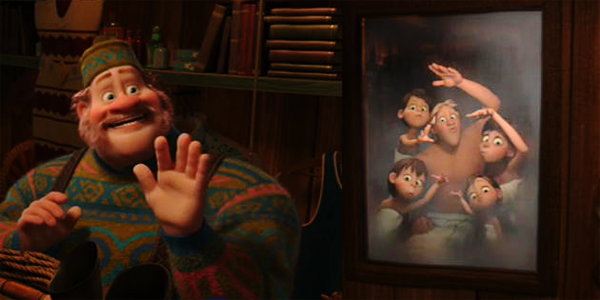
Though it's not completely official, Oaken, of Wandering Oaken€™s Trading Post and €œyoo-hoo! Big summer blowout!€ fame, was noted by eagle-eyed viewers as being suggested as gay. If you pay close attention, when he points out his family to Anna, there is a very discernible, hunky blond man with his four children in the sauna. When this was pointed out to director Jennifer Lee, she made a diplomatic statement, saying simply, €œWe know what we made. I don€™t like to say anything, and just let the fans talk. I think it€™s up to them.€ She added, "This was made in 2013 and it€™s going to have a 2013 point of view." So it does sound like the Frozen crew knew exactly what they were doing with this little hint, without having to respond to those vexed over a possible €œgay agenda€ in the Disney film. Of course, the Oaken scene can be and has been looked at in a variety of ways, some more plausible than others: the girl on the right is the man's wife, "Hi, family!" was Oaken greeting just any old family enjoying the sauna, the man is Oaken's brother with his nephews and nieces, or he's just a friendly naked stranger looking after young children, perhaps. Hey, it's Disney: anything's possible.

6. New Software Had To Be Developed For Elsa's Hair

Yeah, Tangled can€™t even have one thing over Frozen, apparently, not even what it€™s named for. Rapunzel, for all she€™s worth, had twenty times less hair than Elsa: Rapunzel's head contained about 27,000 strands of (very long) hair, whereas Elsa took it to a whole different level, requiring upwards of 400,000 computer-generated threads. Elsa€™s ice magic apparently extends to her superhuman hair, because the average person has only about 100,000 (Anna, by contrast, had roughly 140,000). Because of this, animators had to create a whole new program called Tonic to animate Elsa€™s hair and its intricate, braided styles. The software €“ and the volume €“ allowed Elsa€™s and Anna€™s hair to have more realistic form and movement, allowing it to act more like a moving €˜sculpture€™ than as individual strands. The developers called it a kind of €œbarber-shop€ style of hair animation, useful for the princesses€™ Scandinavian €˜dos. Even more new software was created for other aspects of the animation as well, including the aforementioned creation of snow. A program called Flourish was also created for realistic clothing movement, as the wintry setting required the characters to don many layers of thick clothing.

5. The Voice Actors Did More Acting Than Just Voices
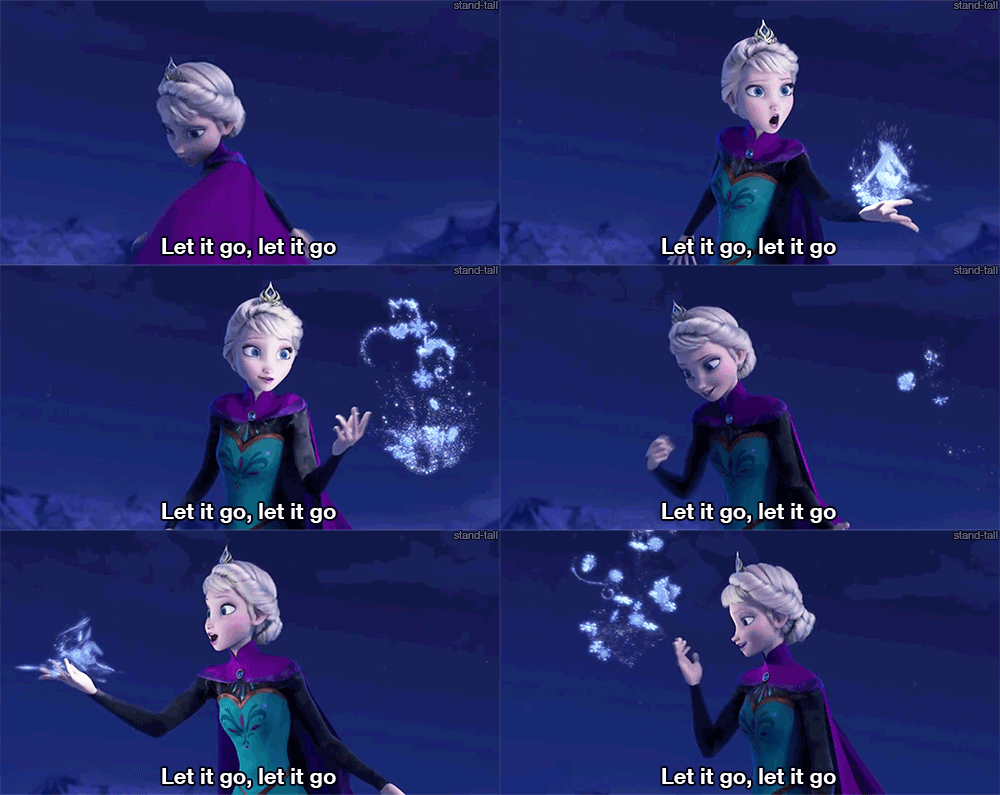
Though far from motion-capture, Bell and Menzel weren€™t just lending their gorgeous vocals to the characters of Anna and Elsa. The pair was analyzed closely by animators while doing their voice recordings, who then applied some of their idiosyncrasies to the characters themselves. Kristen Bell€™s lip-biting, for example, became a hallmark of Anna€™s. Similarly, a very interesting facet of Elsa€™s body movement came about because of this technique. The animators had Idina Menzel, who is well-known for her tremendous belting in singing, demonstrate €œLet it Go€ in person so that they could better understand her breathing techniques. So, if you look closely during big notes in the number, you can see the movement of Elsa€™s diaphragm, and other body language, mimic that of Menzel€™s. Additionally, Bell and Menzel recorded the scenes that they had together in the same room at the same time to increase the chemistry in the dialogue between the two sisters (see a sample of their recording session below). This is rarely done in voice recording, but it looks like it paid off handsomely. https://www.youtube.com/watch?v=SET0DeKtHkc

4. Scenery and Clothing Design Were Inspired By Norwegian Folk Elements
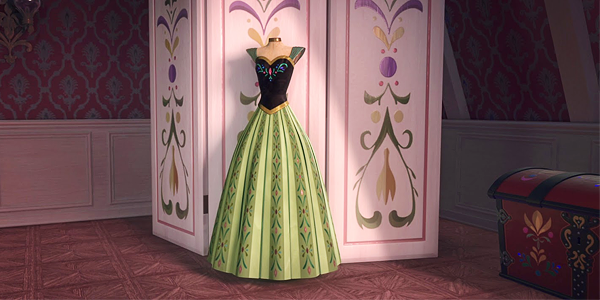
Frozen developers took a trip to Norway to get inspired in the way of scenery, clothing, and even architectural design. The Frozen art and design team visited the Norwegian fjords, which eventually became the principle landscape for Arendelle, nestling the kingdom within the giant ice cliffs for which Norway is well known. For Arendelle€™s castle, the rustic, medieval stave churches and their shingled roofs were an important inspiration from the trip. A castle in Oslo, according to art director Mike Giaimo, inspired the walls of the royal castle, with its €œbeautiful, hand-painted pattern€ in the main room. Traditional Sami culture also inspired aspects of the music, architecture, and costumes, especially for the ice-cutters and Kristoff. A final, important touch that was gained from the Norway research was a ubiquitous, traditional Norwegian folk art technique called €œrosemaling,€ which involves flowing, geometric patterns and floral ornamentation. Rosemaling was highly prevalent in the design of Frozen, including the clothing of characters, the architecture, the tapestries in the castle, and more. Each character was even given their own style of rosemaling: floral and effervescent for the bubbly Anna, flowing and crystal-like for pre-transformation Elsa (after which her rosemaling turned to snowflakes), and geometric for Kristoff. In the picture above, rosemaling is visible on Anna's dress, wardrobe and chest.

3. Frozen Was In Development Hell For Seventy Years
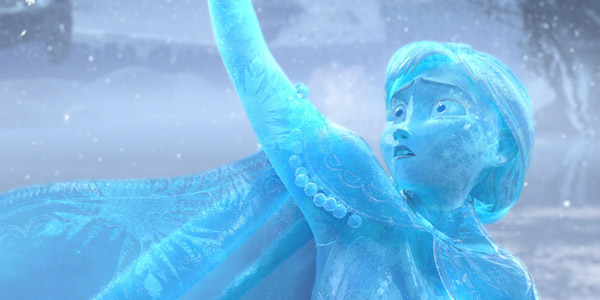
Well, in a manner of speaking. Walt Disney Productions first considered adapting Hans Christian Andersen€™s The Snow Queen in late 1937, even before Snow White and the Seven Dwarves had premiered. The reason it took so long to get here was a problem that persisted for the next several decades: how to get the very dark Snow Queen character and her story to be relatable and palatable to modern audiences. The 1937 project was shelved by 1942 because of World War II, and ultimately shelved indefinitely alongside other Andersen adaptations, including The Little Mermaid. It was revived again in the late 1990s but progress froze by 2002. The next thawing-out of the Snow Queen idea occurred in 2008, when director Chris Buck wanted to do something different rather than an out-and-out adaptation, tentatively titled Anna and the Snow Queen. However, it was scrapped yet again when, yet again, the character of the Snow Queen wasn€™t translating well to screen. Finally, following the success of Tangled, developers finally broke through the ice with the idea of Anna being the sister of the Snow Queen, who was revitalized into Elsa. This paved the path for the soon-to-be classic tale that hit theatres in 2013, 76 years after its inception. So, next time you hear what must be the two hundredth bad YouTube cover of €œLet it Go€ and curse the forces that brought Frozen to the world, remember that it took three-quarters of a century to get to our screens €“ and, surely, it was worth the wait.

2. Elsa Was Supposed To Be The Villain Of The Story
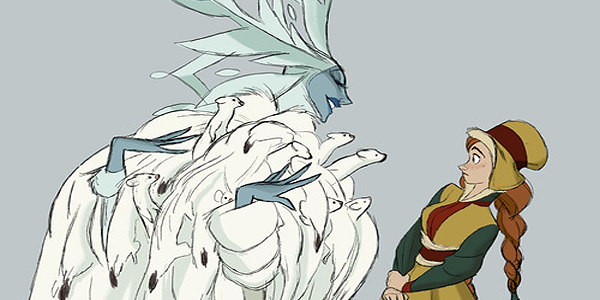
As said in the last point, Frozen was adapted from Hans Christian Andersen€™s The Snow Queen, which ended up being a radically different story with very loose ties to the original work. One of the major changes was turning the evil Snow Queen into the misunderstood but sympathetic Elsa, which writers felt was essential to help the story connect to audiences. Before that, Anna and Elsa weren€™t even sisters; Anna was a peasant who appealed to the Snow Queen, who had a whole army of evil snow creatures, to freeze her broken heart. Elsa€™s design was radically different, and she even had a coat made out of €“ seriously €“ living arctic ermines (pictured above). The character of Elsa/The Snow Queen was crafted as the villain of the piece until quite late in the game, when she was ultimately changed to a flawed heroine. A key factor in this drastic shift was the anthem €œLet it Go,€ written by Bobby Lopez and Kristen Anderson-Lopez, which, when considered by the writers, acted as a game-changer. The song transformed Elsa from frosty antagonist to a complex and deeply troubled, but ultimately very relatable, character who made bad choices when faced with a difficult situation. Then, once Anna and Elsa were established as sisters, the movie finally unfroze the heart at its core to craft the story of two sisters that the world came to love.

1. Elsa€™s Original Design Was Based On Amy Winehouse
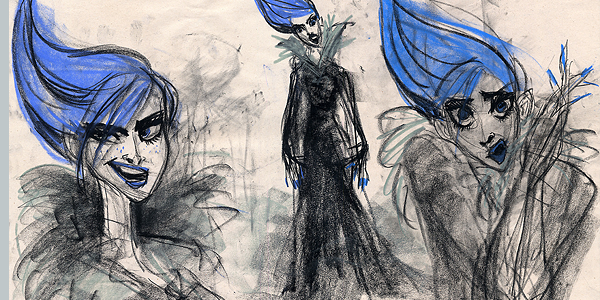
Because of Elsa€™s intended place as a villain, she went through many different stages during the early production cycles of Frozen. Disney villains €“ think Ursula, Jafar, Maleficent, to name a few €“ tend to be designed with more eccentricity and flamboyance than their heroines, and evil queen Elsa was originally no different. Frozen artist Claire Keane posted some early concept sketches of Elsa as an Amy Winehouse-inspired figure, complete with an electric blue up-do reminiscent of the late singer€™s iconic look (pictured above). This Elsa, appropriately to the inspiration, was imagined to have a deep and soulful voice and very dramatic mood swings. But just as Elsa€™s character underwent many changes, so did the ice-powered princess€™s look. Another exploratory visual development posted by Keane depicted Elsa as a short and sassy songstress, a look inspired by none other than diva Bette Midler, complete with more blue hair and villainous face-grabbing. No cloak of living weasels in sight anymore, unfortunately. Though the blond and beautiful Elsa we saw ended up being very different, and fortunately so, there are many who would kill to see a killer musical number €“ one of Disney€™s awesome villain anthems, a la €œPoor, Unfortunate Souls€ €“ with one of these amazingly eccentric designs. Are there any cool tidbits we missed? Let us know in the comments!

In this post: 
Frozen
 
Posted On: 
Contributor

Canadian student. Spends probably an unhealthy amount of time enthusing over musicals, unpopular TV shows, and Harry Potter. Main life goal: to become fluent in Elvish.