10 Things We Learned From Oliver Stone On Joe Rogan Experience
The legendary film director spoke to Rogan about Scarface, Platoon and spiking his father's whiskey.

Though the world seems to be getting crazier and more unpredictable by the day, that hasn't stopped The Joe Rogan Experience train from moving forward.
Rogan has continued to invite a variety of compelling individuals onto his world famous podcast throughout this unprecedented period and he may have just spoken to one of his most captivating guests to date in the form of Oliver Stone.
The Academy Award winning director and writer has lived what feels like a hundred lives during his 70+ years on this planet.
From experiencing the Vietnam War first-hand to being thrown into prison for smuggling drugs, Stone certainly has a tale or two to tell about his fascinating life. He's also been responsible for some of the most iconic movies ever made, writing the screenplay for Scarface (1983) and Conan the Barbarian (1982) whilst also writing/directing films such as Platoon (1986), Wall Street (1987), JFK (1991) and Natural Born Killers (1994) to name but a few. He's also just released a memoir called Chasing the Light.
Thankfully, the filmmaker was in a talkative mood during his near two hour sit down with the comedian-turned-podcast sensation. So, here's what we learned from his riveting appearance on the JRE.
10. What He Thinks Hollywood Gets Wrong About War
It's no secret that Hollywood has a habit of dialling things up to 11 for the sake of making a movie more entertaining.
This is something which Stone admits particularly frustrates him about watching the majority of war films he sees on the big screen.
Due to experiencing a legitimate war up close, various things like unrealistically intense fire power or the enemy being a lot closer to soldiers than they were in real life stick out to Stone more than they would the average filmgoer. Although he does admit that he has been known to do this on occasion. However, he feels newer projects are 'way off' when it comes to what actual war feels like.
He also revealed that the Rambo films drive him crazy (though he did enjoy the first one) and Mark Wahlberg's Lone Survivor (2013) is a film he classes as 'way overdone'.
Stone also goes into detail about how he feels Pentagon endorsed movies don't accurately depict how frequently soldiers were wounded from friendly fire accidents, telling Rogan that he thinks around 15-20% of the American casualties in the Vietnam War were from friendly fire.
9. Platoon Was Originally Rejected

Despite going on to become one of the most successful (both commercially and critically) war movies of all time, it may come as a surprise to hear that the idea for a Platoon movie was originally rejected by the Pentagon and many movie studios.
In Stone's mind, it was clear nobody wanted to see an honest portrayal of what actually happened in Vietnam, with his original idea being rejected by 'the powers that be' when he first wrote it in 1976. Later down the road it was classed as a great script but too much of a 'downer' compared to film likes Apocalypse Now (1979) and The Deer Hunter (1978).
The film also nearly got made in 1983, however it was shot down again after the board of directors at MGM said they were against it, so the company claimed they wouldn't be able to distribute the film.
Eventually, the project was resurrected when Michael Cimino (the director of The Deer Hunter) said he wanted to produce the movie with Stone in the directing chair. The film was finally produced by British production company Hemdale and made on an incredibly low budget ($6 million). It was also shot back-to-back with his other war drama Salvador.
8. The Time He Was Thrown Into Jail For Smuggling
You'd think a person's life couldn't get any more dramatic after being involved in a war as graphic as the one in Vietnam. However, when Stone finally made it back to the U.S. after this life-changing experience he was thrown straight into jail.
The reason for his rapid incarceration was down to the fact that he'd been convicted of federal smuggling after bringing marijuana into the country from Mexico. The young man had decided to take a Mexican detour after leaving the war behind, but he was packing an ounce or two of grass to bring home from his time in Vietnam which was later discovered upon re-entering the states. Stone later revealed that his father eventually paid the money to free his son and without his intervention he feels he could have been left to rot in prison.
During his time in jail he confessed that there were 5,000 people in there with only 2,000 beds available and that the majority of people he was surrounded by in the prison were in that situation due to non-violent crimes, with Stone stating that this was the beginning of the drug war.
7. Spiking His Dad With LSD
Throughout the podcast Stone spoke about his relationship with his father, at one point confessing that he couldn't take his father's word for anything anymore after seeing the horrors of war for himself. Stone's father supported the war like many others did at the time, until one day he confessed to his son that he thought he was right and that war was a futile thing.
Stone also told a story about how he intentionally spiked his WWII lieutenant colonel father with LSD after a fight with him in his younger days. He chose to use LSD as a way of destroying his mindset, which he completely disagreed with.
His father was unaware exactly what he was on, but Stone said he knew he was on something.
When Joe asked how he managed to pull off such a hilarious feat, Stone revealed he planted the LSD in his father's whiskey. He then cheekily added that he used 'quite a bit' to get the desired effect.
Stone confessed that his father handled the drug quite well, as his father 'drank whiskey every day of his life'.
Though the pair never explicitly spoke about the incident afterwards, Stone thinks his father figured out what happened as the pair grew older.
Imagine bringing that one up at the dinner table...
6. Why He's Attracted To The Subjects He Is?
Oliver Stone's career as a writer/director has been defined by projects which don't seem attractive on the surface, but that's exactly why he chooses to take on the challenge.
Stone revealed that the more he gets into these seemingly undesirable stories the more they become exciting for him. The director then went on to describe himself as a 'dramatist at heart', declaring that he thinks he excels at dramatising a situation and bringing difficult subjects to life on screen.
He then referenced the John F. Kennedy murder as one such situation which was 'extremely challenging' to adapt into a movie, but he knew it could work and it became a surprise hit.
The same thing went down with Platoon as the director confessed that war can be seen as boring due to the amount of details and events which tend to happen over a long period of time, not in the short spell it tends to in a movie. Yet, he still managed to produce a film which was captivating as it was realistic.
In an example of him dramatising a situation to make it more compelling, Stone took two different sergeants from two of the different units he was part of (he was in four altogether during his time in Vietnam) and imagined what they would have been like if they were in the same unit. This clash would then lead to more on-screen drama and it would also represent the differences that were present throughout different platoons as people from all walks of life came together and sometimes didn't see eye to eye on certain things.
5. How He Made Platoon As Realistic As He Could

As we've mentioned a few times already in this list, Platoon is famed for being one of the most authentic depictions of war people have ever seen in cinemas. However, that level of detail doesn't just end up in a movie by chance.
Stone's own experience in the war definitely helped him build the story, but the director also managed to bring in an excellent combat advisor who had been in the war as a marine known as Dale Dye. Stone referred to him as a 'lifer type', which meant that he remembered all the details when it came to things like uniforms and the realistic fire power used at the time.
In order to produce a film which was as honest about the Vietnam war experience as possible, Stone also insisted on casting younger people ('who didn't look like they'd done other movies') for the roles. He also wanted these actors to really feel as tired as he routinely felt when in Vietnam. So, to do this he had his stars put through an intense training camp which would leave them physically tired and irritable.
He mentioned that at first there was 'a lot of bitching' about the camp, but the people who didn't want to be there eventually quit and were replaced by other names the director had on his list of potential players.
Bet, they wish they stuck around now...
4. Failed Film Ideas
Despite eventually getting Platoon over the line and helping craft other outstanding Academy Award winning features like Wall Street (1987), Born on the Fourth of July (1989) and Midnight Express (1978) not every idea of Stone's has made it to our screens.
When asked by Rogan if there was ever a film he wanted to make but never could, Stone revealed that there's been a couple.
He spoke about how he wanted to tell the story of the My Lai massacre, which involved a company of American soldiers gunning down unarmed civilians in a village during the Vietnam War. Stone actually got two or three weeks away from shooting the film in 2007, but the film ran into the 'fiscal crisis of 2008. However, Stone confesses this shouldn't have been an excuse and that clearly nobody wanted to make the movie.
Another film the director tried to get made was a Martin Luther King Jr story. Stone said he worked on the story for 'many years', but it's 'too tough a story to tell' as it would look at the iconic figure as a human and wouldn't shy away from his failings. He did, however, suggest that a black filmmaker should take on that project in the future.
Lastly, he spoke about trying to make Evita. However, after he wrote a screenplay for the project it was given to another director (Alan Parker) to work on.
3. Stone's Experience In The Vietnam War

Though it was alluded to at numerous points during this episode of the JRE, there were a few occasions when Oliver Stone spoke at length about his experiences as a soldier in the Vietnam War.
After writing a book based on his own life for two years and attempting to get it published, Stone was ultimately rejected and forced to rethink what he would do with himself from that moment. He eventually decided to enlist in the army as, being a Christian at the time, he wanted to 'let God sort this out'. He then added if he wasn't supposed to come back then he wouldn't have.
He also mentioned how he felt spiritually desolate when he first arrived in Vietnam, but this was later replaced by a feeling of gratefulness to be alive after witnessing so much death and actually surviving the grim period. He didn't make it through unscathed, however, as Stone was wounded twice. He was also a part of 30 helicopter missions and earned a bronze star during his service.
Once he returned to the U.S., Stone then said that he felt numb and alienated, whilst also feeling incredibly confused about the whole war which eventually led to his fights with his father.
2. His Scary Experience Whilst Doing Research For Scarface
In order to build a script which revealed the true state of Miami during the 80s for the now-legendary crime drama Scarface (1983) Stone needed to know both sides of the story.
So, as well as talking to various lawyers about certain drug dealers, the director chose to meet up with some of the actual guys involved and spent a night talking with them in Bimini. This island was 'another kind of world' and Stone recalled sitting there with these dangerously powerful people doing coke with his wife, who was his 'cover'.
The guys liked talking to the Hollywood screenwriter who wrote Midnight Express, yet things quickly became quite tense when Stone revealed the name of the defence lawyer who put him in touch with them. This person had actually been a prosecutor in the past, so two of the three men sat opposite Stone quickly became restless when his name was mentioned.
Stone instantly regretted his decision to drop this name - who had put one of the two men away at some stage - as the pair excused themselves to go to the bathroom, fearing they may return with weapons to take out a man who could be spying on them.
They didn't, but they did cut the meeting short. However, the director was paranoid all night as he was staying in the hotel they owned, so he knew they could come and get him whenever they felt like it.
He luckily got out of there as soon as he could in the morning, but the whole incident taught him that you can literally say one wrong word and find yourself dead when mixing with these men. Which is something he wanted to infuse into his Scarface script.
1. What Motivates Stone Now?
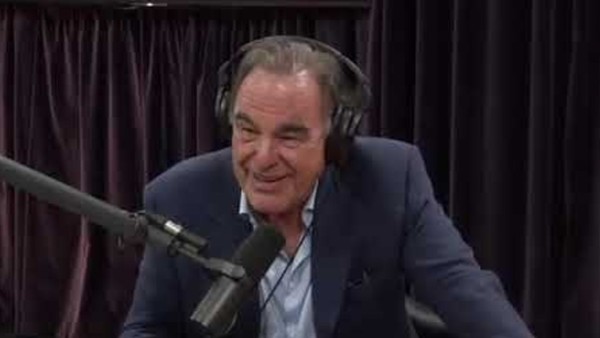
Something that sticks out after listening to Oliver Stone talking to Joe Rogan for nearly two hours, is just how much the writer/director has managed to achieve since deciding to step into the world of filmmaking in the early 70's.
Along with his stellar cinematic resume, Stone has also been behind TV shows like The Untold History of the United States and Wild Palms. So, after all of this success in various forms of media, Rogan was curious how the 73 year-old still manages to keep himself motivated.
Stone quickly turned to his new book, which he said was a 'lot of work' but also gave him the chance to rediscover parts of his life which he didn't really take a minute to appreciate when he was speeding through the filmmaking process in his younger years. Working on his book also taught Stone that he's a 'fundamentally flawed character' and that he has to have two conflicting personalities in order to do the work he does.
If he writes he has to isolate himself and be quite cut off (which he says resembles the way his father was) yet when he directs he needs to be open and warm with his collaborators.
So, it appears that revisiting his old works and the important moments in his life is keeping the legendary director fully engaged and stimulated in his later years.
From the sound of things, Chasing the Light could well be worth a read...