Ant-Man DVD: 10 Things We Learned From Director's Commentary

Peyton Reed and Paul Rudd make for an entertaining, informative double act for one thing.

The hullaballoo surrounding the production of Ant-Man dominated the film's release last year; original director Edgar Wright left the project in 2014 and there was an overwhelming lack of faith when Bring It On director Peyton Reed was announced as his replacement. To be fair to Reed and all involved, the film was a critical and commercial success, and afterwards people began to question where exactly the credit was due. What remained in the film from Edgar Wright and Joe Cornish's draft of the script? What elements did Peyton Reed bring to the table? Thanks to the recent arrival of the film on Blu-Ray, we've been gifted a director's commentary that clears up who was responsible for what. It's a fascinating track - the nuggets of interesting info that come up in the conversation between Reed and star Paul Rudd range from small (Hank Pym has ants on his cufflinks!) to big (it was actually Peyton Reed's idea to do the cool 'word-of-mouth' sequences). Notably, we also learn that Rudd's assisted re-write on the film - alongside Anchorman director Adam McKay - is responsible for a lot of what makes Ant-Man a solid movie. More than that, having both Reed and Rudd on board to share banter and anecdotes just makes for good old-fashioned entertainment, especially thanks to the latter, who's on fire as ever. There are even a couple hints about the planned 2018 sequel, Ant-Man And The Wasp, which are bound to get fanboy juices flowing. Take a look at ten of the more interesting tidbits after the jump!

10. The De-Aging Effects On Michael Douglas Made Peyton Reed Nervous
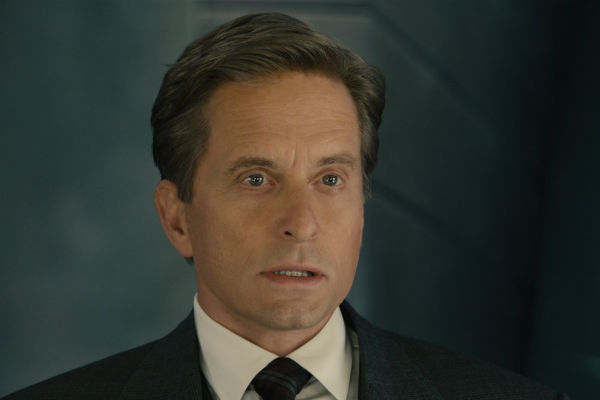
Right out of the gate, Reed speaks about how he was "most nervous" about the de-aging effects on Michael Douglas' character in the 1989 prologue (set in the still-under construction Triskelion from Captain America: The Winter Soldier, by the way), more so than any other VFX in the film. Which is slightly crazy, considering that the sequences in which Ant-Man actually shrinks down were arguably going to be a huge deciding factor in whether audiences believed in (or enjoyed) the character. For anyone who wants to know how the process is achieved, Reed gives an interesting breakdown; it basically amounts to Douglas acting with dots on his face, a younger body double acting the same scene with dots on his face, and the final step of 3D laser-scanning Douglas' face. There's probably a few more steps, but hey, there was a lot to cover in the commentary. Regardless, the effects ended up looking great (completely blowing the work on Jeff Bridges in Tron: Legacy out of the water, incidentally), and inspire interesting ideas as to what might happen in the future of cinema - maybe Harrison Ford could even star in his own damn Han Solo prequel.

9. Making Scott Lang The Right Amount Of Criminal Was Hard

Paul Rudd makes an interesting point that the character of Scott Lang was a hard balancing act. They didn't want him to appear too saintly, after all, in order to give him a redemptive arc, but nor could he be a complete b*stard. The crime that Scott went down for, his noble break-in of Vista Corp, ended up being the perfect tightrope walk. It implied that Scott had done a number of other non-heroic robberies before the Vista job (as no one gets that good at crime the first or even second time out), so while Scott was a self-sacrificing pariah for his good-bad deed, he had also implicated himself as having a far dodgier past. It's a win-win, character-wise. The protagonist remains a badass whilst also being sympathetic to the audience - a difficult thing to achieve, as Rudd so succinctly puts it himself.

8. The Archive Footage Of Ant-Man Was Based On The Patterson-Gimlin Bigfoot Film

By now, everyone on earth over the age of 14 must be familiar with the classic, shaky footage of Bigfoot, supposedly seen sauntering through the woods of Northern California, filmed through the grainy lens of an old camera. Well, this is what Peyton Reed was trying to invoke with his archive footage of Ant-Man that Darren Cross shows during his sales pitch. The parallels are clear, what with the grainy aspect of the film, and the whole angle of 'what-the-hell-am-I-looking-at'. It's a classy touch on Reed's part, and a homage that perhaps escaped a lot of people's notice. That moment really helps to set-up the importance of Ant-Man to the MCU mythos, as well, in addition to the scene set at the Triskelion; it firmly entrenches Hank Pym and his creation as one of the first big heroes on the planet (after Captain America of course).

7. The Studio Wondered Why Scott Put On The Suit Too

The scene after Scott completes his heist of Pym's residence, where he puts on the Ant-Man suit seemingly just... because, is a baffling moment. It's simply necessary on the part of the film to get him into the suit, so that he can experience what it can do and have his trial by fire ("or in this case... water"), but there's no real explanation in the film. Rudd tells an interesting anecdote regarding the scene; himself and McKay actually received notes from the studio asking why Scott would put on the suit for no good reason, to which Rudd replied... "Why wouldn't he?". Which is fair enough. Rudd and Reed also discuss how they did additional takes of Scott in the suit, talking into the bathroom mirror, doing impressions of Robert De Niro in Taxi Driver (you know the scene), and C-3PO, inspired by the retro look of the suit. The latter of which I would pay good money to see.

6. Stan Lee Was Super-Psyched About The Movie

What's nice is that throughout the commentary Rudd and Reed repeatedly mention how pleased Stan Lee was to finally get a chance to see Ant-Man up on the big screen, with his powers done justice. Lee himself said that Ant-Man was built for the big screen, with even the limitless artistry of Tales to Astonish not able to properly do the sense of size and scale when he shrinks down justice For anyone who knows about Stan Lee' storied past with Marvel Comics - and if you don't, Sean Howe's Marvel Comics: The Untold Story is a good start - you'll know that Stan the Man tried for years to get his superhero projects off the ground in Hollywood, correctly surmising that if done well they could be blockbuster smashes. Two of the titles he tried to have adapted the most? Ant-Man and Doctor Strange. The former obviously being one of last year's success stories, and the latter shaping up to be the trippiest superhero story this side of Howard The Duck. The old man must be positively giddy at seeing his dreams come true.

5. Rudd Watched Videos Of Guys Getting Bit By Bullet Ants On YouTube

In one of the more humorous tales from the commentary, Rudd and Reed discuss the Schmidt Pain Index and the video they watched of two guys on YouTube who embarked on a crusade to test it out. These guys evidently went to visit an Amazon tribe who apparently include the ants in their coming-of-age rituals; participants place gloves filled with the ants on their hands and basically just stand there and take it. Afterward the brave volunteer had to go to hospital and get a shot of adrenaline. I've included the video below for your... viewing... pleasure? https://www.youtube.com/watch?v=it0V7xv9qu0

4. Janet Van Dyne Was Never A Big Presence In The Original Script

According to Rudd and Reed, Hope's mother was never a huge part of Edgar Wright's original draft, but was instead brought in when the star and his buddy came in for the oft-mentioned rewrite. It was correctly surmised that Hank and Hope's relationship required an extra dimension, which explains why the film now has the element of Janet's sacrifice, and Hank's desire to protect Hope from the same fate by distancing her from the Wasp technology. It works in the film's favour to have the stuff with Janet; it's world-building, it's good fan service and more than anything we get that really cool, retro action sequence where Wasp goes sub-atomic to stop the wayward nuke her and Hank are trying to stop. The icing on the cake is Evangeline Lily's acting when we finally see her reaction to the story of her mother's self-sacrifice, her face in floods of tears. It's a well-earned emotional beat that we wouldn't have had if Rudd and co. hadn't tinkered with the screenplay, and further fuel to the fire that suggests we never really needed Edgar Wright anyway...

3. The Crew Were Really Excited For Anthony Mackie's Days Of Shooting

Paul Rudd speaks of how he was already looking forward to working with Mackie, being a fan of his work (and being the one to write him into the script in the first place), but got even more pumped when the consistent Marvel crew - who had worked with Mackie on Captain America: The Winter Soldier - were all buzzing about having him on set, because he was known to be such a nice guy and so much fun to work with. It's always nice when we hear about how fun our favourite actors are to be around on set, and if anything fans already had an inkling of that about Mackie having seen The Winter Soldier special features, witnessing his tendency to shout "Cut the check!" after a good take. https://www.youtube.com/watch?v=eKczdF8qabo

2. Mitchell Carson Is Still Out There, And Marvel May Have Plans For Him

"There's a lot of conjecture on who he is and who he might become." With that, Peyton Reed has set a hundred thousand message boards alight (okay... maybe a dozen), as the mystery ensues as to what Marvel's plans are for supporting villain Mitchell Carson - last seen absconding with his Hydra goons, a vial of the Yellowjacket formula safely in his possession. Reed and Rudd speak early on in the commentary about their love for the actor who plays the shady businessman, Martin Donovan, and later when Carson makes his appearance towards the climax of the movie they discuss how he is actually a character that exists in the comics - and sure enough, he was a S.H.I.E.L.D. Agent who turned out to be a bit of a bad apple in Robert Kirkman's Irredeemable Ant-Man series. Considering Reed and Rudd's love of Donovan, and the director's mention that they've been discussing Carson's future, it's safe to say we can expect an appearance from the baddie in the planned sequel, Ant-Man And The Wasp - maybe to suit up as a new-and-improved Yellowjacket himself?

1. Yellowjacket Might Not Be Dead

According to Peyton Reed, if he's not dead, "he's at least severely hurt." Last seen imploding into the Quantum Realm in the most awkward, painful-looking way possible, it can be assumed that Yellowjacket is, for all intents and purposes, no longer among the living. At least until Marvel decide they want to use him again; if the director himself obviously hasn't made his mind up as to whether Darren Cross is alive or dead, it's safe to say he's currently the supervillain equivalent of Schrödinger's Cat. Corey Stoll is a great actor who maybe didn't receive the character he deserved to play; another appearance from his as Cross could go a long way to adding further dimensions to an ostensibly-decent Marvel villain (a breed of character that the MCU is sorely lacking, apart from the oft-praised Loki).

Contributor

Cinephile since 1993, aged 4, when he saw his very first film in the cinema - Jurassic Park - which is also evidence of damn fine parenting. World champion at Six Degrees of Separation. Lender of DVDs to cheap mates. Connoisseur of Marvel Comics and its Cinematic Universe.