10 Things Wes Anderson Puts In EVERY Movie
Quirky families, Shoe-box sets, random violence, binoculars - only Wes of course!

Modern filmmakers are always striving to bring new and original ideas to the industry, whilst also recreating the genius of those who inspired them to go into the field of cinema in the first place. Wes Anderson does both.
He openly admits to being influenced by observant film directors such as Stanley Kubrick, Orson Wells, Roman Polanski, and others, and uses their cinematic intellect to construct his work.
But more importantly, Anderson has ushered in brand new art styles, new filming techniques, and new forms of humour which have made him a modern pioneer in entertainment. His films are moving art and, in fact, are pretty much dubbed a genre unto themselves.
But how is it that Wes Anderson movies have become their own genre? Why is that we see a small clip or even just a freeze-frame of his films, you know instantly it’s directed by him? This list deconstructs his films and all the details, big or small, that have helped shaped the beloved ‘Wes Anderson’ flick. From camera techniques to scripting, let’s see how far his movies have evolved since his debut Bottle Rocket.
10. Frequent Casting Of The Same Actors

Best Example: Bill Murray
Wes Anderson is known to cast the same actors repeatedly. Frequent collaborators include Angelica Huston, The Wilson brothers (Owen, Luke and Andrew), Jason Schwartzman, Stephen Dignan and his very own brother, Eric Chase Anderson.
The repetition of the same actors in similar roles is because the filmmaker seems to be aware of his own phenomenon. He sets out to try something different with each film but admits to noticing a pattern which he can’t seem to escape. According to Anderson, his characters are the fruit of his own subconscious, and he is powerless to control the process.
And it’s not just the cast who are used extensively. Behind the scenes, Robert D. Yeoman has been worked on the cinematography for all of Wes Anderson’s movies (excluding the stop motion pictures), amongst various composers and artists returning again and again for Wes’ latest projects.
The most obvious and recognisable actor of all is Bill Murray. Ever since Rushmore (1998), Murray has managed to land himself a role in all major Wes Anderson flicks and has lent his voice to all the filmmaker's animated works. Maybe he'll play the title role, maybe he'll only be a small cameo but he always features nonetheless. He is also set to appear in Anderson’s latest project The French Dispatch.
9. Abberant Accessories

Best Example: Matching Clothing Items
As a man of impeccable taste, it should be no surprise that Wes Anderson is highly fascinated by costuming. He has always stressed the value of this art aspect and believes it is just as important as music and set design. He sees further advantages of using costume designs other than just to add to the aesthetics. For Anderson, costumes are an opportunity for audiences to learn about his characters and to help set the sardonic tone of his opus.
Often, there is a select part of clothing which links the ensemble or a certain group of characters together. In the image above, Chas Tenenbaum wears exuberant red tracksuits which match to his sons. Within the team of Steve Zissou, they wear those distinctive red hats and light blue jumpsuits. The scouts in Moonrise Kingdom naturally all wear similar outfits, most distinctively the yellow neckerchiefs. There is also a running shade of plum within the uniform scheme at The Grand Budapest Hotel. All of this is a subtle part of what makes Anderson's movies look so neat and organised.
In short, costuming in itself is a characteristic and often the extravagance of them makes for great comedy, thus adding to the whimsy of the Wes Anderson realm.
8. British Rock And Folk Influenced Soundtrack

Best Example: The Rolling Stones
Music has always played an integral role in Anderson’s films. The usual genre of his soundtracks mostly includes early rock, classic British rock and folk music. As aforementioned, the filmmaker can’t seem to escape repetition which is why a lot of his films are composed by Mark Mothersbaugh and Alexandre Desplat.
Specifically, Wes Anderson is extremely fond of The Rolling Stones and often uses their music for his films. Bottle Rocket featured ‘2000 Year Man’, Rushmore used ‘I Am Waiting’, The Royal Tenenbaums had TWO of the rock bands songs - ‘She Smiled Sweetly’ and ‘Ruby Tuesday’ and The Darjeeling Limit featured ‘Play with fire’. Even the stop-motion adaptation Fantastic Mr Fox had The Rolling Stones ‘Street Fighting Man’ on its soundtrack.
As well as The Rollings Stones, the music of The Kinks, The Beatles, The Clash, The Who and David Bowie has also been prominently included amongst his works.
The one movie to completely steer away from pop music and stay within its own contemporaries was The Grand Budapest Hotel which had more of an authentic Russian folk-influenced score with the use of a balalaika.
7. Non-stylistic Director Trademarks
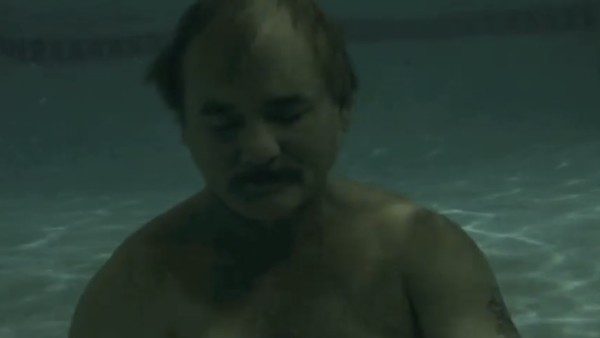
Best Example: A Character Getting Soaked
It sounds a bit odd but like Hidden Mickeys in Disney movies, Wes Anderson ALWAYS includes at least one scene in which a character is greatly submerged in water (and on one occasion, cider) whether it’s in a pool, a bath or some type of natural reservoir. The most obvious instance of this is The Life Aquatic with Steve Zissou – not much explanation needed as the movie is centred around an expedition across the ocean to hunt down a mysterious Jaguar shark.
There’s no real reason as to why Wes includes this, intentional or not, but it has become a bit of an unspoken director’s trademark over the years. This signature symbol CAN be found in every one of his films, from the filmmaker’s debut Bottle Rocket where Anthony and Inez are in the hotel swimming pool together to The French Dispatch where one character (seen within the trailer) is having a bath.
In addition to this, Anderson movies commonly feature a character using binoculars, abrupt violence played out for comic effect, references to the Peanuts comic strips and a production within a production. But mostly, it's the water trademark.
I won’t list every instance but next time you’re watching a Wes Anderson picture, look out for a character or two getting wet.
6. Use Of Slow Motion
Best Example: The Darjeeling Limited Ending
Wes Anderson is not shy to use slow motion and this particular aspect is greater amplified by his whip-pan shots which keep the story sweeping at a fast pace. The purpose of this is to highlight moments of the stories which are emotional, intense and perhaps of symbolic importance.
Most commonly, his films conclude with a slow-motion sequence. The best use of this is in The Darjeeling Limited. The Whitman brothers chase after their train home (foreshadowed by Jack running for it at the beginning) whilst losing their baggage along the way. It’s a representation of their new-found unity, their lessons learned and therefore, the slowing down on the chase emphasises the urgency to capture the train in order to face their lives back at home.
5. Artistic Use Of Typography

Best Example: Futura
Since many of Wes Anderson’s films have a chapter-like structure to them, he often uses title cards as a way of introducing characters, the next part of the movie and sometimes the setting of which the story is taking place. As Wes’ films have a specific look to them, he is consistent in using the Futura font to establish characters and plot advancements.
The Futura font is not contained to just movie posters and title cards. Within the backgrounds of many Wes films, we can see it being used for prints on books, letters, props, shops, vehicles etc. as well as prominently in the ending credits.
The filmmaker does sometimes escape the repetition of the same print, such as using Helvetica for introducing minor characters. Furthermore, Jessica Hische developed the script typeface ‘Tilda’ which was created for the cursive style writing of Moonrise Kingdom.
Whatever the case, typography plays a great artistic role in all of Wes Anderson’s films. And his latest release Isle of Dogs proves that the director is still very much obsessed with the Futura font.
4. Complex Characters And Endearingly Unorthodox Families

Best Example: A Male Protagonist Plagued By Traumatic Memories
People say Wes Anderson is style over substance but in fact, his movies would not have the same great success if it weren’t for how deeply character driven his stories were. After all, his unique visuals and quirky film ensembles go hand in hand to complete the famous Wes genre.
A lot of Anderson’s childhood influenced how his films would become and since he’s a co-writer for all his projects, you begin to realise the parallels of Wes’ movies to his own early life. Anderson is a child of divorce which meant he and his two brothers were raised by a single mother without a father figure in their life. This reflects in how many of his stories involves parental issues. Notice how a lot of his characters have a deceased mum or dad as well as the recurring pattern of a maternal figure (usually portrayed by Angelica Houston) playing an essential part within his films.
Notice also in the world of Wes Anderson, there is also the odd case of children acting like adults whilst the real adults never discipline them and actually treat with authority. Moonrise Kingdom is a key example of this since Sam and Suzy, though only young, embody a seemingly matured couple with very adult-like problems and dialogue.
The exchanges between characters are usually very matter of fact, sometimes with no emotion, where a very comical line can be expressed in a serious way and vice versa. Crazy scenarios are displayed with normalness too because of the comical dryness of the script.
And above all, Wes Anderson movies typically have a leading male character (although not without some excellent female heroines either) who come with a rich backstory and have struggled with arrested development. Take Max Fischer - a 15 year old with a deceased mother and shame of his father's occupation of being a barber.
He falls in love with a recently widowed teacher and befriends an older, wealthy industrialist named Herman Blume who is also in love with the teacher. Things start to spiral out of control for Max and it all becomes a question of how he can resovle his complicated woes and accept the life he's going to lead.
3. Thoroughly Crafted Colour Palettes

Best Example: The Use Of The Colour Yellow
If there’s one film director who knows how to expertly utilise the pastel aesthetic, it’s Wes Anderson. The filmmaker tends to stay away from the extremes of lightness and darkness with very relaxed visuals that are deliberately limited in colour to have a storybook feeling to them.
The greatest visual feast of all is The Grand Budapest Hotel. There isn’t a single second in that movie which you couldn’t frame up as a picture because the entirely of the film is overflowing with a gorgeous selection of colours, despite being very neutral and unvaried in the palette. Everything is not quite a primary colour - not blue but navy, not pink but rose, not green but emerald etc.
Additionally, Wes Anderson seem to gravitate to the colour yellow (or mustard) with many props, costumes, set designs, backdrops, vehicles and even fonts being a distinctive shade of the primary colour and becoming a focal point of the scene. A lot of his films seemingly have a monochrome of yellow to them which is why he was able to achieve the earthy textures of Fantastic Mr Fox and the exotic atmosphere of The Darjeeling Limited.
Watch the clip below and pick out all the ‘yellow-y’ parts you notice.
2. Emphasis On His Set Designs Through Camera Language

Best Example: Symmetry
The set designs of Wes Anderson are upscale to say the least. His films are not just to be viewed, they’re an experience. The director has a way of making sure his art forms are displayed to the maximum by having great control over the cinematography, particularly with the aid of Robert Yeoman.
The set pieces are fully exposed through various methods. Static, anamorphic wide-frames are regularly used in order to display the entire setting and not just the characters. Sometimes, the camera will move with the characters to emphasis the functionality of the micro-universe created as well as keep in form with Wes’ usual sharp-moving storytelling.
Most recognisably, Wes likes to use symmetrical shots. He achieves this through rectilinear set design which gives a precise look of symmetry through understated straight lines on screen. Furthermore, Anderson’s vivid scaled back colouring helps to make sure that the left and right of the screen are completely matching. The symmetry of his art has many great purposes – to evoke a comic quality, to make the tone more eccentric and simply to make his movies more appealing. Most importantly, it shows off his grand production values.
1. Birds Eye Views

Best Example: Everything
The view from above, the point of view shot, birds eye view, Gods eye view – whatever you name it, it’s become a staple of Wes Anderson cinematography. Essentially, it is a frame from the ceiling’s perception, at a 90-degree angle, used to stress a significant moment of the storyline. Within the first four minutes of the filmmakers’ debut Bottle Rocket, we have our first point of view shot in which we see Dignan’s 75-year escape plan on paper from his and Anthony’s perspective so that as an audience, we are given maximum information. This wouldn’t be just a one-off use as throughout the film, there are many birds eye view shots on characters and props.
From then on, Anderson practically claimed the ‘overhead’ shot as his own. And it’s not used frivolously, Wes uses the Birds Eye imaging to isolate the focus on something important to the plot. It could be used for an emotional part of the film such as when Royal Tenenbaum is in his final hour, set up important objects which are crucial to the narrative or even a passage of writing which progresses the story along (think of for example in The Grand Budapest Hotel when the news of Madam D’s death is first shown in a newspaper from the Birds Eye View shot).
Next time you're viewing one of his weird, wonderful movies, maybe have a little fun with it by playing your own bingo (or drinking game, depending on how rambunctious you are) with these elements of filmmaking which have moulded the well-known, iconic 'Wes Anderson Genre'.