10 Times Star Wars Broke Its Own Rules (And You Didn't Notice)
You might not realise just how loosey-goosey Star Wars' internal logic actually is.

When any successful franchise gets sufficiently huge, it becomes a major pain in the ass for those in charge to keep track of every last detail big and small.
And Star Wars is just on a whole other level in that regard - not even the Marvel Cinematic Universe can compete - enough that when Disney acquired the IP in 2012, they tossed most of the Expanded Universe in the trash, rendering it non-canon while establishing a new curated one.
All the same, there are at least some established truths in Star Wars which have been soundly contradicted over the years, whether implicitly or explicitly.
And again, considering the sheer wealth of mythology that comprises the franchise, fans can't be blamed for struggling to keep track of it all. It's basically a full-time job at this point, enough that Disney literally pays a group of lore-keepers, Lucasfilm Story Group, to keep it in order.
Yet those in charge evidently haven't gotten everything right over the last half-century, breaking their own established rules and concepts on the regular, albeit often in ways that might've passed fans by...
10. How Force Ghosts Work

Many elements of the Force are kept ambiguous throughout the series, seemingly intentionally, but one of the more irksome inconsistencies is the means through which a fallen Jedi becomes a Force ghost.
Obi-Wan (Alec Guinness) of course becomes one after being felled by Darth Vader (David Prowse), and Yoda (Frank Oz) and Anakin (Sebastian Shaw) follow suit in Return of the Jedi, but what about other Jedi who die throughout the series?
Namely, what about the 200-or-so Jedi who died in the Battle of Geonosis in Attack of the Clones? Why didn't we see them become Force ghosts?
Beyond that, the time it takes for a dead Jedi to become a Force ghost is totally all over the place - some near-instantly transmuting into ghost form, while others take considerably longer.
Elsewhere there are countless unanswered questions, like who Force ghosts can reveal themselves to, and how extensively they can interact with the physical world.
Again, this aspect of Star Wars is kept vague to give the writers leeway for how they use it, but the constant deviation and variation makes it frustratingly hard to get a bead on what being a Force ghost is actually all about.
9. Jedi Forgetting Their Force Powers

The great thing about being a Jedi is that you've got a battery of basically magical abilities at your disposal at any given moment, but there's an infuriating number of times throughout the Star Wars franchise that they've conveniently forgotten this fact.
The Phantom Menace literally opens with Obi-Wan (Ewan McGregor) and Qui-Gon (Liam Neeson) using Force Speed to escape droid fire, and yet we never see them use this again. It sure would've been useful during that climactic fight with Darth Maul (Ray Park), right?
Elsewhere, nobody ever uses their Force powers to try and damage Darth Vader's armoured suit, and there are literally innumerable other examples of Jedi not using established Force abilities to get themselves out of a bind.
If you want to try and hand-wave this, you might suggest that Jedi intentionally make spare use of their powers to avoid the temptation of the Dark Side, but c'mon, it's a reach.
Basically, if Jedi made continued use of the many powers at their disposal, these movies would be really damn short. "Because plot," essentially.
8. Everything About The Holdo Maneuver

The Holdo Maneuver was first seen in The Last Jedi, when Vice Admiral Holdo (Laura Dern) suicidally rammed the Raddus into Snoke's (Andy Serkis) flagship, the Supremacy, at near-lightspeed to buy the Resistance time to escape to Crait.
Yet this rubbed a lot of fans the wrong way, because even if you accept the science behind the move, if such an unorthodox move was possible, why haven't we ever seen it before in Star Wars canon?
Why, for instance, didn't the rebels perform a similar move on the Death Star, or the Resistance ram the Starkiller Base, and in turn save themselves a ton of hassle? It feels like space warfare would be totally different if this was always a possibility.
Even accepting that it's clearly a difficult move to pull off, The Rise of Skywalker made an unconvincing attempt to quell miffed fans, dismissing the Holdo Maneuver as a "one in a million shot."
Yet The Last Jedi didn't depict Holdo's act that way, so it basically felt like a limp attempt to sweep it under the rug and stop fans continually questioning it - which, of course, they still do.
7. Random Lightsaber Colours When It's Cool

The original Star Wars trilogy plainly established that lightsabers come in three colours - blue and green for Jedi, and red for the Sith - a scheme which remained consistent for decades.
But in the prequels, Mace Windu (Samuel L. Jackson) suddenly rocked a purple lightsaber totally out of nowhere - simply because he wanted to stand out from other actors in the Battle of Geonosis.
Since then, we've seen other canonical shades of lightsaber - Rey's (Daisy Ridley) yellow lightsaber in The Rise of Skywalker, Ahsoka Tano's white lightsabers, and of course the Darksaber.
Though the now-extinct Legends canon attempted to ascribe specific meaning to the colours, most of this has since been wiped out, ensuring the colours assigned to sabers outside of the primary Jedi/Sith template are more-or-less a crapshoot.
Ultimately it really comes down to creatives wanting to explore the colour spectrum, and honestly it's tough to blame them for that, even if adventurous colours are conspicuously absent in the original trilogy.
6. Tusken Raiders' Reaction Times
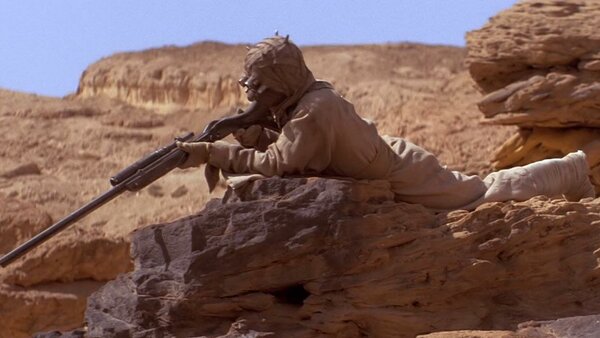
Here's a hilarious inconsistency you almost certainly forgot about, or perhaps never even noticed in the first place.
In A New Hope, Obi-Wan and Luke (Mark Hamill) come across a downed Sandcrawler and Obi-Wan memorably remarks, "These blast points are too accurate for Sand People. Only Imperial Stormtroopers are so precise."
Now, even accepting the whole issue of "Stormtrooper aim," Obi-Wan's summary dismissal of the Sand People/Tusken Raiders' marksmanship runs counter to numerous subsequent depictions of their incredible sniping abilities.
Take The Phantom Menace, where a Tusken Raider shoots a Podracer moving at incredible speed, and more recently The Book of Boba Fett, where Tusken Raiders manage to snipe guards on a moving train.
Of course it's possible to assume that Obi-Wan was simply mistaken in his estimation of the Tusken Raiders, but if Obi-Wan is supposedly such a wise and knowledgeable individual, it feels less like an intentional character flourish than an internal inconsistency with how the Raiders are presented.
5. Lightsabers Cauterising Wounds (Except When They Don't)

One of the key characteristics of a lightsaber is its extreme heat, which allows it to not only cut through basically any material with ease, but instantly cauterise wounds while cutting human flesh.
Except that's not always the case.
Take Obi-Wan's run-in with Ponda Baba (Tommy Ilsley) in the Mos Eisley cantina in A New Hope, where Obi-Wan effortlessly slices Baba's arm off with a lightsaber, before we catch a lingering glimpse of Baba's severed appendage covered in blood.
Sure, you can argue that Ponda Baba's circulatory system and blood pressure act in a different way to humans', but it's another reach.
In reality, most every other time we've seen someone lose a limb to a lightsaber - say, Luke in The Empire Strikes Back - it's been entirely bloodless.
Essentially George Lucas hadn't yet mapped out the rules for lightsaber strikes during production of A New Hope, ensuring Ponda Baba's gory dispatch continues to stick out like a sore thumb compared to the more "family-friendly" dismemberments in subsequent Star Wars movies.
4. People Wearing Glasses
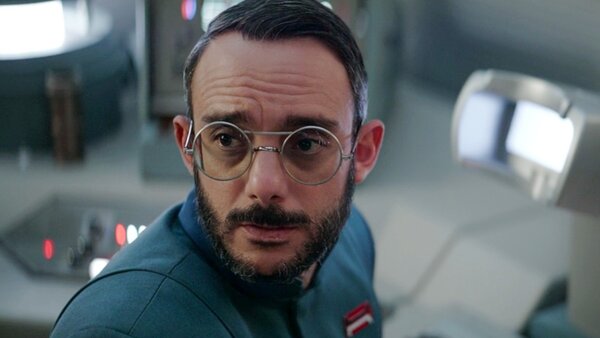
One rule which George Lucas insisted upon from the outset of Star Wars is that glasses effectively don't exist in this universe - and given how technologically advanced Lucas' world is, that's basically fair enough.
Except, a few glasses-wearers have crept into the universe in the years since George Lucas sold the property off to Disney.
For one, an episode of animated series Star Wars Rebels, "Double Agent Droid," featured a character wearing specs, and more recently and prominently, The Mandalorian's Dr. Pershing (Omid Abtahi) rocks some distinctive eye-glasses.
Of course, it's possible that glasses are basically a relic in this universe, with only a select few bothering to use such an ancient "technology."
But all the same, it's tough to believe that someone of Dr. Pershing's standing would favour them over simply having his eyesight corrected with, say, laser eye surgery.
George Lucas lost the opportunity to dictate such things when he let go of Star Wars, yet in the grand scheme of things it's a small inconsistency - and, therefore, one you probably didn't even spot.
3. The Sith's Spare Use Of Force Choke

In the same vein of Jedi forgetting about their Force powers, we have Sith not using the Force to its full murderous potential.
Case in point, though we see Darth Vader use the Force Choke several times on subordinate officers, why the hell doesn't he ever use it against actual Jedi? And he's not the only one guilty of this.
In The Clone Wars, Palpatine Force Chokes Count Dooku from half-way across the galaxy, suggesting it could be extremely useful for the Sith to either kill or pacify enemies - namely the Jedi.
You can certainly argue that Vader and Palpatine being connected with the people they Force Choked made it easier for them to exert the Force upon them from a distance, but all the same, doesn't it feel like an under-used skill in the entirety of Star Wars?
And even if you accept that skilled Jedi can block such a manoeuvre, what about pesky regular rebels who aren't Force-sensitive? It's a move that could do so much damage, and yet it's rarely used - likely because George Lucas created something a bit too powerful for its own good.
2. The Nonsensical Rule Of Two

Even casual Star Wars fans are aware of the Rule of Two, a Sith maxim first concocted by the legendary Darth Bane, which states that only two Sith Lords can exist at once - one master and one apprentice.
It sounds simple enough, and yet, as stringently as Emperor Palpatine (Ian McDiarmid) initially appears to adhere to it, it's been treated more as a guideline throughout the history of the series.
To that end, Palpatine juggled Darth Vader and Luke Skywalker as apprentices - a move which could've conceivably resulted in there being a third wheel in this party.
But of course, Palps ended up sealing his own fate when father and son reconciled, resulting in him getting lobbed down a reactor shaft by Vader.
Then there's The Rise of Skywalker, which saw Palpatine residing on Exogol with a whole-ass fleet of Sith acolytes, prompting the film's novelisation to effectively retcon the Rule of Two, claiming that there are many Sith who are ruled by two.
Really, though, it's just another interesting idea which George Lucas didn't think through enough.
1. Force Healing Is Now A Thing

In addition to the many other ways The Rise of Skywalker left fans bitterly disappointed, it introduced a Force power never seen in the Star Wars movies before - Force healing.
In the film's climax, Rey and Kylo Ren (Adam Driver) Force heal one another, despite the fact that they seemingly haven't been trained to do so, and more to the point, we've never seen any Force users do it before.
Well in fairness, Grogu did perform a Force heal in an episode of The Mandalorian's first season aired mere days before The Rise of Skywalker, but that aside, it's staggering that such a useful Force skill hasn't been extensively used in canon Star Wars media prior to this.
If this was a possibility, why didn't Obi-Wan use it to heal Qui-Gon, or Anakin (Hayden Christensen) to heal Padme (Natalie Portman)?
Sure, you can just hand-wave it by declaring that certain Jedi get certain abilities and Force heal just happens to be incredibly rare among them, or even that Rey learned it from the ancient Jedi texts.
All the same, it strains credibility that the movies went more than 40 years without featuring Force healing at all.