10 Unfilmable Books That Would Make Great Films
 Thesheer amount of Hollywood films which started life as books or short stories is absolutely staggering. Even the onset of CGI, HD and Jason Statham has done nothing to alter the extent of cross-medium borrowing, basing and plain old adapting. Indeed, Some of Hollywoods most memorable offerings ;-Gone with the Wind, Jaws, The Godfather, The English Patient, The Shining, Schindlers List- are actually great improvement upon the original novels. But is there a certain type of book which lends itself to adaptation? And, by extension, are some books inherently unfilmable? What of those books so firmly rooted in their medium that any adaptation would feel reckless, heretical even? What of those mischievous, unreliable narrators that some novels use? What of those wallowing, nebulous inner monologues? How to handle those broken streams of consciousness? How to convey all those invisible, cerebral themes? In short, the challenges of adaptation are just as numerous as those any original, new screenplay provide. Should an adaptation be as truthful to the novel as possible and risk being a second-rate version? Or should it take the liberty to enlist new characters and plot lines to help tell the story in the new medium, thereby risking outcry from the novels mouth-foaming fans? For film adaptations detractors, a central issue is often raised; how can a film evoke the atmosphere or the sheer reading experience of the book? Even if the material is handled well, isnt the spirit of the book always bastardized into a medium it was never conceived as? But for adaptations proponents, there is always that buzz around the news of the latest adaptation. Who will star? Who will direct? Are they serious! That book is unfilmable! And given the recent ambitions of Hollywood, is any novel safe to be considered unfilmable anymore? The Road, Cloud Atlas, Life of Pi, The Great Gatsby-surely none of these were leading contenders for film adaptations. How did Naked Lunch ever get sanctioned? Even Marcel Prousts la recherche du temps perdu has made it to French television screens. Wasnt American Pyscho meant to be unfilmable? All those private sketches of thought dotted around a non- plot with neither thread nor purpose? I mean, Patrick Bateman talked about clothes for a quarter of the entire novel and yet Christian Bale did a great job with the character. Still, the hunt for the one absolute version of the silver screen compared to the myriad versions of the readers imaginations has brought mixed results in Hollywoods rich legacy of adaptation. But the results are never less than interesting, even if only to reveal the shortcomings of the process of crossing mediums. With this in mind, here are ten novels, from the hallowed to the untouchable, which may or may not come to the silver screens but, if they did, would warrant an extreme ambition on the part of Hollywood.
10. House Of Leaves By Mark Z Danielewski
 Johnny Truants move into a new apartment takes him into a world of make believe, love, despair and deceit. With one of the most unusual structures to any bestselling book, this cult classic is more like a maze than a novel. Packed with endless footnotes and appendixes, switching in fonts and colours, its multiple narrators and unknown editors conversing about an unknown documentary film, House of Leaves feels about as unfilmable as they come. Having said that, Danielewski has written something beyond a novel. House of Leaves is already a book that rejects the medium of the book. It is also highly visual- some of the pages only have one sentence, others contain unreadable scribbles- and its firmly enmeshed in modern erdogic literature. House of Leaves is also open to interpretation as to just what the hell its all about, potentially offering more leeway to any film version. Still, House of Leaves feels like theres just too much going on for a single film to tackle. Perhaps the only solace for any would-be director excitedly stroking his beard at the novels end would be the fact hes one of only a few people whove ever read it. House of Leaves has gathered momentum as one of the greatest examples of post-modern horror literature, but I have a feeling this one may never get made.
9. A Hundred Years of Solitude By Gabriel Garcia Marquez
 Spanning generations, A Hundred Years of Solitude is a tour de force of magical realism and thematic complexity seen through the eyes of the Buendía family. The story concerns the founding of the mythical city of "Macondo", a city of mirrors (and allegorical references to modern Colombia), that serves to reveal the perceptions of the family to their surrounding environment and to each other. A satire on Spanish colonisation, the major characters are plagued by visiting phantoms and are unable to escape the torments of their pasts A Hundred Years of Solitude would require a fantastically audacious Hollywood remake; controversial, sacrilegious and stupid. It is surely one of the last remaining Everests of contemporary filmmaking. But could the Gringos do this South American hymn of a story justice? The book is deeply cerebral and so infatuated with history repeating itself through the familial traits of dysfunction and perception, its hard to visualise any screen translation. The novels obsession with temporal flows is another obstacle. Even A Hundred Years of Solitudes overarching theme, that of solitude and its capacity to offer both happiness and greed to its owner, is pretty dense, unfilmable stuff. And without that central theme, what could possibly be the point of any adaptation? Any movie version would need to focus on a few of its central themes rather than showing the mellifluous mixture of its many spices. Gael Garcia Bernal as the head of the Buendia family? I doubt it.
8. Foucaults Pendulum; Umberto Eco
 A game of conspiracy theorizing goes too far amongst the intellectual elite of Europes secret societies. Eco takes us on a rollercoaster ride of esoteric learning and half-truths. Filled with high-brow conundrums and all washed down in a sea of high-falutin verbiage, Foucaults Pendulum is a bit like a thinking mans Da Vinci Code-though its hard to see this being turned into a film. The archplot is perhaps filmable enough and may even be construed as a reasonable thriller about ecclesiastical wrong-doings and the addictive nature of being caught up in a game .But the novel isnt really about the archplot at all. As with so much of Eco, he fills his pages with abstractions about science and theology and just about every other esoteric strain of academia youd expect from a professor of semiotics. To turn this into a thriller film would require a sacrificing of all this filler and internal learning. True, Eco has been tackled before. But whereas The Name of the Rose was a highbrow, ecunemical whodunit, Foucaults Pendulum is plain old nuts. And its worth reminding ourselves that the film of the Name of the Rose was nowhere near what the book was. Ecos Island of the Day Before might provide better movie fare.
7. Infinite Jest, David Foster Wallace
 Another post-modern book, some fans would think it sacrilege for Wallaces singularly unique prose to be turned into a movie. After all, Wallace is revered as one of the modern greats. What makes Wallaces prose stand out is his biting satire and this is most at play with Infinite Jest. At over 1100 pages long, this sprawling ensemble novel about tennis, drugs, and advertising is simply too fractious and disconnected to be turned into a film. Part-parody, party-warning about the rise of material culture, Infinite Jests plot makes a half-hearted attempt to weave itself around the missing master copy of a missing master film so captivating it makes those who watch it lose interest in living out their lives. It is also a comedic portrayal of a unified North America where years are named after products as a national kind of brainwashing takes root. This rambling novel shines with inventiveness and subtle satire but is forbidding enough for a would-be reader to understand it. How would a director tackle such unpluckable fruit? So much would have to be omitted in the film version, particularly in a wide-ranging cull of the extensive cast (theres more characters in Infinite Jest than in War and Peace). But the temptation to do the impossible may prove too great with Infinite Jest. Even though the outcry from Wallaces legions of adorers would surely be heard across the world. With Wallaces suicide, however, its doubtful the film rights will ever come to light-although he wasnt against a movie adaptation in principal.
6. Austerlitz; WG Sebald
 Part-memoir, part-novel, part-something else entirely, Austerlitz is the most elegiac and unfilmable book of the 21st century. Theres an over-riding academic kind-of-sadness to the novel which is so thin on plotlines (sub or arch) any film version would have to excuse itself as testament to and never adaptation of. Why? Well Austerlitz only really concerns the chance meeting of the narrator and protagonist whilst theyre studying the architecture of a railway waiting room. The narrative drive (which doesnt really exist) is carried by fleeting, subsequent meetings throughout Europe. But these meetings do not form the skeleton of a plot. Written without paragraphs, with some sentences a few pages long, illustrated with photos taken by Sebald himself, Austerlitz is almost an inner travelogue through time, memory and the pain of living in the aftermath of Nazi discord. There is less action in Austerlitz than almost any other book of such length. The book is so utterly non-visual too, with its constant meditations on history, architecture and chance encounters. Certain whimsical films have been made recently to great success, Linklaters Waking Life and Persepolis all handled philosophy pretty darned well, but what could be made of Austerlitz? So much more dense, more shallow and more quixotic than any of these, any audience connection would surely give way to cinematic confusion. Also, any film adaptation (and animation may be the way to go) would lose the reading experience altogether. So much of what makes Austerlitz so readable is the digressive style of the narrator, where his thoughts and feelings are interrupted by chance in his aimless odyssey through Europes past. There is no chance Austerlitz will ever become a film.
5. The Catcher In The Rye; J.D Salinger
For years there have been attempts to acquire the film rights to this classic novel of teenage angst and frustration and these have been buoyed to some extent by Salingers recent death. Salinger was so strongly against an adaptation of his seminal novel he successfully rebuffed the attempts of Marlon Brando, Jack Nicholson and Leo DiCaprio to turn it into a film. Salinger even allegedly refused Sam Goldwyns offer that he play Holden Caulfield (the novels protagonist) himself. Apparently, Salinger was not, however, against an adaptation upon his own death. The Catcher in the Rye is far from unfilmable in terms of its difficulty of adaptation. Holden Caulfields yarn about adolescence is perhaps the easiest to adapt on this list. The protagonist is clear and there is a sequence of events; the fight at Pencey Prep, the dancing with the tourist girls, the visitation from the prostitute and pimp to a conclusion of sorts with his sister in the zoo. The novel is also filled with lovely little first-person, bon mots to posterity offered by the rebellious narrator. There is perhaps the issue that Caulfield is a protagonist without a desire( very un-Hollywood) , without external conflict even, and the novel is unclear as to what he has learnt by the end of its telling. But no, the real reason The Catcher in the Rye is truly unfilmable lies in the question of who would play Holden Caulfield? Who could pull it off? Who is young enough and has that kind of composure in front of camera? The weight of expectation would break so many actors. Unlike the brave ambition of turning something like Austerlitz into a film, The Catcher in the Rye, once described as the holy grail of movie scripts, would be a bankable winner. This one will likely see the light of day.4. Blood Meridian, Cormac McCarthy
 How can you tell Cormac McCarthys Blood Meridian is unfilmable? Because theyve already made films out of all his other books. No Country For Old Men, All the Pretty Horses, even the unfilmable The Road have all been made to critical success. So whats so hard with Blood Meridian? Blood Meridian is an ultra-violent Western set during the mid-1800s. It follows the Kid, the murderous though enigmatic protagonist of the story, who glides from one gang of scalp-hunters to the next. These Apache-slayers are paid per scalp but eventually turn their violence on natives and settlers alike in something akin to an anarchic genocide. The Kid shows no remorse for his actions, and McCarthy offers no insights into his motivations beyond the financial. Whats all so unfilmable about this? Well, movie theory stipulates that the protagonist need not be likeable but that they should be understandable; empathy if not sympathy runs the movie mantra. This is so the audience can connect to the story on some level. But that option isnt really on the cards here if the film is to be a true adaptation of the book. And if certain changes are made to The Kids character,that would detract heavily from the novels successful presentation of The Kid as this unknowable, yet engrossing, force of nature. Still, anything with based on the novel by Cormac McCarthy is likely to do well at the Box Office. And The Road film adaptation was also a huge surprise. However, its fair to say the film version of The Road lacked most of the atmosphere the book contained, and no camera angles of post-apocalyptic desolation can match McCarthys sinister, stripped-down style of prose. Another issue with Blood Meridian is that Hollywood tends not to go for kids being excessively violent in its films. The Kids age may have to be tinkered with but it is the very youthfulness of The Kid which makes Blood Meridian such a brutal story. McCarthy, at least, offers almost no interior monologue for The Kid and we only learn of what he is thinking through his actions, which is a real bonus for the film adaptation in its visual need to show and not tell the conflict via action. Also, James Franco has expressed an interest in a film adaptation. But with Blood Meridian a kind of Lost in La Mancha-meets- Mad Max, this is one McCarthy novel unlikely to hit the screens soon.
3. Finnegans Wake, James Joyce
 Has anybody read it? If so, would anybody like to step forward and offer a screenplay? In fairness, Joyces experimental, unknowable comic prose would probably not arouse too many objections if it ever were turned into a film. It is after all the most unreadable, unfilmable novel in the list. Each sentence is open to a variety of interpretations and closed to most readers patience and comprehension. Non-linear, explosive and nebulous, Joyces words fire out like electrons defending the nucleus of the novels inner meaning. Finnegans Wake might work as a kind of slice-of-life affair, in the same way Ulysses could be centred around a single day in Dublin, but would viewers be appreciative enough of this kind of ruptured storytelling? A deep appreciation of both the novel and of Joyce himself is probably going to be the prime motivation for anybody tackling an adaptation of Finnegans Wake. Still, Joyce is literature. Literature is Joyce. Even the apostrophe from Finnegans is omitted so he can bamboozle us from the very first words. Joyce himself loved the movies, opening up the very first cinema in Dublin with the help of his Trieste backers. And there is some history between the three mediums of film, books and Joyce. John Huston adapted The Dead, the final book in the Dubliners series. Joseph Strick also dared the impossible with a faithful film version of Ulysses in 1967, which showed just how unfilmable Joyce is.
2. Being And Time, Martin Heidegger
 A work of enduring and legendary difficulty in themes and exposition, this is the magnum opus of Heideggers writings about philosophy, thinking and existence. But the problem is Being and Time is also an overhaul of modern philosophy, where an entire new vocabulary of words are exploited with verve and gusto to a point where only a few people thoroughly understand the book anyway. The central message is that being (existing) is time. Nothing exists before birth or after death and so time is necessarily finite. But the real message is a positive Hollywood blockbuster one, since, so Heidegger asserts, if time only has a relation to our existence, then a carpe diem attitude to life is all we should ever employ. Obviously this is all a bit simplified as Im sure any film version would also have to be. In truth, Being and Time is nothing short of an impenetrable matrix of thinking that would probably begin to frazzle the celluloid of any adaptation. Being and Time may even break the Hollywood sign on Mount Lee. Film is, ultimately, a visual medium. It does not handle deeply novelistic writing well and it would surely have met its match with Heidegger. The only man who might have a crack at it is Terrance Malick-presumably the Directors Cut would be two months long. Perhaps the one nugget of filmability that lies deep with Being and Time is its Hollywood-friendly central message-that death defines life. Heideggers book is concerned with the choices we make as individuals but then every film has a bit of this Heideggerian notion in them anyway. There just doesnt feel any point in an adaptation of Heidegger Having said that, if they can have a go at Prousts In Search of Lost Time, they can have a go at anything.
1. A Confederacy Of Dunces, John Kennedy Toole
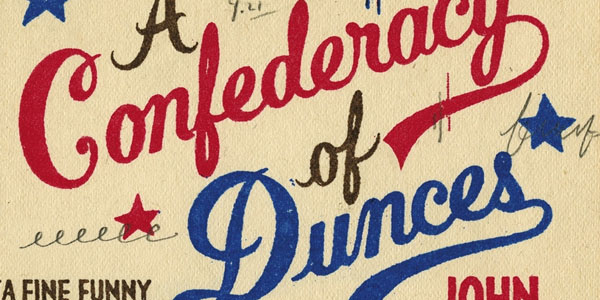 Who would play Ignatius J Reilly? John Belushi and John Candy are both dead. Will Ferrell was linked to the role but the idea has been rubbished by fans of the book. Perhaps Philip Seymour Hoffmann or Jon Goodman were the only men who could pull it off. But theyre both probably a bit too old now. Jack Black anybody? Out of the darkness, step forward one Zach Galifianakis of Hangover fame. It seems he may be the only one who could now pull of the role. But should a film version of this wonderful novel be made at all? The educated but lazy and excessively gluttonous Ignatius J Reilly is a heavyweight of world literature. True, in terms of plot, A Confederacy of Dunces probably has just enough to go by for a film version. At 30 years old and still living with his mother, Reilly finally gets a job, excels at it, and meets a cast of bizarre people on the way. He hates modern culture and revels in citing ancient philosophies like Boethius wheel of fortune as a way of excusing his shortcomings. But the plot is the character, thats the problem And would Hollywood get the subtle bits in? That Toole has based his novel loosely on Boethius Consolations of Philosophy would surely be the first sacrifice. That no reader can attempt a Confederacy of Dunces without the knowledge of the authors suicide and so this heart-rendering story is laced with sadness from the outset. That you just cant separate the sadness with the humour in this incredible novel. And if the film version was too much of one without the other it would be a betrayal of the books very essence. And what of The Big Easy? Tooles portrayal of New Orleans with its odd dialect and even odder characters makes for a great read. Would it make for a great watch? Well I think it would actually. A Confederacy of Dunces only made it to publication through the endless battling of Tooles mother and then by a solitary publisher on her behalf. So if a director could show the same determined spirit then maybe the film version would be a wonderful testament to the city and the story in a post-Katrina, visual context . Whether Galifianakis is the right choice to convey the Ignatius magic is unknown. Could he manage it? All of it? The sarcasm, the moaning, the outrageous sense of betrayal? That certain unique strain of hypochondria-meets- melancholia? Would that renegade pyloric valve be as funny in film as it was on the page? One things is for sure; if Hollywood botch this iconic protagonist we would never forgive them. The stakes dont come any higher than this.