10 Unhappy Movie Endings With Overlooked Positives
 Sometimes movies can be pretty heartbreaking. From cancer in Terms of Endearment to bees in My Girl, deaths in film have affected us in memorable and tear-jerking ways. Other times, the tragedy isn't centered around death but love lost, as in the cult hit Eternal Sunshine of the Spotless Mind. These moments cause emotional resonance that leave audiences crest-fallen, giving them something to chew on long after the end credits have faded and the theater lights have again brightened the cinema. But as we repeatedly had shoved down our throats by Bradley Cooper in Silver Linings Playbook, sometimes seemingly tragic events have silver linings. In life, this may manifest as a car accident victim being an organ donor, saving the lives of many others in a final act of charity. And film, of course, gives us ample opportunities to find similar moments in which the apparently mournful finales actually have an upside. In this article, a companion piece to the recent WhatCulture article that looked at seemingly happy endings that may have had terrible implications, we try to look at the bright side of life. So quit your crying and join us as we put a positive spin on some movies that have depressed you. And of course, thar be spoilers ahead.
10. Life is Beautiful
 The Sad: People now often see Roberto Benigni's 1997 film as slight and a bit shallow, but his idea to create a comedy out of a harrowing event like the Holocaust is actually rather audacious. The film follows as Guido, an enigmatic and charming Italian Jew, is sent to a concentration camp with his young son Joshua. Unwilling to make his son aware of the horrors committed by the Nazis, Guido convinces his son that their hardships are actually a part of a game in which the winners will receive a tank. As the film winds down and the Allies are on the verge of liberating the camp, Guido is pulled away by a Nazi, and executed just out of the line of sight of his boy, who is hiding from the safety of a sweatbox. The Silver Lining: The concentration camp was liberated and the young Joshua survives. Of course it's sad that his father and so many others perished in the film, but Joshua making it to the other side of the concentration camp walls is an occurrence that many weren't so fortunate to experience.
9. The Third Man
 The Sad: Holly Martins finds himself in Vienna to get a job from his friend Harry Lime, but hears Harry has just recently passed away. While falling in love with Harry's girlfriend Anna, Martins learns the horrible truth about his friend; he's a profiteer who faked his death and is making cash by stealing antibiotics and re-selling them, despite the price being paid by the ill people of the town. The film ends with Holly shooting his once dear friend and killing him. Then, in an iconic scene, his beloved Anna walks towards him slowly on the road and then passes him, not even giving him a second glance. He lost his friend and lost the girl. The Silver Lining: Harry Lime is dead, so maybe now Viennese children with meningitis might actually survive their infections. And as for Anna... Holly's probably better off not being with a woman who repeatedly went out of her way to aid the scumbag Harry Lime.
8. Seven
 The Sad: In the first David Fincher movie that counts, Seven follows the detectives William Somerset and newbie David Mills as they attempt to find the elusive John Doe killer. Unfortunately for the detectives, the serial killer with the modus operandi centered around the seven deadly sins finds them first. John Doe turns himself into the police, only to lure them into a trap in which David Mills is delivered a package containing the head of his pregnant (which is news to him) wife. John Doe's envy and Mills' wrath complete the cycle of Doe's septet of murders, as Mills asks repeatedly what is in the box. Upon finding out, he unloads his gun into the nameless and finger-printless psychopath. The Silver Lining: Uh, that serial killer who was force-feeding people to death and invented that horrible knife-dildo contraption? He's dead. That's good news.
7. The Wrestler
 The Sad: In The Wrestler, Mickey Rourke gives tour de force performance as Randy "The Ram" Robinson, an aging professional wrestler coming to grips with the successes and regrets in his life as he tries to merge his career with the relationship with his estranged daughter and the affection of a stripper played by Marisa Tomei. With ailing health due to a lifetime of poor health habits and steroid abuse, the Ram finds himself at a crossroads at the end of the film as he competes against an old competitor known as the Ayatollah. His chest pain worsens as he scales to the top of the ring and leaps onto his opponent. The screen goes black, and the audience is left wondering if the counting in the soundtrack is the intro to Bruce Springsteen's song, the referee counting for a pin, or perhaps a paramedic counting chest compressions. The Silver Lining: The Ram probably ends up dead here, but the guy said he wanted to be in the ring for the fans who loved him. What's more a fitting way to go than by dramatically pinning an old foe in front of the cheering crowd?
6. Late Spring
 The Sad: In the classic Japanese drama by beloved filmmaker Yasuijro Ozu, Shukichi Somiya is a man in his late middle age who lives with his daughter Noriko. Noriko dotes on her father, and despite the needling by her aunt and best friend to get married, she is perfectly content to live with and care for her father. It isn't until her father informs her that he plans on re-marrying that Noriko even considers the man-- who evidently resembles Gary Cooper-- her aunt wants to set her up with. Noriko ultimately marries the man, who we as the audience never get the opportunity to meet. At the end of the film, as Shukichi and Noriko's converse in a bar, we learn that Shukichi never had any intention on finding a new wife; telling his daughter that was merely a ploy for her to feel able to leave his home and start a family on her own. The Silver Lining: Noriko's relationship with her father was far too codependent, to say the least. Getting out of his house is good for both of them.
5. Blue Valentine
 The Sad: The 2010 film Blue Valentine follows Dean (Ryan Gosling) and Cindy (Michelle Williams) meeting as a young couple, falling in love and ultimately the dissolution of their marriage. Told in a non-linear fashion, the audience sees moments of the two as their relationship begins happily, intercut with scenes of Dean drunk and Cindy re-connecting with her old boyfriend. The two make a last-ditch effort to rekindle their marriage, but end up getting drunk and fighting. Cindy leaves early to work, which sends Dean into a tailspin as he storms into her work. Their final fight is so boisterous it results in Cindy getting fired and their marriage ends. The Silver Lining: Dean and Cindy were a horrible couple. Just because we saw Dean serenading her once on the street while she danced five years ago doesn't mean their present-day self-destructive tendencies are something they should work through.
4. Bonnie and Clyde
 The Sad: A key and seminal film in the New Hollywood revolution of the '60's and '70's, Arthur Penn's movie portrays the infamous bank robbers Bonnie Parker and Clyde Barrow. Starring Warren Beatty and Faye Dunaway, Bonnie and Clyde takes place in the 1930's but acts as a metaphor for the counter-culture youth of the 1960's. Exploring topics ranging from love and sex to violence and infamy, Bonnie and Clyde was a perfect lead-in to the American New Wave of dark and meditative films including Badlands and Taxi Driver. The movie sees the young couple Bonnie and Clyde as they go on a crime spree of robbing banks. They revel in their new-found notoriety, reading in awe from newspapers and poems dedicated to their exploits. The two ultimately meet their bloody death at the hands of the police, gunned down in a hailstorm of bullets. The Silver Lining: I know they're our protagonists, and that part of the allure of the New Hollywood was the conflicted nature of having anti-heroes such as Bonnie and Clyde be at the center of the films. But they were still bank robbers who in real life killed at least 9 police officers and an untold number of other civilians.
3. Manchurian Candidate
 The Sad: The 1962 film The Manchurian Candidate at times perhaps errs on the side of fear-mongering in its depictions of possible Communist conspiracy in America during the midst of the Cold War. It tells the story of soldier Raymond Shaw, the step-son of a Senator, who returns from the Korean War as a hero. However, Ray and his army buddies have been brain-washed by the Communists and he now serves as their robotic assassin. Major Ben Marco, played by Frank Sinatra, figures out the ruse a little late, after Ray has already killed two of his army members and later kills his wife and father-in-law, a political opponent of Ray's detestable step-father. Marco attempts to re-hypnotize his friend, but is uncertain of its efficacy. The film concludes with Ray assassinating his traitorous mother and step-father, protecting his country from further manipulation by the Communists. After all he's endured, Ray turns his gun on himself and commits suicide. The Silver Lining: The brain-washing Communists were stopped. In America in the early 1960's, there could be no greater victory.
2. Requiem For A Dream
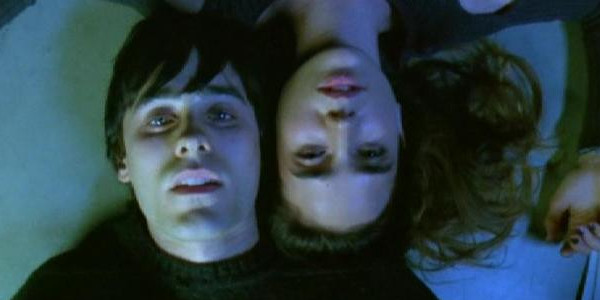 The Sad: So it's another Darren Aronofsky movie on a list of films with sad endings. Though his debut film Pi gained cult success, the film that put Aronofsky on the map was 2000's heroin-drama Requiem for a Dream, which follows the story of three junkie friends trying to stay in heroin, while the elderly Sara Goldfarb accidentally gets addicted to prescription meds. The last twenty minutes or so of this film as so visceral and harrowing that many people refuse to watch this movie, or at least re-watch it. Harry is at a point so low in his life he's injecting scag into a necrotic arm. Tyrone goes through withdrawal alone in prison. Sara is admitted to a psych ward and submitted to electroconvulsive therapy. And Marion... she does some things too. The Silver Lining: It's maybe not a silver lining for Tyrone, who ends up in prison. Nor for Sara, who is stuck not only in a mental hospital but in the depths of her own drug-induced psychosis. But Harry manages to get a life-saving arm amputation, so that's good news, right? And it seems like Marion got what she wanted, even if at a horrible price. So happy ending, no?
1. Casablanca
 The Sad: In what is widely considered to be one of the best films ever made, Casablanca follows Rick Blaine as he goes through life as a jaded bar owner. It's not until an old fling from Paris, the beautiful Ilsa, stumbles upon his gin joint and reinvigorates Rick's life. There's just one catch: Ilsa is there with her husband, Victor Laszlo. Victor is a key resistance leader in World War II. The film concludes with Rick sending his love Ilsa away with her husband, knowing it to be best not just for her, but for the war effort. Rick then kills Major Strasser, aiding in the escape of Ilsa and Victor. The Silver Lining: Despite the fact that Rick is now a murderer and no longer has his beloved Ilsa, the beauty of Casablanca is in its bittersweetness. Rick has transformed from the apathetic lush we met at the beginning of the film to a man of action, rejoining the war effort against the Nazis. Honorable mentions: Big Fish, Amour. Thoughts? Leave a comment below or check out my podcast the Beast Duels Radio Hour for more movie talk.