10 Vintage British Horror Films You Can't Afford To Miss
With Hammer retrospectively getting all the attention, some true gems of British horror often go overlooked.
 Britain is not exactly a place that cineastes would associate with the production of high quality horror films. Italy - yes. Japan - definitely. But Britain, when it comes to horror, gets automatically associated with Hammer. I am a fan of Hammer films, but they get so much focus that the true gems of British horror making go overlooked. In general, I don't think that British cinema gets the credit that it deserves. But this especially applies to British horror films. There have been some fantastic films made over the decades - up to contemporary efforts such as 28 Days Later and The Descent. In this article, I am appraising some iconoclastic British horror films that deserve more appreciation. Please add your own favourites below.
10. Xtro (1983)
 Sam and his son Tony are playing outside when a light appears and abducts Sam. The light returns three years later and deposits a seed from which a half human/half alien creature grows. It kills a couple of people and enters a woman's house where it impregnates her and she gives birth to a fully formed human man who happens to be Sam. Sam makes a beeline for Tony and weird things start happening to the kid. He awakes drenched in blood - but it's not his own. He also has the power to kill people through telepathically transforming and instructing his toys to murder them. Sam and Rachel (Tony's mother) leave to investigate their old house and leave Tony in the care of the au pair. The au pair brings her boyfriend round for a bit of nookie and Tony kills them both. Meanwhile Sam and Rachel get down to even more nookie and Rachel is revolted to find out that Sam is composed of disgusting, rotten, peeling flesh. Tony arrives at the cottage and Sam takes his hand as they are vanished by the light. As if that weren't misery enough for Rachel, there is a rather nasty surprise waiting for her at home... Directed by Harry Bromley Davenport, Xtro flirted around the edges of the Video Nasty scene in the early 1980s. This film gets a lot of flak from the critics and from horror movie fans, but I happen to think it is a nifty little film with some nice flourishes. These include a woman giving birth to a fully grown man, the little boy Tony activating his scary toys to kill people and the weird appearance of the monster at the beginning of the film. The special effects are obviously done on the cheap but they are effective enough in producing revulsion in the viewer. The film has its supporters as well as its critics. The supporters view it as a cult classic which is eerie, trippy and you never know what bizarre thing is on the agenda next. As I said, I would side with the appreciative viewers. Xtro is a little gem of a movie.
9. Death Line (1972)
 Set in the London Underground, a family of cannibals descended from Victorian railway workers wreak havoc with the passengers. Apparently they ended up down there as a result of a collapsed structure confining them. The last cannibal left feasts on the passengers in various stations. His happy existence is foiled whenever he consumes an important politician. A detective is investigating what is going on along with some amateur sleuths - an American student and his British girlfriend. The cannibal man spouts 'Mind the Doors!' - a saying he has picked up over the years from the trains above him coming and going. If you are from the USA, you might know this film under the rather more salubrious title - Raw Meat. It is an excellent movie, very well acted - particularly Donald Pleasance as the detective, and it has an interesting premise. It is a strange horror film in that it actually makes you feel sorry for the killer. He is not being evil, he is feeding his family in the only way he knows how. And his little family have died off by the end of the film. However, the film makers do a good job of rendering the cannibal's underground home as a Charnel House full of partially eaten corpses. It is rather disgusting. You will have a new catchphrase after watching the film. The words 'Mind the doors!' will forever be burned upon your consciousness.
8. Theatre Of Death (1973)
 Edward Lionheart believes that he is the best Shakespearian actor of his generation, but in reality he is pure ham personified. Encouraged by his daughter Edwina, he starts to knock off theatre critics who have dared to criticise him. He murders the critics in what are possibly the most inventive and funny ways ever seen in a horror film. The killings are each based upon a different Shakespeare play. For example, a critic chows down unawares on a tasty dinner, not knowing he is eating his pet poodles. This mirrors the ending of Titus Andronicus in which Queen Tamora was offered up her two sons baked in a pie. He has one more critic to dispense of - Peregrine Devlin. Lionheart insists that Devlin awards him the acting accolades he has been missing out on all these years. He devises a torture device to blind Devlin (based on King Lear) but Devlin stands his ground and refuses to award him anything. The police come to investigate and Lionheart sets the place on fire to distract them. Edwina is accidentally killed in the confusion and Lionheart takes her body to the roof, gives a rendition of King Lear's final monologue. The roof caves in and he falls to his death. Vincent Price as Edward Lionheart and Diana Rigg as Edwina his daughter walk off with the acting honours here. The film has been criticised for being too sympathetic towards Price's character - portraying all of the critics (with the exception of Devlin) as a bunch of pretentious, unlikeable buffoons who get what they deserve. Vincent Price considered this as one of his favourite film roles. Price got his ultimate wish in the film - to do Shakespeare (he was a classically trained actor) and although he is hammy, he performs the Shakespearian monologues with relish. The film is both funny and gruesome with enough hilarity for comedy lovers and enough gore and violence for horror hounds. If you ever wanted to see the sight of Vincent Price acting a hairdresser, look no further than this film!
7. The Abominable Dr Phibes (1971)
 Anton Phibes is a badly disfigured genius who was in a car crash. He is convinced that incompetent doctors caused his wife's death and he is out to get revenge on them in elaborate fashion. Inspector Trout believes that Phibes is behind the killings, but he gets no help from Scotland Yard. Phibes kills the doctors according to the Plagues from the Old Testament. He kills seven doctors and a nurse, aided with his silent female companion Vulnavia. In a final punishment for Dr Vesalius, he kidnaps the doctor's son and places a vat of acid beside him. Phibes has implanted a key near the boy's heart and Vesalius has to operate on his son and retrieve the key within six minutes or else the acid will engulf his son. Vesalius competently achieves this and the vat of acid brings down Vulnavia instead. Phibes is convinced his killing has been successfully retreated and he embalms himself and enters his wife's sarcophagus. Trout and Vesalius muse that the final curse of the Egyptians was darkness and they speculate whether they will see Phibes again. Boasting Vincent Price as Dr Phibes and Joseph Cotten as Dr Vesalius, The Abominable Dr Phibes has a similar story to Theatre of Blood (aggrieved person brings about the flamboyant, themed deaths of their persecutors) but it is one of the most fondly regarded British horror films by critics and viewers alike. Set in 1925, the film (aided by a stellar soundtrack) really brings the period alive. There is just something about the film that lifts it out of horror film banality. It could be the ingenious deaths, the collective performance of the cast, the art deco surroundings, but I reckon it is mainly down to the film not taking itself seriously. This leads to an amusing script and one of the best British horror films ever, that is held in very high esteem.
6. Frightmare (1974)
 Dorothy Yates has just been released from a mental institution where she was held for killing and cannibalising people. Her devoted husband Edmund was convicted too, but he just pretended to be mad so he could look after her. Dorothy has relapsed in spectacular fashion. She invites people to her isolated farm house for a tarot reading and a cup of tea and soon she is chomping down on their brains. Jackie (Edmund's daughter from a previous marriage) suspects what is going on, but she is trying to control Debbie (Dorothy and Edmund's daughter) who is running wild with biker gangs. Debbie wants to know where Jackie keeps disappearing to. When she finds out it is her parents, Debbie flees to their house with her boyfriend Alex. Dorothy, ecstatic to be reunited with Debbie - who is a chip off the old cannibal block - schemes with her daughter on how to punish Jackie for keeping them apart. I was very well behaved in this article because I only included one Pete Walker movie in the list, when I could have crammed the list to the gills with his films. He exemplifies British exploitation horror in the 1970s and managed to crack out several pieces of genius like House of Whipcord and Schizo. Walker is greatly helped in making Frightmare so awesome by David McGillivray, a veteran exploitation scriptwriter whose work was a distinct cut above the average. It is a genuinely creepy and disturbing film with Sheila Keith giving a complex portrayal of Dorothy's character - not just playing her as a mad old biddie, but adding genuine pathos to her role - she makes her cannibalising look like a legitimate past time! Rupert Davies also turns in an excellent performance as Edmund, Dorothy's soft hearted, devoted husband who is incapable of stopping her cannibalistic antics. The fashion may be a little dated in the film, but the movie itself, is one of the finest horror films made in Britain.
5. The Nanny (1965)
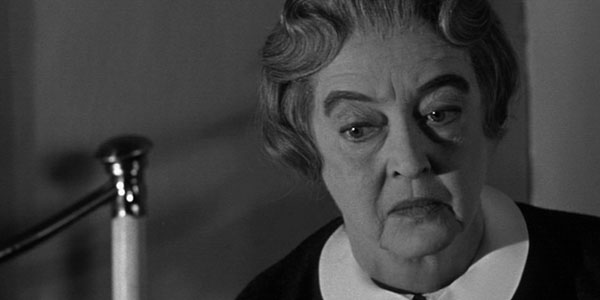 Joey is a ten year old boy from an affluent family. He has just returned home from a school for disturbed boys where he has resided even since his little sister died. At home, he acts in a weird manner - refusing to sleep in a bed the Nanny made for him and moving into a room with a large lock. Neither will he eat anything that Nanny cooks and he goes so far as to say Nanny is trying to kill him. But Nanny seems so sweet.. Is Joey a monstrous little tyke who killed his sister or does he have very good reasons to be afraid of the Nanny? I had to include at least one Hammer film to round off the list so I chose my favourite - The Nanny which stars Bette Davis as the sickly, sugary titular Nanny in an excellent role which showcases her magnificent acting skills and gives us an indication as to why she was a huge Hollywood star. The Nanny is an absolutely brilliant film which relies on suspense and solid acting to sell itself - no gore, histrionics or violence. It is as creepy as can be and there is a push/pull kind of mechanism between Nanny and Joey over their credibility as to being innocent or guilty. One minute you think it is Joey, the next minute you think it's the Nanny and this tug of war between the two keeps the viewer engaged until the final tragic denouement. A masterpiece of psychological horror and in my opinion, Hammer's finest hour.
4. Peeping Tom (1960)
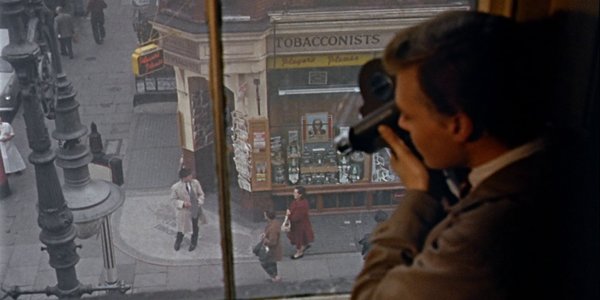 Mark Lewis is a shy and retiring young man who works as part of a film crew. He photographs women in soft core poses and sells them under the counter. He lives in his dead father's house and acts as a landlord to a family below him, he is taken by Helen the young mother. However, behind this skittish demeanour, Mark is a vicious, voyeuristic, murderous pervert who kills young women while filming them. Apparently as a child, he was heavily experimented upon by his eminent psychiatrist father who was studying the effects of fear. Mark's camera is always rolling, he says he is making a documentary film but when a woman turns up dead on set, investigations begin. Mark kills again - a girl called Millie and downstairs Helen becomes interested in his work and wants to see some of his films. He goes to kill her but finds out that he doesn't have it in him. As the police sirens come ever closer, Mark has no option but to kill himself. Made in the same year as Hitchcock's Psycho, Peeping Tom is a trail blazing British horror film that would not be appreciated for the pioneering masterpiece it is for several decades. It ruined eminent director Michael Powell's career as a director in Britain and he had to skedaddle to Australia on the other side of the globe. Ironically both Hitchcock and Powell knew each other and respected each other's work. The two films share similarities - apparently mild mannered men turn out to be killers because of what their parents did to them as children. It is likely that upon seeing the press hullabaloo over Peeping Tom, Hitchcock avoided screenings for the press with Psycho. Hitchcock's film turned out to be very popular with audiences so certain sections of the press had to pay attention to public opinion and give praise to the great man. All Powell got was opprobrium but in 1978, a group of film directors including Martin Scorsese launched a campaign to rehabilitate Peeping Tom's formidable reputation. I think that it is a much more disturbing film than Psycho - which has been overviewed and parodied so often. The voyeuristic nature of the film turns us all into 'Peeping Toms' as we watch the horror unfold on the screen. Simultaneously an horrific experience and a masterpiece in film making.
3. The Innocents (1961)
 Miss Giddens successfully applies to be a governess to a young boy and girl. They are in the care of their wealthy, playboy uncle who tells Miss Giddens he likes to live the high life and he has no place for the children in his life. He basically wants to gad about the place with no cares so he tells Miss Giddens that he doesn't wish to hear anything about the children - just that she care for them in all respects and never bother him. The children's last governess - Miss Jessel died At the house, Miss Giddens immediately likes little Flora and makes friends with the pleasant housekeeper. She wonders where the little boy Miles is. She soon finds out when he is kicked out of boarding school for intimidating and upsetting other boys. But the Miles she meets is so mild mannered, she wonders how it could ever have happened. The kids are as thick as thieves but some of their behaviour worries Miss Giddens when she hears from the housekeeper that former governess Miss Jessel had an affair with Peter Quint - their uncle's valet. They would engage in sexual activity in from of the children. Whenever Quint died, Miss Jessel went into a terrible depression and killed herself. Miss Giddens believes that Flora and Miles are possessed by the ill fated lovers and it is down to her to save the children from their supernatural ordeal. Based on a novel by Henry James - The Turn of the Screw - The Innocents is a film that relies purely on atmosphere and the children's spooky behaviour for its frights. Images linger in the viewer's mind and take on ominous significance and added to the fact is that what you don't see is even more disturbing. A lot of people would argue that The Innocents is close to being a perfect horror film because of its reliance on psychological plot mechanisms and suggestion, rather than the outright gore and sadism of a film like Nightmare on Elm Street. I think there is a time and place for both types of film, but The Innocents carries a quietly sinister theme and makes it into the best British ghost based horror film ever made.
2. Frenzy (1972)
 In the midst of Covent Garden - a vegetable and fruit selling place of London - women are being savagely raped and strangled by neckties. We know from the beginning that Robert Rusk, a fruit seller, is culpable but a lot of circumstantial evidence has gathered around his friend Richard. Richard's ex wife Brenda runs a dating service which Rusk was kicked out of for roughing up his dates. He makes a pass at Brenda and when she declines, he rapes and strangles her - getting away with it and further implicating Richard in all the killings. Rusk also rapes and kills Richard's current girlfriend - Babs. There then follows a famous scene in which Rusk has to roll around in the back of a truck carrying potatoes to retrieve his tie pin that is stuck in Bab's dead hand. Richard is locked up but Oxford - a policeman on the case begins to suspect that they have the wrong man. Richard escapes from prison and Oxford knows he has gone to Rusk's for revenge purposes. Richard thinks Rusk is lying in bed and he bludgeons the figure only to find out it is another victim of Rusks. Oxford makes his way inside and finds Richard with a crow bar beside the body protesting his innocence. Rusk comes into the room dragging a large crate to put the woman's body into. When confronted with both suspects, Oxford utters the immortal words 'Mr Rusk, you are not wearing your tie". Hitchcock's penultimate film, which many consider a return to form for the director after the disappointing Topaz and Torn Curtain, Frenzy is a dark and disturbing horror film which features the familiar Hitchcockian theme of an innocent man being overwhelmed by circumstantial evidence. The identity of the murderer in Frenzy is known from the early part of the film and he is a monstrous, perverted character who rapes and kills women with impunity and thinks he can get away with it. That is where the tension in the film lies - will Rusk get his comeuppance? It was also the first Hitchcock film to feature nudity and strong sexual violence. There is a fair amount of ghoulish humour in the film - such as the retrieval of Rusk's tie pin, but Hitchcock also plays it straight as we can see from another scene. Rusk invites a woman up to his flat to rape and kill her. The camera pans out of the apartment, down the stairs, out onto the footpath and it widens to include the whole street. This emphasises that you never know what is going on behind closed doors and a murder could be taking place anywhere. Hitchcock used stage actors for the roles which is good because it makes it more authentically British and big screen names would have detracted from the suspense with their baggage of fame. It is a very assured piece of film making from the Master. One wonders what other wonderful horror films could have come from Hitchcock had he explored that genre more in depth.
1. Repulsion (1965)
 Catherine Deneuve plays the beautiful young Belgian manicurist - Carol who is living with her older sister Helen in 1960s London. It is clear from the beginning that Carol is neurotic. She has a fear of men and she seems totally disconnected from the world. Her sister goes away to Europe with her fancy man and left to her own devices, Carol cracks up in spectacular fashion. Cracks appear in the wall, imaginary men come into her bedroom and molest her, she doesn't go to work and she ends up killing a would be suitor by bludgeoning him to death, as well as slashing to death her landlord who makes an opportunistic pass at her. By the time Helen and her man come back, they find two corpses, the apartment in disarray and Carol lying catatonic under one of the beds. This film was both Roman Polanski's and Catherine Deneuve's English speaking film debut and because of that, there is not much dialogue in the movie, but it is still a very chilling film. We can tell from the opening shot which focuses on one of Carol's eyes while the credits roll and very ominous music plays, that this is going to be a seriously unnerving viewing experience. Deneuve acquits herself admirably in a difficult role in which she is called on to convert neurosis into fully blown psychosis. Polanski assists her in bringing full on insanity onto the screen with his monstrous effects - such as hands coming through the walls to molest Carol. It is a true psychological horror film classic which depicts a frightening schizophrenic episode and it brings psychosis vividly alive to the screen, in a manner which has rarely been bettered, if at all.