10 Weird Secrets Behind Tim Burton Movies
Just when you thought these movies couldn't get any weirder.
There are many directors who create films that have their own personal flare. The likes of Quentin Tarantino and his hyper-stylized violence or Wes Anderson for his distinct colour palette and visual symmetry come to mind. However, one man has left an unmistakable, dark, twisted path full of mystery that draws people in further with each release: Tim Burton.
Over the course of 17 films, starting with 1985′s Pee-Wee’s Big Adventure, Burton has created an instantly recognisable collection of movies full of bizarre loner characters, quirky production design, and an obsession with the macabre.
Coming from an art and animation background, the first thing you’ll notice in Burton’s films is a strict adherence to gothic colour palettes, production design, and costume design. The fine attention to detail is everywhere though, and it’s time to delve into his strange and unusual films to uncover some spine- chilling secrets you had no idea existed.
10. Jack Skellington: Teacher’s Pet.

Every teacher has a favourite student, just like every director will have a favourite character. With Tim Burton, that favourite is Jack Skellington, from The Nightmare before Christmas.
So which that in mind it makes sense he’d try to include Jack in his other movies. In fact, the character makes cameos in Burton-related flicks including James in the Giant Peach, Coraline, Alice in Wonderland, The Princess and the Frog, and Sleepy Hollow.
Even cooler, before the Nightmare Before Christmas even made it to the big screen, Burton managed to sneak Jack into the 1988 movie, Beetlejuice. His head can be seen on top of Beetlejuice's carnival hat.
This clever cameo in his films softly links them all together into one universe, almost being haunted by Jack himself.
9. Based On A True Story

This might come as a shock to a lot of you, but Burton was a really strange kid. He didn’t really fit in and felt lonely most of the time. So, in an effort to distract himself from loneliness, he turned his focus to creativity.
Any child that has ever felt like the black sheep of their family or community can relate to Edward Scissorhands, and that’s exactly why he exists. Edward was based on a sketch Burton made as a teenager, and he wanted the ‘strange and unusual’ to be able to relate to a character, helping them feel less lonely.
The whole film is loosely based on true events, for example, the town Edward finds solace in is based on his hometown of Burbank, California.
However, Burton is not the only one who had a personal input into this story. Caroline Thompson, who was hired to write the script for the film after Tim read and loved her short story First Born, based the character of Peg on her mother, who was always bringing strangers home.
The two collaborated to create this dark, personal journey and it is evident here that teamwork did make the dream work.
8. Master Puppeteer

Puppetry and Stop-Motion have been present from the very beginning of Burton’s creations.
The company used to create these incredibly detailed puppets seen in the likes of The Corpse Bride and Frankenweenie, is called Mackinnon & Saunders. They have said that it can take up to three whole weeks to create one character.
Peter Saunders, a puppet maker on the set of the Corpse Bride said that the puppets are “about 50% artistry and 50% technicality and hard work”. Even after the puppets are created, they then have to give them behaviours and idiosyncrasies per puppet in each frame, even having to replace their eyelids after every blink. So not only are these artists incredibly talented, but they are also unimaginably patient.
Producer of Frankenweenie, Allison Abbate, admits “If you want to change the expression on a puppet’s face, you use an Allen key in the puppet’s ear [...] There is a system of pulleys inside each puppet’s head and you twist the Allen key to make it smile or frown. Mr. Rzykruski is a little different. He has replacement mouths when he speaks. The bottom half of his face comes off from the nose downwards”.
So, they literally have to tear some of the puppets apart just to help them talk and move. The end result was definitely worth the time and patience, and their hard work will continue to be honoured in these timeless, magical movies.
7. Burton Is A Musical Menace

Sweeney Todd: The Demon Barber of Fleet Street leans away from the usual Burton way and why? Because it’s a live action musical. This is strange as, believe it or not, Tim Burton hates musicals... which is quite surprising considering he has musical numbers in some of his other well-known films.
Burton actually put up quite the fight with Steven Sondheim, creator of Sweeney Todd, to be able to adapt his masterpiece from stage to film.
His pitch ended up blowing him away and he reluctantly gave up the rights, with the condition that Burton would direct the project and Sondheim would be included heavily in the casting. In order to avoid nepotism claims, Helena Bonham Carter actually ended up sending Sondheim twelve audition tapes in order to prove her talent... But Jonny Depp who inevitably ended up playing Sweeney got cast in the role without anyone even hearing him sing.
The end result was a huge hit, but with that much talent collaborating together, what did you expect? Pie anyone?
6.The Queen Of His Dreams

When adapting pre-existing characters to reflect his vision for Alice and Wonderland, Burton did his best to put his own stamp on them.
One character which reflects his usual crazy creations is The Red Queen, a.k.a. Iracebeth Crimms, who appeared as the title super-villain in Burton’s 2010 version of Alice in Wonderland.
Though the character is not a completely new creation, she is actually a coalescence of two characters from the books.
In Carroll’s book, Through the Looking Glass, The Red Queen is a chess piece who battles The White Queen. While The Queen of Hearts, who originates from the 20th Century Disney animated adaptation, is a lunatic ruler with a love for croquet, jam tarts, and beheading anyone that crosses her.
The blending of these two characters is most obvious during the film’s final battle when Iracebeth's army (which is card themed) and The White Queen’s army (who resemble chess pieces) fight on a giant chessboard, perfectly combining the two very different characters into one, big headed Burton monster.
5. Stripy Snakes

In The Nightmare Before Christmas, when Jack is playing as his festive doppelganger, he delivers a sizeable snake to a poor unknowing family.
This is noteworthy because it was designed to resemble the great sand snake from Beetlejuice. I would not like to wake up to one of those on Christmas morning.
Another ode to Beetlejuice is the shrunken head that one child receives as a gift. This is meant to reference the final scene in Beetlejuice, where he is victim to voodoo magic after angering the wrong man in the netherworld waiting room. Never a dull moment with that crazy demon.
4. Unhappily Ever After

The colours throughout his masterpiece Beetlejuice and through many of his other productions have been used symbolically to denote different things.
For example, when Barbara and Adam fall into Saturn with the Sand Worms, the predominant colour is yellow, which you’d usually think is a happy colour no? Well the main reason yellow is used here is because it traditionally represents more cynical images: disease, death, alienation, and madness! Also, when Beetlejuice acts like a circus attraction towards the end, yellow is behind him. Further representing these images.
We see the colour symbolism further in Lydia's wedding dress, which is in fact a nod towards an old wife's tale.
The costume department chose to make her dress red in order to reference an old poem. This informs brides what will happen to them after their big day, depending on the colour dress they wore.
According to the poem, the only acceptable colours to wear on your big day are white and blue, and the worst colours are green, yellow, pink, and red. The poem reads, “married in red you will wish yourself dead”, which she did... crafty costumers.
3. The Netherworld Employees

One of the more subtle jokes in Beetlejuice is that if you end your own life, you will end up as a civil servant in the afterlife. The receptionist in the netherworld, Miss Argentina, references this when she announces how her own life ends saying “If I knew then what I know now, I wouldn’t have had my little accident”, and the joke is maintained throughout the entire film.
If you look closer, every employee in the netherworld has some clear indication of how they met their demise before their ‘chosen time’. For example, Miss Argentina’s wrists, Juno, the Maitlands’ case worker's throat, and the mailman who spends eternity swinging.
This dark joke is a gift that keeps on giving if you pay close enough attention. It’s creepy, it’s meant to be, and soon as you see it you’ll never un-see it.
2. The Corpse Bride Origins

When the production of The Nightmare Before Christmas came to a sad end, storyboard supervisor Joe Ranft approached Burton with a macabre little yarn that he knew he would eat right up.
Titled “The Finger,” this creepy tale came from Shivhei ha-Ari, a 17th century text that embeds a number of Jewish folk stories. Set in Russia, The Finger is about a groom who pops his wedding ring onto the finger of a corpse while reciting his vows. Oops.
Abruptly, the corpse leaps up and proclaims “My husband!”. Sound familiar?
The groom then takes his new breathless bride to a local rabbi who annuls their marriage... as death has already parted them. The bride then collapses into a heap of bones with a piercing wail never to be seen again. Job done.
Burton was drawn to the tale in an instant and began developing a big-screen adaptation of it. However, the story itself had to undergo some big scale changes. Burton’s screenwriters devised a more family- friendly finale.
They also shifted the setting from Russia to a fictional place modelled after Victorian England. Also, any references to Judaism were omitted as they wanted to make the story more universal to his viewers, and after only a short 52 weeks... The Corpse Bride was born.
1. That’s Not A CGI Bird

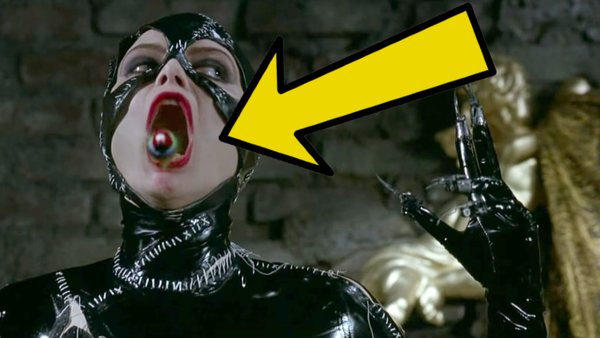
No doubt about it, one of the freakiest moments in Batman Returns appears when Catwoman puts a small bird in her mouth, holds it there for a few seconds, then allows it to fly out.
What's astonishing about this moment is that it doesn't look like any form of CGI, it appears incredibly realistic. And that’s because it was a real bird.
CGI was very uncommon in 1992, when the movie hit the big screens. It was still very early days for this kind of animation, not widely used yet. That meant Michelle Pfieffer had to perform this act for real.
Pfeiffer told a Hollywood Reporter, "I look back and say, 'What was I thinking? I could've gotten a disease or something from having a live bird in my mouth [...] It seemed fine at the time. I don't think the bird was drugged or anything. We did that scene in one take."
Luckily, no birds, cats or bats were harmed in the making of this movie. But it really does give a ‘Movie Magic’ feel all in all.
Watch Next
DC Quiz: How Well Do You ACTUALLY Know Batman?
