11 Awesome Movies With Disturbing Messages
Troubling...but fantastic all the same.
Why do most people watch movies? To be entertained and have a good time, naturally, and to that end the majority of movies can simply be enjoyed as fun entertainment while offering little under the hood for viewers to meditate on. After all, nobody is watching Keanu Reeves in Speed and wondering what it all means on a broader socio-political level.
However, many films do have loftier expectations, and in order to not alienate more casual audiences, these headier commentaries will normally percolate below the surface, waiting for knowing audiences to discover them.
In the case of these 12 fantastic movies, many of them Oscar nominees and even outright winners, they're suffused with some jarringly unsettling messages about politics and society at large, regardless of whether each director will actually admit to intentionally sneaking them in there.
In retrospect, the subversive ideologies may appear rather obvious, but if you're not clued-up, it's easy enough to watch each movie without really thinking about it. Once you know, though, each film will never be the same again...
11. Question Nothing & Have An Awesome Life - Forrest Gump

Forrest Gump is a much-loved movie that not only won the Best Picture Oscar, but has endured over almost 25 years as a feel-good classic with Tom Hanks in his signature Oscar-winning role.
However, there's a rather unsavoury sentiment cutting through the entirety of Forrest's (Hanks) adventure, which seems to promote an "ignorance is bliss" mentality, where the favoured journey through life is one where an individual doesn't question anything, especially the government.
Throughout the film, Forrest effectively falls from one success to another with his blinkered mindset to the realities of the world, while the decidedly more free-spirited, liberal Jenny (Robin Wright) goes from one misadventure to another until she dies of AIDS. Charming.
For his part, director Robert Zemeckis has denied any intentional politicised intent behind the film, but given how far Forrest comes simply by doing what he's told and never standing up to protest anything, it's hard not to see the film as a pointed, deliberate commentary on the virtues of our politics and lifestyle choices.
10. Mentally Ill People Should Be Feared - Split

Split released at the start of the year and seems to confirm that writer-director M. Night Shyamalan is making something of a comeback, aided immensely by James McAvoy's stunning performance as dissociative identity disorder-afflicted man Kevin Wendell Crumb aka The Horde.
Despite largely positive reviews and and raking in over thirty-fold its budget, Split was taken to task shortly after its release for the role it plays in stigmatising those suffering with mental illness, especially dissociative identity disorder.
While it can be argued that the movie's version of the disorder, which sees Crumb's body chemistry change as each personality emerges, is too heightened and ridiculous to have any real-world parity, it nevertheless feeds into a long-standing cinematic tradition of painting the mentally ill as violent people to be afraid of.
It'll be interesting to see if Shyamalan re-jigs the character at all for the upcoming follow-up, Glass, in wake of the outcry from mental health support groups the world over.
9. Restricting Powerful Organisations Is Actually A Bad Thing - Captain America: Civil War

The central dilemma of Captain America: Civil War sees Tony Stark (Robert Downey Jr.) and Steve Rogers (Chris Evans) coming to blows over whether or not superheroes should have government oversight, in the wake of the devastation caused in Age of Ultron's Sokovia incident.
Stark, wracked with guilt about how Ultron grew beyond his control and caused the resulting catastrophe, is a firm proponent of government restrictions, while Rogers has a firmer belief of his own convictions and actions, and vetoes the notion.
Though the film does have a certain moral ambiguity to it, Cap's stance is clearly favoured as the more heroic and honourable one, as though placing restrictions on super-powered people flying around blowing things up is somehow unreasonable.
In real-world politics, liberals campaign for tighter gun control and institutional regulation, so it's baffling to see the most earnest character in the Avengers of all people railing against that. After all, if the Avengers were real, they would come under huge fire from liberals for touting gigantic, unstable weapons and being an unregulated, private army answerable to no-one.
The fact that Cap ultimately wins the fight against Iron Man only cements this viewpoint, bizarrely.
8. Who Needs Consent? - Snow White & The Seven Dwarfs

Snow White is an undeniable animated classic, albeit one that hasn't necessarily aged that well when it comes to gender politics and, well, the mere notion of acquiring consent before making a sexual advance on someone.
This refers to the fact that the Prince kisses Snow White in order to free her from the Sleeping Death curse without her approval or even her knowledge. While the Prince's action rouses Snow White from her slumber, what's troubling is the message it sends to young boys who still grow up watching the film today: kissing someone without consent, even when they're asleep, is totally fine.
The optics of the scene, especially to a contemporary audience, aren't great, and if parents do show the film to their kids, they might want to assure them afterwards that kissing women when they're sleeping isn't sweet or romantic.
7. Black People Can Only Rely On Each Other - Get Out

Get Out is a terrifically entertaining and potent examination of racism in modern America, with protagonist Chris (Daniel Kaluuya) initially facing off against passive-aggressive white-liberal racism before having to literally fight for his life when the Armitages want to use his body as a vessel for an old white person.
Throughout the movie, writer-director Jordan Peele shows a heightened version of what the "black experience" can be, riddled with paranoia and fear, which eventually culminates in Chris being bailed out by his TSA pal Rod (Lil Rel Howery), also a black man, at the very end of the movie.
Considering how the film's closing scene is intentionally shot to make audiences think a white police office is about to show up and blow Chris away, the fact he's saved by a fellow black man seems to make the somewhat depressing if situationally plausible suggestion that black people can really only rely on other black people when the chips are down.
After all, as soon as the police finds the trail of bodies strewn around the Armitage household, there's no doubt that a fleet of primarily white cops are going to be chasing Chris down and trying to pin the murders on him. Rod is his only hope at an escape.
6. Strong, Powerful Women Are Probably Crazy - Fatal Attraction

Fatal Attraction may have netted Glenn Close a well-deserved Best Actress Oscar nomination, but the film's depiction of a successful, professional woman as a secret head-case stalker says a lot about the anxieties of shifting gender dynamics in the workplace in the late 1980s.
The film ferociously defends the notion of what at the time was a "conventional" family unit, where the object of Close's character's affection, Dan (Michael Douglas), is the bread-winner for his wife Beth (Anne Archer), who takes a more passive role by raising their daughter.
Close's Alex, as a confident, career-minded feminist, represents the opposite of this outdated ideal, and that's not only something that's depicted as crazy in this film, but even worthy of being killed, apparently, as the film ends with Beth shooting Alex in the chest (admittedly in self-defence).
That Beth, the literal embodiment of the "traditional" wife or partner, is the one to kill Alex only makes the movie's message that much more blatant and unsettling.
5. Regular People Just Hold Exceptional People Back - The Incredibles

The Incredibles has been cited in recent years as harbouring a pronounced Objectivist philosophy, something which is also readily apparent in writer-director Brad Bird's live-action movie Tomorrowland, which similarly espouses the importance of "exceptional" people and the tendency for normal folks to hold them back. Bird, oddly, denies any of it being intentional.
In his much-loved Pixar movie, the general public is castigated for forcing The Incredibles to conceal their powers from society, and Mr. Incredible memorably whines about the "mediocrity" of his super-powered son's graduation ceremony, while decrying him not being allowed to be "truly exceptional" by trying out for sports (and having an obvious advantage over the other kids).
The most telling way that Bird's political statement manifests, though, is with the villain, Syndrome, whose ultimate plan is to turn everyone into superheroes, so that in effect nobody will actually be super or, yes, exceptional. Syndrome, as a regular man with aspirations of being super but lacking the natural ability, is a blinking neon light of Objectivist propaganda.
4. The Status Quo Must Be Preserved At All Costs - The Dark Knight Rises

Within days of Christopher Nolan's final Batman movie hitting cinemas, there was a ton of discussion about the film's apparently conservative political leanings.
Bane (Tom Hardy) urging the destitute citizens of Gotham to rise up against the rich elite drew easy parallels with the Occupy Wall Street movement that was popular at the time.
Though the film is at least morally ambiguous enough to make sense of the frustration felt by Bane and his followers, ultimately by film's end the rich superhero has quashed the rebellion and restored order to the city, all while leaving the legitimate qualms raised by Bane's crusade completely unresolved.
Rather than show Batman (Christian Bale) attempting to tear down the capitalist social structure of which he is a wildly disproportionate beneficiacy, Batman's focus is squarely on keeping the existing social order in tact, no matter how gross it inherently is.
Nolan, a certified Democrat, has denied any such political commentary being intentional, but given how gritty and grounded his Dark Knight Saga purports itself to be, it's hard not to feel like he's saying something real about the world around us.
3. Rape Is Hilarious - Revenge Of The Nerds
A lot of 80s sex comedies have unfortunately aged horribly due to their problematic attitudes to sex and, well, treating women with the most basic respect.
This is perhaps no clearer than in the otherwise laugh-a-minute 1984 comedy Revenge of the Nerds, which was a solid critical and commercial hit, and endures as a cult classic over three decades later.
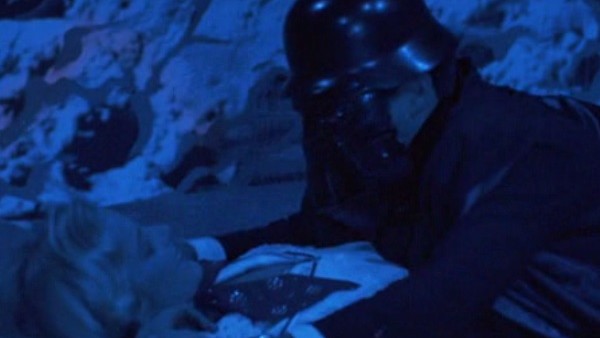
Half-way through the film, protagonist Lewis Skolnick (Robert Carradine) steals the Darth Vader costume belonging to a jock, Stan (Ted McGinley), and uses it to have sex with Stan's girlfriend Betty (Julie Montgomery), who is completely unaware of Lewis' ruse.
The movie plays it totally for goofball laughs and even has Betty become Lewis' wife later in the series, giving birth to their son in the fourth and final movie.
In terms of normalising what's termed rape-by-deception, it's a surprisingly toxic and harmful statement to make in a movie that's supposed to be championing a marginalised subset of society, not earmarking them as huge creeps.
2. Being Infertile Makes You A "Monster" - Avengers: Age Of Ultron

Easily the most controversial scene from Age of Ultron involves Black Widow explaining to Bruce Banner that her assassin training also resulted in her being sterilised, as the possibility of pregnancy could interfere with a killer doing their job.
Widow then asks Banner, "You still think you're the only monster on the team?", which caused a huge outcry online as many fans felt that Black Widow was implying that any woman without her fertility is an abomination and not worthy of being considered human.
A big reason for the rage is that Joss Whedon was, at least at the time of the film's release, considered a strong feminist ally, and so for him to include such a tone-deaf, easily misunderstood line just seemed uncharacteristically sloppy of him.
Whedon ultimately responded that the line is actually referring to everyone Black Widow has killed over the years, but the unfortunate context of her revelation moments earlier makes the scene pretty cringe-worthy to sit through.
1. Meat Is Murder - The Texas Chainsaw Massacre

Now, there's nothing wrong with a movie promoting the tenets of vegetarianism, but in a film about people being slaughtered by a chainsaw-wielding maniac? It's a little bit questionable, yeah.
The Texas Chainsaw Massacre features a lot of imagery that places human beings in positions typically reserved for animals, such as getting bashed over the head, hung on meat hooks and literally butchered with industrial equipment, all for the sake of feeding some cannibals.
Unlike a lot of films on this list, the message is clearly supposed to be disturbing, to alert audiences to the grotesque nature of killing animals for food, and once you realise what director Tobe Hooper's doing, it's certainly bracing effective in its own right.
Which of these awesome movies have the most unsettling messages? Got any of your own to add? Shout them out in the comments!