12 Absorbing Films About Insanity

Movies that treat the subject properly.

One in four people suffer from mental illness in their life, therefore craziness in all its different flavours fascinates and equally appalls humanity at large. The fascination with madness was adopted as a thematic concern in cinema as early as 1920 with Robert Wiene's classic German Expressionist film, The Cabinet Of Dr Caligari. That was far from the end of it, and no director would approach insanity with such gusto as Swedish master Ingmar Bergman who made many very intelligent films that revolved around insanity including Face To Face - in which a psychiatrist has a nervous breakdown, Hour Of The Wolf - which could nearly be called a horror movie it evokes the sensation of encroaching madness so well. It is fair to say, that if you want to wallow in mental health misery, Bergman delivers the goods. But beyond Swedish gloominess, insanity is a theme that film directors revisit time and time again. Mental illness is usually portrayed in the form of psychopathy and murderous villains. And schizophrenics are mass murderers. There is a serious paucity of films that deal positively with mental health. It is much more fun to make the mentally ill look like deviants than to try and understand them. The following films are notable for their interesting and illuminating approach to madness


12. Titicut Follies (1967)

Made by the God of documentaries, Frederick Wiseman, early in his career, Titicut Follies is an incendiary piece of filmmaking that was banned by the authorities of Massachusetts on the ostensible grounds that it violated patient privacy. However the film is a damning indictment of how society treats its most vulnerable people - in this case the mentally ill. In shocking scenes, patients are shown to be mocked or ignored by thoroughly indifferent staff members. The inmates are frequently stripped of their clothes for no discernible reason. A doctor force feeding a patient some liquid solution while he smokes, lets ash fall into the solution and carries on feeding the patient like nothing ever happened. This is just some of the indignities that the inmates of Bridgewater Asylum have to endure. Speaking of endurance, you need nerves of steel to watch this documentary. It is absolutely spot on in evoking the plight of the hospital's inmates but it is dreadfully depressing and soul destroying to watch. Not many people make it to the end of this film which is testament to Wiseman's skills in portraying abject horror. Titicut Follies is the name of the hospital's annual talent/entertainment show put on by inmates. It is enough to make you weep.

11. Whatever Happened To Baby Jane? (1962)

Bette Davis plays the titular Jane - a washed up, deranged former child star who looks after her paraplegic sister Blanche (Joan Crawford) who achieved much greater success as an adult in the movie business than Jane did. Confined to her upstair quarters, Blanche is at the mercy of her crazy sister who kills her parakeet, cuts off her phone line, and handcuffs her to the bed, and starves her. The nurse, Elvira, discovers Blanche in a starved, dehydrated state but before she can tell anyone, Jane kills her. Jane is also a dipsomaniac who believes she can relive the 'Baby Jane' era and she hires a pianist called Edwin to assist her in her very grotesque come back. Jane is severely beaten by Blanche when she makes a break for it to phone the police. The police are actually circling Jane over the disappearance of Elvira. Jane gathers up a dilapidated Blanche, brings her to the beach and when the cops approach her, she starts singing and dancing, pleased she has an audience at last. 'Baby Jane' is a fantastic mad woman. She has lost touch with reality, but she is also dreadfully conniving at the same time - a feature which makes her downright evil in her manipulation of the people around her. Bette Davis gives a laudable performance as Jane, making her very cruel and depraved, chronically drunk and in possession of a bizarre belief that people will want to see the withered up old hag act, sing and dance like a little girl. Her performances as 'Baby Jane' are so hideously warped, you will want to scrub your eyeballs with bleach after watching her.

10. Possession (1981)

Isabelle Adjani plays the main role as Anna for which she was awarded Best Actress award in Cannes, yet the film itself ended up as a video nasty. A deep and harrowing portrait of psychological disintegration, Adjani's performance requires her to be in a state of escalating hysteria throughout the film. Anna has left her husband Mark (Sam Neill) and she is acting strangely, picking up a lover called Heinrich and neglecting her son. Mark and Anna are going through the break up from hell. Anna grows ever more hysterical, argues a lot with Mark, and then attempts to cut her throat with a carving knife. Anna is living in an apartment with a hideous creature who has sex with her. She has an absolutely dreadful miscarriage and starts killing people, whose body parts she stores in the fridge. A whole load of hysteria goes on and Mark and Anna kill themselves. It is extremely hard to write a synopsis of the action in Possession because there are so many plot threads, themes and ideas going on. For the purposes of this article, it is necessary to focus on Isabelle Adjani's portrayal of madness, which some viewers hate, as they think it is over the top, and some viewers think is masterful. Director Zulawski demanded a brilliant high octane performance from Adjani as Anna. Prepare to sit stupefied in front of the film at Anna's antics, and also Mark's dramatics which lead to him becoming virtually as mad as Anna by the end of the film.

9. I Never Promised You a Rose Garden (1977)

Kathleen Quinlan gives a terrific performance as Deborah in this portrayal of a disturbed teenagers three year stay at a not very nice mental institution. Deborah is haunted by a private inner fantasy life which stops her from engaging with reality, but gradually over time, she learns to trust her therapist (played by Ingmar Bergman regular Bibi Andersson) and she attains a measure of functionality despite her illness. The characters in the hospital are all of the usual stereotyped mental patient kind, and the film does little to engage our interest in them. It is a vehicle for Deborah to act out all of her craziness until she is forced into cooperation with the shrink. The inner world of Deborah is not very well rendered and the book upon which the movie is based goes into much more detail about the manifestation of her illness. Still, there is always something interesting going on in the entire duration of the movie and Quinlan really does throw herself into her role. I Never Promised You A Rose Garden is a classic film in the ranks of mental health-based movies, and it is definitely worth viewing.

8. The Madness Of King George (1994)

The film is a horrible catalogue of what quack doctors did to try and cure King George III of his madness, particularly around the Regency period. A procession of doctors fuss around King George using purges, blistering, behaviour modification - the latter administered by a Dr. Willis. King George's son is meanwhile plotting behind his back to take over as King. His political machinations mean that the recovered King is rushed to parliament to prevent his son's usurping of the crown. Nigel Hawthorne plays the beleaguered King George III in grand fashion, bringing alive all of the medical torturing he endured during his madness which put the King into some horrific situations. He was nominated for an Oscar for his effort. Despite his 'madness', George III retains a tiny measure of sanity about the political situation with his treacherous son and also into his own predicament. Hawthorne is able to make George III a complex character and the film stands for medical ignorance and tomfoolery in the days when 'lunatics' were treated incredibly poorly.

7. One Flew Over The Cuckoo's Nest (1975)
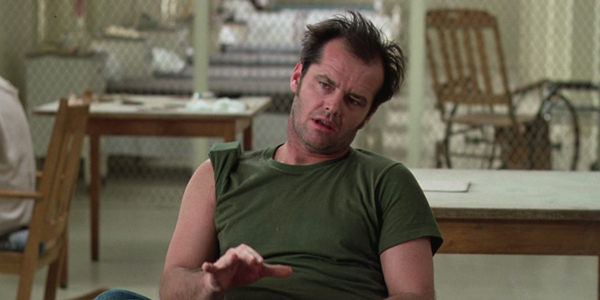
Randle MacMurphy, an unrepentant criminal hoodlum, decides to serve out his remaining sentence in a mental hospital as he thinks it will be a breeze compared to prison and hard labour. He didn't bargain for the tyranny on the ward of Nurse Ratched who has a well established, demeaning routine for the men who fear her greatly. Randle is not insane when he enters the asylum but he grows angrier and angrier on the ward and frequently locks horns with Nurse Ratched about her authoritarian ways. MacMurphy acts as an agitator among the men who begin to defy Nurse Ratched. She coolly cracks down on their new found liberties and MacMurphy is told he is being detained indefinitely. Ever the rebel, the authorities try to control him with shock therapy. Meanwhile, Nurse Ratched is biding her time... And he falls into her trap, strangling her in a fit of rage. He is swiftly lobotomised and that is the end of Randle MacMurphy. Both a reprobate and a hero, Randle MacMurphy's story is rather tragic. It is hard not to like him as he challenges the dreadful Nurse Ratched and her horrible regime on the ward. The patients have been stripped of all of their rights - fun and personal liberty are strictly verboten. The film really showcases just how dreadful mental hospitals are and it perfectly exemplifies through MacMurphy the old adage about psychiatric wards "If you aren't mad when you go in, you will be mad by the time you get out". MacMurphy's subversive, independent nature was his downfall.

6. Apocalypse Now (1979)

Updating Joseph Conrad's short story Heart Of Darkness to the Vietnam era was a clever move by the director Francis Ford Coppola, and he crafted an amazing war movie which has rarely been matched in both quality and excitement. Captain Willard is ordered to lead a mission into Cambodia to kill the renegade Captain Kurtz. After a very eventful ride up the Nung river, Willard and company locate Kurtz (played by Marlon Brando) at a compound where a mad photographer tells them about how wonderful Kurtz is. There are severed heads and bodies strewn liberally through the compound. Kurtz captures Willard and denigrates him, calling him a messenger boy, but after a few days in captivity, Kurtz leaves Willard to roam the camp and talk to people. Kurtz likes to talk to Willard and he extrapolates on how efficient the Viet Cong are and also various deep topics like the ethics of war. Willard can see he is a true madman, he swiftly puts him out of his misery and exits the scene as fast as possible. All power corrupts, but absolute power corrupts absolutely, and this is definitely true of Captain Kurtz. The film shows that we need rules and regulations in society lest the despotic madmen like Kurtz take control and establish an insane tyranny. Marlon Brando delivers a powerhouse performance as Kurtz, an elite soldier turned renegade, who expounds his crackpot theories and actively wants Willard to kill him and inform his wife and son of his deeds. Brando is simply the best madman ever to grace the screens in a war movie.

5. Girl, Interrupted (1999)

Winona Ryder's character Susannah may be the chief protagonist in this film, but she is seriously eclipsed by Angelina Jolie's Oscar winning performance as psychopath Lisa Rowe who keeps absconding from the hospital and who uses her considerable powers of manipulation to run rings around the staff and patients. When she befriends Susannah, she is a malignant influence - encouraging her to not take her tablets and to generally become an obnoxious little brat. On her next sortie out of the hospital, Lisa brings Susannah with her and they wind up at a discharged inmate's flat. Daisy Randone is driven to suicide by Lisa's aggression and her comments on the alleged incestuous relationship with her father. Lisa even robs Daisy's hanging body for money. Susannah is appalled at her callousness and goes back to be a good little mental patient. Lisa is eventually caught and does all she can to annoy Susannah - such as taking her journal and reading out her unflattering observations on the ward's patients. Susannah aims some carefully worded verbal missives to Lisa and she has a mental breakdown. Angelina Jolie has a lot of fun with the character of Lisa Rowe, playing her to malevolent, unhinged, bad girl par excellence. With her performance as a vicious sociopath, Jolie steals the film from under Ryder's nose; contrasted to Lisa Rowe, Susannah who is a rather wet and boring central character.

4. A Beautiful Mind (2001)

A film which deals with the plight of John Nash (played by Russell Crowe), a brilliant academic until he fell ill while decrypting enemy messages in the Pentagon. Nash becomes obsessed with decoding newspapers and magazines in the pursuit of defeating the Soviets, even letting it get in the way of his marriage. Brought to hospital, Nash is labelled schizophrenic. After he is released, he stops taking his antipsychotics because of their side effects and learns to live with his imaginary characters after going through hell for a number of years. He does some quiet research at Princeton and was eventually able to teach again, winning a Nobel Laureate in 1994 for his work on Game Theory. A Beautiful Mind is a brave movie in its attempts to bring schizophrenia to 'ordinary' audiences and for the most part, director Ron Howard is successful in crafting the terrible paranoia, delusions and hallucinations that characterise psychotic illness. The creation of imaginary characters was a brilliant idea which demonstrated just how real the person with schizophrenia perceives their hallucinations. Crowe gives a terrific performance and is able to convey the complex behaviour and mindset of a schizophrenic very well.

3. A Streetcar Named Desire (1951)

The highly acclaimed adaptation of Tennessee Williams' play which features an Oscar winning turn from Vivien Leigh as Blanche DuBois, a faded Southern belle who pretends to be the very epitome of a well-bred lady, but who becomes flummoxed in a sweaty urban setting (when she visits her sister) and comes across her sister's husband Stanley. Stanley is a force of pure raw masculinity and increasingly pissed off at Blanche's extended stay at his abode, her genteel manners and delusions of grandeur. He lets her know this. Blanche is disgusted at how Stanley treats her sister and Stanley retorts that Blanche seduced a school pupil when she was a teacher. Eventually, Stanley gets so wound up, he rapes Blanche who then has a massive breakdown and is carted off to the asylum. Okay, Blanche is deluded and flakey, but her plight at the end of the movie when she goes totally doolally is utterly heartbreaking, tear inducing stuff. With her cheap evening clothes and gentrified manners, Blanche cannot face her reality - mainly that she is getting older and her looks are fading. Still stuck in her debutante days, Stanley's devastating act of sexual violence is what tips her into total insanity.

2. Repulsion (1965)

In her first English speaking role Catherine Deneuve plays the part of Carol, a beautiful but deeply disturbed manicurist who has a phobia towards men. She lives with her sister in a London flat and she seems strangely disconnected from life, unenthusiastic, cold and frigid. When her sister goes off to Europe with her lover, leaving Carol behind, she begins to slide into psychosis. Cracks appear in the wall as well as the famous molesting hands. Strange men come and assault her in bed at night. But most sinister of all, Carol becomes a murderess. When the landlord shows up for the rent, he makes an opportunistic pass at Carol and she responds by slashing him to ribbons with a razor. The end of the film shows Carol in a catatonic state, and it is clear she isn't coming back to earth any time soon. A psychological horror film, Repulsion is critically adored and it is still as eerie and disturbing as it was when Polanski made it back in the 1960s. It was an auspicious start to Deneuve's career - for such a young woman in such an intense and psychologically demanding role she pulled it off with great aplomb.

1. Through A Glass Darkly (1961)

Karin has just been released from a mental hospital after receiving treatment for severe schizophrenia. She is accompanied by her husband Martin, father David and younger brother Minus. At first things start off relatively innocuously, but then in the middle of the night, Karin enters her father's room (he is a writer) and she reads his accounts of her illness, learning her finds it horrible yet fascinating to watch her go mad. At this, Karin's sanity starts to tremble. Martin attacks David for treating Karin not as a child, but as a test subject. David admits to this and tells Martin that he almost killed himself, but love for his family saved him. After a seriously messed up rendezvous on a boat, in which Karin may have sexually seduced Minus, an airplane ambulance is sent for Karin who is convinced that God is going to reveal himself to her through a crack in the wall. She asks everyone to pray with her and she freaks out and has to be sedated when God is revealed to be a giant spider. As a schizophrenic, Karin lives in two separate worlds - reality and one of severe psychosis. In the film she declares that she can not exist in a dual world and it is easier for her to accept a long term future in a mental hospital in which she can succumb to her demons, than struggle to lead a normal life. Nowadays, there would be a plethora of drugs to which Karin may respond positively to. Back in 1961, the prognosis of the schizophrenic was risible. Harriet Andersson gives a stand out performance of a woman undergoing the mental equivalent of the Vietnam War. Such a portrait of female schizophrenia has yet to be bettered. What other movies provide an insightful look at mental illness? Discuss them down in the comments.

Contributor
Contributor

My first film watched was Carrie aged 2 on my dad's knee. Educated at The University of St Andrews and Trinity College Dublin. Fan of Arthouse, Exploitation, Horror, Euro Trash, Giallo, New French Extremism. Weaned at the bosom of a Russ Meyer starlet. The bleaker, artier or sleazier the better!