12 Common Movie Criticisms That Make No Sense
Wonder Woman is SJW bait? Try harder next time.
Isn't modern film fandom just a wonderful thing? The Internet has given everyone in the world a voice, and what better thing to do with that voice than complain about why you hated the latest Fast and the Furious movie?
And as entertaining and even insightful as these platforms can be to learn more about movies you both love and despise, it's fair to say that a lot of the modern hand-wringing over cinema is, well, a load of bulls***.
Not only does hyperbole run riot in casual film discourse, but people will too often draw from a series of stock, unimaginative criticisms that they're regurgitating from somebody else, regardless of whether they truly fit the bill or not.
12. "Who Was This Made For?"

One of the most snidely passive-aggressive criticisms out there is the infuriating, "Who was this made for?".
This was heard a lot following the recent release of both Star Wars spin-offs Rogue One and Solo, with some viewers expressing surprise that any fan of the franchise would actually want to watch these stories...for some reason.
The misplaced sense of smugness that the phrase brings with it makes it tough to take someone seriously when they say it, even if their veiled complaint about Hollywood's general lack of creativity isn't with its sure validity.
If you're closed-minded enough to think that any movie that doesn't connect with you also won't land for anyone else out there, well, you're probably beyond helping. Tastes can be diverse, and what seems "off" to you might be absolutely killer to millions of others.
Studios don't always get things right, but the vast majority of the movies you've ever watched have been meticulously designed, filmed and marketed with mass audience appeal in mind, obviously.
11. "It's Style Over Substance"

The phrase "style over substance" may sound swish, but it's so often used in place of actual, considered criticism when somebody simply doesn't like a movie that just so happens to be pretty.
The easy rebuke is that style can itself be substance, and even if a filmmaker opts to tell a simple story, the way that it's told can be extraordinarily complex - and yes, substantial - on a technical level.
As much as humans respond to words, pictures are indeed worth a thousand of them, and so to downplay the visceral effect pure aesthetics can have on moviegoers is just straight-up ignorant.
That's not to completely deny that some films are nothing more than shallow exercises in gloss, but many films rubbished as style over substance - such as Drive and Sin City - effectively make their style a "character" in its own right.
10. "The Characters Are Too Unlikeable"

One of the most obnoxious complaints you'll hear about a movie is "the characters were too unlikeable", as though that really means anything.
Sure, it can be a problem if a movie wants you to like its characters and doesn't realise how detestable they are, but there are literally hundreds of fascinating movies centred on awful, morally bankrupt human beings with full knowledge of that fact.
Unfortunately some audiences approach cinema from a narcissistic point of view, that a movie isn't worthwhile if there's no character to relate to and liken to themselves.
But that's not how human experience works, and a lot can be learned from observing characters like American Psycho's Patrick Bateman (Christian Bale) who, let's face it, the average person will neither relate to nor find remotely likeable.
Character studies of flawed, prickly characters can be enormously dramatically rewarding if you ditch this hang up that movie protagonists need to pass a certain standard of charm or likeability.
9. "It's Different From The Book"

Read a handful of reviews of any movie based on a book, comic or graphic novel and you'll inevitably find someone whining that it wasn't faithful enough to the source material.
Congratulations, you can read, but your critique fundamentally misunderstands what the point of a film adaptation is.
A film is markedly different to a novel, and while there are certainly circumstances where a filmmaker fails to fully understand the tone or themes of a book, it is also impossible to comprehensively translate hundreds of pages of detail to the big screen.
Take Watchmen, which was torn asunder by comic fans for excluding the gigantic, apocalyptic squid from its finale, but given that this would be a) extremely difficult for a casual audience to take seriously and b) a tough technical challenge, shifting the world-ending threat to Doctor Manhattan (Billy Crudup) was actually pretty smart.
The point is that change isn't inherently a bad thing, no matter what your lizard brain might tell you. Psycho, A Clockwork Orange, Jaws and Fight Club are just a few instances of films which actually bettered the source material, elevating the written word and making something truly iconic in the process.
If you love the book so much, the film does nothing to change that, and as such screen adaptations are best thought of as spiritual companion pieces to the source. With cinema unable to compete with the expansive power of the human imagination, do you really want films that just dispassionately regurgitate a novel as close to verbatim as possible?
Movies are interpretations of books, not some definitive authority that retroactively changes the original.
8. "Nothing Happens"

This tends to be a younger-skewing complaint that you'll hear a lot about character-driven dramas, that "nothing happens" simply because a film is focused less on plot and overt incident, and more on the people within the world.
Take No Country for Old Men, a film which toyed with expectations of what a thriller film could be, by actively denying the audience much of the bloody catharsis they expected, especially in the third act.
This caused many casual viewers to simply dub the film "empty", but if you were at all paying attention to what the characters said and did, a whole hell of a lot happened in the film.
Unfortunately those who tend to stick to big-budget multiplex fare expect plot with a capital P and tons of action, and so anything that diverges from that model is both alien and wrong.
Few people with a real interest in film would dare make this complaint, but if you're talking with your more casually-minded family members or acquaintances, it's likely to come up every now and then.
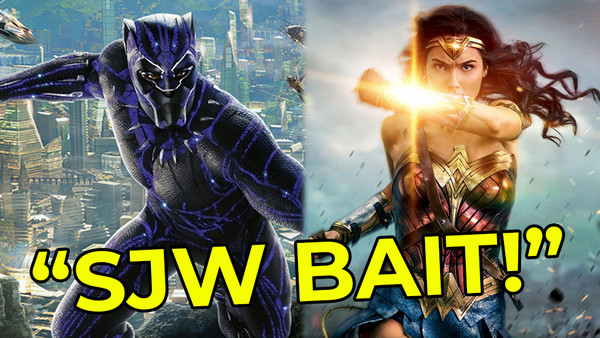
7. "It's 'SJW Bait'"

With the uptick in progressive, diverse movies over the last few years, there's been an inevitable backlash from the political right, that Hollywood is "pandering" to liberals with "SJW bait" movies such as Get Out, Wonder Woman and Black Panther.
While there's no guarantee that a movie with a diverse cast and crew will be good - looking at you, A Wrinkle in Time - anyone who seriously slams Black Panther for having a predominantly black cast and celebrating that fact is, well, a bit of an idiot.
It's fine to dislike or even hate the movie, but maybe just do it for a valid reason? Representation is a fantastic thing, and though there certainly are instances of diversity being shoehorned into movies - usually in the hope of strengthening box office performance in China - it's hard not to cringe at white people sneering at diversity when they've never lacked for characters who look like them on screen.
6. "I Won't Watch It Because It's Animated/Subtitled"

Where to even begin with this one? There are, believe it or not, people who will refuse to watch a film because it's animated, because that apparently means a film is "childish" and unsophisticated.
But Disney and Pixar in particular have proven that fact categorically untrue over the decades, with their character-driven stories often ending up among the best movies of their respective years.
Even more maddening is the more widespread disgust for subtitles, with many casual filmgoers being turned off by foreign films because, and let's quote someone we've likely all come across at least once in our lives, they "don't watch movies to read."
If you can't juggle the mentally taxing task of reading subtitles while paying attention to what's happening on screen, you might have bigger problems than this, to be fair.
But to avoid animated and foreign films for such fanciful, misinformed reasons is to shut yourself off from a gigantic cachet of classic cinema. Fools!
5. "It's Factually Inaccurate"

We've all got at least one friend, perhaps they're a doctor, a lawyer, an historian or a scientist, who just loves to point out insignificant inaccuracies in movies as though it's a personal affront to them and their field.
Nothing quite boosts the ego like telling a room full of people all the scientific flaws in Interstellar or that Taken wasn't, believe it or not, a factually accurate depiction of the complexities of human trafficking. Oh, and did you know that Lucy's claim about humans using just 10% of their brain was total bulls***?
Though there are obviously limits to the tolerance of factual inaccuracy in films, ultimately it comes down to this - does it affect the heft of the story or betray the world depicted therein?
Filmmakers frequently sacrifice historical veracity - usually unintentionally but sometimes not - in favour of capturing the spirit of a moment or time, and they'd be the first to chide you for ever assuming that a period epic was supposed to be an authoritative representation of anything.
Basically, if you take your entire knowledge of a human being or event from an Oscar-baiting movie, more fool you. And if you can't watch a movie for more than five minutes without complaining about how it disgraces your own professional field, you need to build up some damn suspension of disbelief.
4. "It Wasn't Scary"

This is again a young-skewing complaint and naturally clings primarily to the horror genre, which is of course perennially popular with the teen crowd.
Just look at the audience reception to the most critically acclaimed horror films of the last few years such as The Babadook, The Witch, It Comes At Night and Hereditary.
The problem is that mainstream horror audiences, especially the young'uns, are so aggressively conditioned to expect jump scares that they practically end up asking for them, and when a film doesn't have them, viewers apparently don't have any other qualifiers for what's scary.
The above films are all far more reliant on atmosphere and mood than loud tension chords, and honestly, if in 2019 you don't do your due diligence about a film before going to see it, that's basically your fault.
Now, not all art-house horror films are automatically good or scary, but poo-pooing a horror flick just because it isn't loud and there aren't CGI monsters leaping into the frame every five seconds doesn't mean a film lacks for frights. Try putting the phone down, shutting up and just soaking in the experience.
3. "The Characters Didn't Behave How I Would Behave"

Even smart, film-literate people make this complaint. There's nothing quite like watching a movie and becoming an "armchair character", that is, constantly calling out characters for not behaving how you certainly would behave in the same situation.
While some characters are certainly written to carry the idiot ball, it's also important to remember that critiquing a character's behaviour from the comfort of your sofa is easy when you're not going through said experience yourself.
Take the widely-ridiculed Prometheus, which has been ripped apart by fans for numerous reasons, perhaps most of all that Meredith Vickers (Charlize Theron) gets crushed to death by a falling spaceship because she keeps running in a straight line rather than simply running left or right out of its path.
But of course, this completely ignores the fact that when you're running with all your might and rocks are flying past your face, you don't really have much time to actually turn around, gauge your position in relation to the ship and then figure out where you should run next.
Panic is a most basic form of human behaviour under pressure, and while it's not always easy for filmmakers to translate this into satisfying drama, it is usually quite representative of the sloppiness - and yes, the stupidity - of humans in a chaotic situation.
You can proudly claim you'd have survived had you been in Vickers' position, but the reality of that situation may have turned out otherwise.
2. "It's Pretentious"

Thanks to Family Guy, there's an entire generation of people who unironically use the phrase "it insists upon itself" to dismiss films that they believe to be "pretentious."
Pretentious has to be one of the emptiest criticisms you can level against a film, and it so often ends up translating to "a film that I didn't get or didn't like but can't explain why."
The typical conception of a pretentious film is one which presents a false sense of loftiness which it doesn't live up to.
But many use this criticism against bold films which swing for the fences, and while many of these types of movies don't necessarily always achieve their goals, should we really be ridiculing filmmakers for trying to do something different with the medium?
Ultimately art is subjective and one person's pompous tosh is another's affecting masterpiece, but flippant use of the word has become insufferable in recent years, with too many using it as a catch-all to shut down intelligent discussion about a movie, regardless of whether you actually liked it or not.
Not every movie is made for everyone, and it's totally fine for a film not to be for you without needing to trash it as self-important dreck.
1. "The Pacing Sucked/It Was Boring"

Another classic piece of armchair film criticism that so often proves completely hollow is "the pacing was bad" or "I was bored." Many feel that this is sufficient to encapsulate their dislike for a film without needing to actually expand on their feelings in any way.
Take Blade Runner 2049, a slow, atmospheric film that absolutely isn't for everyone, and that's fine.
But the movie's tempo is consistent and compliments Denis Villeneuve's masterful world-building, allowing audiences to soak all of it in. Is it badly paced? No, but might it be too slow for some? Sure.
Similarly, calling a film boring just feels like you can't actually be bothered to explain why you didn't like it. Was the direction flat? The writing dull and generic? The characters uninteresting? There's so much more you can say beyond mere boredom, because that alone is not a meaningful criticism.
Which movie criticisms do you hate the most? Got any more to share? Shout them out in the comments!