Knowing that every Star Wars movie begins with A long time ago in a galaxy far, far away is kind of a tease. It implies that the amazing technology we see in the saga has existed for thousands of years but just happens to be sitting in a pile somewhere on the other side of the universe where we can't get hold of it. Its okay though, weve got our own clever little scientists working incredibly hard in order to catch up with that galaxy of Jedi, bounty hunters and Wookies. You might actually be surprised at how far along we are with some of this technology. All we need to do is wait for the costs to come down and some incredible pieces of kit will start to become commonplace. Before then, you could maybe try joining the army because it seems that they are the ones who are developing half of this stuff. Whoever claimed that the next world war would just be computer hackers and nuclear bombs doesnt have a clue what theyre talking about. If this list is anything to go by, World War 3 will involve spaceships, robots, speeder bikes and, yes, maybe even lightsabers.
12. Space Travel
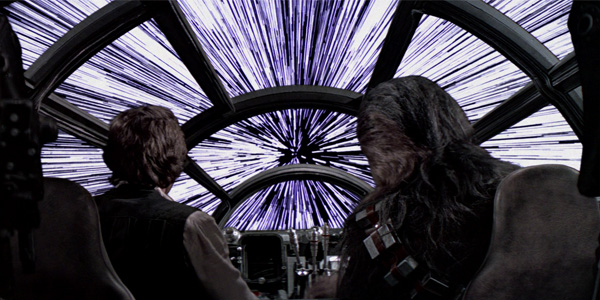
The fact that space flight exists is hardly breaking news and we have of course been sending manned missions into orbit for many more years than we have been enjoying Star Wars. However, it's the actual developments that have occurred since George Lucas' original trilogy that are worth mentioning here. Admittedly, we're not all flying around in our spaceships for the morning commute just yet, but two very significant advancements are on the cards; commercial space travel for (exceedingly rich) tourists thanks to companies like Virgin Galactic and the prospect of manned interplanetary travel for a few brave astronauts. NASA intend to send a team to the red planet in the 2030s and another crew to an asteroid in the meantime (where, if Star Wars is anything to go by, the crew will have to be sure not to land in the mouth of a giant space worm). But what about the real meat of sci-fi space travel? How far along are we when it comes to traversing thousands of light-years in a matter of minutes? Well, hyperdrive technology itself might be a long way away but a number of physicists are definitely working hard on the underlying physics. British aerospace engineer Roger Shawyer designed the EmDrive at the turn of the century, which may eventually be capable of using microwaves to produce enough thrust for faster-than-light travel. A number of small-scale experiments suggest he's onto something. But it's all just theory at this stage. When it comes to summer holidays for the next few decades, you're far more likely to find yourself in Marbella than Mars.
11. Prosthetics
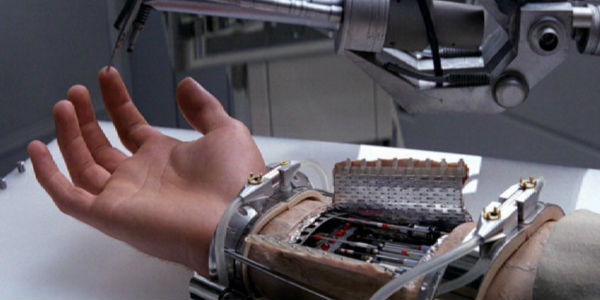
Again, prosthetic limbs have existed long before A New Hope was released in 1977. Indeed, references to wooden and metal appendages date as far back as the Ancient Egyptians. However, the technology has come across exceedingly well in the past few decades to the point that we're not a million miles away from Luke's seamless replacement hand. The prosthetic arm of The Empire Strikes Back has three main qualities that experts in the field today are striving to perfect; it moves, it feels and it looks the part. You'd currently be hard-pressed to find a replacement hand that can do all of these things but there is pioneering technology in all three fields, meaning it will soon just be a matter of combining it all together. Scottish prosthetics company Touch Bionics have been developing ultra-realistic hands with freckles, hairs and wrinkles. They are able to match the patient's skin tone and apply it to their patented fleshy silicone. Bebionic, in contrast, is a company who might not claim to have the most realistic-looking prosthetics but are at the forefront when it comes to functionality. Provided a patient has retained some level of nervous control within their arm, use of a Bebionic hand allows them to use 14 different types of grip to enable them to do things that would otherwise be completely impossible. As for sensory perception, DARPA in the USA have developed a hand that detects physical contact and transmits the information to the brain via electrodes. Patients can detect touch on their prosthetic fingers with up to 100% accuracy and can even tell when two fingers are touched simultaneously. One can only hope that, over time, experts will be able to combine all three of these fantastic innovations to produce a replacement limb that functions almost as well as a real one.
10. Moisture Vaporators
One of the more obscure pieces of Star Wars technology is the moisture farm vaporator.
Both the barren deserts and bustling spaceports of Tatooine are littered with these strange objects, which look like some sort of cross between a pylon and a little space rocket. Their purpose is to extract moisture from the air to help sustain life on such a hot and arid planet.
Well, some bright spark (Australian man, Edward Lincare) managed to make one in 2011 and the concept is surprisingly easy to understand. Essentially, air comes in through the top of the device and is pumped down through a pipe that is embedded in the underlying rock. Away from the searing heat of the desert's surface, the air cools and so the moisture condenses into liquid water. Simple yet ingenious!
At present, the Airdrop vaporator is used as more of an irrigation system rather than to supply drinking water. However, it's easy to imagine that further research into this technology could potentially help combat the water shortages in sub-Saharan Africa.
George Lucas might have tainted Episode 1 with the Gungans but if he's managed to inspire technology that could one day help desert villages get plenty of water, he's well on the way to redemption.
I feel like there's a Jar Jar Drinks pun in here somewhere.
9. Holography
Interestingly, A New Hope's prediction of hologram technology is surprisingly accurate when compared to other works of fiction.
Take Star Trek's holodeck for example; it's exceedingly difficult at the moment for scientists to create 3D holographic imagery that we can touch or pass through. When it comes to simulating a whole room, you're really asking for trouble. There are too many possible angles at which to view something, plus there would be too much interference if the user walked through the lines of sight of the projection devices.
The best we can do at the moment is the likes of the glasses-assisted virtual reality of Die Another Day, where everything is calculated with a computer and projected onto your retinas. This isn't holography though but rather CGI that integrates with the real world. Creating a real 3D environment you can play with without glasses isn't really doable.
However, what Star Wars depicted was a single 3D image sitting by itself in the middle of the room. It's fair to assume that if anyone crossed in front of R2-D2's beam or stuck their hand into the projected image, it might have ended up a garbled mess. This is actually pretty similar to current 3D holograms.
Dozens of holography companies are well on the way to perfecting the technology required to create hovering 3D images that can be viewed from all angles and rotated remotely. Again, try to get up close and touch the image and you're going to create problems but, as far as Star Wars holography is concerned, it basically exists.
That said, the amount of tech that you have to rig up to get it going is kind of insane. You might not fit it into a robot the size of a waste paper bin just yet.
8. Electronic Binoculars
Don't leave home without them, especially when looking for a troublesome astromech droid that's gone AWOL in the Jundland Wastes.
What's nifty about Star Wars electronic binoculars is not simply their reliability and accuracy. The most useful thing about them is the extra information that appears on the display. Luke's MB450 macrobinoculars provide a reading of the distance and elevation of a target, while the TD2.3 electrobinoculars used by rebels in the Battle of Hoth also calculated the size of a focussed target, even when zoomed in to 500 times magnification.
It will come as very little surprise to learn that many of the world's armies are now equipped with sophisticated reconnaissance gear such as this. What might surprise you, however, is that we've actually taken things one slightly creepy step further.
DARPA claim to be halfway through enhancing their electronic binoculars by establishing a neural link with the user's brain. The fancy head gear is able to zoom in exceedingly well, identify all manner of information about the images it detects (just like the Star Wars tech) and then, get this, analyse live EEG recordings of the user's brainwaves to establish whether they are responding appropriately to the images.
If the binoculars reckon that the two-legged figure in the distance poses a threat, it will make sure that the user is eliciting the kind of brain activity expected when they spot danger.
If, on the other hand, the binoculars realise that the two-legged figure in the distance is actually a penguin, it will make sure you're not about to unnecessarily blow its little brains out.
7. Tractor Beams
Tractor beam research actually dates back to the 1960s before Star Wars first graced our cinema screens. However, nothing tangible was created until the 90s, when physicists started making serious developments in the lab, though on a much smaller scale than in A New Hope. Of course, it's been relatively easy to remotely move certain objects for many decades simply by employing magnetic or electrostatic forces. However, these techniques only work on particles that are magnetic or electrically charged. A new method had to be developed in order to direct objects that do not fall into either of these categories. Initially, researchers began experimenting with what were described as "gravity impulses" to move very small particles around the lab. This resulted in limited success that has thus far not been replicated by repeated studies. However, as recently as October 2015, physicists have been developing tractor beam technology that works in an entirely different way. An array of speaker-like devices send out high pitched vibrations to create cushions of air similar to that which is generated beneath a helicopter rotor blade. These vibration cushions have a small area between them where the object sits, as though it is being gripped by fingers made of air. Moving the locations of the air cushions in tandem allows the object to be carried around at will or indeed held in place. Let's just gloss over the fact that this wouldn't work in space because there's no air to vibrate.
6. Jetpacks
Being one of the staples of recurrent sci-fi technology (along with the likes of AI, flying cars and hoverboards) it's little wonder that engineers have been working on jetpack technology for decades. There have been numerous devices crafted since the 1960s that have propelled people through the air with varying levels of success. Technology reminiscent of jetpacks has been used in space for a number of years, allowing astronauts to leave the safety of their shuttles and float around above the earth. They do have weightlessness and the vacuum of space on their side though, so we're totally not going to count that. However, just after Boba Fett flew into the mouth of the Sarlaac in 1983, the real world research really started to take off (pun definitely intended). Interestingly, the consensus among assorted military groups seems to be that a jetpack is neither reliable nor efficient enough when compared to other available technologies, and so most research into wearable rockets actually comes from the extreme sports sector. As a result, engineering companies have created all kinds of jetpack devices to cater to everyone's needs. Most people have seen the hydro jetpacks that can be used in lakes and oceans. Simply stick the contraption on your back and let it rip. Powerful jets suck up water and then fire it downwards with astounding momentum. Newton's laws do the rest, forcing you away from the water's surface and up into the air. The best bit is that if you have a high speed crash, you're not going to die a horrible death provided you can swim. Then there's the VegaV3 wingsuit style jetpack which allows you to jump out of a plane and descend like Buzz Lightyear in the rocket scene of Toy Story. No chance of a vertical take-off though. So, for those naysayers who think these don't count either, it's official; 100% bona fide jetpacks do actually exist. The JB-9 from JetPack Aviation is everything we've ever dreamed of. All you have to do is pop it on your back, fire it up and soar into the air. You'd probably still want to fly it over a lake in case it conked out on you but there's no need to suck up half an ocean to stay in the air. Sure, it would be even better if it was slightly more compact and could spit flames out of the back but there's no arguing that it isn't the real deal.
5. Energy Shields
Many Bothans died to bring us this information. During the Cold War, fear of nuclear attack was rife in both the USA and the Soviet Union. A massive arms race began in 1949 in which both nations not only attempted to develop the most powerful nuclear weapons but also ways in which they could defend from them. Enter Star Wars, and I'm not talking about the movie franchise this time. The Strategic Defense Initiative (SDI) of 1984 was a concept proposed in America towards the tail end of the Cold War. Dubbed "Star Wars" by the media, it was effectively an array of orbital satellites that could track and deflect incoming missiles that were on course for the States. In essence, it could create an enormous shield to quell fears of nuclear bombardment. However, it never came into fruition due to expense and time constraints. It's worth noting here that part of the research concerned high-energy orbital lasers that could knock out Russian satellites. That's totally the beginnings of Death Star tech. Fortunately, they never made anything of that either and there's now an international ban on space weapons. But back onto shields, there is something out there much like a Star Wars style deflector shield. Britain's MOD have developed what they are describing as "electric armour", which is able to vaporise rocket-propelled grenades and anti-tank shells when they impact an armoured vehicle. When tested, the shield protected tanks from enough shells to destroy the vehicle multiple times over, many of which were fired point blank. Best of all, the whole thing is powered by the tank's internal battery and so there's no chance of the shield being taken offline by pesky Ewoks.
4. Droids
We're no strangers to the notion of artificial intelligence or robotics. However, if you'd asked an original Star Wars fan what they think robots will be capable of in the next thirty to forty years, they probably wouldn't have expected things to have become so sophisticated and indeed, so much like Star Wars' droids. The Imperial probe droid of The Empire Strikes Back (pictured) might look like something we've got no hope of creating for another few decades but it is essentially just a hovering reconnaissance drone, which are commonplace in today's military arsenal. I've not heard of any drones that have little arms dangling off the bottom (though it wouldn't surprise me if they existed) but they're certainly equipped with all the tech you'd expect either an Imperial scientist or a terrestrial engineer to put into a robot designed for recon. And yes, in case you didn't know, modern drones can be fully automated and no longer require someone to pilot them. Slightly scary. Boston Dynamics even developed strange four-legged walking robots that can plan a route across tricky terrain and even correct for mistakes (or being absolutely booted in the side by its creators). It's not unlike a mini AT-AT but we've got one up on the Galactic Empire here because our walkers don't even need a pilot.
3. Blasters
There are two options for real world blasters. The first is weaponry that utilises lasers or other electromagnetic radiation. This iteration of a blaster gun is very much a reality today. High intensity lasers that are capable of blinding, burning or pretty much disintegrating people can be built with relative ease and a whole lot of money. However, Lucas ruined everything in 2004 when he changed the already altered Cantina scene to depict Han Solo dodging Greedo's initial shot. Apart from causing uproar amongst people without any bigger fish to fry, he also drew enormous attention to something that pedants had been moaning about for years; you can't dodge something that travels at the speed of light. You can't even see it coming. So, despite the fact that we can make laser weapons at the drop of a hat, we're back to square one in terms of staying true to the movies. The Star Wars extended universe went on to describe the workings of blasters in more detail in order to explain why they don't move at lightspeed and yeah, the technology that was described is a little beyond us right now. I'll get back to you when we can encase superheated ionized gas inside a particle shield using an electromagnetic coil. Until then, laser weapons have the same effect, only quicker.
2. Speeder Bikes
As with previous items in this list, the answers to "Do we have speeder bikes yet?" are "Sort of; it's in development" and "We've mimicked the effect but with different tech". But that's sort of fair enough because Star Wars speeders are allegedly lifted by antigravity gear, which is one thing we're really not capable of creating right now and might not be for decades. So, the clever people at Malloy Aeronautics are developing an alternative; hoverbikes that use the same concept as drones and helicopters. High powered propellers provide a down force that lifts the vehicle off the ground and allows it to hover. The team have already built a prototype that is a third of the size of the final product and it all seems to be going well. The American military are apparently very interested. The technology is very much in its early stages at the moment but, with enough funding, we could be flitting through forests on the back of our speeders in no time at all.
1. Lightsabers
In 2009, Dr Michio Kaku appeared in a TV show called Sci-Fi Science and, in one episode, discussed whether or not a lightsaber could actually be created. The short answer is probably. The programme examined Star Wars' most iconic piece of technology with great scrutiny to address all the possible problems with its production. One thing that took great thought was dealing with the immense heat that would be produced by a saber. A special hilt and container for the blade would have to be created to protect the wielder. Furthermore, a large amount of energy would be required to power such a device and there's not really a lot of room for a big power source in something you can stick onto your utility belt. The final design was turned into a blueprint, consisting of a ceramic hilt to contain the heat, a plasma torch to shoot out a super-hot blade and an electromagnetic coil to keep it under control. This would produce a glowing blade that could melt metal and would even clash against the blade of a fellow force user. Its all theoretical though. Perhaps this is a bit of an anti-climax. You've got this far in the list and pretty much everything in it does indeed exist in some form or other, whereas lightsabers have simply been marked as a "could happen". There is one little titbit left though. Havard scientists experimenting with photons in 2013 found themselves producing a new kind of matter; light with photons that had "hardened" into molecules such that they would physically hit each other when two beams were crossed. Admittedly, these strange lights aren't yet being emitted by handy little hilts you can grip in your hand but just know that somewhere in the world there are beams of light that actually clash against each other. You have to add the FFWOOOOM sounds yourself though. Want to write for What Culture Science? Click here to find out how you could get paid to write about what you love.Love all things science? Like us on Facebook or follow us on Twitter for your next fix.
Peter Austin initially joined WhatCulture as an occasional contributor to our Film, Gaming and Science sections, but made the mistake of telling us that he'd been making videos in his bedroom for over a decade. Since then he's been a vital member of our YouTube team and routinely sets the standard for smart-casual wear in the office.