12 Things You Learn Rewatching Spectre
What a waste.

After spending the last six months revisiting the entire James Bond franchise, our weekly retrospective series reaches its conclusion with 007's most recent adventure, 2015's Spectre. Helmed by the returning Sam Mendes, Spectre was released to high hopes from Bond fans, given Mendes' incredible success with Skyfall and the delicious casting of Christoph Waltz as this movie's villain.
And so, what a crushing disappointment it ended up being. Though hardly among 007's worst outings, Spectre is still a towering monument to wasted potential and what can happen when getting a movie shot is more important than waiting until the script is good enough
At least Daniel Craig has one more chance to end his tenure on something approaching a high, but if you haven't bothered revisiting Spectre over the last few years, few would blame you...
12. The CGI Is Embarrassingly Bad At Times

Considering that Spectre ended up costing an estimated $300 million, it's nothing short of an embarrassment to MGM that the final movie features such shambolically bad visual effects so frequently.
An otherwise impressively executed pre-title sequence is thoroughly undermined by the distractingly unconvincing CGI, making it clear that Daniel Craig performed large chunks of the scene against a green screen.
The alpine chase later in the film meanwhile features a comically bad CGI plane, and some explosions in act three look incredibly rough for such a lavish production.
Admittedly Skyfall had the same problem, especially when it came to close-ups during its set-pieces, but clearly Sam Mendes learned little from the previous film's technical foibles.
For Bond 25, MGM desperately needs to offer the work out to different VFX houses, because these results aren't even close to satisfactory.
11. Sam Smith's Title Song Is Better Than You Remember
You might remember that Sam Smith's title song, "Writing's on the Wall", was almost universally reviled when it debuted in the weeks leading up to the film's release.
The primary criticisms were that it sounded like a "lazy" attempt at a Bond song and fell far short of Adele's Oscar-winning "Skyfall", even though it ultimately went on to win both the Golden Globe and Oscar for Best Original Song.
Three years removed from Spectre's release, it's much easier to take the song on its own terms, and while it's hardly a classic of the Bond canon, it's really not bad at all.
Following Adele's all-timer is a nigh-on impossible task, but its bombastic tone suits the film's absurdly melodramatic mood to a T, and Smith's unique vocal tenor is a nice change from the ordinary without being, well, Jack White and Alicia Keys.
10. Denbigh Should've Been A Red Herring

From the moment that Joint Intelligence Service head Max Denbigh (Andrew Scott) is introduced to audiences, it's ludicrously obvious he's going to turn out to be a not-so-secret villain; it's practically neon-signposted.
For starters, Bond calls him a c**t - something Mallory (Ralph Fiennes) confirms later in the film - which is all the proof you need, really.
Considering how Denbigh's villainy in Spectre's third act is groan-inducingly predictable, it would've been far more compelling if Denbigh was actually a red herring. He could still be a bit of an a**hole, sure, but did he really need to be in league with Blofeld (Christoph Waltz) all along?
Perhaps the filmmakers were fearful of repeating the Mallory red herring twist in the previous film, but considering that the new M ended up being a genuinely honourable, likeable character, there was surely room for Denbigh to remain detestable without becoming a flat-out megalomaniacal turncoat.
Blofeld was really enough villainy for one movie, but that's a whole other issue altogether (and more on that later).
9. Monica Bellucci Is Totally Wasted

Film fans rejoiced when the classy, beautiful Monica Bellucci was cast as one of Spectre's Bond "girls", both because of Bellucci's luminous appeal and acting chops, and because it paired Bond with an age-appropriate actress for once. Bellucci, the oldest official Bond girl to date, is actually three years older than Craig.
What a shame it is, then, that Bellucci only shows up for what's basically a throwaway extended cameo as an assassin's widow, Lucia Sciarra. She gets picked up by 007 at her hubby's funeral, he saves her life, the two bang, and then...that's pretty much it.
Considering her acting cred made her worthy of a far more substantial role, this remains one of the most intensely disappointing things about the movie.
Given the fuss that Eon Productions made about her casting before shooting even started, it ended up feeling wildly overblown, presumably in an attempt to score dubious PR points for casting an "old" actress.
Well, at least she isn't randomly killed, I suppose.
8. Felix Leiter Should've Been In It
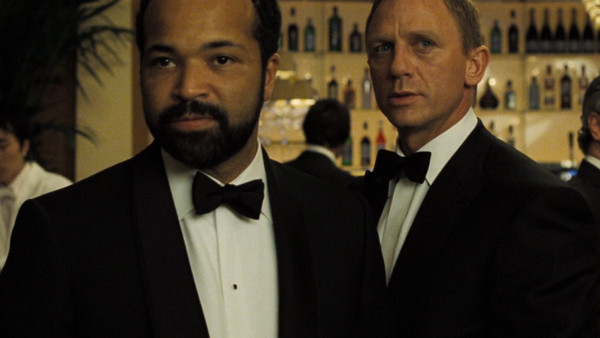
When Bond leaves Lucia, he tells her that he's made contact with his CIA pal Felix Leiter (Jeffrey Wright) who will ensure her safety. This is nothing if not a potent reminder of how poorly-served Jeffrey Wright has been in the role of 007's state-side buddy.
Given that Wright gave arguably the franchise's most grittily entertaining rendition of Leiter in both Casino Royale and his short role in Quantum of Solace, it was extremely frustrating to see him again left out of the party despite how much of a fan fave he is.
One can only hope that, given Wright's recent career boost from HBO's Westworld, there will be renewed interest in giving him a meaty role in Bond 25. Assuming his schedule can accommodate it, of course.
7. Mr. Hinx Is Awesome But Criminally Underused

Just a year after he shocked the world with his show-stealing performance in Guardians of the Galaxy, Dave Bautista won the prestigious role of Spectre's main henchman, Mr. Hinx.
And though the role didn't ask for the former WWE superstar to speak a word, he nevertheless gave an entertainingly physical performance, from his eye-gouging debut scene to his brutal, score-less final showdown with 007 on a train.
It's a shame Hinx doesn't get more to do, though: he's introduced at the end of act one, tails Bond to a few locations, gives chase, and then gets killed with a surprising amount of ease at the end of act two.
Bautista was a great casting choice and did fine work, though only Sam Mendes knows why he bafflingly decided to dub-over Hinx's dying utterance of "s***" with another actor. The replacement sounds absolutely nothing like Bautista and as a result it's unintentionally hilarious.
6. Mr. White's Cameo Is Awesome

One of the low-key best scenes in the film is Bond's confrontation with The Pale King aka Mr. White (Jesper Christensen), who he tracks down to an isolated cabin in remote Austria.
White, who of course appeared in both Casino Royale and Quantum of Solace, is now a broken man, dying of thallium poisoning and in his final request asks Bond to protect his daughter, Madeleine Swann (Léa Seydoux), who will lead him to Franz Oberhauser aka Blofeld.
White's in the movie for just a few short minutes before checking out, but Christensen's haggard performance opposite a ruthless Craig is an absolute delight. Furthermore, this and later scenes reveal more about White as a person - namely his membership in Spectre and his divorce - while giving the character a satisfyingly grim send-off.
Though many of the movie's callbacks to Casino Royale fell horribly flat, this stayed the right side of believable and didn't try too hard.
5. Madeleine Swann's Arc Is Just Terrible

Léa Seydoux is pretty much a perfect casting choice to play a Bond girl: she's beautiful, has an air of class about her, and as her role in Mission: Impossible - Ghost Protocol proved, she sure can handle herself physically.
It's enormously disappointing how fatally the movie mishandles her character, then. She's initially introduced as a stern foil for Bond, but soon enough she's getting drunk, telling Bond she won't jump into bed with him, and then 15 minutes later does so regardless. Apparently Hinx's death made her all kinds of horny.
For the rest of the movie she just becomes a bit of a wet blanket, largely following Bond's lead and eventually becoming a typical damsel-in-distress for her troubles.
Plus, Bond swanning off (sorry) with her at the end of the movie never felt especially earned: he had far more convincing chemistry with both Vesper (Eva Green) and Camille (Olya Kurylenko), and it sure didn't help that Seydoux is almost 20 years Daniel Craig's junior.
4. The "Everything Is Connected" Twist Is Awful

So much of Spectre's script feels like first draft material that desperately needed another pass, such as the extremely hokey revelation that "everything is connected and has been building to this point."
Of course, every major baddie Bond's encountered since Casino Royale has been part of Spectre, and the man pulling the strings has always been Oberhauser aka Blofeld. When Oberhauer exposition-vomits this information at Bond, it's hard not to laugh at how lazy it all comes across.
Nothing feels remotely earned about this reveal, and it instead feels like a ham-fisted attempt to elevate Oberhauser's villainy without actually putting the real leg-work in.
Above all else it just feels contrived and rustled up out of nowhere. A twist like this needs to be telegraphed somewhat in advance to feel truly satisfactory, rather than retroactively attempting to tie four movies worth of story together.
3. The Third Act Is A Total Mess

The finale to Spectre is, to be kind, a jumbled misfire. It begins with the thorough squandering of Christoph Waltz as Blofeld: he shows up far too late into the movie to have much of an impact and his portentous revelations are laughable.
As for the action, we get a weird torture sequence, a generic shootout at Blofeld's compound, a creepy, almost Saw-esque house of horrors, and an all-too-typical "save the damsel" beat before Bond just shoots Blofeld's chopper down.
A lot happens, but little of it is really fun or interesting at all. It was known long before the movie's release that the third act was struggling to come together in the scripting stage, and clearly that wasn't remedied by the time shooting began.
There's too much going on, most of it hokey or low-effort, and very little of what we see is rewarding emotionally, character-wise or in terms of pure spectacle.
2. It's Too Bloody Long

Holy moly, this is a long film. Clocking in at a wildly excessive 148 minutes, Spectre is the lengthiest Bond film to date, and it sure makes you feel a good deal of that length.
The second half of the movie feels especially sluggish, and it's all the more frustrating as the film could've easily been re-worked into more concise shape with some pretty simple trimmings.
Sure, neither Casino Royale nor Skyfall were short movies, but they kept up a consistent pace and ultimately justified their meaty run-times. Spectre meanwhile feels like an overbaked attempt to one-up Skyfall's success, but the result is a bloated, agonisingly slow-moving Bond flick in sore need of a more ruthless edit.
1. The New-Old Hybrid Doesn't Really Work

Tonally, Spectre is an interesting film in that it attempts to find a compromise between the grit of modern Bond and the more tongue-in-cheek silliness of the Roger Moore years.
While Skyfall had just fringes of Bond's sillier days, following on from the grittier Casino Royale and Quantum of Solace, Spectre tips the balance too far in the wrong direction, creating an awkward, off-putting clash of tones.
The set-pieces feel both goofier and more lethargic than Skyfall, with the infamous Fiat 500 gag proving a perfect example of what's wrong with the film. Sam Mendes clearly wanted to create something of a semi-homage to classic Bond, but considering that the far more balanced Skyfall became the most profitable Bond film ever (and one of the best-reviewed), why didn't he just stick with that style and tone instead?
It'll be interesting to see what sort of tenor Bond 25 takes on: will it lurch even closer to the "glory days" of 007, or will it lean back in a grittier direction once again?
What's your verdict on Spectre? Shout it out in the comments!