13 Great Female Characters In Hollywood Who Weren't Relegated To Romance
13. Lenore Case (The Green Hornet)
 I'm not above complimenting a good thing where it's due, even if it exists within a movie like The Green Hornet, which I think is fun and creative enough on its own but does a horrible disservice to the source material. By extension, others like myself understandably feel a duty to disparage Cameron Diaz in this movie, but my point of view is quite the opposite. Lenore Case has a very interesting role in the movie with a lot to do, and Cameron Diaz plays it wonderfully. Sure, both Britt Reid and Kato are trying to get at Lenore. She faces their constant attempts at romance. But in the end, the three of them are just friendsa team. And she could have easily been written as just a secretary with a few good lines (in addition to pratfalls, a common default "comedy" element when it comes to women), but she legitimately has a great way to be introduced into the story and help create an excellent group dynamic. With a background in journalism and criminology, she inadvertently gives Britt and Kato cues on what to do. On the page, she holds her own comedically just as well as the other two, and Diaz has the talent to convey that perfectly. Lenore is great, and I think her characterization does the most justice to the Green Hornet mythos out of everyone in the movie, possibly going beyond what was laid out for the character in previous incarnations.
12. Bethany Sloane (Dogma)
 Linda Fiorentino's Bethany Sloane is one of my favorite characters in any Kevin Smith movie, and one of my favorite female characters in any movie. She is just as funny as she is investing, and her performance doesn't come across as staged, even though there are some moments of typical protagonist angst. Her role unfolds in so many great scenes that stem from her central conflict of faithher scene with Janeane Garofalo in the abortion clinic, her moments with Bartleby on the train, and her realizations at the end of the movie. Bethany goes through a great deal after the end of her marriage, and the resolution of her story puts her in a very unique place not often seen in movies. Throughout the movie, she has an incredibly subtle presence that makes Dogma very appealing to watch; in fact, her performance stands out even more because it comes across as very different for the style of a Kevin Smith movie, partly because I think Linda Fiorentino isn't a usual part of the Kevin Smith crowd, but also because the character is so great. It also makes me think about how the Men in Black franchise really dropped the ball by removing Fiorentino's similarly-positioned character.
11. Olive (Bringing Up Bobby)
 Bringing Up Bobby is a movie that's very rough and uneven around the edges, but you can tell that there is a great talent underneath it all being honed. One of the movie's good elements and one we need to see more of on the big screen in general is Olive, the protagonist. Olive goes through a very affecting conflict to determine what's best for the life of her son, Bobby, and the resolution doesn't involve tying herself to a man or kissing one along the way. Olive doesn't give any signs of thinking about a relationship in the least, unless it's describing the ones she's had in the past. She's just a person working through life. She does what she needs to do in her mind to get ahead. Her life is all about the necessity of happiness for her and her son. It's a very interesting point of view and just as engaging as a romantic story, and over the course of that journey Olive goes through many incarnations. And although her individual strategies also change by the end of the movie, her core, practical belief in working for her goals on her own never falters.
10. Serendipity (Dogma)
 So Serendipity isn't technically a female, but by being in a female body, she is experiencing the events in Dogma as a female. If not necessarily from a female's point of view. Serendipity shows up when you think Dogma has already exhausted all of its star power and makes you even more thrilled for the movie's possibilities with her own awesome element she brings to it. With her unabashedly frank comments on art and femininity, she really adds an angle that enriches the overall satire of the movie. This could have been easily done with passionate dialogue or witty humor alone, especially in a Kevin Smith movieand Dogma does use those thingsbut this satire is also conveyed in so many other, better ways as well, not only with her introduction as a mysterious stripper, but also through how she interacts with the points of view of her metaphysical comrades. It goes so far beyond the girl-meets-boy idea. It's really interesting and a lot of fun.
9. Nurse Ratched (One Flew Over The Cuckoo's Nest)
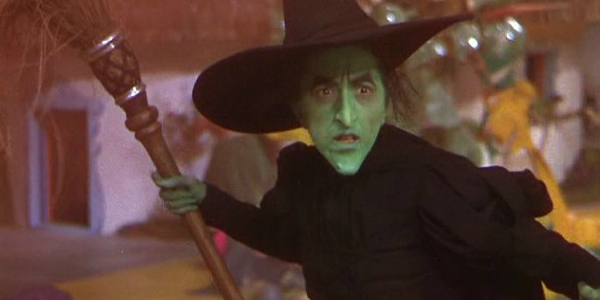
 As many of us already know, Nurse Ratched is one of the greatest movie villains of all time, and so much has been said about Louise Fletcher's outstanding performance. One could say that since she's a villain, why would romance matter? There are so many female villains who are sexual in nature, from the Queen in the various incarnations of Snow White, to Selina Kyle in Batman, to the Borg Queen in Star Trek, to Mila Kunis's Wicked Witch of the West in Oz the Great and Powerful. Nurse Ratched is one who stands on her own as absolutely terrifying without having to hint at any such suggestions. From beginning to end, she is fueled by her own intricate, personal and, unfortunately, very human underlying motivations.
8. Every Single Dinosaur (Jurassic Park)
 Oh yeah. I went there. Okay. So this point's title is a bit misleading, because as we all know, in the first Jurassic Park, some of the dinosaurs "found a way" to reproduce. But we can say with fair certainty that most of the dinosaurs in the movie are girls, and girls whose primary purpose is awe and terror. Furthermore, it is interesting think about how some of them had to become males to begin relationships, which I think turns the romance convention on its head. Regardless, Jurassic Park is filled with very interesting female dinosaur characters. Whether they're plucking lawyers off toilets, sneezing on kids, or searching relentlessly for protagonists throughout compounds (even surprising the resident Great White Hunter Robert Muldoon), this movie really shows how females of any species can carry a movie and not be in a wedding or one-night stand by the end of it. Sure, you think, everyone likes dinosaurs and would have watched this movie no matter what, but I think part of what has made Jurassic Park hold up and stand out so well isn't just the special effects, isn't just the hilarious awesomeness of every single line, but because of the underlying themes as well. The dinosaurs have the freedom to go beyond the human female characters, who pretty much fall into expected family roles by the end, as they do in many thrillers. I don't think a female character has to be a gigantic carnivorous dinosaur who gets napalmed off-screen at the end to command respect, but still. Great movie. Clever girl(s)...
7. Pretty Much Every Actress In A Christopher Guest Movie
 Most of the pictures above are from one movie. But still. In any Christopher Guest movie, the female characters are just as hilarious on their own as the male characters. Even when they're in relationships, romance isn't a focus because of the satirical nature of Guest's films. Everyone is just entertaining as people. Both the men and women characters are able to play with their comedic talents just as appealingly, superbly bringing their own signatures to stories that are just as smart and telling about American society. It's always done so well, and so differently than most comedies. The movies' combinations of improvisational styles and random specialized subject matter give the movies such a fantastic pace and tone that is just wonderful to watch. The fact that the roles are just as random and free within those stories is even more delightful.
6. Dorothy Gale (Return To Oz)
 Return to Oz is my second-favorite movie for a lot of reasons (those who really know me are probably wondering why it took me so long to mention it), and one of those reasons is its interpretation of Dorothy Gale. It takes what makes her character great in the books and goes even further by giving her ingenuity practical, very real meaning. Dorothy is a step above many other protagonists her age, and, no matter how much the 1939 Wizard of Oz claims a special place in your heart, this Dorothy is a step above the Judy Garland one as well, because this Dorothy is legitimately thoughtful, insightful, and, most of all, is a problem-solver, able to get out of even the worst situations through her own spirit as well as teamwork. In the 1939 Wizard of Oz film, Dorothy isn't relegated to romance, but she is consistently portrayed as a definition of innocent in which most of what she achieves happens by accident, and is consistently flabbergasted at anything that occurs around her. She doesn't read anything into the world beyond what she sees. She is not so much determined as strong-willed, yet is a frantic spectator of her own life. I'm not saying this is Judy Garland's fault; this version of Dorothy is what the filmmakers wanted, despite the presence of strong female characters in existence at the time. Very tellingly, her version of Dorothy is the one primarily revered and held as beloved by most of Western culture. Dorothy in Return to Oz, on the other hand, is also innocent, and she has the curiosity of a child, but she is legitimately and refreshingly logical and perceptive, and it's frequently her resourcefulness that gets her out of her situations, whether just by asking questions and taking it upon herself to escape from Dr. Worley's facility, or escaping the overwhelming horror that is Princess Mombi, or restoring the Emerald City with all of her friendsand living enemiesintact. Sure, Dorothy leaves some elements up to chance, but she really is a force to be reckoned with among those who would try to oppress her, and not just by sliding under the grown-ups' legs while running away. In fact, it's much more entertaining. Return to Oz's Dorothy Gale is a great role model for kids and adults. She can grow up to be whatever she wants, on her own terms, based on what's important to her, all while retaining and applying the wonderful possibilities of her imagination.
5. Leona (What Dreams May Come)
 Leona is such a rich, complicated character that brings such a great deal to What Dreams May Come. In a movie about the afterlife, Leona's "heaven" represents her feelings and emotions in a way that not many settings can or bother to do in many movies, and her quiet, positive, enlightened yet grounded personality both supports the setting and forms a window into a beautiful, moving character. The movie is one that really takes its time to achieve a very mature, weathered tone, and Leona gives off the energy of a person with many years of emotion behind her with a lot to talk about, and her conversation is about something very deep, a theme that is rarely addressed in such a way. At the same time, she is a supporting player in the movie, but just as much a part of the main protagonist Chris Nielsen's journey as the resolution of her own, whose personal universe is entirely intertwined with Chris's, and it culminates wonderfully with a beautiful moment in a boat.
4. Charlotte (Charlotte's Web)
 Charlotte is one of the most insightful characters ever created. I haven't seen the entire 2006 version of Charlotte's Web, but from what I have seen of it, her character has many core elements in common with the 1973 version. Charlotte has an arc that's seen primarily through the eyes of Wilbur the Pig, so we only see her from a distance. Charlotte is a tiny, insignificant creature who takes it upon herself to work incredibly hard to save the life of one young pig in the line of many others who will be slaughtered just the same by the society that wrote and watches Charlotte's Web. Charlotte knows about this way of life, but decides to help Wilbur anyway. We don't see how she eventually becomes pregnant, but her life and her characterization aren't about thatshe is about a much greater point, what life means in its entirety. She doesn't patronize and she doesn't sugarcoat, but manages to have a positive outlook, full of peace, and is there as much as she can beall in all, an excellent person to be around (unless you're a fly, but that's also part of life). Charlotte is one of the most important characters anyone can remember, and she ends up at just as interesting a conclusion.
3. Celie Johnson (The Color Purple)
 Celie Johnson goes through so many things over the course of The Color Purple that I'm always amazed the filmmakers were able to bring all that they did to the screen. And Whoopi Goldberg shows how fantastic an actor she really is. Celie goes through so many horrific forms of abuse over the course of her lifebrought upon by her father, her husband, society, and her husband's friends and family. And in the end, she breaks free of her multifaceted oppression. But even with all she goes through, this movie never forgets that it's about the rich complexity of Celie's experiences and perceptions. It's not about her physical relationships, but about her life experience, reactions, and efforts; her emotional and intellectual evolutionnot her powerlessness in being beaten or being rescued. And Celie really is an interesting person. And not only is she a tremendously active, dynamic, and organic character in what could have easily become a passive, consistent situation, but her outlook is very inspirational. She does not give into hate or bitterness, even with all that she knows and when things seem overwhelmingly hopeless, and finds a life she is happy with instead. Similar stories have been repeated so many times before and since, but rarely with this much humanity. Anyone can say, "Be positive no matter what," but this movie really knows what that means. It is an excellent reminder for a variety of reasons, with a great character to take us there.
2. Ellen Ripley (Alien: Resurrection)
 I know most people want to praise Ellen Ripley in Aliens, over and over and over again, and deservedly so. Her character is very interesting in that far more entertaining movie. But we can learn even more from thinking about Alien: Resurrection. Alien: Resurrection is certainly a flawed movie to say the least. But the character of Ripley really does come together in a lot of interesting ways (no pun intended). She has to come to terms not only with her origins as a clone but with many other aspects of herselfher "longevity," her "memories," and her genetic makeup containing Xenomorph material. She interacts with the other characters in fascinating wayshuman, synthetic, and Xenomorphthat are simultaneously enigmatic, awe-inspiring, and scary. Ripley goes far beyond her role as survivor in Alien, mother to new family unit in Aliens, and heartbreaking sacrificial hero in Alien3. As many other writers have observed, in this movie, which I won't even call underappreciated, Ripley retains her complex femininity and brings it into extremely unsettling territory. The movie takes the human motherhood concept and turns it on its head in many very, very grotesque ways. Ripley is ultimately the mother of a monster, and must come to terms with that as well. She seems to feel tremendous love and empathy as well as incredible revulsion and duty about it, and whether through its vague tone or on purpose, the movie blurs the lines. I think the movie comes from a very good and ambitious place in trying to strike a balance between wanting that happy ending we all wanted at the end of Aliens while also taking the lead character somewhere and evolving her (no pun intended) in the spirit of the series, even if it doesn't successfully achieve both of those things. It's too much to ignore.
1. Sarah Connor (Terminator 2: Judgment Day)
 I think Sarah Connor in T2 and Ripley in most of the Alien movies are similar in a great many respects, but Sarah goes even a step further than Ripley in the Alien movies. Sarah is the complete opposite of what she was in the first Terminator movie, and like Ripley in Aliens, it's a logical evolution of her character. But so many layers are organically added to that evolution. She is haunted and driven by the specter of Judgment Day, and the cause of stopping it comes above all else. Added to that are her memories of true, deep love for Kyle Reesewhich is past the prospect of creating a family unit at the end of Aliens (which also included a guy who looked like Kyle Reese); she has places to go past thatthe strained, awkward relationship with her son John that is lost between love and duty, and the uneasy truce (in her eyes) with the latest Model 101, this time sent into the past to protect John. And those are just the initial things she has to deal with. As the story unfolds, Sarah has to come face-to-face with the dichotomy of her mission's importance and the nuances of her own humanity, the fate of herself as well as those around her, the confusion between who she is underneath it all and what she has learned over the course of her life, the emotional and the logical, compassion and survival, creation and destruction, natural and unnatural, masculine and feminine, society and realitynot just through herself, John, and the Terminator, but through interaction with Miles Dyson. And where she winds up by the end of the story on her ragtag team is absolutely excellent to watch and think about. What's also really cool is that Sarah isn't even the primary focus at the beginning of the story. She's collaterala setback, a side mission for John. But she has a presence all her own just as much as the other characters, and proves to be crucial to the outstanding thematic success of the overall story. Sarah makes an awesome movie even better, and helps it achieve its uplifting and inspiring goal. It's awesome.