13 Movie Moments That Surprised The Hell Out Of The Audience

Mind genuinely blown.

As Kirby Ferguson€™s web series told us, €œEverything is a Remix:" all of the big hits and films are variations on the same stories, told over and over again, with the serial numbers filed off and repackaged to make them look new. But sometimes, in those remixes, an original moment crops up; sometimes it€™s subtle, but it changes the entire way you look at the concept, and sometimes it€™s strong, making you reassess the entire subject. And sometimes it€™s so jaw-droppingly stunning that you have to pick yourself up off the floor, thinking, €œDid that really just happen?!€ These are the moments that endure: the mind-blowing, or mind-bending flashes of brilliance or difference that the film's success ultimately distils down to, and the ones that will endlessly be recycled, with "you won't believe what happens..." at their front. Not always brilliant, these moments defy expectations in a way that is infinitely valuable to particularly well-versed movie audiences who grow cynical and weary in their familiarity with endlessly replayed tropes, and they deserve their plaudits. With that in mind, we've compiled a list of moments where something happened that, given the conventions of the genres the films inhabit, the writers/directors/actors did something that made us do what can only be described as "Neo face"...
Warning: Spoilers ahead. If you don€™t want to know, don€™t read the entry for that film.

13. Political Allegory In The MCU?! - Captain America: The Winter Soldier

Reviews for the Cap sequel have all praised the 1970s political thriller feel imbued in the film. They even got Robert Redford, who built his career on political thrillers in the 1970s, and whose grandkids convinced him to take a part in the MCU, to play the heavy in the film. Steve Rogers is a man out of time, from a time when a man was measured by his honesty, and €œDuty, Honor, Country€ was practically the national motto. Since The First Avenger had him frozen in World War II and waking up in 2011, the film couldn€™t take the tack the comics had with Cap fighting the Cold War, then the political establishment, but that didn't mean they had to ignore that approach entirely. The plot draws heavily on established tropes of political intrigue movies: a shady, duplicitous military project, a global spy network, and the patriot's suspicions, which Nick Fury uses against the forces that sought to wipe him out. The Winter Soldier borrows elements from 1970s political thrillers Three Days Of The Condor (which also starred Redford), The Parallax View and Marathon Man, but it is also very topical and current, considering the current situation featuring the U.S. National Security Agency (NSA) and the revelations by whistleblower Edward Snowden. You expect such things in a political thriller, and comic book readers have even come to expect them in the comics, with the Civil War and Watchmen series coming to mind, but if you€™re not a regular comic book reader, it€™s a strange thing to find political commentary in a comic book movie - especially when it€™s done so well.

12. A Machiavellian Disney Movie?! - Frozen

Disney€™s Frozen has become the highest-grossing animated film of all time (not adjusted for inflation) and it isn€™t even a Pixar film - that's some achievement. Loosely based on €œThe Snow Queen€ by Hans Christian Andersen, it tells the story of two royal sisters: Elsa, who has the ability to manipulate cold, snow, and ice; and her younger sister Anna, who has no powers. A childhood accident illustrates how dangerous Elsa€™s powers can be, causing their parents - soon to be killed - to contain them in the castle in order to avoid striking fear into their subjects. Naturally, Anna meets a typical Disney romantic lead, who seems heroic and steps in to guide the country through adversity when Elsa's powers get out of hand and Anna is forced to abandon her own post to seek her out, and lift the unwitting winter curse. Eventually, Elsa accidentally almost kills Anna, and when she is imprisoned, and her dying sister is taken home, in pursuit of the true love's kiss that will save her, her apparent knight in shining armour flatly refuses to oblige. Wait. What?! A Disney Prince refusing to kiss a Princess? It gets worse: Hans then goes on to explain that, given his status as the 13th in line in his kingdom, he would never be king, and he therefore planned to marry Anna in order to give himself a better chance. Now he will use Anna€™s impending death as justification for killing Elsa, giving him a clear shot at the throne of Arendelle. That level of political sophistication is unheard of in a Disney cartoon. Younger children just look at Hans as being a good guy who turned into a bad guy, but this is plotting of Machiavellian proportions. It€™s almost something you would expect in a Die Hard film instead.

11. It's The Little Things That Matter - Harry Potter And The Deathly Hallows, Part I

After Ron Weasley (Rupert Grint) gets into his Horcrux-fueled snit and storms off into the night, Harry (Daniel Radcliffe) and Hermione (Emma Watson) are left alone; the former is upset at the lost of his best mate, but Hermione is truly distraught. She€™s sitting there, moodily staring at nothing, listening aimlessly to Ron€™s radio as Nick Cave and the Bad Seeds plays €œOh, Children.€ Harry gets up and walks over to her, removes the Horcrux from around her neck and sets it aside, and then, taking her hands, he starts to move them in cadence with the song. She looks slightly exasperated, but soon mellows out and even giggles a bit as Harry attempts - badly - to dance, but as the song ends, her expression returns to sorrow, and she drops Harry€™s hands and turns away. Of all the scenes in the film, that probably was the most controversial among the Potter faithful. It€™s been established in the books and films that Harry and Hermione€™s feelings for each other are more sibling-like than anything else, but this little charming scene set off a firestorm in the Twitterverse, blogosphere and Facebook domain, with a lot of people calling it names bordering on the sacrilegious. Harry realized that the enormity of losing Ron was weighing down on both of them, and the emotional draining power of the Horcrux wasn€™t helping either of them deal with it very well. And crucially, since series author J.K. Rowling was an executive producer of the film, the scene couldn€™t have happened without her blessing, and for the complainers, it becomes a case of hit the €œnext chapter€ button.

10. Tell It Like It Is! - Harry Potter And The Deathly Hallows, Part II
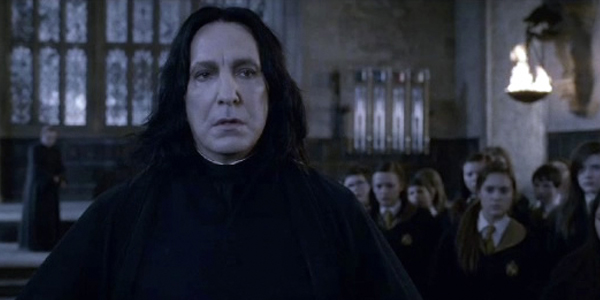
All of the Hogwarts students are roused out of bed and ordered to march down to the Great Hall for an important announcement by the rarely-seen Headmaster Snape (Alan Rickman): Harry Potter has been sighted in Hogsmeade. After a nasty admonition about how withholding information about Potter will be treated in the harshest possible manner (delivered in Rickman€™s most supercilious tones), he €œinvites€ anyone with knowledge of Harry€™s whereabouts to step forward € now. There's a moment of silence, then a stunned gasp as someone walks into the centre aisle, and holy hippogriffs, it€™s only HARRY himself! He rips Snape on his security measures (as the rest of the members of the Order of the Phoenix walk in), and then tears into him on the subject of Dumbledore€™s death. Yes, we as the audience knew that Harry was already in the castle, and we knew that Snape knew about Harry€™s appearance in Hogsmeade (even though he was actually never seen by the Death Eaters), but this dramatic appearance by Harry in the middle of the Hogwarts crowd was one of those galvanizing moments, especially when he told the school what really happened up on the Astronomy tower the previous year. This is a much more emotionally satisfying moment than was presented in the novel, which had Harry hiding under the Invisibility Cloak with Luna Lovegood while Professor McGonagall confronted Snape. One might speculate that the idea was taken the book in the moment when Harry took off the Cloak in the middle of the Great Hall to face Voldemort in the final battle.

9. The Canon Violation - Star Trek (2009)

Trek has played around with alternate timelines in several episodes of the different series, and with the reboot, TOS fans knew that an alternate timeline was in play as soon as Kirk€™s father died aboard the USS Kelvin, and then subsequent events confirmed it, before Spock eventually says it out loud. The biggest stunner in the film has to be the destruction of Vulcan, one of the core planets in Star Trek canon. It later turns out that Romulus, home of the Romulan race, is also destroyed, but that€™s glossed over as part of Spock Prime€™s (Leonard Nimoy) story. The importance of Vulcan to the Star Trek canon is immense: it was actor Nimoy€™s portrayal of the half-human/half-Vulcan Spock that caught the attention of legions of fans. The various series and subsequent novels have all offered tantalizing glimpses into the history of Vulcan and Romulus, and now both worlds are gone, not to mention 29 seasons (three years of TOS; one year of the Animated Series; seven years each of Next Generation, Deep Space Nine and Voyager, and four years of Enterprise) are basically now all for naught. Series creator Gene Roddenbery is on record as saying that he hoped that someone would come along and remake the series €œbigger and better than he had ever done.€ Since the reboot and it€™s subsequent sequel have outgrossed the other 10 films that have been released, it looks like he got his wish, at some cost.

8. The Refreshing Truth - My Big Fat Greek Wedding

This charming romantic movie has a claim to fame as being the highest grossing romantic film that never hit number one at the box office. Based on the one-woman play by star Nia Vardalos, it told the story of Fotula €œToula€ Portokalos (Vardalos), a middle-aged Greek woman who falls in love with a non-Greek man (John Corbett) and marries him with the (at first) begrudging support of her large family. Heading towards "unmarriable age" Toula falls in love with Ian, a teacher, counter to her family expectations of her being a good Greek girl: she hasn€™t married a good Greek boy and had lots of Greek babies. The pair are smitten but Toula knows that her father (Michael Constantine) will not approve of her choice, as Ian is definitely not Greek. Ian is forthcoming about his background, but Toula demurs as Ian presses her for details of her family, but finally, she blurts out how different Greek traditions are from his traditional ones, and she €œdoesn€™t think this is going to work.€ Ian listens calmly, and then replies, €œSo you€™ve got a weird family. Who doesn€™t? I just want to spend time with you.€ This subtle shift to the truth is what sets this film apart from most other romantic comedies. The usual formula would have been for Toula to lie about her family history and the rest of the film would have exposed the ever-expanding consequences of that first white lie.

7. "I Am A Leaf On The Wind..." - Serenity

The short-lived but dearly beloved Joss Whedon series about a motley crew flying essentially a moving truck in space got a second chance at life when Serenity was greenlit; Whedon reuniting the cast and put together a script that not only satisfied fans, but won new ones who had missed the show. Movie audiences didn€™t get much time to grieve over the death of Shepherd Book (Ron Glass): since he was on screen for probably less than five minutes, we didn€™t have that much invested in him (although the Browncoats in the audience were probably gasping in horror), but after Wash (Alan Tudyk) managed another brilliant landing for the battered Serenity, a javelin-type spear pierced the cockpit and his chest. Zoe (Gina Torres) cried for him to €œget up, we got to go,€ but he was already dead. As the voice of reason (and deadpan humor) on the ship, it was a shock to see him die just after he€™d managed to save the ship; his heroism adding a greater note of tragedy to his death.

6. Haven€™t You Guys Ever Heard Of Lèse-majesté? - South Park: Bigger, Longer And Uncut

Even though the unlikely animation hit was on cable television, it still had to conform to Federal Communications Commission rules - no swearing or nudity - but that all changed in 1999, when it hit the big screen. The animation hadn€™t changed much, but it could get away with a lot more than it did on television, which lead to plenty of stunner moments: the Terrance and Phillip song €œUncle €œF*cka€; Kenny€™s trip to Hell, where he meets George Burns, Hitler and Gandhi during the fall; the idea that a war with Canada would start over naughty language. But the use of Iraqi dictator Saddam Hussein, who was very much alive and in power in Iraq at the time, as Satan€™s sadistic gay lover, was fascinating and horrifying at the same time. As the film progressed, and as the character grew more and more debased, one wonders if creators Trey Parker and Matt Stone ever heard the harrowing story about how Saddam Hussein ordered the assassination of former U.S. President George H.W. Bush? Since the film was never released in Iraq, one might assume that Hussein never saw it. Maybe no one dared to tell him, and no execution orders have ever been issued, as far as we know. And now that Hussein is really curling his toes in Hell, perhaps his sentence in the Fields of Punishment is to watch this film on an unending loop.

5. It's Only Obvious On The Second Viewing - The Sixth Sense

Director M. Night Shyamalan has been pilloried for his bad films: from The Village onward, his films have gotten such consistently bad reviews that it€™s almost become a cliché, and it's almost enough to make us almost forget that his first big hit, The Sixth Sense, rocked the world upon its release in 1999. The well-versed long and short of the story following "gifted" and troubled Cole Sear (Haley Joel Osment) and child psychologist Dr. Malcolm Crowe (Bruce Willis) is that in helping Cole find out his duty to the ghosts (which, when you think about it, seems a remarkably odd thing to put on a child), Crowe finds out he's been dead all along. If you watch the extras on the DVD, they point out the clues that Shyamalan used to indicate which characters were alive or dead: selective use of the color red; Crowe€™s clothes; scenes where Crowe is in the frame with living people but does not interact with them, and it's like a slap in the face. But that doesn€™t mean that it didn€™t blow your mind when you realized that Crowe was dead for the whole film.

4. You Killed WHO In The First Act? - Executive Decision

In 1996, when Executive Decision hit theatres, martial arts action star Steven Seagal€™s bankability was starting to decline. Most of what he did in later years wound up direct-to-video, but he was still a name when this film came out. In the film€™s opening, he plays Lt. Col. Austin Travis, the leader of a U.S. Army Special Forces team that failed to recover a stolen Soviet nerve agent and lost one of its men in the process. So he€™s got a score to settle. In Washington D.C., the nebbish Dr. David Grant (Kurt Russell), a terrorism expert, is informed that a leading terrorist has been captured. Shortly after, an Oceanic Airlines 747 heading for Washington has been hijacked; they demand the release of their leader, however, intel indicates that the plane is really carrying that stolen nerve agent. Travis€™ team boards a modified F-117 Stealth aircraft with Grant tagging along as an observer. The plan is to fly under the plane and attach a sleeve to the 747€™s cargo hatch, allowing the team to board in secret, but the plane€™s captain alters the course in mid-transfer, causing the sleeve to break, and Travis has time for a last look at Grant before being blown into the atmosphere, falling to his certain death. Wait a minute. Seagal is the badass who is supposed to roundhouse kick all of the terrorists and save the day. Did they really just kill off one of the biggest action stars in Hollywood in the first reel €“ before the action really started? He didn€™t even get to dispatch any terrorists! This is on the same level as killing off Marion Crane (Vivien Leigh) in Psycho in the first act.

3. Never Leave Your Weapon Unattended - Pulp Fiction

In Pulp Fiction when Butch Coolidge (Bruce Willis) returns to his apartment to retrieve his father€™s precious watch (at great personal risk), he finds it seemingly empty so makes himself some PopTarts before glancing around the kitchen to discover a silenced MAC-10 machine gun lying on the counter. Picking it up, he inspects it curiously, as if wondering on its presence, when the toilet flushes and Vincent Vega (John Travolta) steps out of the bathroom. The two stare warily at each other; Butch holding the machine gun pointed at Vincent, and when the toaster pops, Butch instinctively hits the trigger, riddling Vincent in a hail of silenced bullets. The €œwhoa€ moment is, of course, that director Quentin Tarantino killed off one of his primary characters when we as an audience had already invested a lot in him as a character - possibly more than any other in the film. In Army Basic Training, all of the troops are instructed about weapon security. The mantra was, €œNever leave your weapon alone.€ Your weapon should be within three feet of you at all times, preferably on your shoulder if not in use, and at night, you were to keep it inside your sleeping bag, and woe betide the private who had a mental lapse and walked away from his weapon. The wrath of the drill sergeants would come down like a fury from Hell. Vincent€™s little mental lapse cost him his life, just like the drill sergeants said it would. There had already been a lot of €œwhoa€ moments in the film already, but that was especially ballsy.

2. Oh, The Hell With This! - Raiders Of The Lost Ark

The scene: a crowded Cairo marketplace. Marion Ravenwood (Karen Allen) has just been kidnapped by Nazi thugs, and Indiana Jones (Harrison Ford) is frantically searching for her. Suddenly the crowd parts, and a warrior brandishing a huge scimitar is standing there, laughing evilly and ready for battle. What does our hero do? Why, pull out your pistol and shoot him dead, of course. No questions asked. During filming of Raiders in Tunisia, most of the cast were sick with dysentery, including Ford. For the scene in question, a fight had been carefully choreographed (you can see Ford preparing for the fight as the camera focuses over the swordsman€™s shoulder), but after several takes, director Steven Spielberg wasn€™t satisfied, so Ford, just wanting to go back to his trailer and rest, suggested €œLet€™s just shoot the sucker." The result was film history: audiences roared at Indy€™s simple solution to the problem, and it was even spoofed in The Temple Of Doom.

1. That's Impossible! - The Empire Strikes Back

You didn€™t really think this one wouldn€™t be here, did you? Hanging out over the abyss that is the Bespin mine€™s central shaft, Luke Skywalker (Mark Hamill) has just lost his hand and lightsaber to a well-placed strike by Darth Vader (body by David Prowse, voice of James Earl Jones). Vader invites Luke to join him in embracing the Dark Side of the Force, with the goal of unseating the Emperor and taking power together. Luke refuses, screaming, €œI€™ll never join you!€ Vader shifts tactics.
Vader: €œObi-Wan never told you what happened to your father, did he?€ Luke: €œHe told me enough. He told me you killed him.€ Vader: €œNo. I am your father.€
Cue a thud as the collective jaw of the audience drops. This €œsecret€ has become a punch line in the intervening years since the film€™s release, mocked in several films, books and TV shows. Younger audiences, who didn€™t see it in its initial release and who have the prequels to distract them from it, don€™t realize the impact that this had on the Star Wars universe. Back in 1980, we were blown away by this revelation; there were no €œscoop€ websites that revealed the surprise, and the reviewers were kind enough to indicate that there was a major plot point to come, but didn€™t give away the surprise. (Of course, if you had picked up the novelization, released a month prior to the film, you would have already known.) It€™s said that only five people knew of the secret during filming: producer George Lucas, director Irvin Kershner, writer Lawrence Kasdan, Mark Hamill (told just before the scene was shot) and James Earl Jones (told when he was doing the voice-overs). David Prowse complained bitterly about the change, stating that he would have done some different things if he had known, but then since he really wasn€™t much more than the physical representation of the bad guy, he really didn€™t have much room to complain. Can you think of any more moments that genuinely shocked you? Let us know in the comments below.

Contributor
Contributor

Mr. Thomas is primarily a graphic artist for the San Antonio Express-News, but also finds time to write the DVD Extra blog for the paper’s website.