13 Problems That Almost Ruin The Hobbit: The Battle Of The Five Armies

There's something a bit broken here at the end of all things.

It€™s the end of an era: the culmination of almost twenty years of creative work by Peter Jackson and a sprawling cast to adapt two of the most important literary works in the history of the written word. But did Peter Jackson manage to pull off two trilogies perfectly? Well no, but then the Hobbit was always a more difficult sell: it€™s not as compelling, not as dark and not as grown-up as the Lord Of The Rings, and plainly put, it€™s just not as interesting. But there was lot in there to justify adaptation, even if the method remains questionable. At the end of the day, The Hobbit trilogy is just good enough: it is forever condemned to be the little brother of an over-achiever, whose merits will always have that caveat €œ€but it€™s not quite the Lord Of The Rings is it?€ In truth, a lot of that is well-placed: it€™s too long as a trilogy, it lacks the resonance of the other trilogy - perhaps because the text just isn€™t as good in the first place - and it feels like Peter Jackson was significantly more invested in the idea of the thing than any audience possibly could be. He wanted everyone to love it, but his fandom was at times a little more insistent than the delivery of his production. So now that the final film is out, it€™s time to look at some of the biggest issues with Jackson€™s vision. Inevitably spoilers do follow. If you do not wish to read discussion of some of the major plot points of The Hobbit: The Battle Of The Five Armies, turn away now.

13. The CGIed Billy Connolly

Why oh why did Dain have to be a CGI dwarf? Billy Connolly€™s vocal performance was a good addition, but building a character from scratch (when no other dwarves were) was a distracting mistake. Had it been done better, perhaps it wouldn€™t have been so, but unfortunately it was a low point. The CGI in general is a little iffy - particularly when showing acrobatic sequences for characters (like Legolas more than most for some reason) who end up looking like rag dolls. Looking back at the first Matrix sequel it€™s hard to see any advancement in the area at all. Had he followed through, Guillermo De Toro would have used animatronics and more practical effects, which now looks like a major missed opportunity, and you have to suspect that even sticking with the make-up/CGI mix of the Lord Of The Rings would have been better.

12. The Fight Choreography

You have to wonder about the logic of spending a massive amount of money and time on setting up massive set-pieces and effects and then shooting it in close-up that undermines the whole point of having a cinematographer. The camerawork is too fancy and artful for sequences that deserve to be shown simply and without unnecessary framing flourishes. Also, if you compare the fight sequences to those in the Lord Of The Rings (an inevitability, and an unfortunate one, frankly), they just don€™t have the same kind of threat. Even when faced with gigantic beasts (like the oddly familiar earth eaters that look like they€™ve been ported in from Tremors) the choreography never really makes it feel like the odds are in any way stacked. Perhaps that's because everyone knows most of the outcomes, but the lack of a surprise for most of those toe-to-toes combined with the way they're framed robs something. The problem is that so much of the combat is shown in super slow motion that it€™s impossible to really believe the threat: when everything is injected with false importance or emotion, none of it rings true. Jackson clearly wanted his one-to-one battles and scores to be settled, so the fighting is a lot more personal at times, but there isn't enough of the grand staging and voyeuristic camera work that made the same sort of scenes in The Lord Of The Rings so good.

11. The Idiotic, Unsatisfying Villains

The problem for the end of the Hobbit was always going to be the lack of a really compelling Big Bad: both Smaug and the Necromancer are seen off in the first third (which feels rushed to get to the battle) and the source book€™s lack of a replacement (other than Bolg, who was killed by Beorn in the books rather than a dwarf, elf or hobbit) didn€™t offer any solution. Instead Jackson changed Middle Earth history, saving Azog The Defiler from death in the opening battle of the first movie and giving him elements of Bolg€™s story. Bolg then became a secondary villain, splitting one underwhelming villain in half, with somewhat inevitable results. The problem then was that two villains had to be dealt with, and the writing simply didn€™t match up to Tolkien€™s original. Instead of being skilled, genuine threats, both of them end up being killed because they both stand on some ice and then break it themselves. Seriously, it happens twice.

10. It€™s All Very Uneven

Because of the decision to chop the second film in half to make a trilogy at the point where Smaug heads to Laketown, there€™s a rather abrupt start to things, as the audience is dropped into the middle of a sentence. From there it€™s a rather break-neck sequence, with impressive effects and an engaging stand-off between the dragon and Bard, before the equally important fight between the Necromancer and the white council. But then the film comes to a natural end point (probably where the second film should have ended frankly) and has to build again from zero for the climactic battle of the five armies. It€™s a jarring change of pace and it doesn€™t help that the lead up to the battle feels very much like Jackson has pillaged appendices and footnotes to stretch it out. Generally speaking it seems like some of the most important parts are rushed (like the ending and the opening third) so that Jackson could heap emphasis on things that mattered less, like his fondness for pregnant, furtive glances and solemn, important romances.

9. Richard Armitage

His casting was always a sore subject for some (and the revelation that Bryan Blessed could have taken the role), but he did do pretty well with the first two movies even if his automatic setting seemed to be surly. If he was one of Snow White€™s company, he€™d undoubtedly be Grumpy. But in the final film, Armitage has a little too much to do in emotional terms and there€™s not a massive change from his default demeanour to really sell the fact that he has dragon sickness. It is to the film€™s great loss that Jackson didn€™t choose to make Thorin go through the kind of transformation that Theoden underwent in the Lord Of The Rings, and unfortunately Armitage doesn€™t really convince in that key respect. It seems Armitage - and his performance - will inevitably remain a Marmite decision, and while the casting could have been a lot worse it could also, sadly, have been a lot better. But that's what you get when you cast an actor known mostly for TV work.

8. The Anti-Capitalist Message

Tolkein€™s entire Middle Earth world was very much impregnated with an anti-industrial message: Sauron€™s plundering of the land for his own gains and his €œnew war€ techniques stood in contrast with the nature-loving armies of elves, dwarves and men. Very basically, it€™s all a hippy fantasy, and it worked marvellously, including in the Lord Of The Rings films. Unfortunately, perhaps because Jackson wanted to over-sell the politicised message of the Hobbit (the dangers of greed and capitalism) the undercurrent makes way for sledge-hammer obvious preaching. Thorin€™s nightmare sequence where he battles with his thirst for gold is aesthetically pleasing, but at times it feels like some of the characters should have been been holding placards in support of some Occupy Middle Earth protest. Subtle, it really isn€™t.

7. The Frozen River Sequence In The Trailer

Remember that exciting looking sequence in the trailer when the dwarves are chased on the frozen river by wargs? It looked mighty impressive didn€™t it? Such was the excitement sold on it that some jokingly suggested it was likely to be over-extended in Jackson€™s usual manner. The thing is though that it didn€™t actually make it into the final film: the cinematic cut (which is a suggested 25 plus minutes shorter than the director€™s cut) is mysteriously without such a sequence, and yet there are at least five lingering shots of Tauriel crying. Cut them down to a couple, and Jackson might have had time to put in the impressive looking set-piece that was ridiculously submitted as a key element of the final trailer. Of course things have to be cut for run time - and Jackson was in fact uncharacteristically restrained in that respect - but it€™s disappointing not to see the culmination of that sequence. And if you're keeping track, the battle goat charge doesn't make it either.

6. It's All A Bit Hollow

Perhaps because the film is basically a sequence of set-pieces and momentous moments (which are loaded with fan service and the kind of mythologising of characters that becomes tiresome pretty swiftly), it€™s almost impossible to make any room for actual character development or anything like an arc. Fans might be massively excited by the idea of the battle, and in that sequence the currency for Jackson is clearly fan-baiting mega moments. But because there€™s no room to build them up, even the most lavish or weighted moments (including the death scenes) end up falling flat. And unfortunately for Jackson, no amount of heaping emotion onto things or furtive glances can mean anything other than false importance between the punches.

5. It€™s An Endless Commemoration Rather Than A Celebration

As Peter Jackson€™s almost sombre presentation at the London premiere of the film confirmed, this final film wasn€™t just an event movie but also a full-stop on a film-making experience that had lasted since the mid-90s. As the director offered his melancholic reflection that everything was over, you really got the feeling that he had felt the end in very real terms. Unfortunately that has bled into the film in a big way. Rather than being a balls-out celebration of the Hobbit story and the climactic battle, the film is haunted by the fact that this is where the journey ends. Everything is over-shadowed by an almost maudlin sentimentality: as if the ceremony of the film was more important than the actual substance, and it€™s hard not to feel like it€™s a bit of a gravestone that came before any actual death. Some have read that tone as a reflection of the grimness of the story, and perhaps there is some of that, but the endless slow motion and the portentous moments and fan service muddy the waters a little too much.

4. Alfrid Lickspittle

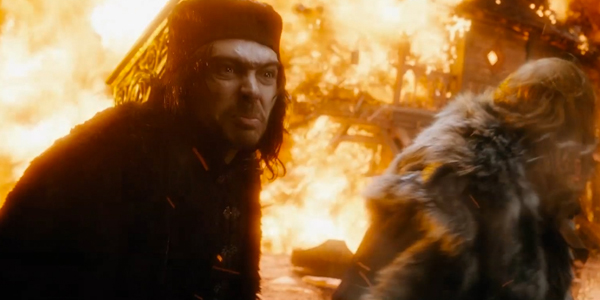
Is this the most annoying character in the last decade of blockbuster films? That might seem like a grand, empty statement - unquantifiable hyperbole for the sake of criticism - but Alfrid is a horrendous addition to the Hobbit. Having been impressed enough with Ryan Gage to expand his role from Bilbo€™s father to a more prominent screen presence, Peter Jackson unfortunately went full Jar-Jar on the snivveling, weasle-like Laketown resident. He€™s a grotesque, a conniving sycophant who is unfortunately and unfairly given more screen time than Stephen Fry€™s Master and sadly it seems the director believes the worthiness of the character a little too much. Alfrid is used for uneven comic relief - much like Binks - and he€™s wholly unnecessary; another new element given way too much focus at the cost of something far more welcome.

3. The Endless Slo-Mo (And The Orgasm Shots)

It€™s no revelation that Jackson likes slow motion to build the emotion of a scene, but in the Battle Of The Five Armies, the director takes one of his trademarks beyond an acceptable level. It€™s fair enough using slo-mo as a device in combat sequences to add emphasis to killer blows, or even to show reaction shots to those moments in slow motion, but to have 70% of all dialogue slowed down unnecessarily is laughable. There is literally no service in the amount of slow motion Jackson uses, and unfortunately for the actors it is almost impossible to convincingly act when everything you do is pushed through a snail filter. Even more unfortunately, almost every single reaction shot is slowed down and extended into a near-orgasmic moan, which becomes distractingly jarring after a while and flat-out ridiculous quickly after that.

2. Tauriel Is Mostly Pointless

The danger for The Hobbit in bringing in new characters, or hyper-extending some like Radagast and Legolas and the White Council is that there€™s nothing really for most of them to do when the film skips back to the original text. In that context, Radagast has precious little speaking time (if any at all), the majority of the company of dwarves have absolutely nothing to do and Tauriel is relegated mostly to a passenger, witnessing important events through perpetually wet eyes. She€™s mostly robbed of her power, though she adds impact to Kili€™s inevitable death and you get the feeling that Jackson didn€™t really know what to do with her for the end. In the end, the director didn€™t really do anything: she got something of a fight sequence (but was upstaged by Legolas), got to tell Thranduil off and became the emotional heart of things for a while, but she was passive in most respects. And then there€™s the question of what happens to her in the run up to Lord Of The Rings since she was spared death.

1. The Elephant In The Room

It was perhaps foolish to expect much of an appearance by Sauron, but the Hobbit as an extended film experience was sold as a bridge between Tolkien€™s original text and the Lord Of The Rings films. Even when the idea of a single bridge film to fill in the 60 years after the Battle Of The Five Armies was scrapped, Jackson still seemed to promise a prequel to The Fellowship Of The Ring. In some respects he delivered - Legolas being sent to see the €œyoung ranger€ was a nice touch - and so too was the lead in to Bilbo€™s 111th birthday party, but the single most intriguing element was brushed aside all too quickly. With Christopher Lee brought in as Sarumon there was always a hint that we might get to see the white wizard€™s temptation by Sauron, but ultimately that only amounted to a mysterious twinkle in his eye and a promise that he should be the one to deal with the rising threat. There was no build to it, and little more than a flash of that now iconic flaming eye, and then that was it done. That still feels like a missed opportunity to tell a part of the story that genuinely deserved to be told, and while a lot of loose ends were tied, that barely hinted at question hangs heavy in the air at the end. Have you seen The Hobbit: The Battle Of The Five Armies? Share your thoughts below in the comments thread and read our full review of the film here.

Contributor
Contributor

WhatCulture's former COO, veteran writer and editor.