15 Funniest Times Movies Broke The Fourth Wall
Oh, Hi, I Didn't See You There.

It's good to see you again. Come on in, I'm just working on this article about breaking the fourth wall. It's that trope you see in TV and movies where the characters are self-aware and realize that they exist within a work of fiction. It goes back years- basically as long as the theater itself- and was used frequently by Shakespeare.
Breaking the fourth wall can be used for many reasons. It can be done to unsettle the audience. Bertolt Brecht and other playwrights used it to help comment on the medium of theater itself. Nowadays, it's most commonly seen in comedies.
When a character breaks the fourth wall, they bring themselves in on the joke along with the audience. Whether it's a narrator inserting themselves more forcefully in the story, or just a brief sly glance by a character showing that they're not quite the dimwit that others think, breaking the fourth wall always adds an extra layer of comic effect.
15. High Fidelity

Rob Gordon (John Cusack), the audiophile owner of Championship Vinyl, is a miserable jerk who loves to wallow in the misery of his own making. And while this could easily have been written in a way to make the audience loathe him, Rob's first-person narration directed towards the audience helps create a sense of sympathy. He even begins the movie by asking the viewer a question: "What came first, the music or the misery?"
By directly engaging with the audience, Rob goes from an unlikable prick to the type of prick that's fun to hang out with, talk about records and go to a show or two with. The audience gets a better look into his psyche and emotional hang-ups than even his best friends and girlfriend do.
But instead of hating him, Rob continually breaking the fourth wall throughout his narration helps the viewer sympathize with him and find humor in his pain.
14. The Ballad Of Buster Scruggs

Sam Elliott's narrating cowboy, "The Stranger", is the most famous use of breaking the fourth wall in the Coen Brothers' oeuvre, but it's not the funniest. That distinction is held by their most recent film, the fatalistic anthology film The Ballad Of Buster Scruggs.
The happy-go-lucky singing cowboy with a penchant for killing introduces himself to the viewers as he strolls along the gorgeous desert landscape. Buster addresses the audience jovially, discussing his journeys through the outdoors, his nicknames and love of singing. He also notes, almost in passing, that he's a wanted criminal.
Tim Blake Nelson's sunny speaking manner and expansive vocabulary, along with his friendly introduction to the viewer, allay the abrupt violence to come, making those scenes a classically Coen combination of shocking and hilarious. Later, he jokes with the audience as he gets cocky mid-duel, shooting a man while looking through a mirror.
The framework of the movie itself also works as an example of breaking the fourth wall. It begins with a book being opened, its pages describing the story about to be told. Each vignette is bookended with the turning pages of the western tome.
13. Hot Tub Time Machine

Breaking the fourth wall is often done in the silliest moments of a movie and when the plot of the movie is a hot tub that can be used to traverse the space-time continuum, ramping up the silly factor is a huge feat.
By the time Hot Tub Time Machine was released in 2010, Craig Robinson had already accrued a small modicum of stardom from his time spent on the US remake of The Office. Though the show had a host of goofy and absurd characters with no insight, Robinson's Darryl Philbin was one of the few people on The Office who seemed to be competent and self-aware.
Robinson brings an element of the pseudo-documentary style of The Office with the best moment in Hot Tub Time Machine. After realizing its powers, he acknowledges that yes, it "must be some kind of hot tub time machine". Robinson stares directly into the camera, straight-faced, as if to let the audience know that he is indeed aware that the premise of this entire film is laughably dumb.
This moment is the filmmakers winking at their audience at the absurdity of the premise, and Robinson's glare is the invitation to just accept the silliness and go along for the ride.
12. Ferris Bueller's Day Off

Like many other comedy narrators, Ferris Bueller addresses his audience directly. They're brought into his scheme and made accomplices during his truant day off through the city of Chicago. He chats about his girlfriend and their relationship, and the troubles haunting his sad-sack best friend Cameron.
The vice principal's secretary notes that everyone in each social clique likes Ferris, and by him directly conversing with the audience, they're made to be insiders. Him talking to the viewer makes them feel cool.
But the best moment of breaking the fourth wall is at the end of the film. Everything is over. The story is done and wrapped up. Why is the crowd still watching? Before that can be asked, Ferris himself does the asking. "You're still here? It's over! Go home!" he says, shooing the audience out of the theater. Watching this after dozens of Marvel Cinematic Universe mid-credit and post-credit sequences, it leaves one wondering if the final Marvel installment will also end in Tony Stark telling us to pack our bags and leave.
11. La Joli Mai

From the French experimental filmmaker and documentarian Chris Marker, La Joli Mai is a travelogue through Paris near the end of the Algerian War. The freeform documentary is comprised of unscripted scenes, including many subjects being interviewed as they walk the streets of the city. Documentary films often break the fourth wall, but perhaps none do so in such a clever and unexpected way as in La Joli Mai.
One man is being interviewed, with the director Chris Marker speaking to him from off camera. The man seems pompous, discussing finances and his own sense of self-importance. While he's rambling, the camera operator notices a spider crawling on the man's jacket. Marker notices it too, but despite the spider skittering up and down frantically, the interview subject remains oblivious.
Instead of cutting, or pointing it out to the man, the lens fixates on the spider, completely ignoring the man's musings. Chris Marker, too, seems to be no longer interested in the man himself, but instead the arachnid on his jacket. When the man struggles to find a particular phrase to describe something, Marker interjects- "like a spider's web?" The man agrees, and continues, hopelessly unaware. It's a wonderful small moment where the filmmakers subtly acknowledge the unpredictable nature of the documentary medium.
10. The Muppet Movie

The Muppets love to break the fourth wall. In their TV shows, this can be seen most obviously in Sesame Street, with characters directly speaking to their young audiences. This helps engage them, facilitating learning and aiding in teaching things like numbers, the alphabet, and manners. The Muppet Show often winked at the audience, portraying a show-within-a-show, even going as far as including its own hecklers in Waldorf and Statler.
But The Muppet Movie, Jim Henson's magnum opus, has the best Muppet moment of breaking the fourth wall. At a low point in the film, the Muppet gang is lost in the desert, their hopes of attaining stardom in Hollywood apparently dashed. Then, seemingly out of nowhere, the rock band Dr. Teeth and The Electric Mayhem appear. How did they know where to find their stranded friends? They had a copy of the script and they just read ahead. Simple as that.
9. Wayne's World

Illinois native Wayne Campbell likes to party, go to concerts, and host a local cable access show out of his basement with his best friend Garth. Multiple instances of breaking the fourth wall are peppered throughout the movie. Garth nudges the camera to confer with him while hiding under a dinner table so he can commiserate with the audience about his suspicions regarding Rob Lowe's scheming character, Benjamin.
The climax of the film is also dependent on information that the characters accidentally learned, which they later acknowledge "seemed extraneous at the time".
But the best example of breaking the fourth wall in Wayne's World is the introduction to Wayne himself. After having already seen a clip from his TV show, he directly introduces himself to the audience. He's charming and self-deprecating, acknowledging that he doesn't really have a career, but has instead amassed a collection of name tags and hair nets.
It's a funny moment, but also helps establish Wayne's aspirations; his ideal career would be to do his show Wayne's World for a living. (Chyeah, and monkeys might fly out of his butt!) Everything someone would need to know about Wayne they learn within this brief introduction- the way he talks, his lovable slacker past, and his motivations for the future.
8. Tampopo
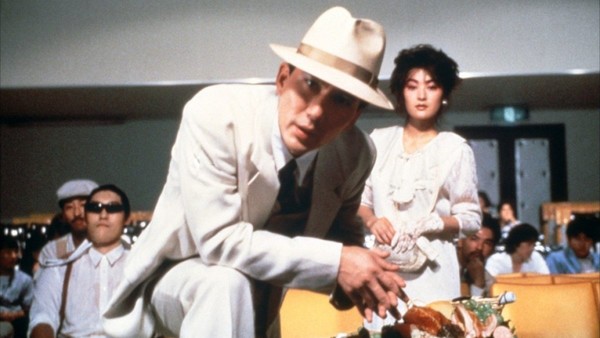
In the world's premier Ramen Western, Juzo Itami's Tampopo meanders through multiple disconnected storylines involving food. Food and its relation to death. Food and its relation to sex. The hardships of creating the perfect ramen and finding a way to sell it efficiently.
But before the treatise on ramen and foreplay with raw eggs, the audience is warned to be quiet while the movie is on. In most theaters, a cartoon box of popcorn gently reminds the viewer to turn off their cellphones and not to disturb the other patrons during the movie.
Tampopo takes a more aggressive route, with one of the films gangsters sitting in the front row of a theater, his moll's head on his shoulder and food laid out in front of him. He notices the audience, leans in front of the camera and asks what food they're eating. He bemoans hearing alarms go off during movies and complains about noisy eaters in theaters, even threatening to kill a man in the row behind him if he continues to chomp down on his snacks during the film. As Tampopo begins, the lights onscreen dim and he too notes "our movie's starting."
7. Deadpool

One of the most defining qualities of Marvel’s favorite antihero is his constant breaking of the fourth wall. Since his debut in the comics nearly thirty years ago, and now in more recent appearances in two massively successful blockbusters, Deadpool has paid no regard to the typical boundary between himself and the readers and viewers.
While the trope is omnipresent throughout the movie, its most memorable use is during the opening credits sequence. The filmmakers lampoon the action genre with a Zack Snyder-esque slow motion pan through a scene of violence.
The credits then pop up, introducing us to what they refer to as "some douchebag’s film.” People Magazines with Ryan Reynolds on the cover flutter onscreen. The credits continue, noting that Deadpool stars an idiot, a hot chick, and a British villain. And of course, it concludes by noting the movie was written by “the real heroes”.
6. Monty Python And The Holy Grail
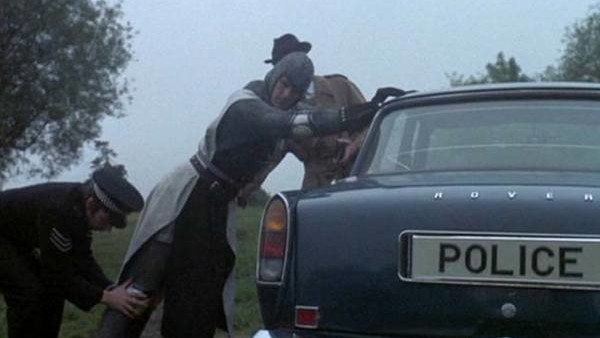
In the middle of Monty Python And The Holy Grail, a historian is speaking to the camera about King Arthur and his knights. This documentary-style interlude is abruptly cut short as the historian is swiftly killed by one of the knights. It's a funny joke that seems to be a one-off throwaway gag.
King Arthur manages to cross the Bridge of Death after defeating the bridge-keeper in a battle of wits. His knights then assemble behind him, dozens of armor-clad men converging together, preparing for swift and brutal action.
King Arthur begins his rousing speech to rally his troops in the style of King Henry V's St. Crispin's Day speech. As the troops charge, they are cut short by a police cruiser that darts in front of them. King Arthur is grabbed by a detective and tossed in the back of a paddy wagon for his role in the historian's death, bringing the movie to a fittingly ludicrous ending.
5. Blazing Saddles
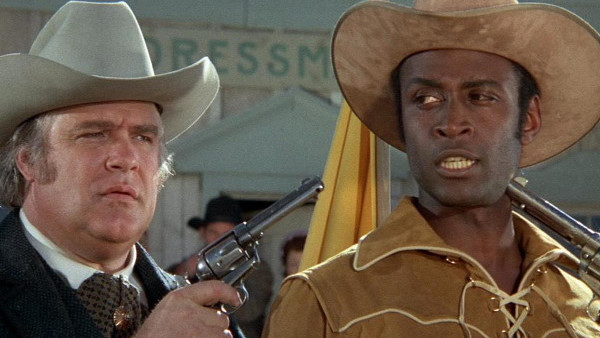
A year before an intervention by police ended Monty Python And The Holy Grail, another beloved comedy also wrapped up by breaking the fourth wall in a famous way. But instead of a run-in with the cops, the brawl that comes at the climax of Mel Brooks' take on the western crosses through the movie lot that the film takes place on.
The characters crash into other films. A Dom DeLuise musical gets interrupted as the fighting cowboys smash into the dances and splash into the watery set piece. They accidentally start a food fight in the studio's cafeteria. And the villain Hedley Lamarr ends up in a movie theater, which is screening the very film he is in, Blazing Saddles.
Hedley Lamarr himself is also the center of many memorable moments of breaking the fourth wall throughout the movie, chief among them being his claim that he would have an "almost certain Academy Award nomination for Best Supporting Actor" (he unfortunately did not as that field was chock-full of the Godfather Part II cast, but his costar Madeline Kahn did receive a Best Supporting Actress nomination).
4. Spaceballs

Blazing Saddles isn't the only time that Mel Brooks broke the fourth wall- it's a trope he uses in many of his films. Maybe the best use of breaking the fourth wall in any of his movies comes in one of his underrated gems, Spaceballs.
In the Muppet Movie, the band Electric Mayhem refer to the script to find their friends. The villains in Spaceballs use a VHS copy of the film Spaceballs to track down the location of Lone Star and his companions. The humor of the scene doesn't just come from using the film's final product in aiding their search for their enemies, but in the way it does so. The oafish Dark Helmet, his prime henchman Colonel Sanders and a Storm Trooper stooge sit in front of a small video monitor as they fast-forward and rewind to find themselves in the present moment on the screen. Instant cassettes!
As they speed through the movie, the audience gets to revisit Dark Helmet crashing during a ludicrous-speed launch and gets to re-live his embarrassment all over again. When they reach the present time, "now now", Dark Helmet turns back to the camera, then back at the monitor. When he waves his hand up and down, not only does the Spaceballs The Movie VHS show the character raising his arm, but the monitor onscreen in THAT monitor shows Dark Helmet also watching himself on an even smaller monitor. It's enough to make Charlie Kaufman weep.
3. Annie Hall
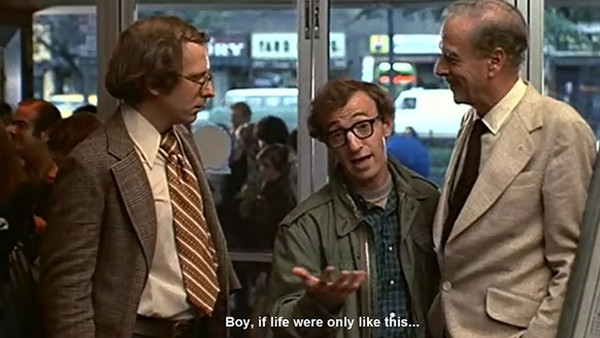
Much like High Fidelity, the Best Picture Winner Annie Hall has its protagonist direct his narration towards the audience in a conversational style. But Woody Allen's breaking of the fourth wall doesn't end here. There are many other moments in the film in which the character directly addresses the audience.
Perhaps the most famous instance occurs while Annie Hall (Diane Keaton) and Alvy Singer (Allen) are in line for a movie. They're standing just in front of a man attempting to impress a date by spouting off obnoxiously about media theory and the work of philosopher intellectual Marshall McLuhan.
After having had enough, Alvy loudly laments to the audience he wish he had a sock full of manure- presumably to beat his fellow movie patron with. The man defends himself, bragging that he's a professor at Columbia so his ideas hold some weight. Alvy then pulls McLuhan himself from around the corner who essentially calls the man a pompous moron. "If life were only like this!" Alvy shouts to the viewer. If only.
2. Airplane!
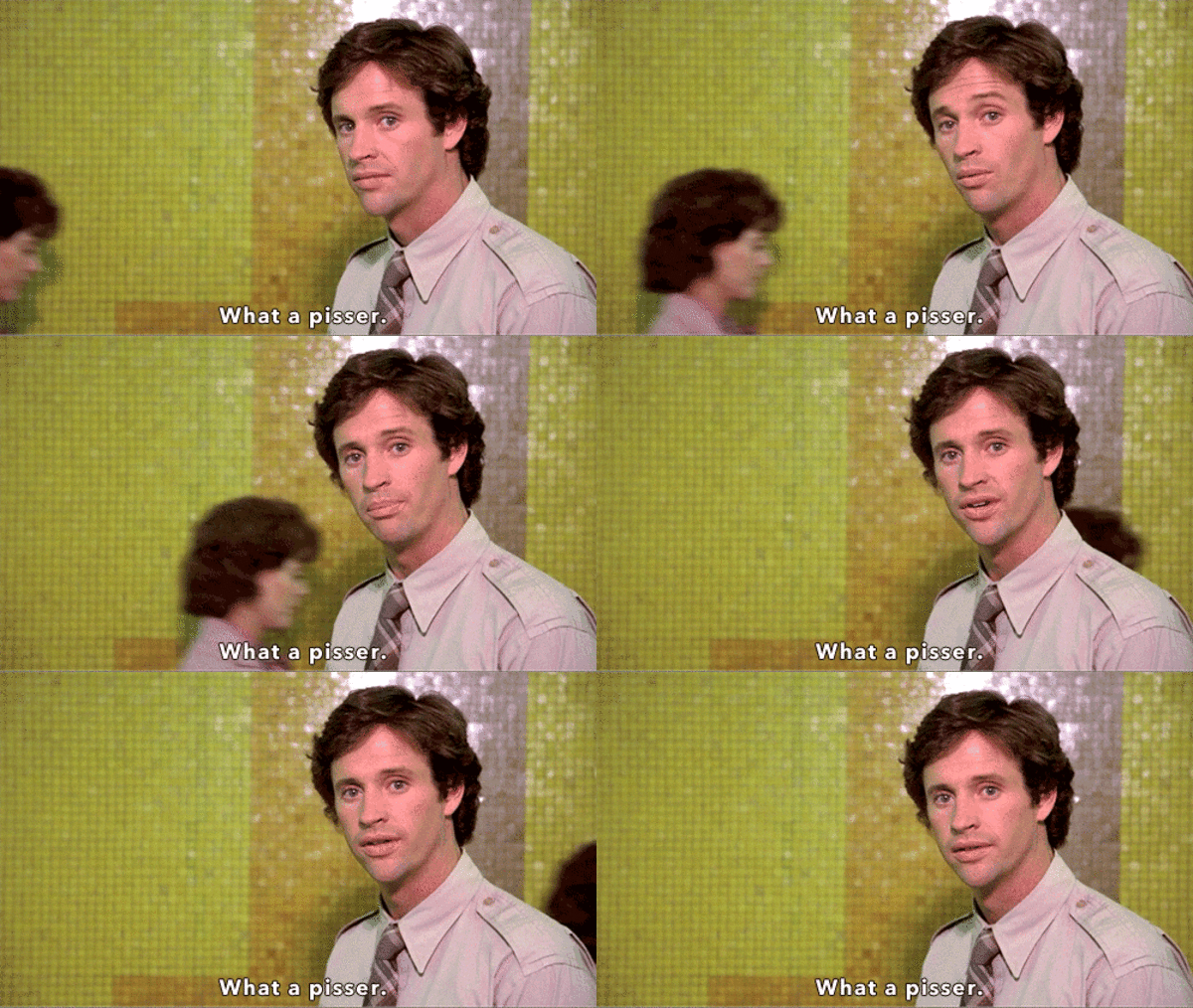
The comedy classic Airplane! manages to pack in just about every element of comedy in its brief 87 minute runtime. From sight gags to puns, dirty jokes to Kareem Abdul-Jabbar cameos, Airplane! has just about everything. And while it doesn't lean hard on the trope of breaking the fourth wall, one of the most memorable moments of this comedy gem is a brief aside, glancing at and acknowledging the audience.
Though the story of Airplane! is minimal, it does include a subplot in which a fighter pilot Ted (Robert Hays) and his girlfriend, a flight attendant named Elaine (Julie Hagerty) undergo strife in their relationship due to his psychological misgivings and his very particular and peculiar type of drinking problem. After she publicly strips him down and emasculates him, telling him that she can't live with him because she has no respect for him.
This should feel like a heavy moment, and in most other films, it would be. But in Airplane!, they manage to diffuse the tension and bring in a good laugh, as Ted reacts. He stares into the camera, and understatedly sums up the entire ordeal: "What a pisser."
1. Trading Places
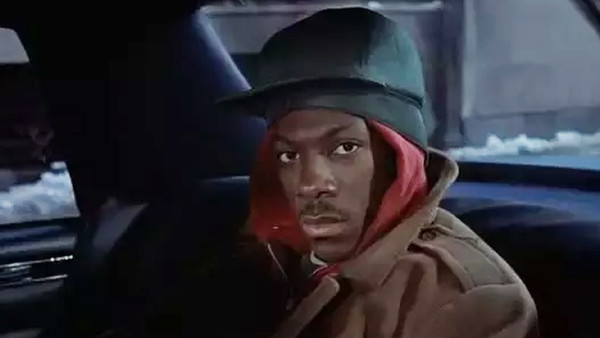
The two old men behind the scheme in Trading Places are vile in a very particular sort of privileged way. They use their influence and riches to meddle in the lives of two innocent, unsuspecting men. Billy Valentine (Eddie Murphy) goes from being an angle-shooting street hustler to finding himself in the world of white collar business.
The two commodities brokers try to educate Valentine on their profession. They speak down to him, slowly and condescendingly, including visual aids to get their point across as simply as possible. They name each item sitting on the table, as if Valentine needs their assistance to even comprehend what they are.
When they get to bacon sitting on a platter, they further clarify that it is a food item that one "might find in a bacon and lettuce and tomato sandwich". Valentine allows himself one brief glimpse into the camera, a ferocious eye-roll at the patronizing, racist and classist lecture from the pair of old buffoons.