1917 Review: 9 Ups & 1 Down
Roger Deakins is coming for his second Oscar.

Sam Mendes' new war epic 1917 is in cinemas now, mere days after it won the Best Picture (Drama) and Best Director awards at the Golden Globes, bolstering its status as a major contender at the incoming Academy Awards.
But 1917 is far more than a mere Oscar-baiting film: it's a thunderously intense and entirely unique entry into the genre that's rightly scored near-universal critical acclaim.
Quite simply one of the most immersive and stylistically audacious films of its kind, 1917 melds an achingly human - and horrifying - story with cutting-edge technical craftsmanship to deliver a nerve-shredding war movie like no other.
Though like Christopher Nolan's Dunkirk it ultimately sacrifices a little dramatic meat for its overall spectacle, for the overwhelming majority it's a staggeringly impressive achievement that absolutely begs to be seen and heard on the biggest screen you can find.
Downs...
1. The Script Is Pretty Simplistic

If the film has any one "weakness" - and it barely qualifies as one - it's surely the fairly down-the-line screenplay, co-written by Sam Mendes himself and based on war stories recounted to him by his paternal grandfather Alfred Mendes.
From a character and story perspective, 1917 doesn't really do much new or inventive: it's fairly invested in the typical tropes of the war film, and its "war is bad" message isn't all that nuanced.
Much like Dunkirk, it's pretty on-the-level storytelling in order to allow the spectacle to take precedent, but on the balance of everything 1917 has to offer, it can be argued that a more complex narrative may have made the overall experience a little too overwhelming for audiences.
Mendes' and Krysty Wilson-Cairns' script could certainly have done more to flesh itself out, but it's thankfully the only real gripe, and a mild one at that. And so, here's everything Mendes and co. got right...
Ups...
9. Roger Deakins' Oscar-Worthy Cinematography

Arguably the real MVP of 1917 is legendary cinematographer Roger Deakins, whose eye-melting lensing work gives the film most of its jaw-dropping visual identity.
Handed the gargantuan task of designing the film's visuals to resemble a single continuous shot - achieved by digitally blending smaller takes into a whole - Deakins' mastery of the cinematic space has arguably never been more palpable.
Even away from the "single take" gimmick, Deakins lights the hell out of every single moment in the movie, be it a potentially drab dialogue in a field or a haunting showdown in a burning village.
Deakins is guaranteed to receive his 15th Oscar nomination for his work on the film, and it'd be shocking if he didn't also scoop his second Oscar.
It's the most technically impressive photography in any film this year by a long shot, and really helps make 1917 stand out from its genre familiars.
8. George MacKay & Dean-Charles Chapman's Superb Performances

Though it would've been easy for 1917's two central characters to disappear into the film's oft-bombastic spectacle, Dean-Charles Chapman and especially George MacKay are given plenty of room to deliver terrific performances as Lance Corporals Blake and Schofield.
As two young men sent on a gruelling messenger mission in order to save 1600 lives, Chapman and MacKay sell the terror of their characters' situation perfectly, while also bonding believably amid the torrid scenario.
MacKay in particular is thrown into some gut-wrenchingly perilous sequences and is clearly up for the task, cementing the dehumanising and innocence-annihilating outcome of war.
While their characterisation is fairly straight-forward per the script, they both do wonderfully heartbreaking work, often realised more through physical acting and facial expressions than the spoken word.
7. Sam Mendes' Excellent Direction

To the surprise of nobody, Sam Mendes directs the absolute hell out of this film, striking a remarkable balance between the narrative's human concerns and the action-packed concerns of most every war movie.
Much has been said of 1917's single-take gimmick, and while you can argue that the seams between the takes are themselves fairly obvious to spot, that Mendes manages to keep the film fully engaging all while unfolding the majority of it in "real time" is an undeniably staggering achievement.
Pulling a "one-r" in a drama is one thing, but doing so in a war film is an altogether greater level of challenge, and while the result perhaps sacrifices some dramatic depth, its blinding visceral impact ultimately speaks for itself.
Needless to say, Mendes will be nominated for the Best Director Oscar, and given how unique his work was on this film compared to every other filmmaker competing for the award this year, there's also a strong chance he takes the gong home.
6. The Outstanding Supporting Cast
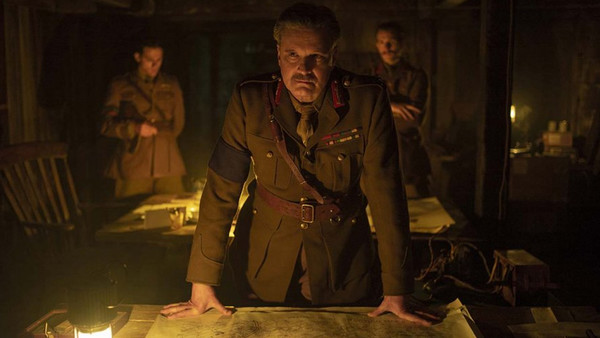
Though the film is focused pretty squarely on Chapman and MacKay's characters, the pair do intermittently run across a bevy of A-list talents, as well as a couple of recognisable names and faces who haven't even appeared in the film's marketing - and who we shan't spoil.
It's no secret that Colin Firth, Andrew Scott, and Benedict Cumberbatch each have small roles in the film, which while effectively amounting to little more than cameos, all lend crucial context and gravitas to the soldiers' mission.
In conjunction with the other roles we won't give away, they ensure that 1917 is jam-packed with top-shelf acting talent, and milks its soulful premise for every drop of possible emotion.
5. The STUNNING Action Sequences

1917 is actually a lot less action-packed than you might think: the trailers focus a lot on the bone-shaking spectacle, but the set-pieces are actually relatively brief for the most part, scattered liberally among a multitude of more quiet moments.
But the scenes themselves are nothing short of stunning, be it a showdown in the aftermath of a plane crash, a desperate chase through a ruined village, or Schofield's goosebump-inducing run across the trenches.
It's all intensely memorable and beautifully executed, never forgetting the abject horror of war even as it's depicted by such technically astonishing means.
As reliant on Roger Deakins' creative photography as its smartly deployed visual effects, 1917 provides a welcome antidote to monotonous shootouts and excessively CGI-soaked mayhem.
4. Thomas Newman's Incredible Musical Score

This is composer Thomas Newman's seventh time collaborating with Sam Mendes, and the result is one the very best musical scores of his widely celebrated career.
Though it's fair to say that Newman's pulsing work here feels inspired by Hans Zimmer's iconic score for Dunkirk - especially by using a ticking sound as an urgent motif - it stands on its own as a beautifully operatic compliment to the gorgeous visuals.
The climactic track "Sixteen Hundred Men" proves especially stirring during by far the most emotionally evocative and intensely epic moment of the film, and there's absolutely no chance Newman isn't nominated for the Best Original Score Oscar.
Above all else, it's sure to rank among the very best musical scores of any war movie ever.
3. It's Fantastically Edited & Paced

It's easy to take editing for granted in a "one-take" movie such as this, but the conceit itself wouldn't work without a note-perfect editing job from Lee Smith, who has edited seven of Christopher Nolan's films including Dunkirk (for which he finally won the Best Editing Oscar).
Though the transitions between takes are again obvious to those in the know, they're nevertheless smart and unobtrusive, creating a near-seamless whole which supports Mendes and Deakins' fluid camerawork perfectly.
And despite the apparent limitations of forcing the camera to stick with two characters for the entire movie, the pacing is absolutely immaculate throughout.
As mentioned, it's not a relentless, breathless chase movie, and there's plenty of downtime between the frequent chaos, such that the film lands on the right side of stressful and exhausting rather than being entirely overwhelming.
2. The Blistering Sound Design

In addition to Thomas Newman's fantastic musical score, 1917's general sound design is absolutely spectacular, and as much a reason to see the movie on the big screen as the outstanding visuals.
The gunfire and explosions have an uncommon crispness to them, even for the genre, mixed into an intensely atmospheric whole that, in all of its chaos, is really quite beautiful.
If the intent was to evoke both the horrors of war and the thrill of being alive, it succeeds exceptionally well. Without question, 1917 is immediately an Oscar frontrunner in both the sound editing and sound mixing categories.
1. The Emotional Finale

No spoilers, but if you were worried about the movie's sheer rollercoaster ride intensity taking away from its emotional thrust, fear not, because the film's final sequence brings things to a close in intensely bittersweet fashion.
Cementing the toll on humanity that war takes while honouring the sacrifices made by those on the front lines, it's an ending sure to leave many wiping tears away, especially with Mendes providing a final dedication to his own grandfather.
While the story might paint in fairly broad strokes, much like Dunkirk it is an inherently affecting story due to the young men we witness being put through the wringer over the course of two hours, and the wider sense of humanity from all the soldiers we meet over the course of the film.
Above all else, it's further proof that technically superlative filmmaking need not sacrifice the human factor or emotion whatsoever.