20 Alternate Disney Characters You Never Got To See

Remember sweet old Rafiki? Yeah, he was almost an awful lot different...
There's nary a person alive in the Western world that isn't utterly infatuated with at least one of Disney's animated classics, from 1937's Snow White and the Seven Dwarfs, all the way up to the recently released Frozen. But in many cases, what lies closer to the heart is not the events of the movies themselves, but their characters. The hero, the heroine, the love interest, the helper, the villain, the talking wardrobe; yes, Disney has had them all, and all numerous times over (well, except for the talking wardrobe; thankfully, that was a one-off). But what most of us will probably disregard is that these dynamic, entertaining, life-rendering characters are not fully conceived overnight. Rather, they are meticulously developed over a course of many months, maybe even years, and as changes are made in the narrative or tone of the overall movie, these characters must also be altered accordingly. So here is a list of the 20 alternate versions of Disney Characters that you never got to see. Maybe their appearance didn't fit in with the overall aesthetic of the picture. Maybe their general demeanour wasn't in tune with their striking personality. Or maybe they just plain sucked. In any case, they're all here for your infinite viewing displeasure.

20. Mushu (Mulan)

Adopting the role of the classic Disney 'helper' character in 1998's Mulan, Mushu (voiced by Eddie Murphy) succeeds in stealing the show for the majority of the 87-minute runtime (as is the case with many of the 'helper' characters in Disney movies). But as this early sketch reveals, Mushu was originally intended to be purple, with far more prominent horns, and clothed in sandals and a robe. But more than that, he seems a lot less crazy and a lot more peaceful, which wouldn't be at all in line with his role in the movie, or with the casting of Eddie Murphy.

19. Maleficent (Sleeping Beauty)

The memorably-named Maleficent personified pure evil in her antagonistic role in 1959's Sleeping Beauty. As far as Disney villains go, her design is easily one of the most effective in encapsulating the dark side, so much so that she's been given her own live-action film scheduled for release in May 2014 (starring Angelina Jolie as the lead). But as this early concept sketch shows, Maleficent's original design was far more muted and mellow; facially, she still looks evil, but on the whole she is far less striking and powerful without her infamous cloak and crow combo.

18. Timon (The Lion King)

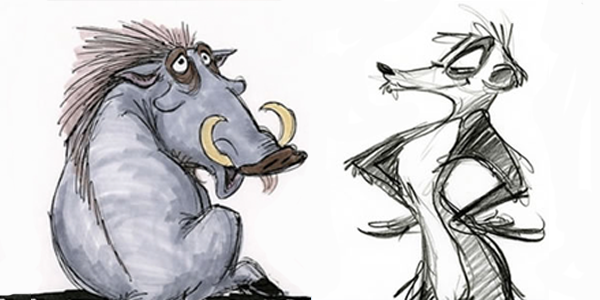
Everyone loves Timon. Contradicting his obvious neurosis with his mantra "Hakuna Matata", his relationship with Pumbaa forms the much-needed comic relief in 1994's The Lion King. Part of Timon's effectiveness is his ability to be the aggressor and leader in his relationship with Pumbaa, despite being largely inferior physically. This early imagining of him highlights this, in which, he looks far more wily and self-assured than his final form. One can only imagine that Timon was changed to look more vulnerable in order to ensure he didn't alienate viewers, which consequently allowed his bossiness to come across as more of a Napoleonic complex than deliberate manipulation.

17. Pumbaa (The Lion King)

In keeping with the last entry, this sketch of Pumbaa is a far cry from the greedy, gassy warthog we all know and love. Pumbaa here looks downtrodden and depressed, with unmistakable shades of everyone's favourite anthropomorphic pessimist, Eeyore from Winnie the Pooh. This dynamic of a far more astute Timon and a far more gloomy Pumbaa makes for disturbing viewing, and it is almost certainly a good thing that these imaginings never came to fruition.

16. Zazu (The Lion King)

Neither Timon nor Pumbaa provide the greatest deviation from their original character design in The Lion King, however; that honour goes to Zazu, Mufasa's royal advisor (voiced by Rowan Atkinson). Zazu's trademark despondent British wit (which is strange, considering he's from Africa) alleviates the terror from even the gravest of situations (such as being kept a caged prisoner by Scar), but this early sketch (in which he also seems to be some sort of kingfisher as opposed to a red-billed hornbill) shows a different Zazu; his fear is less slapstick and more morose, and, alongside the early concept art of Timon and Pumbaa, really makes you wonder what kind of film The Lion King was originally intended to be.

15. The Cast Of The Jungle Book

This early sketch of The Jungle Book's characters, which serves almost as a line-up, shows a blue-covered Mowgli, a brown Baloo and a rather confused-looking Shere Khan, but also an unfamiliar Rhino by the name of Rocky. According to Disney's Animated Research Library, Rocky was short-sighted, relying largely on his sidekick, Ticker the Tickworm, and featured in many sequences in the original story until Walt Disney decided to cut him out completely. How a visibly-challenged rhinoceros and a tickworm would have fit into the final film is unclear (and for that reason it was probably the right idea to rethink their involvement) but it certainly would be an interesting thing to see.

14. The Seven Dwarfs (Snow White And The Seven Dwarfs)

Dopey. Doc. Sleepy. Sneezy. Grumpy. Bashful. Happy... full marks if you got them all without looking. But if the finished dwarfs would have looked like this early imagining, it surely would be nigh on impossible to remember them all. Dopey is instantly recognisable here, as are Sleepy and Grumpy. As one of them is wearing glasses, we can assume this is Doc. But what about the other three on the right? Who's who? They all look exactly the same. Luckily, Disney did eventually decide to make each dwarf instantly individual, making it much easier to differentiate between Bashful, Sneezy and Happy.

13. Ursula (The Little Mermaid)

It's fair to say that The Little Mermaid's antagonist Ursula is hardly the most aesthetically pleasing of Disney's many females. But compared to this early artwork, her final form looks like Marilyn Monroe. However, the early impression of Ursula, though unused, was not completely wasted, as it quite clearly provided the inspiration for Hades' hairstyle in Hercules five years later, and a whole host of faces in Monsters Inc. some time after that.

12. Aladdin (Aladdin)

The eponymous hero of 1992's Aladdin must've hit the weight room pretty hard between this early concept and the final cut. While the hat, vest, and trademark black locks remain, Aladdin's early form is far more elegant and feminine, and one can only assume that the main reason for altering this was to provide more of a contrast between him and Princess Jasmine. Speaking of which...

11. Jasmine (Aladdin)

Regarded by many as the most beautiful of all Disney heroines, Jasmine's design changed just as much as Aladdin as production went on. Similar to her other half, the accessories (in her case the large gold earrings and headgear) remained largely unchanged, but Jasmine's natural appearance evolved quite a lot, with her complexion, eye colour and the general shape of features being completely re-imagined.

10. Sebastian (The Little Mermaid)

Ask anyone who grew up in the 80's or 90's to name their favourite crustacean and, unless they feel some sort of attachment to Spongebob's boss Mr. Krabs, the answer you'll receive is: Sebastian from The Little Mermaid. As these early sketches show, he was always a lover of music, and was always a crab. But that's pretty much where the similarities between the old and new Sebastians end. Originally, he was a lot more... well... crabby; in actual fact, his final form is as much reminiscent of a lobster as it is a crab. But the question on everyone's lips is: was he really intended to be navy blue at first, or was this simply the only colour felt tip the artist had at their disposal at the time? You decide.

9. Lumière (Beauty And The Beast)

Similar to the last entry, ask anyone who grew up in the 80's or 90's who their favourite talking candle is and, unless they grew up with no electricity and are prone to hallucinations, they will almost definitely answer: Lumière from Beauty and the Beast. In between borderline sexually harassing broomstick maids, this fabulous Frenchman brought us the now timeless classic 'Be Our Guest', and for that, we thank him. But would the rendition have been quite as memorable had Lumière ended up looking like this original sketch (i.e. without a face)? There are numerous objects in Beauty and the Beast that don't have faces (mostly plates and cutlery), but no one's getting a tattoo of any of them in a hurry. But what of Lumière's partner in crime, Cogsworth? Well...

8. Cogsworth (Beauty And The Beast)

Cogsworth's initial design, though more in line with his final form than that of Lumière, is still somehow a lot more disturbing than his final form. Has anyone ever had a clock in their house that looked like that? Nobody know. But in any case, this early version of Cogsworth seems a lot taller, and so would presumably be a much larger clock (maybe even a grandfather clock) and therefore a lot bigger than Lumière, rendering the relationship between the pair a lot less equal.

7. Gaston (Beauty And The Beast)

Much of the early Beauty and the Beast concept art is a lot more focussed on the 18th century setting, and this sketch of self-proclaimed expectorating expert Gaston is a prime example. He seems much more a nobleman here (as opposed to a huntsman), illustrated most effectively by the differing size of his neck between these two images. As Gaston is defined by his impressive physicality in the film (for there's no one as burly or brawny; as you see he's got biceps to spare) it would have changed his role completely if he'd looked like the original impression, presumably as man known for his superior wealth and status rather than his strength.

6. Princess Aurora (Sleeping Beauty)

Is there a girl alive that hasn't lay in bed, wishing they were Princes Aurora from Sleeping Beauty? Her beautiful appearance fits the archetype of any princess, but many will be surprised to see that she was originally intended to be a brunette, as this early sketch denotes. Why this was changed remains to be seen, and why she's so high in this list is also up for debate but, well... chicks just take their hair really seriously, don't they?

5. Pocahontas (Pocahontas)

The eponymous heroine of 1995's Pocahontas is virtually unrecognisable in this early conceptual sketch. Rather than the gentle, spiritual Pocahontas we're all familiar with, in this image she appears far more sly and mischievous. It's an interesting point that the name 'Pocahontas' actually means 'little mischief', and it was surely with this fact in mind that the character designers dreamt up this initial form. But in addition to the general demeanour, the early Pocahontas just looks completely different, and is practically a complete stereotype of a Native American in every sense. She's also notably wearing shoes, something Pocahontas famously refrains from doing in the finished movie.

4. Cruella de Vil (101 Dalmations)

There is something about animals, particularly animated ones, that tug on our heart strings in more powerful manner than humans can. It is for this reason that 101 Dalmations' Cruella de Vil is probably the most universally despised Disney character of all time. Her tacky, trashy appearance perfectly matches the hideousness of her evil heart, but as this early sketch proves, this what not always the case; in fact, she was originally intended to be quite the looker, with her experimental hair and fur coat a statement of her suave individuality rather than an indication of a long-standing drug habit.

3. Rafiki (The Lion King)

A large part of the most iconic image from The Lion King (the new baby King behind held aloft atop Pride Rock for all the animals of the kingdom to behold), Rafiki's presence as a whole is one of the most important, memorable and widely-loved elements of the movie. However, it seems that the part-witch doctor, part-martial art expert wasn't always as jovial, as this quite frankly terrifying early sketch suggests. Mufasa's death not enough to make your kid break down in tears? Try showing him this!

2. The Genie (Aladdin)

Though his name might not be on all the posters and DVD covers, it's clear to pretty much everyone that the true star of Aladdin is Robin Williams' Genie. But this instantly recognisable figure didn't always look like a gigantic blue Craig David. There are a whole host of different versions of the Genie that can be found online, but here are two of the most striking: one where he's green (as he is in many of the original concept sketches) and appearing to be on the same wavelength as Heimlich from A Bug's Life, and another much more akin to his final form, albeit around 300 pounds lighter (although, in actuality, he must not actually weigh anything, right?). What is clear, though, is that of all the Genie's designs, the final version is by far the best.

1. The Beast (Beauty And The Beast)

'Tale as old as time...' It really is difficult to see the Beast without Mrs. Potts' signature tune ringing in your eyes. With the Beast, the Disney animators managed to create an anti-hero that was capable of looking frighteningly vicious one minute and heartwarmingly fragile the next. But it took a while getting there. Like the Genie, there were a lot of different versions of the Beast before the development of this final creation. Here are two are the most horrifying: a sort of boar-type creature that seems to have stolen Hamlet's wardrobe, and then a kind of half-dog, half-rat with a penchant for extravagant headgear and a garish streak of blond hair. Luckily, the final form of the Beast was far less of, well, a beast, and simply a bigger, hairier, toothier version of his human self, most visible in those beautiful baby blue eyes. What do you think of these alternative Disney character designs? Share your thoughts below in the comments thread below.

Contributor

I'm a university graduate/full-time layabout who fills his days writing fiction, watching 90s sitcoms and growing irate after failing to catch Mewtwo with 99 ultra balls on Pokémon Red. I think that says it all, really, doesn't it?