20 Lesser Known Facts Surrounding The Making Of Star Wars

May the facts be with you. Always.

Think you know everything about Star Wars? Well, I'm here to give you a run for your money. Star Wars is a motion picture franchise that has stood for over thirty-five years as a permanent fixture in the realms of popular culture, of course. But what, exactly, happened behind-the-scenes of our beloved saga? What incidents and stories are there to tell about the making of what is arguably the greatest movie series of all time? I've sifted through tons of books and websites with regards to the making of Star Wars in order to bring you a well rounded list of lesser known factoids that you might never have stumbled upon before. This includes information from both the Original Trilogy and the Prequels, so we have something for both sets of fans. Now, sit back, buckle your seatbelt, and get ready as we make the jump to hyperspace...

20. Reduce, Reuse, Recycle

Keep your eyes open, because if you love one of the minor Star Wars actors enough, they may just appear in different roles throughout both trilogies. In the Original Trilogy and also occasionally in the Prequels, we see quite a few actors don a mask or helmet and become an entirely new character. One such example is Jeremy Bulloch, well known for playing Boba Fett, everyone's favorite bounty hunter. He can also be seen wrenching Princess Leia around a corner in Cloud City while she screams to Luke not to follow her since it's a trap (Okay, I know you all just screamed "It's a trap!" in your heads). Other actors include Kenny Baker (R2-D2) and Warwick Davis (Wicket). You would expect with all the money Lucasfilm has, they would be able to pay for different people. Yet I believe it's something that is fun for the different actors - besides getting paid for two roles as opposed to one, and probably logistically easier for Lucasfilm.

19. Turn On The Radio

I've actually only made it through half of the first radio dramatisation of Star Wars, but oh yes, they do exist. National Public Radio (NPR), with the blessing of George Lucas, created radio dramatisations of the original Star Wars trilogy. All three radio programs expanded into the politics and relationships between the characters, giving you a little more depth into the Star Wars that we already know. The Return of the Jedi version even brought in some Expanded Universe stuff by briefly mentioning a dancer named Arica within Jabba the Hutt's palace - a shout out to her real identity, Mara Jade. Very few of the actual movie actors participated in the radio drama, but A New Hope and Empire Strikes Back included both Mark Hamill (Luke Skywalker) and Anthony Daniels (C-3PO). Billy Dee Williams played Lando once more in Empire Strikes Back, but only Daniels returned for Return of the Jedi.

18. "Remember, Nothing's Gonna Work..."

Those were the famous words George Lucas said to Irvin Kershner in regards to getting the special effects on a set to look good and work correctly. Many consider The Empire Strikes Back to be one of the best Star Wars films, but considering all the atrocities that occurred while filming, it might have been one of the worst films. At times, the crew had to skimp on the technical portion of the effects because of all the problems they had getting things to work whilst trying to meet their deadlines. A perfect example? When the motorised R2-D2 randomly stopped working, and the crew were forced to pull the droid along by a wire, putting boxes in place so that the audience could not see what was happening from the view of the camera.

17. Lawrence Kasdan Loves Star Wars

Lawrence Kasdan's work on Star Wars began when he took over writing the screenplay for the Empire Strikes Back, after Leigh Brackett (the original screenplay writer) passed away due to her battle with cancer. After the success of Empire, Lucas commissioned Kasdan again to work on the screenplay for Return of the Jedi, where the characters continued to be fleshed out and the plot twisted and turned in unexpected ways. As of October 2013, it was announced that Kasdan would now be working on screenwriting duties for Episode VII, alongside director J.J. Abrams. So here's to hoping - if we can base our assumptions off of established history - Episode VII will be a tried and true Star Wars film with all the moments, characters, and dialogue that we've come to expect from Kasdan thus far.

16. Bigger Does Not Mean Better

Can you guess which is the longest and most expensive Star Wars film? Attack of the Clones. It's a shame, really, since that film is often considered the worst in the entire saga. Don't get me wrong - I love Star Wars, and that includes loving its rougher edges, but it's very hard for me to acknowledge that the acting was good or that some of the scenes deserved to be in Attack of the Clones (droid factory scene, anyone?). Attack of the Clones had a budget of $115 million, but ended up going slightly over budget and looking closer to $120 million when it was time to call wrap. In terms of length, Attack of the Clones clocked in at a whopping 142 minutes (longer than A New Hope by 21 minutes). It goes to show that money cannot buy everything - especially not a good film. Instead, Attack of the Clones felt like it was dragging narratively in places and some fans believe the special effects were overdone to the point of ridiculousness. Perhaps if Lucas had spent his money on hiring better screenwriters, the film would have been worth all that time and money, huh?

15. Realistic? You Decide...

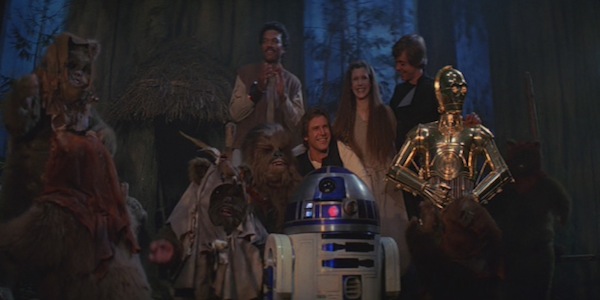
Has no one else found it a little strange that Han, Leia, Luke, Chewie, and Lando all live until the very end of Return of the Jedi? Not that I'm disappointed that they did, but it really reminds you that these movies are a work of fiction and not completely grounded in reality. Originally, there was talk of Han Solo not living to see the demise of the wretched Empire. Harrison Ford was not contracted for the entire trilogy of Star Wars, you see: he thought it could be a good idea to kill off his character through an act of self-sacrifice, the ultimate redemption for a smuggler who previously only thought about himself. Lawrence Kasdan, who helped write the screenplay, also agreed with Ford, thinking it could add little tension and realism to the movie. Lucas strongly rejected the idea. Keep in mind that Lucas continually, above all else, tried to stay true to his roots in wanting children to be able to watch and enjoy these movies, and the deaths of everyone's favorite heroes were deemed unacceptable. So maybe it wasn't the most realistic ending, but hey, it's a galaxy far, far away. Anything can happen.

14. From Episode IV To Episode III

Wookiees were one of George Lucas' obsessions from the very beginning. He always wanted to show their home planet of Kashyyyk and have these creatures be a big part of the Star Wars universe. In the end, though, we ended up with only Chewbacca in the Original Trilogy, and a smaller battle on Kashyyyk in Episode III, which is currently the last movie to be produced in the Star Wars saga. But this battle in Episode III actually dates back to the earliest screenplays of Episode IV. Originally, Lucas wanted to have Wookiees help out Rebels in overtaking an Imperial Bunker. Sound familiar? The idea was later utilised with Ewoks in Return of the Jedi instead. George also had the planet of Utapau featuring in early drafts of A New Hope. Utapau finally gets to appear in the same movie that the Wookiee battle appears in, though: Episode III. So it seems that anything George Lucas could not work into his first Star Wars movie actually got recycled into the final installment. How's that for coming full circle, then?

13. Destination: Mos Espa, Tatooine

There's not much to see on the lonely planet of Tatooine and as Luke Skywalker once said: "If there's a bright center to the universe, you're on the planet that it's farthest from." Shot in Tunisia, the country still clings to the remnants of the set of Mos Espa, the home of Anakin Skywalker in The Phantom Menace, and also features the Lars Homestead where Luke grew up. You can visit both to feel like you are living and breathing as both young Anakin and Luke Skywalker did. For the die-hard fans that want to venture away from their hotel, you can actually stay overnight at Hotel Sidi Driss, which actually took the interior of the Lars Homestead set and made it into a hotel. Or, if you'd rather not spend that kind of money but still want to feel like you live in the Star Wars universe, you can wait a few years for when Disney will hopefully build an entire theme park devoted to Star Wars and only Star Wars. Rumor has it that's actually in the works.

12. Star Wars: No Title

We've grown accustomed to labelling each Star Wars movie by its subtitle, of course: Empire Strikes Back (ESB), The Phantom Menace (TPM), etc., are all adequate titles that give you sense of what the movie will be about before you settle down to watch it, right? But this was not the case with the first movie released. The movie we all know so well as "A New Hope" was originally just titled "Star Wars," as George Lucas did not know what kind of success his movie would have and didn't feel the need to factor in the episode factor. The name was officially changed to Star Wars Episode IV: A New Hope on January 1st, 1978, around eight months after the movie was first released (if it was actually renamed while it was still in theaters is debatable).

11. Female Sith Lord

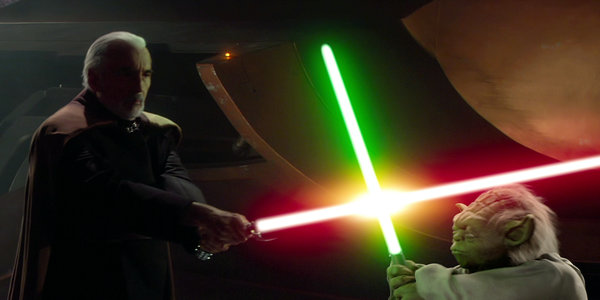
Female fans of Star Wars have been clamoring to see more gender equality in their saga - not only as heroes, but as villains, too. Sure, Leia and Padme are great characters, but the scale clearly tips in favor of the men throughout all six movies. Count Dooku was originally supposed to be a female Sith Lord. In the beginning, Lucas wanted to have a "Sith Villainess" who would look almost as a hag-like samurai. While the idea was ultimately rejected in favor of Count Dooku, the original concept art for this Sith Villainess was later used in The Clone Wars, for the character of Asajj Ventress. Asajj played many pivotal roles throughout The Clone Wars series, but one of her key jobs saw her as Commander of the Confederacy of Independent Systems, under Count Dooku's supervision.

10. Loose Lips Sink Ships: Part I

Following the huge popularity of The Empire Strikes Back, it became even harder to keep the filming of Star Wars a secret - especially as most of Return of the Jedi was filmed in or around California. In order to keep some semblance of secrecy, Lucas created a fake working title for Return of the Jedi, calling it "Blue Harvest: Horror Beyond Imagination." No one was interested in the filming for a movie called Blue Harvest, so they were left in relative peace while making it. Interestingly, the title was taken from the 1929 Dashiell Hammett novel "Red Harvest,' which is said to have influenced film director Akira Kurosawa, one of George Lucas' biggest influences.

9. Loose Lips Sink Ships: Part II

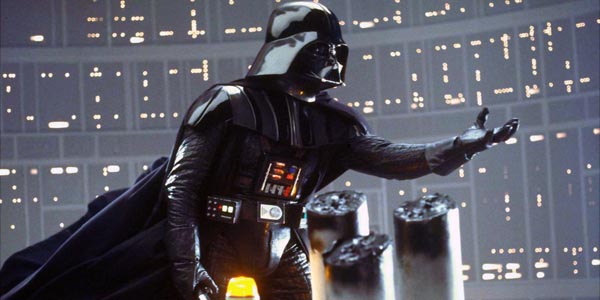
After the ginormous success of A New Hope, George Lucas had to create some secrecy around big reveals in the plot of the sequel. And what was the greatest revelation in The Empire Strikes Back? The origins of Luke's birth, of course, and the identity of his true father. In order to keep the big revelation a secret, then, they planted a false page of dialogue into the script. This was somewhat easier to do in the case of Darth Vader, since the man under the suit (David Prowse) was later going to have his voice recorded over (James Earl Jones). When everyone got the script for The Empire Strikes Back, Vader tells Luke: "Obi-Wan killed your father." I mean, that's a shocker in and of itself, but nowhere near what we later find out. Mark Hamill only learned the real truth of what Vader actually says right before the scene was filmed. Other than Mark Hamill, the only people who really knew what Vader was saying were Lucas, the director Irvin Kershner, and later, James Earl Jones, when he recorded the voiceover.

8. Preserving The Opening Of Star Wars

George Lucas believes that the openings of his films should pull the viewer in instantaneously. He didn't want to waste the audience's time as names of actors, producers, and the director flash across the scene. Instead, he decided to push every screen credit to the end of the film. The billing laws are complicated, but suffice it to say, it worked in A New Hope because the name of the director (George Lucas) matched the company name (Lucasfilm Ltd.) that had appeared before the film began. Lucas decided to keep the same format with the Empire Strikes Back, but the Directors Guild of America were not pleased. They insisted that Irvin Kershner be credited at the beginning of the film, since the company name of Lucasfilm was also there. When Lucas refused, they fined him $250,000, and also went after Kershner. Lucas stepped in and not only paid his own fines, but also protected Kershner by paying for his fines as well. After this incident, Lucas resigned from the Directors Guild of America. The lengths that George Lucas went to protect his movie and keep it authentic to his own vision makes me wonder why some people call him a sellout. Perhaps they should take a look at little moments like this to realize that Lucas always had Star Wars' best interests at heart.

7. Can You Find 1138?

George Lucas' directorial debut was a movie called THX 1138. The science-fiction film did not find box office success, but Lucas fans know how much this film means to its director. If you watch closely, Lucas continually tries to find a way to incorporate shout outs to his first film, more commonly known as Easter Eggs, within the Star Wars saga. I won't ruin it completely for you, but some examples of such Easter Eggs are a battle droid with 1138 labeled on its back in the final battle of Naboo in Episode I, and the number cell block number that Luke and Han claim to be transferring their "prisoner" Chewbacca from. As you view the six movies once more, try to keep your eyes open and ears listening for more signs of 1138. Once you know about the fact that it exists, you won't be able to stop looking for them.

6. The Camera That Revolutionized Special Effects

Sure, we know that when Star Wars came out, the special effects were lauded as the best that had ever been seen in the film industry. But did you know that in order to get there, a completely new camera had to be created? John Dykstra created a camera that was able to go in multiple axes of motion: tilt, swing, boom, lens focus, motor drive, pan, roll, traverse, and shutter control. This camera became known as the Dykstraflex. Dykstra won an Academy Award for best special effects and special technical achievement for his work on Star Wars, and went on to lend his expertise to many other films that needed the same treatment. Unfortunately, due to disagreements between Dykstra and Lucas, Dykstra did not return for any more Star Wars movies. We should thank John Dykstra for his invaluable work that made Star Wars look real and not campy, though, as some science fiction films of the day turned out to be. The camera took Star Wars to the next level - I can only imagine what could have been done if Dykstra had stayed with the team.

5. Revenge Of The Jedi

Yes, you read that right. Originally, Lucas decided that the title for the third and final installment of the Original Trilogy would be "Revenge of the Jedi." Later, he changed his mind, realizing that Jedi do not necessarily take revenge. He decided that a more appropriate title would be "Return of the Jedi." But he was a little too late. Lucasfilm had already distributed some posters with the title of Revenge of the Jedi. On top of that, the photos had an error where Luke had a red lightsaber and Vader had blue. Lucasfilm stopped shipping the posters and most were destroyed, but 6,800 original posters still remain. Legitimate Revenge posters are hard to come by and unfortunately most of those being sold out there are actually bootlegged. And, as a side note - and in case you didn't realize by this point - Episode III's title, Revenge of the Sith, is a throwback to this discarded title from 1983.

4. Duel Of The Sanskrit

We all remember the music from the lightsaber battle between Qui-Gon Jinn, Obi-Wan Kenobi, and Darth Maul. The music, along with the choral work, still gives me chills when I watch the Jedi and Sith battle it out at the climactic point in Episode I: The Phantom Menance. The words are actually taken from a poem by Robert Graves called The White Goddess. But Graves based his version off of the original early Celtic work called The Battle of Achren or Cad Gaddeau. In it, there is one line, which says: "Under the tongue root a fight most dread, and another raging, behind, in the head." After finally finding the line he liked, Williams took it and translated it into Sanskrit, because he felt it sounded more appropriate for the composition. So when listening to Duel of the Fates, what we actually hear is a translation of a translation. And that, my friends, is why John Williams is the man.

3. George Lucas Is Losing Money From Star Wars (Because Of An Old Bet)

What? Lucas is actually losing money from Star Wars? Thirty-seven years later, Star Wars is still on the list of the top 100 highest grossing movies of all-time. When adjusted for inflation, it comes in at second, placing only after Gone with the Wind. Don't worry: he's still raking in the money. But he's also losing quite a little bit because of a bet he made with Steven Spielberg before Star Wars was released. Now, I have no idea if he's still paying this bet off, but Spielberg claims that he actually is. While Lucas was working on post-production of Star Wars, you see, he visited his good friend Steven Spielberg on the set of Close Encounters of the Third Kind. Seeing Spielberg making this movie on a huge set, he relayed to him that he believed Star Wars would be a huge flop and made a bet. George would give Spielberg 2.5% of Star Wars if Spielberg agreed to give him 2.5% of Close Encounters. Spielberg was so sure Star Wars would be a hit that he agreed to take the gamble. It was almost like betting on a pod-racer that had never finished a race. Of course, we know what happened. It's estimated that Spielberg has made around $46 million from this bet, and it still continues to grow if he hasn't let his good friend off the hook yet.

2. Matching Keys

By now, we all know that the Star Wars legacy is in the hands of Disney. The next time we watch Star Wars in the movie theater, we will hear the iconic theme of Disney's "When You Wish Upon A Star" before hearing John Williams' beautiful Star Wars theme erupt in our eras. What many people don't realize is that the 20th Century Fox opening sequence, complete with the drumroll, horns and spotlight, was essential to transitioning into the main Star Wars theme. By 1977, Fox had largely retired that dramatic opening, but Lucas fought to have it put back for Star Wars: John Williams composed the Star Wars theme in B Major, so that the main theme could shift easily from the 20th Century Fox fanfare.

1. Alan Ladd Jr. Gave Us Star Wars

Okay, so it was George Lucas who put his dream out there and created an amazing movie. But people forget that with a big project like a Hollywood movie, it takes someone on the corporate end to believe in you. Alan Ladd Jr. is that man. After studio upon studio rejected George's concept for Star Wars, Lucas sought Alan Ladd Jr., who was the head of 20th Century Fox, to help him with his dream. Though Ladd did not understand much of the movie in 1973, he agreed to take on the project because he saw something in Lucas. Lucas often said that Ladd: "invested in me, he did not invest in the movie." Lucas ran into problem after problem with Star Wars. The budget kept getting increased and Lucas was falling behind schedule. Board members at 20th Century Fox complained about the budget and how they could not understand the storyline. After Star Wars fell two weeks behind, board members wanted to scratch the project, but Ladd intervened and asked for a small extension. Ladd did not get Lucas much time, but he did get him one extra week to finish production. Lucas took his crew, split it into three units, and finished the filming within the deadline. Let's not forget the people who believe in others and have the power to push something through. That's why I believe that Alan Ladd Jr. is the most unknown or, perhaps, forgotten fact of Star Wars and deserves the number one spot. Like this list? How many did you know already? Let us know in the comments section below.

Contributor
Contributor

Just trying to, I don't know, fly casual? For more Star Wars goodness, you can follow my blog: http://starwarsanon.wordpress.com/ or twitter: @krlrix.