20 Mind-Blowing Facts You Didn’t Know About Groundhog Day
Haven't you read this before?
It's 2 February, again, and once again all of the world's eyes turn towards Gobbler's Knob and the twitching nose of one hairy weatherman. Which means it's the perfect time to turn your attention back to one of cinema's most beloved and critically acclaimed comedies from the great minds of Harold Ramis and Bill Murray.
Witty, barbed and with a dark heart that was never quite as nasty nor as draining as it could have been, Groundhog Day has transcended the usual limits of the medium to become a genuine cultural phenomenon as well as a bona-fide dictionary term. That's no small achievement in itself, but in film-making terms it is the least accolade of a justifiably adored film.
It might have cost the world Harold Ramis and Bill Murray as a team, but it did transform the latter from clown into pathos-laden leading man in very real terms. And for that you should be eternally grateful.
Precisely 25 years after the cult classic hit cinemas, now is as good a time as any to look back at some of the least known and most eye-opening facts about Groundhog Day...
20. An Early Script Had An Angry Witch In It

Considering how well-served the magic of the film is by the lack of explanation - aside from Phil just being a pretty bad guy - it's surprising to discover that the studio initially wanted there to be a reason for the time loop.
It would have had Phil cursed by a spurned ex, called Samantha. Eventually, director Harold Ramis agreed with screenwriter Danny Rubin that it was better to leave it out:
"While I was brainstorming I did consider various ways he got into the loop, but the arbitrariness of that enterprise convinced me that it didn't matter and when I thought of NOT having a device it gave the whole enterprise an existential flavor that I liked... I never wrote a draft with a cause. When Harold and the studio got involved we had lots of conversations about the cause, all of it painful to me but it seemed to be what the studio was pushing for. I think Harold wrote a draft where the cause had something to do with Phil crossing the wrong girl. They made me write a gypsy curse scene. But ultimately the studio came around and none of those things were shot."
Good.
19. It's Lent Its Name To Military Boredom

In light of the film's release and success, the military adopted the term "Groundhog Day" as a slang reference to how boring their everyday existence was, and it also gave its name to the USS Saratoga's mission to the Adriatic Sea - which was nicknamed 'Groundhog Station' because of its monotony.
It even forms the basis of one chapter in The Oxford Handbook of Military Psychology. Bill Clinton referenced the naming trend in 1996, speaking to American troops in Bosnia:
"I am told that some of you have compared life here with the Bill Murray movie Groundhog Day, where the same day keeps repeating itself over and over and over again. I'm also told that there are really only two kinds of weather conditions here in Tuzla. When it snows, the mud freezes, and when it rains, the mud thaws. Even the dining hall apparently is in on the act, dishing out the same food every morning and night."
As Roger Ebert noted, once people are compelled to use your film to describe everyday feelings, you've made it.
18. There's A Remake... And A Musical
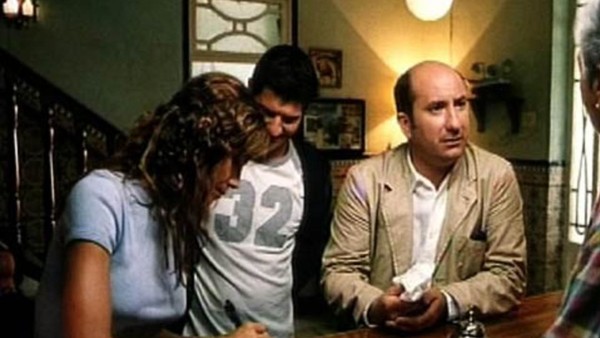
Thankfully Hollywood has so far resisted the urge to remake the film (well, aside from Edge of Tomorrow), but in 2004, Italian film director Giulio Manfredonia did shoot a remake called Stork Day (or It's Already Yesterday), which makes no sense considering the implications of the film. His version is about an egocentric TV documentarian who is trapped in a loop whole filming in Tenerife.
For a while Stephen Sondheim was linked with a musical remake, but he distanced himself in 2003 saying that "to make a musical of Groundhog Day would be to gild the lily. It cannot be improved."
17. Someone Sued The Production
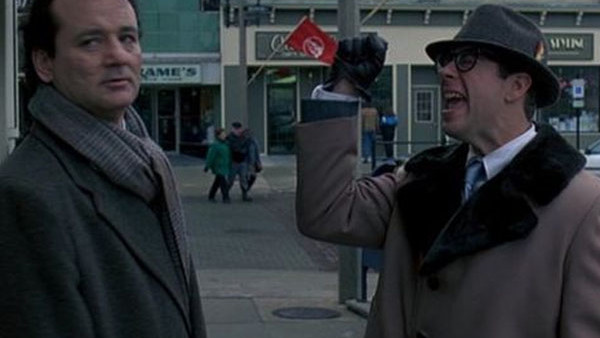
The store Lloyds, which is seen frequently in the background of the scenes between Bill Murray and Stephen Tobolowsky, attempted to sue the production for several thousand dollars for lost business, but failed thanks to their suit asking for far more than they could ever have actually lost in earnings.
Ironically, the film has now made Punxsutawney a tourist attraction - though that wouldn't ever have helped Lloyds since the store isn't actually anywhere near it.
Also after its release, several writers claimed that the story was stolen from their idea, despite Danny Rubin stating openly that his only inspirations were the 1892 story "Christmas Every Day" by William Dean Howells and Interview With The Vampire, which inspired him to consider the idea of eternal life.
16. It Named Some Streets (But Not In Punxsutawney)
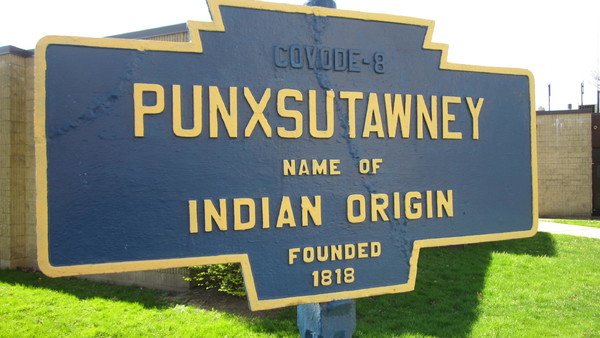
There are two plaques to the film, but not in Punxsutawney - which has profited over the years despite not being the actual filming location. It was actually shot in Woodstock, Illinois and there is a small plaque that reads "Bill Murray stepped here" on the curb where Murray steps in the puddle while talking to Ned Ryerson.
There is also a second plaque on the building wall at the corner that says "Ned's Corner" - which is unsurprising considering he's probably the most memorable character in the film. In another geographical fake, the Groundhog Day ceremony is depicted as occurring in the centre of town, when in fact Gobbler's Knob is a rural, wooded area, about two miles outside of Punxsutawney.
But then you couldn't resist that name, so the move was understandable.
15. Tom Hanks Was Almost Phil Connors
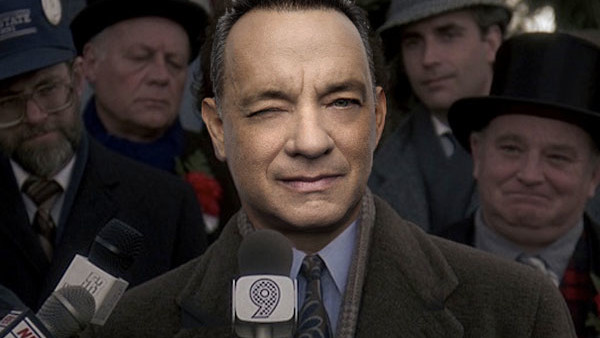
Rubin admitted that he had never considered Bill Murray for Phil Connors when writing the script, and thought it more suited to a more serious actor who could do comedy:
"I suggested Tom Hanks and they actually asked him, but he declined. He later told Harold that he was right to turn it down because he wouldn't have worked in the part. He said everybody knows that he's a nice guy, so if he started out as nasty everybody would anticipate his transformation. With Bill you have no idea what he's going to do."
So counter to popular belief, it was Hanks who actually turned the role down; something he has in common with Michael Keaton, who also passed. Meanwhile Harold Ramis also considered Chevy Chase, Steve Martin and John Travolta for the role of Phil Connors, but he considered them as "far too nice" compared to Bill Murray. Clearly, he hadn't spent enough time with Chase.
14. It's All About Psycho-Analysis
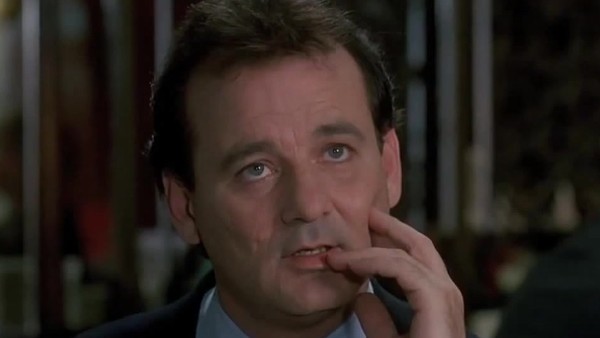
Critics are always falling over themselves to compare films to psycho-analysis: after all, it's attractive to think of the cinema screen as an unconscious mirror (in which case Lars Von Trier has some serious issues).
In a talk at the Hudson Union Society, Harold Ramis talked about the number of psychiatric professionals who told him that obviously the movie's a metaphor for psychoanalysis, because we revisit the same stories and keep reliving these same patterns in our life. And the whole goal of psychoanalysis is to break those patterns of behaviour.
Again, it's an alluring reading, and it does make a lot of sense, but it does suggest that humanity's psyche is inherently broken... Ah well, at least it leads to entertaining films.
The theory, which also turned up in a 2006 article in the International Journal of Psychoanalysis fits more because of some of Ramis and Rubin's creative changes. For instance, Rubin admitted that he wanted to have more escape sequences - "I had him driving and riding snowmobiles and stealing a plane and trying to teach himself how to fly, etc." That would have distracted from Phil's more gentle approach to self-realisation (aside form his suicides, of course).
13. It Could Have Been Called "February 29th"
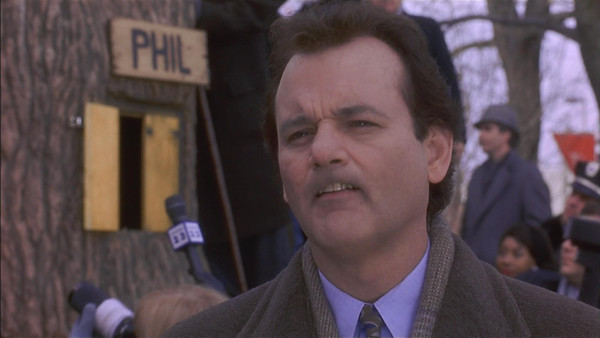
Danny Rubin has said that after his initial idea for the film, he set about choosing a suitable day to loop over and over, initially considering setting it during a leap year, so Phil would be trapped on 29 February - underlining the time hole idea - but eventually landed on Groundhog Day because "it's a completely unexploited holiday."
He also thought that because of the limited competition they'd be able to "play it on TV every year like the Charlie Brown specials. Infamously, there were at least four different versions of the film (though some were inevitably incomplete): thanks to the filming schedule and Harold Ramis' indecisiveness over how the film should look, he demanded that every film be shot in every weather condition.
"The story is that Harold Ramis had not determined what the repeated day of Groundhog Day would look like. And you have to remember in the movie, the day IS a character. So we shot the outdoor scenes in every weather condition. Sun, gloom, rain, snow. So I joked that in a vault somewhere, there had to be four versions of the film. It created an excitement on the set because no one had a day off. If the clouds parted and there was sunshine, they'd yell out "Everybody on the street! We have time to shoot another street scene!"
12. There Could Have Been Scope For A Sequel
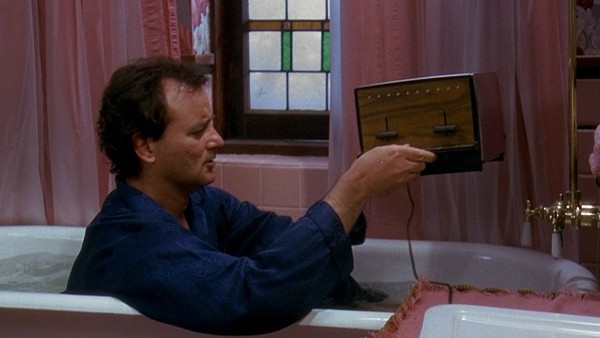
Rubin's first draft of the script ended with Phil waking up on 3 February having escaped his own loop and lying next to Rita at 6am in sublime happiness. Unfortunately, though, Rita wouldn't have felt the same:
"In my original draft I had a different ending: Phil wakes up and for the first time he's lying next to Rita. It's February 3rd! But Rita can't wait to get out of there. Why? Because she's been waking up for weeks on February 3rd!"
That was in response to someone questioning whether the ending was tacked on by the studio, a fact Rubin refused to accept, admitting that it was always going to be difficult not to make the ending look arbitrary. It would have added a nice little nasty sting to the tail though.