20 Most Powerful Film Images Of All Time

Those emotional moments we'll never forget.

Creating a powerful, indelible movie image is no easy feat, and most of the time it's not done deliberately, nor can it really be predicted. Though Hollywood likes to think they know exactly what audiences like, that's been proven wrong countless times, and far beyond their creators' wildest dreams, these 20 film images became ingrained in pop-culture history forever more as high-points of the medium. So, what creates a powerful film image? The criteria are diverse and numerous: to touch our hearts in a way we could never have imagined, to so perfectly summarise the journey the movie as a whole has taken audiences on, or to change the landscape of cinema as we know it. These 20 movies, with their flaws and faults, all brought something fresh and game-changing to the table: they all provoked our hearts and minds in various ways, and kept us both thinking and talking about each movie long after the credits rolled. But what we've also tried to discover are images that succeed in creating meaning even if you haven't seen the particular film, or perhaps aren't even aware that it's taken from a work of cinema. These images on their own manage to conjure up plenty of emotion, and therein lies their true power. Of course, power comes in a number of forms, and 20 images isn't nearly enough to cover the gamut of incredible cinematic images, so did we miss any of your favourites? Let us know in the comments!

20. Sgt. Elias Dies - Platoon

The most iconic scene from Oliver Stone's classic Vietnam war film has Sgt. Elias (Willem Dafoe) emerging from the jungle while being fired at by North Vietnamese soldiers. In absolute despair and unable to run anymore, he throws his hands up into the air as his comrades exit the area on a chopper, and he finally succumbs to his numerous injuries. On its own, this is a powerful image about the nature of war, not only of the loss and bloodshed inherent in any conflict, but the clear psychological torment and hopelessness that it ultimately invites. Whatever the war we might be fighting at any given time in the present, this visual has remained devastatingly relevant over the last three decades, and adorns the DVD cover for a good reason. Furthermore, the anonymous nature of the soldier only enhances the universal savagery of the image: we're not looking at Willem Dafoe in his final moments, we're looking at potentially any soldier on any battlefield the world over from any political stance, and that loss is never a good thing.

19. An Uncertain Future - The Graduate

Mike Nichols' superb coming-of-age tale The Graduate concludes on an unexpectedly ambiguous note, as Ben (Dustin Hoffman) rescues Elaine (Katharine Ross) from her arranged marriage and whisks her onto a bus, where they leave her family behind and drive off into the unknown. Though their expressions at first are of joy and relief, they soon change to something more oblique, of fear, uncertainty and sadness. Even ignoring the movie's existential tones, the image is incredibly powerful: here we have a woman sat in a wedding dress, on what is supposed to be "the happiest day of her life", yet she appears more confused, and the man she's with appears deep in thought rather than paying attention to his "bride". It's a perfect summation of life: no matter how great and well-planned things might seem, we're always going to have the fear of an unknown future to contend with, often even when we're with the one we love. Rather ingeniously, Nichols managed to give audiences a crowd-pleasing romantic ending but also one that was coloured with the subtle inflections of its two lead actors, creating a brilliantly thought-provoking final statement on life.

18. Ellie Dies - Up

Pixar's Up told us more about the passage through life in its opening 4-minute montage sequence than most movies do in 120, as life-long lovers Carl and Ellie grow old, and Ellie dies in hospital, leading to the above image of Carl sat alone, presumably following her funeral. The power of the image is in its universality, in conveying the sadness and heartbreak of the death of any loved one, and that no matter how much support one might have in their lives, when it's someone deeply close to you who has died, you're going to feel defeated and alone. It may just happen to be a still from an animated film, but for all intents and purpose, it may as well be a still photograph of a real person: the emotion is the same, and nothing is diluted through the shift in medium. Animated films have a brilliant knack for communicating complex humanist ideas through visual means rather than words, and this is one of the all-time best examples. Just try not to tear up while looking at this image, we dare you.

17. Thumbs Up - Terminator 2: Judgment Day

If there's one thing most people watching Terminator 2: Judgment Day for the first time probably didn't expect, it's that the movie would have their eyes stinging by the time the credits rolled. The above image occurs after the T-800 (Arnold Schwarzenegger) saves the day, but must also be lowered into the molten steel himself to decisively ensure that judgement day cannot happen, giving a final thumbs up as he is enveloped by it. Remove it from its context, however, and the image is still a potent metaphor, that despite the trials and tribulations one might face throughout their life, the odds are still in their favour that things are generally going to be OK in the end (with some exceptions). In a world that can so often seem hopeless and confusing, a little hope and positivity can go far as long as it doesn't become delusional. That's totally what this image is about: most of the time, for most of us, things just aren't that bad, and sometimes we simply need a reminder of that fact. And in regard to the film itself, if you saw this as a boy and didn't get the sniffles, you're absolutely lying. Or heartless.

16. Fredo Dies - The Godfather Part II

One of the greatest sequels in movie history, Coppola's The Godfather Part II managed to live up to the impossible standards of the original movie, in large part because of the intense, emotional pull of Michael Corleone's (Al Pacino) relationship with his family members, namely brother Fredo (the late John Cazale). The movie concludes with Michael unexpectedly having his brother assassinated while out fishing, leading to this beautiful image. The still is a clever work of juxtaposition by Coppola, contrasting the gorgeous visual landscape with an exceedingly ugly act, though even if we remove the image from this known context, it still greets viewers with a certain dark tone: why is this man standing up, looking down at the boat? What is the object protruding from the boat? The image conveys a certain loneliness, and this is coincidentally rather apt as a commentary on Michael himself, but even on its own merits, it proves to be a powerful statement. It's an at once unsettling yet undeniably serene image, and one that helped give this magnificent sequel the emotional edge over the original.

15. The Host Of Seraphim - Baraka

Ron Fricke's Baraka is one of the most haunting cinematic experiences you'll ever have, a non-narrative documentary about the various trials and tribulations of life on Earth. The massively-acclaimed stand-out sequence of the movie is the montage set to Dead Can Dance's elegiac The Host of Seraphim, in which we observe a number of bleak scenes of poverty, most memorably a landfill in Calcutta. We see the citizens poring over trash looking for goods they might be able to sell, all while a dumptruck piles on yet more rubbish. It's a startling, disturbing image that causes most of us as comfortable, well-fed Westerners to feel an immense sense of gratitude for our lives, and perhaps also a sense of guilt over the inequality in the world. That people have to live like this is deeply unsettling, and juxtaposition of the impoverished people with the expensive machinery in the background only enhances this feeling. It's a simple message for sure, albeit one that's elegantly composed and utterly vital.

14. The Spinning Top - Inception

Christopher Nolan has had audiences fervently discussing the ending of his ingenious sci-fi Inception for the last 4 years, as it remains ambiguous whether extractor Dom Cobb (Leonardo DiCaprio) is awake or, in fact, still inside the dream world. The very image of the spinning totem is a potent metaphor for audiences to ponder on the nature of their own reality, and just might have students poring back over their dusty Descartes books to consider the notion of "I think therefore I am". As a still, it takes on an even more interesting meaning, as if we do not see the totem spinning in motion, we can never be sure of whether it will continue to spin or is mere nano-seconds away from wavering and falling over. Outside of the movie's context, this means less about being awake or asleep, and is simply more indicative of life's uncertainty: things might continue as they are, or could change at a moment's notice. Our reality is our own to confront and shape to our will as much as humanly possible. This sole image has fostered so many passionate discussions between cinema-goers that its power should certainly not be underestimated.

13. "Hitler" Plays With The Globe - The Great Dictator

Charlie Chaplin's outrageous, ahead-of-its-time political satire saw the comic legend sending up Adolf Hitler by way of his creation Adenoid Hynkel, the tyrannical leader of the fictional nation of Tomania who bears a not-so-dissimilar resemblance to Hitler. The most iconic scene from the movie has Hynkel playing with a comically oversized balloon globe of the Earth, dancing and kicking it around. The image of Chaplin playfully spread on a table in full Hitler garb, balancing the globe on his hand, is a hilarious reminder of one key fact about life: nobody should be beyond mockery, not even a murderous lunatic of Hitler's variety, and the more we laugh at these figures, the less we legitimise their actions. More to point, it also suggests that, inside every maniac, there is a playful, little boy who once existed, even if he is now long gone. To take a figure so commonly associated with hate and turn him into a laughing stock was the bravest thing Chaplin ever did as a filmmaker, and it still blows us away almost three-quarters of a century later.

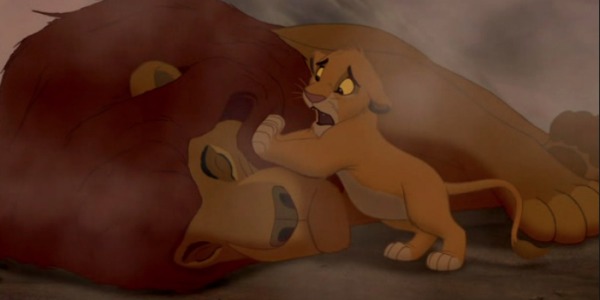
12. Mufasa Dies - The Lion King

One of the saddest scenes from any Disney movie is the death of Simba's father Mufasa, after the evil Scar hurls him back into the stampede he just escaped from. Poor young Simba has to deal with discovering his father's body and heartbreakingly tries to wake him up. Animated films may anthropomorphise animals in a way that a real-life still image simply never can, but take away the Disney flourish and expressiveness, and you still have a son coming to terms with the untimely death of his father, and in any language, that's devastating, especially at such a young age. The heartbreak and sense of loss is something most of us are likely to feel one day when our own parents are no longer around, and as the saying goes, to children, their parents are like Gods, as is especially true in Simba's case. Whether we're 15 years old or 60, whether we still have our parents around or are in fact parents ourselves, for most of us that fear never totally goes away, and Disney have perfectly tapped into the universality of that feeling.

11. The Titanic Breaks In Half - Titanic

James Cameron's Titanic is an overlong, overly treacly epic romantic disaster flick, but it's hard to argue with Cameron's absolutely impeccable craft, especially when the Titanic breaks in half, causing many to plunge to their deaths while Jack (Leonardo DiCaprio) and Rose (Kate Winslet) prepare themselves for an icy dip. It's a difficult moment to remove from its historic or cinematic context, but let's break it down to its core components: we have a giant cruise liner, a marvel of (at the time) modern engineering, facing off against the overwhelming forces of nature, and unsurprisingly, it's nature that comes out on top. It's not so much a cautionary tale as a tragic reminder that no matter how brilliant humanity can be, we are almost always subject to the Earthly forces around us, and we should absolutely respect them. In our increasingly technological world, it's an important lesson to remember. Sure, we all love that clip of the guy falling from the top and smashing his head on the way down, but the sheer scale and chaos depicted here takes on an entirely more important meaning than that.

10. The Star Child - 2001: A Space Odyssey

Stanley Kubrick's 2001: A Space Odyssey may understandably not be to all tastes: it's a vague, esoteric, trippy visual feast that doesn't necessarily offer enough clear narrative nourishment for all audiences, but its visceral power and visual majesty cannot be denied. The most startling image is of Dr. Bowman (Keir Dullea) being transformed into the Star Child, the celestial baby-like being who floats next to Earth at the end of the movie. On one level, the image is a tribute to the massive creative power of cinema, and on another, it's a statement about everything we simply don't know about the universe. We may in many ways see ourselves as masters of our own destinies, but outer space remains largely unexplored, we fear our own deaths, and in honesty, who doesn't at some point in their lives wish that they could return to the warm, care-free comfort of the womb? Bowman's journey may be difficult to relate to, but that's why this sole image itself is so great: removed from Kubrick's wacky space story, it's about a desire to know the answers to life's grand mysteries and our future, while yearning to hold onto something from our past as well.

9. The Dance Of Death - The Seventh Seal

Ingmar Bergman's existential masterpiece The Seventh Seal follows medieval knight Antonius Block (Max von Sydow) as he plays chess with Death (Bengt Ekerot) in an attempt to hold off his own demise. However, Death ends up winning the game, and at the end of movie, Block and everyone he has been travelling with is united in a dance of death. The beautiful silhouetted image makes its context clear from the black gown and scythe at the front of the pack, forming the popular symbols for Death, while those behind him are helplessly in his thrall, marching towards their end. Even ignoring its potent stature in the film itself, this image has an undeniably haunting quality, that whether we like to think about it or not, we're all taking that same walk towards death, though the length of our journeys are of course completely different. Through Bergman's accomplished career examining life and death, no image has remained as brilliantly indelible and thought-provoking as this.

8. Russian Roulette - The Deer Hunter

Michael Cimino's The Deer Hunter is a classic Vietnam war movie, and one that trained its focus on one particular aspect of the war: the psychological damage dealt to the soldiers risking their lives out there. The movie concludes with shell-shocked soldier Nick (Christopher Walken) committing suicide during a game of Russian roulette, as his friend Michael (Robert De Niro) can only look on in horror. Take the image away from the movie, or better yet, take it out of the war-time context (which isn't immediately noticeable from the picture alone), and what do we have? A visual of a man who clearly hasn't slept in days, and with a gun pointed to his temple, probably isn't in the sharpest frame of mind. It's a reminder of how fleeting life is, and more importantly, that we ourselves have the power to "end our problems", or try to find a solution and keep on living: the choice is ours. Does this man pull the trigger or not? As a sole image, he remains forever in limbo, though most of us won't be able to erase the visual of Nick pulling the trigger from our minds. Walken's piercing expression and the morbidly curious (rather than fearful) expressions on those behind him again cements our fascination with the specter of death in all its forms, be it natural of self-administered.

7. "I Am Your Father" - Star Wars Episode V: The Empire Strikes Back

It's one of the most iconic and pervasively-parodied moments in any Hollywood movie, as well as perhaps the worst kept plot twist, that Darth Vader is in fact the father of Luke Skywalker (Mark Hamill), as revealed during their climactic confrontation in the second Star Wars movie, The Empire Strikes Back. It's the defining moment of not just the darkest and most dramatically potent Star Wars film to date, but of the series entirely: it frames everything we see both before and afterwards, and as soon as we see the above image, we know that "I am your father" has to follow. The image is one difficult to consider on its own terms, though know this: with this nuclear bomb of a plot reveal, sci-fi and blockbuster cinema was never the same, and seeing the villain with the hero so thoroughly over a barrel even before revealing his parenthood (having cut his hand off just prior) wasn't exactly something audiences were used to seeing in high-budget Hollywood cinema. The message here? Sometimes the good guy doesn't win. And sometimes he's your dad, too.

6. The Playground - Ikiru

Akira Kurosawa's dramatic masterpiece Ikiru follows a middle-aged Tokyo bureaucrat Watanabe (Takashi Shimura) who learns he is dying of stomach cancer and, in trying to do one last, worthy act in his life, decides to try and transform a cesspool into a children's playground. The movie's most memorable image is of Watanabe in the final moments of his life on Earth, sat on the very swing he helped build. On its own terms, the image represents a very clear metaphor: the notion of keeping young at heart even as we age, and not to become too tired and fed up with life before our time is up. And of course, much like the 2001: A Space Odyssey image, the use of childlike imagery also reflects a desire to return to the carefree nature of youth as opposed to the crushing responsibility of adulthood, which leads to the finality of death as we age. How many of us are really going to still be playing on a swing-set when we're in our 70s? Probably not very many, but maybe more of us should every now and then...

5. Ryan's Salute - Saving Private Ryan

Yes, it still blows most people's minds that Saving Private Ryan lost the Best Picture Oscar to Shakespeare in Love, but at least Spielberg scooped the Best Director Oscar and Janusz Kami„ski's evocative cinematography also won the gong, considering pretty much every image of this movie could be framed and hung on a wall. The movie ends with an elderly James Ryan at the grave of the very man who saved his life in WWII, Captain Miller (Tom Hanks), as he gives him a dutiful salute. On its own terms, this is a deeply moving image about both the camaraderie and massive loss of war, a reminder that, regardless of your politics, it's worth respecting the men who laid their lives down in order to secure our personal freedoms. The superb framing of the image, with Ryan's family hovering in the background, is also a reminder of how lucky subsequent generations are, to be free of war on their own turf and live their lives freely as they see fit. You'd need a heart of granite not to be moved by this display of respect, a tribute to the men who died to give him life.

4. The Red Coat - Schindler's List

Spielberg strikes again with Schindler's List, one of the most emotionally gripping movies ever made, a grim though vital account of German businessman Oskar Schindler's (Liam Neeson) covert efforts to save Jews during the Holocaust. The most striking visual symbol in the movie appears as Schindler notices a girl in a red coat in the Kraków Ghetto, and later sees her corpse being loaded onto a cart to be burned, which is very much the tipping point in convincing him to act. Spielberg's decision the colour the girl's coat red inside of an otherwise monochromatic frame is an easy though potent visual metaphor: the colour and vitality of the red represents life and innocence, strewn amid what are clearly grim, lifeless circumstances. On a more simple, visceral level, it's an image of two dead children, which is always going to strike up strong emotions in people, as this is seen as a perversion of the natural order of things. We live, we grow old, we die, or at least we're supposed to: anything else is just haunting.

3. The Incinerator - Toy Story 3

Toy Story 3 was an emotional movie right from its very first scene, though the high-point comes when the gang are left to perish inside an incinerator, and the toys, seeing no way out of their predicament, appear to accept their fate, holding hands as they edge closer and closer to being burned to a crisp. The parallel between the toys heading on a conveyor belt towards their demise and human beings taking a similar (albeit slower) inevitable journey towards their end is obvious, but the most powerful image in the movie is that of Woody (Tom Hanks) and Buzz (Tim Allen) joining hands, a universal sign of friendship that, like Up's image earlier, may as well be live action, because the meaning is absolutely the same (and funnily enough, it reminds us a little of the Schindler's List DVD cover). It's elemental and doesn't hide behind clever symbolism: it's one of the most simple yet important things we ever do as humans, to form meaningful bonds with people that transcend our limited lifespans. To see a film primarily aimed at children tackling such existential, adult themes is a testament to Pixar's pure filmmaking genius.

2. E.T. Flies Through The Sky - E.T. The Extra-Terrestrial

Spielberg's crowning achievement just might be his heart-warming, fantastical sci-fi E.T., telling the tale of friendship between lonely young boy Elliot (Henry Thomas) and a homesick extra-terrestrial. The most famous image from the movie is without question the shot of Elliot and his alien buddy flying through the forest and soaring by the moon on Elliot's bike. The image may be forever associated with both the movie and the logo for Spielberg's Amblin Entertainment, but even if you forget the whole alien angle, it's a majestic, beautiful image on its own terms. It's an invitation to entertain the impossible and strive for those things outside your comfort zone: as adults we need to be grounded and sensible, but at the same time, you're never too old to have an imagination and get caught up in some magic and wonder every now and then. We're not suggesting you should try cycling off cliff edges in the forest just because everyone else sticks to the pavement, but a little outside-the-box thinking every now and then isn't such a bad thing.

1. Andy Escapes - The Shawshank Redemption

One of the most heartfelt and uplifting films ever made, The Shawshank Redemption culiminates in Andy Dufresne's (Tim Robbins) escape from prison, tunneling through literal sewage and emerging out the other side into the rain. It's cinema's go-to moment of salvation, as the filth of the prison is literally washed away by the rain, a not-so-subtle though nevertheless potent visual metaphor. On its own terms, the image is one of sheer adulation, a reminder to embrace nature and smell the roses every now and then...and hopefully you won't have to wait twenty years like poor old Andy. If you're able to stand out in the rain and just soak it in, then at least in that moment, you're free, and that's about as great as life gets. Even if you can't quite get on board with the absurdity of Andy's means of escape, it's almost impossible not to get wrapped up in the emotion of his two-decade quest to win his life back. Did we miss any immensely powerful cinematic images? Let us know in the comments!

Contributor
Contributor

Stay at home dad who spends as much time teaching his kids the merits of Martin Scorsese as possible (against the missus' wishes). General video game, TV and film nut. Occasional sports fan. Full time loon.