20 Sci-Fi Movies You Must See Before You Die

Don't even think about dropping dead until you've seen these.

The first thing we all probably think of when we hear the word sci-fi is "the future." Dystopian worlds made up of neon-clad towers, robots so advanced that they pass for human beings, monstrous alien creatures, huge ships, laser beams, memory implants, time travel... these are just some of the tropes that mark sci-fi out as one of the most exciting and innovative of all movie genres. Indeed, we tend to think of science-fiction as the "intelligent genre." It's often thought that the best science-fiction movies pose the question: "What does it mean to be human?" After all, this is the question that many of the best and most acclaimed science-fiction pictures attempt to find answers to - be it by way of comparison the human being against smart, artificial lifeforms, probing our innate tendency to explore and create and destroy, or in our will to understand why we're even here on Earth in the first place. Join us, then, as we countdown our picks for those 20 sci-fi movies that you must see before you die: the pictures that we feel tap into what it means to really make a great science-fiction movie that absolutely everybody should watch at least once before their time up is. Every film included on this list will enrich your life experience in at least one way: they'll give you something to think about, to appreciate, to shoot for; they will open you mind. There were just a few qualifications that the movies included here had to meet in order to be considered: sci-fi/fantasy hybrids weren't considered (no Star Wars, then), we leaned towards "harder" science-fiction movies as opposed to more comically-inclined ones (no Back to the Future, unfortunately), and there aren't any comic book adaptations on the list, either. That said, then, strap your jetpacks on, set tasers to stun, and let's start the countdown...

20. Sunshine (2007)

Penned by novelist and screenwriter Alex Garland, Sunshine isn't the most cohesive movie on this list; helmed by Danny Boyle, who also adapted Garland's novel The Beach for the big screen and collaborated with him on horror flick 28 Days Later, Sunshine takes place some time in the near future, at a point where our sun is on the verge of dying. Tasked with re-igniting the star with a "pay load" are the crew of the Icarus II, one of whom is bomb designer Robert Capa (Cillian Murphy). As the crew steer towards their destination, though, things go terribly wrong when - in true Alien style - they pick up a distress beacon emitting from aboard the ill-fated Icarus I. Boyle directs the movie beautifully, taking his cues from classics like 2001: A Space Odyssey, and Garland manages to craft dense, memorable characters that defy the kinds of stereotypes that often plague movies of this sort. Though the idea might feel somewhat overwrought at times, Sunshine manages - for the most part - to make the premise believable, rendering this is as smart sci-fi that isn't afraid to embrace itself as a genre movie. Its biggest problem comes in the third act, where logic is replaced for what feels like careless ambiguity for lack of better to do; still, the first two acts are mesmerising enough to mark this as essential sci-fi viewing.

19. Moon (2009)

Every once in a while, an unlikely director comes out of nowhere and blows you away with the sheer brilliance of their debut work; in the case of Moon, the first feature film from British filmmaker Duncan Jones (who is, rather aptly, David Bowie's son), this smart, relevant, sad and funny sci-fi flick marked him out as a wonderful new talent, whose impressive knowledge of sci-fi cinema is made apparent in every frame (he would go on to make Source Code, a sort of sci-fi Groundhog Day). Starring Sam Rockwell in what is undoubtably his best performance (or best two performances, perhaps?), this little gem proves that budget isn't always everything. Which is to say, Moon features Rockwell's charismatic engineer, Sam Bell, who works alone on a small base located on - you guessed it - the moon. He communicates with Earth using just a satellite phone, and is counting down the days until he can return home to his wife and daughter. But all is not as it seems: an accident suddenly finds Sam having to face off against not aliens or evil robots, but... himself. Literally. Rockwell plays dual roles in the movie as different Sam Bells, and indeed, the movie largely works because he is so convincing in both parts. Coupled with Duncan Jones' clean, crisp direction, this is low-budget sci-fi at its very, very best.

18. Total Recall (1990)

"Get your ass to Mars!" Who knew that a line like that could come from one of the essential sci-fi pictures of all-time, a movie which also happens to be one of the most relentlessly entertaining and downright bonkers science-fiction movies ever made? With renowned provocateur and satirist Paul Verhoeven behind the camera, and Arnold Schwarzenegger giving one of his finest performances as construction worker turned secret agent Douglas Quaid, this violent, compulsive, special effects bonanza is a genuine classic of blockbuster sci-fi, and features great turns from everyone involved, including Sharon Stone, Ronny Cox, and Michael Ironside. The plot, loosely adapted from a Philip K. Dick story, is purposely all over the place, and mostly asks that Schwarzenegger looks perplexed and out of his depth for the entire film. Set mainly on Mars, Verhoven crafts a picture that looks surprisingly great and vibrant in its dank, slum-like aesthetics, as Quaid battles his way across the Red Planet searching for answers about his identity. There are so many great things to consider about Total Recall - the three-boobed prostitute, to name one - but it's important to note that this is also a picture of great ideas. The lingering questions Total Recall asks about memory will stay with you through all the bloodshed.

17. Planet Of The Apes (1968)

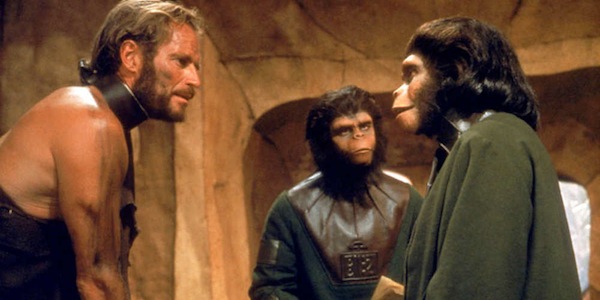
"You blew it up! Ah, damn you! God damn you all to hell!" And so laments Charlton Heston's George Taylor in one of sci-fi cinema's most infamous scenes, as his cynical, battered hero looks upon the ruins of the Statue of Liberty and realises... that it was Earth all along. Planet of the Apes is often lambasted for being too on the nose and - in retrospect - somewhat dated, but to criticise the movie for those reasons is to miss the point of it all. This intoxicatingly mad, thrilling, satirical mess of a motion picture, which sees an astronaut crashing landing on the titular planet which he finds is ruled by humanoid apes, has a lot of intelligent things to say about race and sex. If Planet of the Apes is best remembered today for its shocking twist ending (is there seriously anybody out there who is still unaware of what it entails?), there is still so much more here to enjoy; indeed, Apes is remarkable in the way that it throws so many ideas into the melting pot and manages to implement them in and amongst a blockbuster. Yes, it's camp, and yes, some of it looks a little iffy now, but the scope and drama mark this out as essential science-fiction; the most interesting aspect, perhaps, is that of Charlton Heston's protagonist, who has to be one of the most resentful and agitated heroes in all of cinema - a role he totally nails.

16. Akira (1988)

The only animated movie to make our list is based on the epic, sprawling, mind-boggling manga series of the same name, and deals with a storyline that - in its simplest terms - explores a future government who experiment on children in a dystopian Japan branded as "Neo Tokyo." On the surface, Akira might just look like a very well-drawn cartoon, but rest assured - this "cartoon" clings to an incredibly complicated and often headache-inducing plot, one that even fans of the movie have trouble trying to explain to the uninitiated. Directed by Katshuhiro Otomo, who also created the manga, Akira is bold and intoxicating sci-fi at its densest. Our hero is Shotaro Kaneda, a member of a biker gang who finds himself going up against the government when his best friend is captured. Most people come to appreciate Akira first for its visual aesthetics; appreciation of its plottings usually comes a lot later, after four or five attentive viewings. If it sounds like the movie is a something of a tough nut to crack, it is - but that doesn't mean that it can't be enjoyed immensely even if you can't follow the storyline. Indeed, the brilliant thing about Akira is the way in which it pulls you into its world regardless, through a dizzyingly explosion of neon and towering skyscrapers. It's impossible not to feel awed.

15. Donnie Darko (2001)

Donnie Darko is a movie that - quite simply - shouldn't have worked. It's a confusing, puzzle box of a picture, verging on the pretentious; impenetrable to a first time viewer, and increasingly elusive to even long-time fans. And yet writer and director Richard Kelly, who was just 26 at the time he made his debut, somehow managed to craft a movie that transcended the disarray - Donnie Darko is arguably the essential cult sci-fi movie, one that clings to its own, deeply strange mythology and never fails to engage, entertain and mystify upon repeat viewings. Indeed, more than 10 years after its release, Donnie Darko is still as interesting as it ever was. The explain the plot in a few sentences is to do the movie an injustice, but here goes: after a near death experience, troubled teenager Donnie Darko (Jake Gyllenhaal) suddenly finds himself faced with visions predicting the end of the world, which are delivered via a man wearing a rabbit costume. But the key to the movie's success arguably lies in Kelly's approach to his material; though Donnie Darko is a dense science-fiction film, bringing in themes centered around time travel, existentialism and a myriad of other philosophies, its major draw is in its brilliant exploration of teen angst. You don't even need to care about the plot to enjoy it; and what a soundtrack!

14. Stalker (1979)

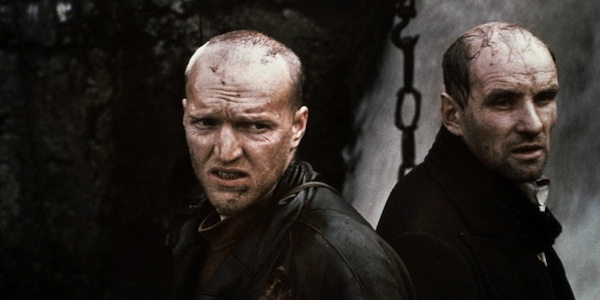
Stalker might be most innately difficult movie to make our list - at least from a sheer "entertainment" perspective. Because Russian filmmaker Andrei Tarkovsky's slow and mediative sci-fi masterpiece is one of those movies that chooses to reward only patient viewers. If you're easily bored, or the thought of three hours of characters walking through a wasteland just chatting about whatever comes to mind doesn't sound like your idea of a good time, then this one probably isn't for you. And yet here is a movie that, if given a chance, will wash over you, tunnel deep inside your consciousness, and never let go; as a result, it undoubtably ranks as essential sci-fi. Much - if not all - of Tarkovsky's work could be called existentialist, and Stalker is no exception. Set at some point in the future, the plot follows a man whose job - as the "Stalker" of the title - is to navigate a dangerous, quarantined terrain on the outskirts of a city called 'the Zone," rumoured to send anyone who enters it barking mad. But there are also rumours that, having ventured into this wasteland, a man's deepest desires will be granted. And so we follow the Stalker as he accompanies two men, a Writer and a Professor, on a long, dream-like odyssey into the unknown. The cinematography is phenomenal; the direction impeccable. Truly haunting.

13. Twelve Monkeys (1995)

Twelve Monkeys is the sort of strange, twisted, brilliant time travel movie that only Terry Gilliam could have cooked up; despite taking his influence from Chris Marker's short film La Jetée (itself considered something of a sci-fi classic), it's a picture that feels wholly original and totally unique in its downright balminess. So Twelve Monkeys tells the story of Cole (Bruce Willis), a disillusioned convict who is sent back in time to the present from an apocalypse-ravished future to prevent the end of the world. As soon as he arrives, though, he winds up being thrown into a mental hospital - here, his doomed journey to escape and stop a devastating plague begins. Not only does Twelve Monkeys contain what is perhaps Bruce Willis' best performance (you can really feel the desperation in him here - he's totally unlike John McClane, which is nice), this might also be Gilliam's most complete and essential film. The mood that he creates through innovative camera work, a deft script, and a cast of truly nutty characters separates this film from the rest of Gilliam's canon in a way that feels refreshing - all his bonkers traits are still in place, but there's a sense of story here that moves the narrative along at a brisk, exciting pace. What's more, the ending is both shocking and clever; obvious, and yet you'd never have guessed.

12. The Fly (1986)

Jeff Goldblum gives what is arguably his finest performance in David Cronenberg's remake of the 1956 movie of the same name, which sees scientist Seth Brundle accidently spliced together with the DNA of a fly during a teleportation experiment gone horrifically wrong. What follows is a picture centered around a terrifying transformation, as Brundle slowly becomes more alert, powerful and confident, before succumbing to the horrors of what it really means to be half man, half fly. A special effects triumph that also works as a reverent allegory for the AIDs crisis, The Fly shows Cronenberg working at the absolute height of his brilliant, twisted powers. And here's a remake that also happens to be better than the original film. What makes The Fly so riveting is the way in which Goldblum manages to make Brundle's transformation believable - at no point do we question his descent into madness, because the actor grounds his performance in reality. Indeed, there are many who believe Goldblum was robbed of an Oscar for his work here. Geena Davis is also excellent as his love interest; the makeup and costume effects are vivid and gruesome; Howard Shore's musical score hits the right note of tragedy; the sci-fi elements feel detailed and thought out. At a lean 96 minutes, this is bold, mandatory stuff.

Contributor

Sam Hill is an ardent cinephile and has been writing about film professionally since 2008. He harbours a particular fondness for western and sci-fi movies.