20 Things You Didn’t Know About The Green Mile
Trivia, tidbits and trifles on one of the best Stephen King adaptations ever made...
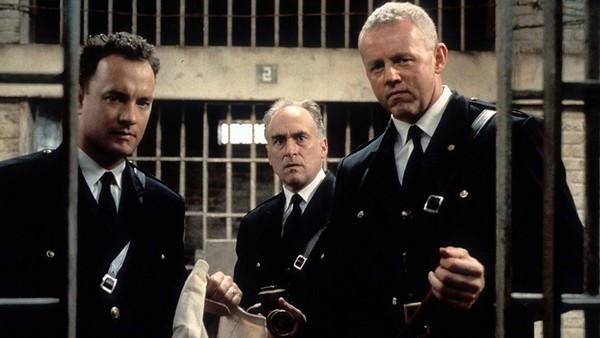
When Frank Darabont’s feature film adaptation of Stephen King’s ‘serial thriller’ The Green Mile hit cinemas in 1999, it was a big deal. King’s six-part novel had debuted in 1996, and the excitement that had surrounded the innovative marketing of the old school Victorian-era format was still fresh in people’s memories.
It didn’t suck, either, something that people at the tail end of the millennium had come to expect from adaptations of King’s body of work. The era of seventies and eighties classics like Carrie, The Shining, The Dead Zone and Stand By Me was long gone, and while Misery and The Shawshank Redemption had been top shelf adaptations, the nineties had seen ten other movies based on King’s properties utterly crash and burn.
It had been Darabont who’d adapted Shawshank, so expectations were high. The Green Mile exceeded them: the script was moving and faithful to the novel; the performances were extraordinary, the actors perfectly cast; the production design and the soundtrack were evocative and meaningful.
It’s not flawless, but as a supremely faithful movie adaptation of a serialised 600 page novel it succeeds far, far more often than it fails.
So let’s see how much you know about the ins and outs of making the movie...
20. The Serialisation

At the time, original author Stephen King called The Green Mile the single most faithful adaptation of his work, which until that point hadn't always been treated with a vast amount of reverence by Hollywood.
The novel was originally published as six short books, once a month between March and August 1996. For King, the serialised format was a creative challenge - and an impish thumb to the nose of readers who insisted on skipping to the end to see what happens. His mother had been one such - he remembered being twelve and, horrified, catching her holding her place on page 50 of an Agatha Christie mystery while she flipped to the climax to find out whodunnit.
That wouldn't be possible here - in fact, King was still writing as the first volumes were published and had only the vaguest idea how it ended himself.
King made sure to make each of the six instalments a story on its own. Frank Darabont's adaptation, as a single sprawling narrative, elides the serialised format entirely. Today, it would probably have been presented to HBO as a serial, but the television landscape of today is significantly different to the television landscape of twenty years ago…
19. The Two Veterans Signed Up Because The Script Was So Moving

Darabont wanted James Cromwell for the part of Warden Moores from the very beginning: and after he read the script, Cromwell was moved to the point of tears and agreed instantly.
Even twenty years ago David Morse was one of the most respected character actors in the world. He hadn’t heard about the script until he was offered the role of Edgecomb’s right hand man Brutus ‘Brutal’ Howell, and admitted that he was in tears by the end of it:
“[It] was another experience where no matter where you looked on the set, someone was doing the best work of their career. It was one of those extraordinary scripts everyone wanted to be part of—Tom Hanks, Patricia Clarkson, Gary Sinise—just an amazing group of actors. Michael Clarke Duncan, who passed away recently, and Michael Jeter, who passed away a while ago, had so much heart; they are a big part of what makes that movie so meaningful to people.”
18. Bruce Willis Got Michael Clarke Duncan The Gig

Darabont had been struggling to find an actor who could inhabit the pivotal role of John Coffey, the gentle giant wrongly accused. Ving Rhames and Shaquille O’Neal had been considered, but Rhames was a suave and savvy presence in front of the camera, while O’Neal wasn’t an actor and couldn’t be relied upon to hit the emotional beats required.
it was Bruce Willis who stepped in and saved the day, as he tended to do back in those days. He heard about the open casting call and suggested the late Michael Clarke Duncan, who he’d just worked with on Armageddon.
Duncan blew everyone away: the movie works on many levels, but it doesn’t work at all without him.
17. Duncan Used To Be A Bouncer And Bodyguard

Raised in Chicago by a single mother, Duncan was 42 when his big break came. He’d dropped out of college to support her when she became ill, digging ditches and working the door at clubs to make ends meet.
He’d always wanted to be an actor, and by his mid-twenties was living in Los Angeles, hustling for roles while he worked as a bodyguard to the stars. It was former client the Notorious B.I.G.’s murder that led him to quit that job and pursue acting full time.
Still, until Armageddon he’d mostly been typecast as bouncers or bodyguards, there not being a significant casting call otherwise for tall middle-aged black men built like Sherman tanks.
After The Green Mile, things changed - not vastly, but the film gave him the career he’d longed for. Even better, Duncan beat former protection clients Jamie Foxx and Will Smith to a best actor Oscar nomination.
16. He Was Also A Treasure

After his tragic early passing, Tom Hanks gave his former co-star a moving tribute, calling him "the treasure we all discovered on the set of The Green Mile."
Producer David Valdes recalls Duncan being the heart and soul of the shoot, loved by cast and crew alike, and remembers Hanks actually crying on the big man’s last day on set.
That powerful, sensitive performance didn’t come from any formal training. They’d hired an acting coach for him, a man named Larry Moss, who’d told him that ‘Big Mike’ (as all Duncan’s friends called him) wouldn’t be able to play the part - he’d need to find Little Mike first.
Duncan was forced to recognise that the muscularity and intimidating presence that had served him so well in smaller roles wasn’t what he needed to rely on to play John Coffey:
"I think John Coffey is an angel. That is the best way I can describe it. Any time you give of yourself and don’t ask for anything in return, I think that is very angelic. And, to want to see the simple things. I think that says a lot about his spirit. And, you have this man if he could, if he had the heart of a villain, there would be no cell in that town that could hold him. It is very humble, and nice and sweet."
He tapped into that childlike confusion and hurt that he’d felt when his father walked out on the family when he was a kid - and the results speak for themselves.
15. He Wasn't As Tall As He Looked

While Duncan was a great wall of a man, he wasn’t seven foot tall, only six foot five - and both David Morse and James Cromwell were of a similar height.
To give the impression that Duncan’s John Coffey was even larger than real life, Darabont used subtle tricks of perspective and creative camera angles to make him seem to tower over everyone even more than he already did.
To keep up the illusion, Coffey’s bed and the electric chair they used for him at the climax were both built to a smaller scale, making it look as though he could barely squeeze his gargantuan frame into the furniture.
However, if anything, Duncan was actually too ripped and muscular for the role - in order to look more like a man would have in the thirties, he was forced to limit his work in the gym during the shoot.
14. Casting Paul Edgecomb

Both Michael Keaton and Michael Douglas were considered for the role of Paul Edgecomb, head of the prison guards, while John Travolta was actually offered the role, but turned it down.
Eventually, Tom Hanks took the part as a personal favour to Frank Darabont. He’d been offered the role of Andy Dufrezne in The Shawshank Redemption five years earlier, but had declined at the time as he was more interested in the title role in Forrest Gump.
Happily, when Frank Darabont had lunch with Stephen King and mentioned the fact of Hanks' casting, the author was over the moon - Hanks had been the guy he'd had in mind for Edgecomb all along.
13. The Older Paul Edgecomb

Originally, Hanks was set to play the older version of his character as well, but make-up tests just didn’t seem convincing enough.
Veteran character actor Dabbs Greer was hired to play the older Edgecomb because Darabont had been a huge fan of Invasion of the Body Snatchers (1956) and It! The Terror from Beyond Space (1958), both of which had benefited from Greer’s work.
It turned out to be Greer’s swan song in movies. At first, his poor health wouldn’t allow him to accept the part, but Darabont had his heart set on the casting and shot scenes around the character until Greer was well enough to come in.
His performance in The Green Mile came over sixty years after his first work as an extra in Westerns - and he died in 2007 after a long and rewarding career.
12. Period Inauthenticity Part 1 - Pop Culture

When Hollywood makes period-set movies, the idea is usually to create the illusion of the time and place - not necessarily to be perfectly accurate.
The Green Mile was originally set in 1932, but was pushed forward to 1935 to allow the important insertion of footage from the film Top Hat, which had come out that year.
However, music doesn’t have quite the same fixation in time as cinema: popular forties and fifties singer Eddy Howard is featured on songs on the film’s soundtrack that were recorded in 1940.
Similarly, the Billie Holiday recording of ‘I Can't Give You Anything But Love’ they use in the movie wouldn’t be recorded until 1936. It’s also highly unlikely that a Louisiana radio station in the thirties would play anything by a black artist, too.
And if you really want to be picky, when Edgecomb describes the doctor’s diagnosis as ‘gobbledygook’, he was anticipating the coining of that word by nine years, since it was invented by Congressman Maury Maverick in 1944.
11. Of Mice And Men

Fifteen real mice were actually used in The Green Mile, each trained for months to do specific tricks. In the part where Mr Jingles pushes the spool across the floor, it was actually being pulled by a small rig that was later digitally removed from the shot - the mouse was just following scent applied to it.
However, most of the time the actors were reacting to a laser pointer moving around the floor and not to a real rodent. For the stomping scene where Mr Jingles loses his life, a puppet was used that was far more expensive than any of the genuine mice had been.
The exception to that came with the moment where the mouse defecates on Edgecomb. That didn’t require any acting on Tom Hanks’ part - the mouse really did sh*t on him.
10. The Mice Weren't The Only Thing That Squeaked

Doug Hutchison played the sadistic, broken guard Percy with his usual flair for surly, wet-lipped malice. But according to Frank Darabont, he had help in clearly defining the monstrous nature of his character.
That help came from the squeakiest pair of shoes that the props department had ever witnessed.
Darabont was so enthralled by how loud and obnoxious the squeak was that he kept it in the film. Apparently it felt like fate that one of his two villains made people suffer in this manner… listen closely and you can hear the demented squeak of his shoes screeching away like a pair of evil Pokemon.
9. Period Inauthenticity Part 2 - Prison Anachronisms

The movie, like the book, insists on the prison guards wearing a uniform when at work. In reality, prison guards didn’t wear uniforms in 1935. Hanks et al were, at least, aware of the anachronism, but chose to ignore it as, despite the lack of authenticity, the uniforms gave the scenes an authentic feel and were useful for the actors:
”The reality is that they didn’t wear uniforms on death row in 1935. But Frank [Darabont] wanted them because it looked really cool, and I wanted them as an actor because it gave me this exoskeleton that was communicating some of the subtler aspects of the scenes.”
Similarly, the straitjackets used in the film use buckles despite this accessory not being introduced until nearly fifty years later - back in 1935, straitjackets were laced up.
The biggest prison anachronism in the film, of course, comes from old Sparky himself: prisons in Louisiana in the thirties used hanging as their method of execution, and didn’t swap to the electric chair until 1940.
8. Hanks On Set

Tom Hanks is uniformly agreed by all who’ve ever met him to be the living embodiment of pleasant awesomeness, and tales from the Green Mile set do nothing to contradict his reputation.
Every Friday night, dinner was on Hanks: he’d order in a specific type of cuisine for the entire cast and crew, from sushi one week to In n’ Out burgers the next.
Whenever Stephen King visited the set, Hanks would remain in character: King didn’t meet Hanks, he met Paul Edgecomb. At one point King asked if he could sit in the chair but Hanks point blank refused, because Old Sparky was his responsibility as the guard in charge of the block.
Doug Hutchison wagered the extras that they couldn’t call his lines during Delacroix’ execution scene and was flabbergasted when they got it right and he had to pay up. Unfortunately, what he didn’t realise is that Hanks had written the lines on giant cue cards placed behind him.
Duncan was reportedly incredibly self-conscious about the scene where Coffey heals Edgecomb’s urinary infection, because it would involve holding Hanks by the groin. When it came time to do the scene, Duncan discovered that Hanks had placed an empty plastic water bottle in his trousers to make things easier for him.
Finally, Hanks was invited to place his handprints in the cement outside of Grauman’s Chinese Theatre on Hollywood Boulevard during the shoot, an honour that means as much as an award to many Hollywood stars - it’s a sign that you’ve ‘made it’. Hanks didn’t suspend shooting to attend the ceremony, but ran over to place his hands during his lunch break, legging it back to set in time to read off-camera lines for Hutchison’s coverage scenes. That job could just as easily have been done by a member of the crew - but Hanks knew that actors prefer to act opposite other actors, and cut his big moment short to support one of his peers.
7. The Cast Got On Really Well

Hanks is Hanks; but everyone else in the cast got on astonishingly well, considering the length of the shoot.
Hutchison tells the story of Michael Clarke Duncan finding out that he’d been one of the cons on Con Air a couple of years previously. If the Green Mile set was a bed of roses, the Con Air set was a bramble patch: Hutchison had a horrible time on the film. His scenes with John Malkovich were cut, so he had no lines, and in the few scenes where he was on camera, he’d been so determined to distance himself from the film that he tried his best to remain out of shot: turning his shoulder to camera, or bending down.
During week eight of the shoot, Duncan finally found Hutchison in that film and thought it was the funniest thing he’d ever seen:
“Over the course of the week, [Duncan[ manages to tell the entire cast and crew... At one point, his trailer is jammed with the likes of Hanks, Morse, Pepper, DeMunn, and Jeter for a "Doug-Hutchison-Con-Air-Marathon." The entire trailer is rocked with laughter… Nina Pasowitz, our key hair stylist, presents me with a giant, cardboard Con Air collage with the caption "I'm ready for my close-up, Mr. DeMille" printed in bold letters at the top. The collage is made up of several still frames pulled from the video. They're all me avoiding the camera in one way or another. Even as you read this, I contemplate my revenge on Michael Clarke Duncan.”
6. Period Inauthenticity Part 3 - Product Placement

This is where we get to the really anal retentive part of the period inauthenticity section of the article. Feel free to roll your eyes, but it has to be done.
That edition of Weird Tales that Delacroix is reading in 1935 was published in November 1937.
The quartz clock used in the room with Old Sparky might have been invented in 1927, but it wasn’t actually used anywhere in the world until the 1940s - and that was in laboratories.
Those particular bottles of Royal Crown Cola the guards drink were made in the 1950s. Before 1936, when painted bottles began to be used, the bottles would have been unadorned.
Back in the 1930s, Scotch tape was a brand new invention and completely lost its adhesive qualities when wet - so it would never have been used to gag someone.
The worn old clock on the desk in E block is a Westclox Big Ben Style 5, a model designed and marketed between 1939 and 1949.
5. Two Of The Characters Are Named After Harry Dean Stanton

Two of Edgecomb's fellow guards, played by Jeffrey DeMunn and Barry Pepper, are named Harry and Dean Stanton. However, the movie also features a horrible old man by the name of Toot-Toot, played by veteran character actor Harry Dean Stanton.
Every other mention of this tidbit of trivia claims that this was purely a coincidence, citing the fact that these are the names of the same characters in King's 1996 novel. This, of course, handily ignores the fact that Stephen ‘Mister Americana’ King would have been well aware of Stanton's incredible body of work when writing the novel - in point of fact, Stanton had played the detective in the 1983 adaptation of King's novel Christine.
That means the guards are still almost certainly named after the actor.
4. Always The Bridesmaid, Never The Bride
Legendary composer Thomas Newman crafted a haunting, elegiac score for the movie, the second he'd worked on with Darabont after The Shawshank Redemption.
Incredibly, Newman has been nominated for a musical Oscar fifteen times without a win in the last 25 years - in 1995, he was nominated twice for Best Original Score (for Little Women and The Shawshank Redemption) and in 2009 he was nominated twice for WALL-E (for Best Original Score and Best Original Song). His latest Oscar nomination is this year: Best Original Score for the marvellous 1917, which he has to be front runner for.
The Green Mile was the longest soundtrack Newman had worked on at that point, and he spent six months on the project. His aim wasn't necessarily to write catchy tunes, but rather to find “a kind of hyper-reality to intensify the sense of mysticism".
Darabont described Newman's score "a rainbow of music and emotion", and he's not wrong.
3. The Green Mile Vs. The Green Mile

Hollywood has a long and appalling history of playing fast and loose with their adaptations of literary properties, leading to oddly euphemistic credits such as 'based on', 'inspired by', or 'based on a two-line summary of the novel written on the napkin of the hotel in which I pitched it to a bored executive while coked off my ugly face'. One of those may or may not be made up.
Astonishingly, here there are very few important differences between the source material and the adaptation. The time frame of the main story is jigged a little forward to 1935. We never get a description of the crimes that lead to Delacroix' and Bitterbuck's imprisonment. Edgecomb is telling the story in the present day, not writing it, and found out that Wild Bill was the real murderer through a vision he experienced through Coffey, not through detective work.
Aside from that, King's 600-odd page novel is carried to the screen almost completely - an impressive feat of screenwriting at the best of times.
2. Some Critics Believe The Premise Is Racist

Legendary director Spike Lee, amongst others, has criticised the film for employing the tired trope of the 'Magical Negro' with the John Coffey character.
This idea invariably comes from white writers, and features a black character whose only function in the narrative is to help the white protagonists, usually both practically and spiritually: their lives are bettered by his presence as, displaying otherworldly wisdom, he uses some form of mystical power to perform miracles, usually sacrificing himself in doing so.
Lee's dismissal of the film is typically blunt and to the point:
"These films all have these magical, mystical Negroes who show up as some sort of spirit or angel but only to benefit the white characters. I mean, Michael Clarke Duncan gave a good performance in The Green Mile, but when I saw that movie I knew he was going to get an Academy Award nomination. The Academy just loves roles like that because it makes them feel so liberal. But if this character has such magical powers that he can touch Tom Hanks and cure him of his urinary tract infection, why can't he use those gifts to walk out of prison?"
King’s defence has always been that Coffey’s railroading all the way to the green mile was only due to the colour of his skin: he made him a black man because of the extent of racism in the South back in the 1930s.
1. The Green Mile Was Very Personal For Frank Darabont

As Darabont was about to begin work on the screenplay, his cat was diagnosed with a tumour. On borrowed time, the animal wasn't in any pain - so Darabont cared for it at his desk while writing, describing it as his 'co-writer' or even his 'co-pilot'.
"It's the whole 'Green Mile' death row experience... The writing of it was very much that. I had this creature I really cared about walking that mile."
The screenplay was complete in only eight weeks, a remarkable accomplishment considering its quality and especially the length of the novel it was so faithful to. Darabont's co-pilot passed away peacefully shortly afterwards.
The celebrated writer/director has called The Green Mile "the most satisfying movie of his career", and audiences tend to agree - close to 50 of King's works have been adapted for the screen since Carrie in 1976, but The Green Mile was the only one to pass the $100million milestone at the domestic box-office until It in 2017.
The Academy also agreed - he was nominated for the 2000 Oscar for Best Screenplay Based On Material Previously Produced/Published, alongside the Bram Stoker Award for Best Screenplay and Best Script at the 2000 Nebulas.
Darabont was also recognised by his peers by being nominated for the Outstanding Directorial Achievement in Cinema Award at the 2000 DGA Awards, as well as Best Director at the Saturns.
In fact, The Green Mile was one of the more popular and recognised movies of 1999, winning the People's Choice Award for Favourite All-round Motion Picture and Favourite Dramatic Picture, and the Best Action/Adventure/Thriller Film at the Saturns.
Not only that, but it was nominated for the Best Picture Award at the 2000 Oscars and Best Film at the Broadcast Film Critics Association Awards.