20 Things You Didn't Know About Fight Club
Let’s have a chat about Fight Club. What’s that? Why not?

In two months it’ll be the 20th anniversary of the world premiere of David Fincher’s brutal satire Fight Club. It’s a dense, intelligent movie that rewards repeated viewing, snatches of dialogue taking on deeper resonance over time.
What this means is that, despite the first - and second - rule of Fight Club (hey, sing along if you know the words), a lot of people have spent a lot of time talking about Fight Club.
The internet is dotted with articles detailing trivia, Easter Eggs and theories (many stolen from each other: if one’s made a mistake, so have two dozen others). For film buffs, this film is the gift that keeps on giving.
That being the case, it’s been a challenge to come up with twenty snippets of information for the 20th anniversary that aren’t necessarily common knowledge amongst every Fight Club fan in the world: theories, quotes, trivia and filmmaking facts that not everyone knows.
But let’s be honest. Many of you will have already read about a couple of these little tidbits, and some of you will be familiar with several. However, only movie anoraks will know most of them - and it’d take a true Fight Club obsessive to tick off the lot.
So which are you? And can you trump us and come up with something more... something that you think no one else will know?
And obviously there are spoilers, but come on - it’s been twenty years now.
20. The Protagonist’s Name Is… Confusing

Edward Norton’s protagonist is never named: in the credits, he’s just ‘Narrator’, which is how most people refer to him (including Fincher). In the self-help groups, he takes on a variety of fake names - Cornelius, Rupert etc.
Casual fans of the movie infamously took to calling him ‘Jack’, after the Narrator’s satirical use of non-fiction article titles: I Am Jack’s Colon, I am Jack’s Raging Bile Duct, etc etc. For ‘real’ fans, this was clearly a shallow misunderstanding.
The thing is, they’re almost right: in the shooting script, the character is referred to as ‘Jack’ - but probably just for the sake of convenience (just as this article will, going forward).
Those article titles were adapted from real-life Reader’s Digest pamphlets, which is how they were presented in Chuck Palahniuk’s original novel: I Am Joe’s Colon, I am Joe’s Raging Bile Duct, etc etc. However, Reader’s Digest refused permission at a late stage for Fincher’s film to use their copyrighted titles. They didn’t want their buttoned-down brand associated with a film like Fight Club.
This led to Norton having to step back in to re-record sections of his narration, replacing ‘Joe’ with ‘Jack’, the name in the script.
However, to Project Mayhem and Marla Singer, his name is Tyler Durden. ‘Tyler’ buys plane tickets in his name: does he have fake ID? Or was that the narrator’s name all along? Did ‘Tyler’ just take it from him, leaving him nameless as he did with the members of Project Mayhem?
19. How Many Times Does Tyler Durden Appear Before Tyler Durden Appears?

Everyone knows that Fincher spliced subliminal flashes of Brad Pitt as Tyler Durden in the first twenty minutes of the film before the Tyler Durden character himself actually makes an appearance… but how many are there?
The first one pops in when Jack is at work struggling to stay awake at the photocopier, Tyler looking equally bored; the second comes at the tail end of Jack’s visit to the hospital with Tyler smirking over the doctor’s shoulder. The third flash comes during the first support group meeting, which is then followed by a fourth flash on the street outside another meeting as Jack looks for Marla.
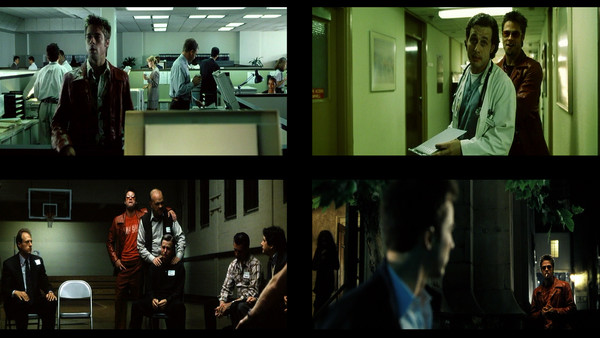
These are what Fincher refers to as ‘Subliminal Brads’. There’s another one that not everyone picks up on, and that's in the hotel welcome video that he has on in his room while travelling for work. Tyler Durden crops up as one of the waiters in the presentation on the right of the screen.
There is, of course, another appearance - it’s one that might pass you by, as it's not really subliminal. The camera lingers on him this time, showing him on an airport travelator going in the opposite direction to Jack, who has his back to him. It appears to be the first appearance of the Tyler Durden character... but of course we know that there is no Tyler Durden character. If we see him and he’s not interacting with Jack or acting as Jack, it’s an interpolation.
18. Pitt Kind Of Worked With DiCaprio On The Film

Although this year’s Once Upon A Time In Hollywood is the first time Brad Pitt and Leonardo DiCaprio have acted together, it’s not quite the first time they’ve been in a film together.
In the scenes with Jack’s meditational cave towards the beginning of the movie - where he encounters the penguin he believes is his ‘power animal’ and then when Marla replaces the penguin - there’s a lot of icy breath. Needless to say, it wasn't really that cold: it was created by CG composites.
Blue Sky Studios, who worked on Fight Club, have multiple points of contact with VIFX, who worked on similar areas of CG manipulation for James Cameron’s Titanic, another 20th Century Fox movie: VIFX have been on record as suggesting that their work on Cameron’s movie provided them with “a library of generic breath elements” that they can use as a basis for other movies.
John Siczewicz was the digital artist for Fight Club, describing it like this:
After starting with those existing breath elements (from Titanic) we cut and pasted and dissolved until we had some animated breath that worked with the wind action within this ice tunnel. Since either the camera or the actor was in motion for all of these shots, I had to track in the origin point for each breath. Once these swirly breaths blended in, the whole scene dropped sixty degrees.
So there you have it: that’s not Edward Norton's breath. That’s the ghostly huffing of another Jack, puffed out from beyond the grave.
17. Bonham Carter Understood Her Character, But Not The Film

Helena Bonham Carter’s been in a lot of weird movies now, but people forget that twenty years ago, Fincher cast her against type. She was better known for working in period dramas - for being a pretty young sophisticate in a corset.
Fight Club changed that: her performance is the strongest in the film. Following discussion with costume designer Michael Kaplan, she based it on the troubled Judy Garland’s final years, leading to Fincher actually calling her ‘Judy’ while on set. She also insisted on the film’s make-up artists applying her make-up with their off hand, believing that Marla wouldn’t care enough.
However, those huge, impractical platform boots were ironically actually a practical choice. Bonham Carter is just over five foot in height, while Norton is nearly a foot taller: for scenes requiring them to be in the same shot they needed to be closer in height.
It was the smoking where things went too far. Fincher is notorious for demanding take after take after take, and needed Marla to smoke in every scene. By the time shooting wrapped after five months or so, Bonham Carter was on sixty a day and had bronchitis, making sure to pointedly give Fincher a copy of her lung x-ray as a parting gift.
Helena Bonham Carter had all that down: yet she didn’t really ‘get’ Fight Club as a movie, commenting years later that she worried that the male empowerment aspect of the film was a shallow message, and might result in copycat fight clubs cropping up.
16. None Of The Main Cast Were The First Choice

The cast were so perfect on this movie, it’s still baffling that anyone else could possibly have been considered.
Yet before going for Pitt, the film’s producers had first considered Russell Crowe for the part of Tyler Durden. Not a terrible choice, but they admitted afterwards that Pitt had been the perfect match for the role.
The part of Jack, on the other hand, had both Matt Damon and Sean Penn in consideration before Fincher decided on Norton, primarily because of his performance as the lawyer in The People Vs. Larry Flynt.
It was Marla who caused the most deliberation - both Reese Witherspoon and Sarah Michelle Gellar were initially offered the role. Witherspoon said no as she thought it was too dark, while Fincher said he thought she was too young; so was Gellar, who was also tied down to Buffy The Vampire Slayer and couldn’t sign up to the long shooting schedule the part required.
Courtney Love and Winona Ryder were also considered - Love was actually seeing Norton at the time, and many thought that this made her a sure thing, but Fincher felt exactly the opposite. Fincher’s preferred choice for the role was actually Janeane Garofalo, but word is that the script made her uncomfortable, and she passed.
Fincher also met with Julia Louis-Dreyfus, at that time still on Seinfeld, but came away from their meeting convinced she had no idea who he was, despite having Se7en and The Game on his resume by then.
15. Fincher Wasn't Even The First Choice

Although Fincher was involved in the development of the film from the beginning, he nearly didn’t get the job at all: in fact, he was the producer’s fifth choice.
Peter Jackson, fresh from the well-received Heavenly Creatures (which had changed many perceptions of him as a director), was the preferred choice. However, by that point he was a year into developing The Lord Of The Rings movies, having won the rights in 1997. Universal tied him down to do King Kong while he was finishing The Return Of The King, so he wouldn’t have had any availability until 2006.
Bryan Singer was free but hadn’t bothered reading the book when he met with Fox for the job. Flirting With Disaster’s David O’ Russell had read the book but didn’t understand it - he went on to direct Three Kings instead. That left Trainspotting director Danny Boyle, who would have been an interesting choice - but he elected to develop and direct Alex Garland’s The Beach.
Fincher, on the other hand, had bad form with Fox, having clashed with them so much during the filming of the disastrous Alien 3. But he wanted the job badly. He’d read the galleys of the unpublished work while developing The Game, identifying with the characters and themes and from all reports, laughing his head off.
He initially tried to buy the rights himself, only to find that Fox had beaten him to it. He swallowed his pride, made a pitch: and Laura Ziskin hired him.
14. They Tried To Make Marla’s Scenes Less Crude .

Who was Laura Ziskin? The head of Fox 2000, their attempt at a Miramax-style stable of low-budget, high-powered movies, Ziskin had a reputation for bringing together talent by the time she brought Fight Club into development, and this movie was no different.
However, she balked at a number of the projects more challenging aspects - specifically, Tyler’s toxic relationship with Marla.
The original line Marla utters after a bout of ‘sport-f*cking’ was supposed to be "I want to have your abortion," but Ziskin declared that to be far too offensive. Fincher agreed to change the line provided that he would not be required to amend it a second time - but of course, the replacement was "I haven't been f*cked like that since grade school", which is so much worse. Caught by her promise to the director, Ziskin’s hands were tied: the new line stayed in.
Interestingly, Bonham Carter herself didn’t properly understand that line when she delivered it: in England, there’s no such thing as ‘grade school’. It was only much later that she twigged that her character was talking about primary school, and a pre-teen upper age range.
Ziskin also flailed when she saw the yellow rubber gloves an otherwise naked Tyler is wearing when Jack interrupts the two of them. They’d been Pitt’s idea, a last minute addition that wasn’t in the script, but Ziskin was appalled at the crude implication. However, she let it slide after the gloves got a big laugh in a test screening.
13. Insomnia Is The Film's Secret Protagonist

In many ways, insomnia is a character in Fight Club, continuing the theme of dissociation and alienation. Jack describes it as an unreal state: “everything’s far away, everything’s a copy of a copy of a copy”, just as a Subliminal Brad flickers on the screen.
An insomniac all his life, sleeplessness was key to Palahniuk’s creation of Fight Club. Writing in the Guardian in 2014, he recalls:
I wandered sleepless... exhausted, delirious, and inventing a story about a man who thought he had insomnia but was actually living a double life: whenever he thought he was asleep, his alter ego would venture forth to have all the adventures he, himself, could never consciously dare.
Tyler Durden is most alive when Jack is ‘asleep’, something Palahniuk was very familiar with, admitting that his zoned-out self had cleaned and tidied up without him being aware of it, once even doing his taxes for him.
Palahniuk obliquely refers to insomnia self-help techniques in the story. Some insomniacs open a window or drink iced water before bed: this led to Jack’s ‘ice cave’ meditational zone with its puffs of frozen breath. Tyler’s tinted shades can also be used to control sleep cycles.
This extends to the fights. The film’s exhortation to ‘pick a fight and lose’ is mirrored in studies showing that when a fighter loses, their testosterone levels drop and their metabolism slows, allowing them to sleep like babies. Supposedly this prevents him from starting a new fight before recovering from the last one.
12. There Are More Hints About Tyler Than You Think

With hindsight, there are a lot of clues throughout Fight Club about the true nature of Tyler Durden.
When Jack and Tyler get on the bus, Jack only pays the fare for one; someone barges past the two men but only apologises to Jack. Later on, the same thing happens with the doorman at the bar. Tyler’s business card shows two identical angels facing each other; the two men have identical briefcases. Before Tyler crashes the car, the film shows Jack getting in on the driver’s side and scootching over - after, he’s dragged out of the driver’s side.
When Jack answers the phone, the noise of Tyler and Marla having horrible sex instantly stops. Earlier, Tyler returns Jack’s call from the payphone - a sticker on the machine reads ‘No Incoming Calls Allowed’.
Tyler allows himself to be beaten by the owner of Fight Club’s venue. Seconds later, Jack beats himself up, frames his boss for it - and tells us he’s reminded of his first fight with Tyler.
There are so many clues in the dialogue: references to Tyler speaking for him or Tyler’s words coming out of his mouth. Jack tells us that Tyler works when everyone else is asleep; previously, he’s talked about how insomnia makes everything less real. When they talk about Tyler’s father, Jack echoes everything he says; when Tyler says his father told him he should get married, Jack replies, “I can’t get married”.
There’s much more - why not expand on this entry in the comments?
11. The Differences Between The Novel And The Film

Jim Uhls’ script is remarkably faithful to Palahniuk’s novel, but there are key differences between the two.
First, in the book the narrator and Tyler meet at a nudist beach, not on a plane. Tyler is constructing a driftwood edifice so that, one minute out of every day, its shadow will become that of a giant, perfectly proportioned hand.
In the book, Tyler picks up the cry-for-help phone call from Marla, leading to their affair: the film has Jack pick up the call but choose to ignore her, leaving us with the tease of what might have happened had he saved her rather than Tyler.
Palahniuk’s novel has Marla burning herself with lye by accident, while the movie makes a significant rite of passage out of the incident.
The ending has the most significant changes. In the novel, Tyler plans to destroy the building he’s in, making himself a martyr. Marla and a collection of support group members try to reason with the narrator, but the bomb simply fails to go off and he shoots himself.
The movie has Tyler acting with far grander, more political motives, targeting several credit card company offices to eliminate their books and give America a clean slate.
In the book, the narrator wakes up in a psychiatric hospital, although he believes himself to be in Heaven and that his doctor is God. Marla writes to him, and the orderlies, Project Mayhem cultists, whisper encouragement to him and call him ‘sir’, implying that Tyler will cycle back into control again.
10. The Lost Art Of Subliminal Messaging

We’ve talked about the Subliminal Brads, and everyone knows about the penis frame spliced into the end of the movie.
Everyone also knows about the fact that, on the original Fight Club DVD, following the standard piracy warnings, a one-second long subversive message from Tyler Durden appears:
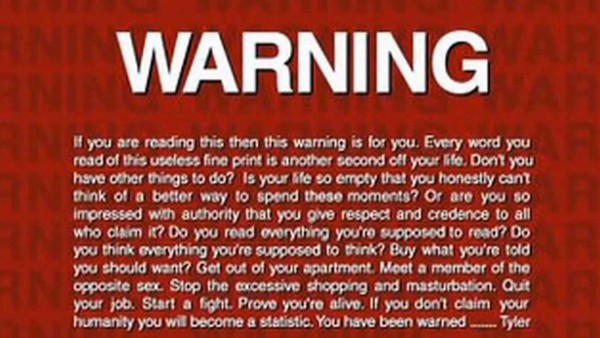
Fincher actually wanted to do more - he wanted to splice subliminal images into the title cards at the beginning of the film, but neither Fox nor Regency Pictures would allow him to mess with their logos.
However, Fincher got to play a little more on the tenth anniversary Blu-Ray version of the film. Load the disc, and the menu for Drew Barrymore romcom Never Been Kissed appears for a good fifteen seconds before the real menu for Fight Club comes up and it’s revealed to be one of the director’s little jokes.
9. The Towers They Blow Up Were Based On Real Buildings

Of course, that final scene where they blow up all of the buildings isn't real: not just the explosions, but the skyline itself.
Norton and Bonham Carter are standing in front of a glass wall on a studio set, the view before them a computer generated composite of ten different Los Angeles buildings from downtown and the nearby business district of Century City.
In the classic framing shot with Jack and Marla holding hands, you can see the twin Century Plaza towers in the centre (the last two buildings to explode), with the St Regis Hotel to the right and the Fox Plaza tower to the left in the foreground, all of which are in totally different locations to each other in real life. The latter, by the way, also doubled as Nakatomi Plaza in Die Hard.
And they’re all buildings owned at that time by the Fox conglomerate. It’s not just some Simpsonsesque middle finger to the parent company: the practical consideration was that threats of litigation might arise should they ‘blow up’ real buildings owned by third parties.
The shot itself took well over a year to put together, with the visual effects artists working frame by frame to create each shard of glass from the windows: 4 million separately animated elements in total.
Fincher remembers his progress report calls as the kind of thing that could have had him put on a watch list: “well, building number three is going to go down really easily.”
8. There's A Reason They Trash The Beetle

During their brainstorming sessions over the script in the development stage, Pitt and Norton bonded over one specific loathing of Generation X for a boomer icon gone bad.
The new, updated Volkswagen Beetle had debuted in 1997 amid a wave of nostalgia for the sixties and seventies, and Fight Club’s two stars hated it with a passion. The car had been a key symbol of sixties youth culture: but the radicals of the sixties had become the bosses and gatekeepers of the nineties, and had repackaged their own idealised youth to sell to the next generation as Swinging Sixties™.
In their minds, this kind of sell-out of authentic culture as an inauthentic marketing experience was exactly what Fight Club was kicking against - and that’s the reason why they insisted on one of the cars that Tyler and Jack beat to hell with bats be a New Beetle.
Funnily enough, shortly after Norton recounts this story on the DVD commentary, Pitt admits that in the intervening time he’s had a volte face regarding the car and believes it to be “a great reworking of a classic design.”
7. Tyler And Marla Have Bullet Time Sex

Now, everyone knows that Pitt and Carter took three days recording the sex noises that echo horribly throughout the Paper Street house and bug the hell out of Jack. As Pitt puts it:
That was just HBC and I, sitting in a room, screaming our guts out. The sad thing is we had no qualms about it, no politeness, no little hint of embarrassment... just go!
What you might not know, however, is that the sex scene is computer generated, or at least shot and enhanced. In fact, it was created using the same revolutionary 'bullet time' technique pioneered by The Matrix, which had come out in June that same year.
Still cameras had been set up to surround the bed, each recording a single image in sequence, which were then edited together and enhanced with CG. That’s right: Pitt and Bonham Carter were wearing early versions of mo-cap suits during shooting, gamely re-enacting positions from the Kama Sutra with dots all over them.
Apparently this represents the first photorealistic CGI sex scene in film. Which is nice.
6. Brad Pitt Didn't Chip His Own Tooth For The Film

One of the perennial bits of misinformation that still flies around about Fight Club, gleefully reposted by site after site, is that Pitt had a tooth - or more than one tooth - chipped in order to play Tyler Durden. Some news sites even reported it with a confirmation quote from his publicist.
The truth, of course, is a little less dramatic. Pitt likes to be authentic, but he’s not Method: his tooth was already chipped, and had been capped some years before. All he did for Fight Club was have the cap removed to reflect some measure of imperfection in the character.
He’d done the same thing when playing the role of serial killer Early Grayce in 1993’s Kalifornia, directed by Dominic Sena (also a former music video director, just like Fincher). This time Fox had paid for the dental work required to refit the cap after filming - but only on the condition that Pitt would be shirtless in at least two scenes in the film.
In fairness, it feels like Tyler Durden is shirtless in about half the movie, so they certainly got their money’s worth.
5. The Production Caused Problems With Locals

The mammoth Fight Club shoot included two hundred locations in addition to studio shooting, which inevitably caused some friction with the locals.
The exterior of the Paper Street house had been built from scratch on an empty lot in Wilmington, California. Initially it looked like a brand new property, but the production designers dilapidated and aged the prop to achieve the desired look. Once the film had been shot, the prop was torn down and the lot emptied again.
However, during night shooting at that location, director of photography Jeff Cronenweth had floated lights on helium balloons above the ‘house’ in order to get the lighting he needed. These lights ended up causing a number of reports of UFO sightings in the local area, which prompted a visit from the local Sheriff’s Department to get to the bottom of things.
In other location shoot, the production annoyed one local so much that he threw a 40oz beer bottle at Cronenweth’s head, cutting him open. Another visit from the police had the culprit arrested.
4. All The Guys Had A Hand In The Script

Although Jim Uhls has sole credit for the screenplay, he wasn’t the only person to have input into the writing of the movie.
While the project was in the later stages of development, Fincher, Norton and Pitt made frequent trips to meet with Andrew Kevin Walker, the writer of Fincher’s Seven a few years earlier, who provided uncredited revisions here and there. Walker plays down his influence on the final product:
He [Uhls] made this amazing chair, and I came and sanded some of the edges and maybe put the little things that protect the floor on the bottom.
WGA rules state that uncredited means uncredited - they couldn’t even include a thank you to Walker. As a gesture, Fincher named the three detectives in the last third of the movie after him.
But those meetings with Walker were more than just hangout sessions. The two actors, the writer and the director were engaged in frantic brainstorming, meeting at Pitt’s place or a nearby office to talk about and around Fight Club and its themes for hours at a time, days on end, breaking the dialogue into pieces and examining it for authenticity and value.
All four men provided ideas that became a monologue they nicknamed the ‘Mamet rant’, inspired by quotes from Palahniuk’s novel and the spirit of playwright and filmmaker David Mamet and his epic meditations on masculinity.
3. The House At Paper Street Doesn’t Exist

So Tyler Durden is a dissociative personality, Jack’s ‘evil twin’... but he’s not the only thing in the movie that isn’t real. Remember Jack’s diatribe about insomnia making everything unreal, and how sleeplessness is practically a character in the film?
Let’s start with the Paper Street house, the huge, dilapidated old building that Tyler Durden lives in, and that Jack moves into after his condo explodes. Although the street name isn’t referred to in dialogue, Fincher makes sure we know it: we get a very deliberate close-up of Tyler’s business card - the one with the two identical angels facing each other - and later on, we see a street sign for Paper Street.
The thing is, in mapmaking terminology, ‘paper streets’ are roads that only exist on maps, not in real life: they’re made to trap people duplicating the map without permission from the copyright holders.
Not only that, but when Tyler and Jack are screening potential Project Mayhem members on the front porch we see the address of the Paper Street house by the door: 1B, when the address on Tyler’s business card was 537.
It’s a format usually used with apartment or hotel room numbers. Remember what Tyler says to Raymond K Hessel? “Because they give sh*tty basement apartments letters instead of numbers.”
We know Tyler’s not real. Why should his house be real? Jack’s been living in a hotel (Room 1B?) since his condo exploded: the Paper Street house and its comedy wiring and plumbing doesn’t exist.
2. Marla Singer Isn’t Real Either

To reiterate: Fight Club is a film about dissociation and alienation. From expectations, from father figures, from culture, from previous generations, from yourself - and from masculinity.
Look at the number of references to penises, penis substitutes and castration in the film: beginning with the testicular cancer support group that Marla shows up to.
Marla offsets Tyler’s style throughout - chainsmoking, shades, rings, fur coat. She lives in a hotel, as Jack almost certainly does. When Tyler meets her, he struts and grins but never says a word - odd, for a man who never stops talking (Marla does all the talking instead). Marla calls herself ‘infectious human waste’ in the third person: a term taken from the bins outside the liposuction clinic, which she couldn’t have known about unless 'she' was there.
She walks out into traffic without anyone slowing or reacting: when Jack steps into the road after her, they frantically beep their horns at him. When Jack negotiates with her for the support groups he literally tells her “you can’t have the whole brain”.
It's clear: Marla doesn’t exist either. She’s another alternate personality. Remember that classic shot at the end, the two holding hands? Without trousers on, wearing a long coat, Jack mirrors her perfectly.
You think the restaurant scene - where a waiter appears to take Marla’s order - plays against this? Well, how many other times in the third act do we see insanely loyal Fight Clubbers across the country humour their insane leader's insanity?
1. Where Is My Mind?

Fincher walks us through the Tyler Durden reveal like children - yet editor Jim Haygood reminds us that “David’s thing is ‘You’ve got to assume that people are smart—you want them in on it’.”
This is the guy behind The Game, a thriller about what’s real and what’s not, but Fight Club, a film about dissociation, is far, far smarter than The Game. Fincher leaves this finish open, after all. The bomb in the van has been reset: this isn’t a fairytale ending. That and Fincher’s final subliminal c*ck-shot suggest that Mister Toxic Masculinity is about to have the last laugh.
So Marla is potentially as much a figment as Tyler. What else is there that we haven’t been spoonfed?
Well, logically, if the house at Paper Street is all in Jack’s head then so is Project Mayhem - how can they occupy a house that doesn’t exist?
Jack spends a long time ‘asleep’ (ie, with Tyler in charge) while convalescing from his head injury - we know this because the wound on his forehead is completely healed when he comes downstairs to find the ‘house’ being used as a paramilitary base. If the ‘house’ is in his head, then now his brain is rammed with potential new personalities, nameless and identically dressed.
The house had become a living thing, wet inside from so many people sweating and breathing. So many people moving, the house moved. Planet Tyler. I had to hug the walls. Trapped inside this clockwork of space monkeys...