20 Things You Didn't Know About Jackie Brown
A great novelist, a character actor regaining glory and a quirky filmmaker join for a very odd hit.

It's important to remember that the rise of Quentin Tarantino gave voice not only to one filmmaker, but a generation of them. The one-two punch of Reservoir Dogs and Pulp Fiction not only gave prominence to Miramax, it also inspired a long line of forgotten or poor imitators throughout the 90s. The Boondock Saints, Two Days in the Valley, and Things To Do In Denver When You're Dead tried to ape the director's pop culture-obsessed dialogue and bold stylistic decisions learned from the days of blacksploitation and grindhouse cinema.
These weren't filmmakers who worked their way through the system to prove their salt, putting in their hours on television before graduating to features such as Spielberg and John Frankenheimer before them. These were film brats, raised working in video stores on Fellini binges.
But the director suddenly shifted into unexpected territory with his third feature, an adaptation of Elmore Leonard's novel Rum Punch. Leonard's crime fiction had seen the screen before, most successfully with the comedic Hollywood send-up Get Shorty, but the writer was more known for his Westerns. Other adaptations, like Frankenheimer's 52 Pick-Up, received mixed reception at best.
Rum Punch told the deceptively simple story of a flight attendant who makes extra cash smuggling money in from Mexico. After getting busted, she works with a reluctant bail bondsman to bring down a gunrunner. But Tarantino's own blend of inspirations and a genuine enthusiasm for the material led to one of his most controversial, ambitious work until Django Unchained.
20. It Was Always Going To Be Robert Forster

Oftentimes when looking over the production history of a film, the studio hems and haws for months on end, debating about casting, negotiating salaries and dealing with whatever personal issues said actor has had made public lately. This isn't the case with Tarantino, who writes with a fairly clear head about who he wants for a role, dream-casting scripts along the way. It's rare that an actor ha refused a role with such rich dialogue.
Such was the case with veteran character actor Robert Forster, who would go on to be nominated for an Oscar for his performance. Forster was largely known as a tough guy actor, taking on cop roles in movies like Alligator and a lot of B-movie fare throughout the 80s.
Brown, little did he know, wouldn't necessarily make him a household name, but it would elevate his status and open him up to roles in Mullholland Dr., The Descendants and perhaps most notably the mysterious vacuum cleaner repairman in Breaking Bad. He would die of brain cancer the day El Camino: A Breaking Bad Movie debuted on Netflix.
And he certainly didn't forget what Brown wound up doing for his career, often promoting literacy campaigns by encouraging kids to read Leonard's novel.
Forster had auditioned for the role of Nice Guy Eddie in Reservoir Dogs, but Tarantino decided on tough guy Lawrence Tierney. By the time Jackie Brown had become a property, he didn't even have an agent.
Instead, Tarantino approached him at an L.A. restaurant, through the script on the table and said, "You're going to do this and that's all there is to it."
19. But It Could Have Been...

Despite Tarantino being fairly clear-minded about who he wanted in what role, that didn't stop a parade of actors from wanting in on the project. Pulp Fiction had revitalized the career of a longtime box office poison John Travolta, and there were no shortage of actors whose careers couldn't use the same shot in the arm.
Though many applied, few were even considered. Of those names, the most prominent for Max Cherry, the reluctant bail bondsman who gets embroiled in Jackie's plot to double-cross both the ATF and Samuel L. Jackson's gunrunner for $550,000 were Gene Hackman, Paul Newman and John Saxon.
There's no word how far Tarantino went in pursuing those names, but they were certainly fullbacks. You know you're a major director with almost complete creative control when names like "Hackman" and "Newman" are considered your understudies.
18. Robert De Niro Originally Wanted Another Role

Continuing his tradition of having more power than anyone else in Hollywood, Tarantino said no to Robert De Niro.
The actor had gotten a copy of the script and immediately was interested in the Max Cherry role. It's no surprise, the role is a plumb part for any aging actor and De Niro was of the age where he'd fit the role. But it would have been a very different movie. Both actors are not afraid to display immense vulnerability but in drastically different ways.
Ultimately, Tarantino convinced De Niro to take a role that was largely against type: that of Louis Gara, Ordell Robbie's vaguely clueless former cellmate. Forster went on to add in clever layers to the Cherry character - he was clearly the role everyone was interested in, which is quite a feat considering Pam Grier's placement in the film.
It was Forster that added in the scene in which Jackie and Max discuss how he had his hair done to make him look younger is taken directly from Forster's own mid-life crisis.
17. Sylvester Stallone Really Tried

It seems like everyone in town wanted their hands on Max Cherry. Sylvester Stallone had hit a slump in the latter half of the 90s. It would eventually lead to a string of Direct-to-DVD films around the millennium before he ultimately put pen to paper to reboot himself, but before that he was looking for any way he could. with Judge Dredd and Assassins both bombing.
Stallone campaigned hard for the role of Cherry, but he never stood a chance. He would, however, see some success the same year playing against type in James Mangold's Cop Land.
Stallone claims he was offered the role of Louis, but there's no confirmation on that.
16. Another Tarantino-Travolta Team-up?

With Cherry cast, one would assume the hard work was over. Movies typically have one role that every actor covets and when it's sealed, the film becomes a less attractive property.
The only problem is Tarantino and Leonard spent their careers making fully realized, complex, quirky characters that any actor would be crazy to turn their back on. Such was the case with ATF Agent Ray Nicolette. Fans of Leonard are familiar with Nicolette, the fast talking, funny agent that was ultimately nailed by an under-appreciated Michael Keaton. Keaton would go on to play the character in Steven Soderbergh's Out of Sight the following year.
But the role was just as attractive as Cherry, and Keaton was reluctant. "His whole process was to convince me that he's not right for the role", recalled Tarantino. "But he never quite convinced me. Michael's whole thing is to deny himself and to say he's not right."
But before he secured Keaton, Tarantino's first choice was to continue helping Travolta. It would have been his second Elmore Leonard adaptation following the successful Get Shorty.
15. Pam Grier Was Always The First Choice, Despite The Novel

The casting wrapped pretty early on in the process, with Tarantino immediately setting his sites on Blacksploitation star Pam Grier. But the whole process for the veteran star was a bit surreal; her name hadn't been synonymous with "hit" in some time.
Nevertheless, she was stunned when she walked into Tarantino's office to find it littered with posters for films she made "when [she] was just a piss and vinegar kid." She asked if he had put them up to impress her.
He instantly turned red and admitted that he was just about to take them down so she wouldn't notice. But it's unlikely Leonard would have made the same casting decision.
After all, Jackie was white in the book.
14. Wait, What?

Yes, the film's biggest hook, that it was a love letter to the blacksploitation films of Tarantino's youth, was entirely absent in Rum Punch. Jackie Brown is a caucasian flight attendant Jackie Burke.
All the changes to make it fit the Blacksploitation mold, from the casting to the soundtrack, were inventions of the director. In fact, the film's opening moments intentionally mirror another popular film of the era it recalls: Jackie going through the airport to Bobby Womack's "Across 110th Street" is almost identical to Dustin Hoffman walking to Simon and Garfunkel in The Graduate, decidedly NOT a blacksploitation film.
You'd be within your rights to make the logical leap that Tarantino renamed the character as a callback to Grier's signature role Foxy Brown. But you'd be wrong...
13. "Brown" Actually Comes From A British Film, Not Foxy

Tarantino's actual reason for the name change is surprisingly unrelated to Grier's past. Tarantino, like many crime filmmakers, is a big fan of Peter Yates' 1973 crime tragedy The Friends of Eddie Coyle, which features a flamboyant gunrunner who is also named Jackie Brown.
It may have been more fitting, then, to rename Samuel L. Jackson's Ordell Robbie, as much of his character's tics and behaviour are inspired by Coyle's Brown.
12. Louis And Ordell Have A Much RIcher History Than The Film Explores

Louis and Ordell are introduced in the film as longtime friends and ex-cellmates who worked jobs together in the past, but it's never expanded upon. Tarantino was familiar with the two character's backstory, he must have been. After all, he spent a night in jail, his only brush with "real crime" for stealing the novel where they first meet, The Switch.
In the book, Louis and Ordell kidnap a millionaire's wife, only to learn that he doesn't want her back. The plot was then lifted for the 1986 Danny DeVito vehicle Ruthless People. When Louis and Ordell are re-teamed in Rum Punch, they are complaining about the fact that a movie producer stole their idea - though they don't specifically call out the film by name.
It would have been somewhat awkward had they done so in Tarantino's film, given the hand that DeVito had in bringing Pulp Fiction to the screen.
11. Despite Having Basic Carte Blanche, Tarantino Was Petrified Of Elmore Leonard

Given Tarantino's long history with Leonard's work, the film was just as deeply personal to Tarantino as any of his others. The script was laboured upon endless with co-writer Roger Avary, who also worked on Pulp Fiction, and they hesitated to call the author whenever they made any changes to the novel.
It was only just before shooting was to start that Tarantino finally, sheepishly, handed Leonard a copy of the script. To the fimmaker's delight, Leonard said that of the then 26 adaptations of his work that had been produced, it was the best script he'd read.
Additionally, the author added, it was the best script he ever read, period.
10. The Evolution Of Tarantino's "Hangout" Film

Despite both the film and novel having a fairly complicated double-cross at its core, one would expect that the mechanics of the operation were of the utmost importance. It would be critical that the scenes in which money is being changed hands, plans go awry, people end up getting killed and others walk away clean, that the nuances of just how Brown would escape with the cash be clear.
But no, Leonard had handily worked all that out in the novel. Instead, Tarantino focused more attention on the in-between scenes where little plot is pushed forward. He says he looks at it as a "hangout" film like the kind he grew up with. He loved Rio Bravo, not for the big action scenes but the moments leading up to the siege where the characters are just hanging out.
Tarantino has since perfected this kind of movie, peppering long stretches of Once Upon a Time...In Hollywood with scenes in which characters just watch themselves on television and drink beer. What sounds like a chore to watch actually makes the viewer want to be there.
That's what Tarantino remembers most revisiting Jackie Brown - those scenes in Samuel L. Jackson's house in which weed is inhaled, movies are watched and AK-47s are discussed at length.
"Jackie Brown is better the second time," said Tarantino, "and I think it's even better the third and the fourth time. Maybe even the first time we see it, we go, 'Why are we doing all this hanging out? Why can't we get to more of the plot?' But, now the second time you see it, and the third time you see it, you're not thinking about the plot anymore. You're waiting for the hangout scenes."
9. Jackie's Car Might Look Familiar...

It's no secret that Tarantino films have within them their own shared universe; that the coked-out movie producer in True Romance is a relative of The Bear Jew in Inglorious Basterds and Vincent Vega is Mr. Blonde's brother. But even with a property that isn't entirely his own, Tarantino managed to further develop his little in-joke that keeps threatening to spill out into a full-fledged film (see: a failed Vega brothers movie).
Jackie's white 1980 Honda Civic is the very same care that Butch (Bruce Willis) used to knock down Marsellus Wallace (Ving Rhames) in Pulp Fiction. Given the damage done to the car in that film, it's a wonder it was in working order for its next appearance.
8. Bridget Fonda's Character Is Based On A Real Actress

Ordell Robbie's operation has a bit of a fatal flaw in that of Beach Bunny Melanie Ralston. Bridget Fonda's character is not particularly helpful, spending much of the movie smoking weed until she's called upon to participate in the film's big money smuggling scene that she ultimately botches.
And she doesn't botch it by failing to perform her tasks, but criticizing others. She's helplessly gunned down by Louis after mocking him for forgetting where to park. It's her untimely, spur of the moment death that leads to Robbie killing his longtime friend Louis.
But Fonda's character didn't come from whatever planet she appears to think she's living on throughout the film, rather she's based on 70s str of trashy drive-in cinema Candace Rialson. Rialson appeared in Candy Stripe Nurses and Mama's Dirty Girls, and she was a favourite of Tarantino. He based Melanie's characteristics on that of Rialson.
It's unknown whether or not Rialson ever saw Jackie Brown, but she was alive at the time. She's since passed in 2006 due to liver disease.
7. We Still Don't Know If That's Danny DeVito Or Not
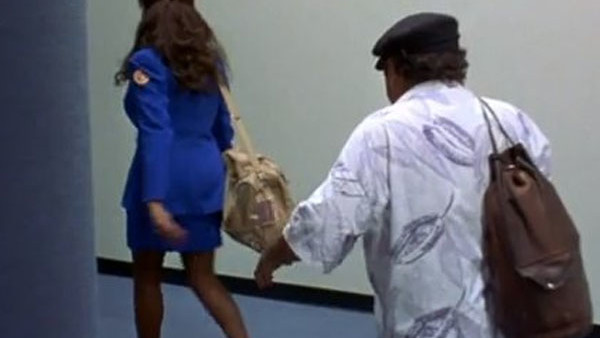
We mentioned earlier that Danny DeVito was key in shepherding Pulp Fiction through production, serving as Excutive Producer. But we're unsure if Tarantino ever repaid the favour with a tribute, but there's evidence to suggest he did.
At around one minute and fifty seconds into the film, a short man appears in a white shirt and a black cap. This may or may not be Danny DeVito. He's not credited anywhere, and the only confirmed cameo appearance is Tarantino's own voice on Jackie's automated message, but it stands to reason DeVito would appear.
6. But That's Definitely Mira Sorvino

We have no confirmation on DeVito, but we know for a fact that Mira Sorvino appears out of focus at Jackie's arraignment hearing. Sorvino, at the time, was dating Tarantino and happened to be on set that day.
But she technically is credited in the "special thanks" credits as "Bert D'Angelo's Daugther."
In the 70s, MIra's father Paul was on a short-lived detective show known as Bert D'Angelo/Superstar. Confusing title aside, it was Tarantino's nerd-centric way of thanking Paul Sorvino for making Mira and allowing her to date a strange man with a foot fetish. Which, according to our files, is indeed still kind of creepy.
5. Grier Was Tickled To Run Into Sid Haig
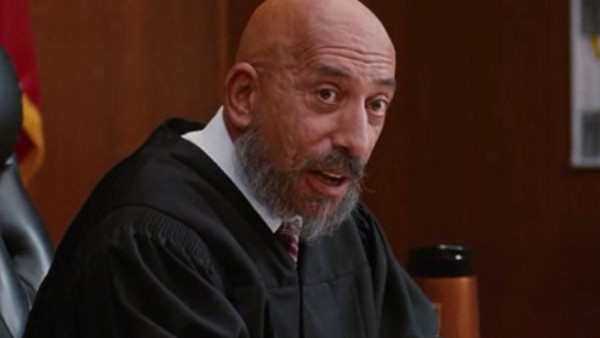
While there are few cameos, the cast is stacked with the trademark list of character actors that Tarantino had always wanted to work with. But he didn't count on the recently departed Sid Haig, being such a well-liked personality.
Haig made a name for himself playing authority figures in blacksploitation films and later served as a muse to Rob Zombie, so when Tarantino cast him as Grier's judge, he had neglected to notice that the two were old friends from the grindhouse days. They hadn't seen each other in a dog's age, and instantly reconnected.
Haig would have been a part of the film whether or not he took the role: Tarantino ensured one of the names in Melanie's apartment complex read, "S. Haig."
4. Samuel L. Jackson MFer Count: 238

There's a word, you know it, we know it, and unfortunately our advertisers prevent us from saying it, but Samuel L. Jackson happens to be a big fan, notably exceeding fan's expectations by demanding a reshoot of Snakes on a Plane so he could say the damn word twice.
But he has never surpassed his use of "MotherF***er" in Jackie Brown, using it 238 times. There's another, much more taboo word we'll get to in a minute, but the sheer vulgarity on display is astonishing.
3. That Is Actuallly $550,000 Cash

The entire plan hinges on Jackie and Max successfully absconding with a bag full of $500,000 cash while the ATF catches Robbie trying to smuggle only $50,000.
A special feature on the DVD confirms that Tarantino was deadset on authenticity, and demand that prop master Steve Joyner track down that sum of cash. Joyner did, and if you were ever wondering, yes, the bag was heavy.
2. It Almost Resulted In A Spike Lee/Tarantino Debate

And so we come to the stickiest issue with any Tarantino film, particularly work from his early period. HIs liberal use of the N-word has always been the subject of controversy, especially after watching the director himself casually spout it out in a character in Pulp Fiction. He was getting hit hard from critics, most notably Spike Lee, who was outraged that a Caucasian filmmaker would even try to use the word in such a casual way.
But Tarantino had one Get Out of Jail Free card in Samuel L. Jackson, who has often come to his defense and called out journalists who wanted to make it a controversy without ever using the word themselves. Jackson was a former Black Panther who had once held the Morehose College Board of Trustees hostage until they reformed the school's curriculum. He knew from where he spoke when it came to the Civil Rights movement and the struggle African Americans faced in America.
In a sentence that could only sound reasonable in the 90s, producer Harvey Weinstein intended to serve as a mediative voice in ongoing controversy, inviting Lee and Tarantino to debate the issue in a public forum.
Lee refused to have that conversation.
1. Tarantino Practically Lived In The Theatre
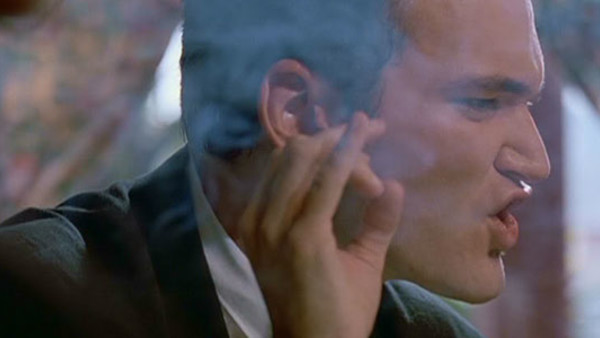
With the film in the can, ready to debut, Tarantino still had doubts. This was the first time he had not been there at the birth of the process, and his personal history with Leonard's novels throughout his childhood made him especially fearful that he'd failed his hero.
So for the first four weeks of the film's release, he attended 13 different screenings at the Magic Johnson Theatre. "I just lived there," he said.
And reaction was positive, with several critics noting that it was Tarantino's most mature film to date. It didn't have the chronological gimmickry that served Pulp Fiction and Reservoir Dogs so well, it was a straightforward narrative and, to this day, it remains unlike any other film the director has made.
We don't know what the filmmaker will do in the near future, he floats ideas to the press as quickly as he abandons them (the most recent being the Once Upon a Time...In Hollywood novelization he intends to write but probably never will), but it's unlikely he'll revisit the same well more than once.
Whatever the case, Jackie Brown was a bit of a watershed moment for Leonard and Forster, whose careers were never off-track, just not as recognized as they should be.