20 Things You Didn't Know About Saw
What traps didn't make it into the film?
Nobody expected a lot from Saw. The director, James Wan, only made one movie, Stygian, which... let's be honest, you never heard of it. At the time, Saw seemed like it was going to be just another schlocky B-movie horror flick.
But audience members fell in love with Saw due to its fascinating premise, terrifying scenes, mesmerising soundtrack, fluid editing, mind-blowing twist, and one of the most intriguing villains in recent horror. The movie is so haunting, it made a whole generation terrified of vaudeville puppets. (That takes real skill.)
The film made nearly a hundred times its budget, guaranteeing it would become the new horror franchise. Despite inspiring seven sequels, the first film is considered to be the best by far.
How the original Saw came to be is just as fascinating as the film itself. What was it inspired by? How different could it have turned out? Have you heard some of the crazy fan-theories viewers have made about the franchise?
And with that out of the way, let's have a look at the 2004 horror masterpiece. (It goes without saying that this article will contain many, many, many spoilers.)
20. The Story Nearly Had Astral Projection

When director, James Wan, and writer, Leigh Whannell, agreed to make a film together, they pitched a lot of different ideas. In the end, they boiled it down to three plot lines. Before they decided to make a movie about a serial-killer, they considered a story revolving around a man who could, much like Doctor Strange, project his consciousness out of his body. Wan abandoned this idea, stating, "We weren’t quite sure if that was going to be cool enough to be our breakthrough film".
The second plot was about a man who woke up in the morning to find scratches all over his body. He doesn't know if he is doing it himself or if another force is attacking him. To learn the truth, he sets up security cameras to film him during the night. Wan and Whannell devised this idea many years before the release of Paranormal Activity, which has a similar story and structure.
Ironically, Paranormal Activity was the first film to beat a Saw film at the box office. In fact, the developers made Saw 3D the last in the series (for a while) because they felt like the franchise couldn't compete with Paranormal Activity.
19. How The Story Came Together

While Leigh Whannell was writing the original script, he suffered migraines which were so intense, he worried he had a brain tumour. He was so paranoid, Whannell had himself scanned at the hospital.
After he received the all-clear, Whannell wondered how he would've reacted if he was told by the doctor that he had little time left to live. This helped him devise the character of Jigsaw; a terminally ill serial killer who forces his victims to face their own mortality.
Okay, Whannell had a premise... but there was one problem. He didn't have any money. Despite the fact Saw's budget was just over a million dollars, that was still light-years away from the money Whannell could spare. Whannell and Wan decided that most of the story had to take place in one place for budgetary reasons. Because of this, the pair strongly considered having the film take place inside an elevator. The killer would look at his prisoners through the lift's security cameras (which sounds like a fusion of Paranormal Activity and Devil).
In the end, the director and writer decided to shoot most of the movie in a bathroom.
18. It Started As A Short Film

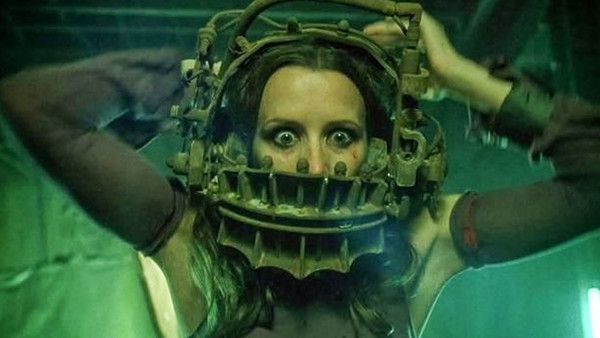
In the first film, Amanda wakes up to learn she has a padlocked contraption attached to her head. Her abductor, Jigsaw, speaks to her through a television screen and explains how the device is attached to her upper and lower jaw. if she doesn't remove the contraption within a time-limit, it will rip her mouth open.
The Reverse Bear-Trap is the most famous device in the series. The reason why this trap is so important is because it is what made Lions Gate Studios agree to make the film.
When the screenwriter, Leigh Whannell, was pitching his idea for a movie to different studios, he created a short film of Saw for $2,000 (just over £1,600). The short is, in essence, the same Reverse Bear Trap scene in Saw except Leigh Whannell himself plays the victim.
He didn’t have money for special-effects so he had to place his teeth in the rusty bear-trap to make it look authentic. Although the mechanism in the movie was safe, the one used for the short film could snap forward if it malfunctioned, which could cause serious damage to Whannell's face.
17. Saw Was Dirt-Cheap To Make

Despite being one of the most lucrative horror franchises in the last 20 years, Saw has been repeatedly criticised for glorifying violence and gore. Because the films depict bones being snapped open and bodies being crushed or melted, it's easy to see how the saga has popularised the term "torture-porn". This is ironic since there isn't that much gore in the original film.
Many scenes were meant to be gorier but the production team didn't have the money to film them. The budget was a measly $1.2 million. Although the franchise is best-known for its traps, only one trap is shown in its entirety in the first film. The Razor Maze and the Flammable Jelly scenes were meant to be shown in more detail but the developers realised it would cost too much money. As a result, these scenes are mostly shown on fast-forward.
There are no exterior shots and most of the story takes place in one room due to the budget. The director, James Wan, intended to shoot the film in 2.35:1 but had to settle for 1.85:1 because it was cheaper.
16. The Developers Turned Down DreamWorks

Every student fresh out of film school dreams of a big studio picking up their movie. But not James Wan. You see, Wan was inspired by the film, The Blair Witch Project. Because the fake documentary didn't have a studio, they kept ALL the film's profits. At the time, the Blair Witch had the highest box office ratio since it made $10,931 for every dollar spent.
When the director's manager told Wan to seek out an American studio, he refused and pitched Saw in Australia for a year. When it received no interest, they made a short film of Saw and pitched it in the US.
Dreamworks offered to fund the movie but Wan realised he would lose creative control and the finished product would have no resemblance to his vision. He believes Dreamworks' version would be like "Michael Bay presents Saw, starring Josh Hartnett and Michael Douglas. The trailer would have been car chases, and maybe the puppet would have been driving the car or something."
In the end, he went with Lions Gate and formed his own company, Twisted Pictures, which allowed him to have full control.
15. The Shotgun Trap Was Meant To Be Completely Different

When Sing and Tapp chase Jigsaw down a hallway, Sing activates a trap when he passes through a trip wire. The wire is connected to the triggers of four double-barrelled shotguns which are attached to the ceiling. When Sing passes the wire, the guns go off, blowing his brains out.
Considering how creative the traps are, this one seems pretty mundane by comparison. Why didn't the creators think of something more creative?
But here's the thing. They did. According to the audio commentary, two hidden metal plates were supposed to appear from the walls after Sing passed through the trip wire. These plates would then trap Sing inside a device which worked similar to an iron cocoon. They plates would close in, crushing Sing to death. An alternative idea was for the trip wire to activate a Rack Trap that would slowly stretch and break Sing's limbs.
The director realised he didn't have the time or the money to set up such an elaborate device and so, settled for the Shotgun Trap instead. The Rack Trap was repurposed for the ending of Saw III.
14. Saw Spawned A Comic

As soon as the creators realised Saw was a hot property, they franchised the hell out of it. Not only did it spawn novels, merchandise, and video games, but it also inspired a prequel comic called Saw: Rebirth.
John Kramer AKA Jigsaw is depicted drastically different in this story compared to his film counterpart. In the comic, John is a toymaker who was abandoned by his wife years ago due to his lack of ambition. But in the movies, Kramer is depicted as being incredibly ambitious. He was a successful engineer and the founder of his own company. The films also shows that it was John who left his wife after she suffered a miscarriage.
There were elements from the comic that were carried over to the film series. When Kramer realised he was terminally ill, he tried to kill himself in a car crash. Surviving the crash is what inspired him to become Jigsaw. This idea was carried over to Saw II.
When John takes on the Jigsaw persona, he shaves his head as a symbol of his rebirth. This scene was meant to be in the first film but was ultimately cut.
13. It's Plot Is Similar To A Vincent Price B-Movie

Although Saw is renowned for its originality, it has similarities to the Vincent Price film, The Abominable Dr. Phibes. Like Jigsaw, the titular villain kills his victims with over-elaborate traps and teases one of them with a creepy doll. For the final trap, a surgeon must remove a key from his son's body to free himself from a harness. This same concept is used for Saw II where a victim has to cut a key out of his body to remove a contraption.
But Dr. Phibes wasn't the first film to have this type of plot. It was directly inspired by the 1939 horror flick, The Man They Could Not Hang. In the movie, a scientist fakes his death and then has his enemies invited to his home so he kill them all using over-elaborate traps. One of the victims tries to call for a help on the phone but the scientist has it rigged with a blade which stabs him in the ear. This same trap was used for the Phibes sequel, Dr. Phibes Rises Again.
Many people complain the horror genre has run out of ideas. Sadly, horror has been recycling the same ideas since the beginning of cinema.
12. Tobin Bell Wrote His Own Dialogue

Until Tobin Bell was cast as Jigsaw, he was best-known for playing bit-parts in shows like Seinfeld, The X-Files, and Stargate SG-1. Considering Jigsaw doesn't speak much and is seen even less, there wasn't much expectations for the actor portraying him.
But when Tobin Bell auditioned for the role, the creators knew they hit the jackpot. They thought Bell's performance was so simple and yet, so chilling, they allowed him to write dialogue for his character. And I don't mean he changed one or two lines. He was given the freedom to add, remove, or change large parts of his dialogue.
The writers had so much trust in Bell's understanding of the character that some parts of the script in the sequels read, "Insert Tobin Bell dialogue", since they knew they couldn't write anything half as good as Bell.
It's also worth mentioning that Bell doesn't like the horror genre. This may sound absurd considering he's best-known for playing a serial killer but it probably helped his performance since he sees Jigsaw as a human being rather than a psychopath.
11. Billy The Puppet Was Created From Scratch

The most iconic image in the Saw franchise is not the serial killer himself but his puppet, Billy. Surprisingly, Billy's design isn't based on anything. The director, James Wan, devised the puppet from scratch. Billy was made of clay, papier-mâché, and paper towel tubes. Ping-pong balls were painted black-and-red and used for his eyes. To make Billy move on his tricycle, the director attached a fishing line to him and moved him around the set.
In the Saw short film that he debuted in, Billy looks the same except he wears a bowler hat. (This was probably removed from the series because Billy looked too awesome.) However, this version of Billy does appear in the first film. When Amanda is watching Jigsaw's tape, the original puppet appears in the background for a split-second.
Although the puppet is pretty primitive in the first film, he was redesigned for the sequels so he had mechanical features which allowed him to be moved with a remote control.
Because Billy is so beloved by fans, Leigh Whannell and James Wan have inserted him into other projects they have made including Death Sentence and Dead Silence.
10. The Editing Style Hid Glaring Mistakes

Astoundingly, the entire film of Saw was shot in 18 days. Isn't that mind-blowing? The actors must've rehearsed the scenes like crazy to make sure they didn't make any mistakes, right?
Nope. Only five days was spent on pre-production and there was no time for rehearsals. Sometimes, the director, James Wan, only shot one take of some shots before moving on.
As Wan looked at the dailies, he noticed glaring errors e.g. boom mic popping into the shot, visible shadows from the crew members, etc. Although Wan had to reshoot scenes, he didn't have the time to fix every mistake and so, had to get creative.
While Wan looked back on his original short of Saw, he had an idea. For the short film, Wan used an editing effect where the shot moved at top-speed while being interspliced with erratic cuts. Although this was done to make the scene more chaotic, Wan decided to implement the technique in the film to hide errors in the scenes.
Also, if a mistake occurred while characters were giving exposition, the shot usually cut to evidence photos, flash-backs, or newspaper clippings. Basically, Wan proved a film can get away with glaring errors if the director is really sneaky.
9. The Crew Regretted Destroying The Bathroom Set

When the film was released, it was so successful, a sequel was announced within days. Any filmmaker would be thrilled to hear that people wanted to see more of their work.
But there was a problem. When production wrapped on Saw, the crew dismantled all of the sets, including the bathroom. Because the bathroom appears in the sequel, it had to be recreated from scratch.
You think the filmmakers would have learned their lesson about dismantling the set again, right? Nope. They got rid of the bathroom before they realised they needed it AGAIN for Saw III. By a complete coincidence, Saw III was shot at the same time as Scary Movie 4. The beginning scene of Scary Movie 4 takes place in a replica of the Saw bathroom. The producers of Saw asked the producers of Scary Movie 4 if they could use the bathroom for their film as it would save them a lot of money because they wouldn’t have to build their own.
Since the bathroom appears in Saw 3D, the crew had to build the bathroom yet again. Whoever is charge of dismantling the set really should be fired.
8. The Producer Cameos As One Of The Victims

For Amanda to release herself from the Reverse Bear-Trap, she needs to unlock the contraption's padlock with a key, which happens to be in the stomach of her cellmate. This character is portrayed by Oren Koules; the producer of all the Saw films. He also cameoed in Saw III and Saw IV.
Because he starred in three of the films and produced every entry in the franchise, you would assume he is a huge fan of the series.
Not at all. Koules has never seen Saw. In fact, he has never watched a single Saw film! Why he agreed to star in not one, not two, but three of the movies is anyone's guess.
It's also worth mentioning that Koules was the executive producer for Two And A Half Men... but don't hold that against him.
7. The Real Reason Shawnee Smith Was Cast As Amanda

The character of Amanda plays a small but pivotal role in Saw because she is the first victim of Jigsaw to survive a trap. Also, her scene is the first time the audience sees the iconic puppet, Billy.
When James Wan was setting up auditions, he contacted Shawnee Smith and said the role of Amanda was hers if she wanted it. Considering Smith was struggling for work at the time, this sounded like a perfect deal. For one day's work, she would have one of the most memorable moments in the film.
However, Smith said she found the script's violence "horrific" and was worried that filming the scene would haunt her. When she turned it down, Wan sent her the original short film, hoping it would changed her mind. After watching the short, Smith agreed to star in the movie.
But why was Wan so eager to have Smith for the role? Why didn't he just have other actresses audition for Amanda? And the answer is; he had a crush on her. Wan said he fancied Smith after seeing her in films like The Blob and Summer School and so, desperately wanted to work with her.
6. The Film Inspired Many Outlandish Fan-Theories

When the detectives chase Jigsaw, the killer slashes Tapp with a blade. This moment is odd since Jigsaw's philosophy is that he will never try to kill someone directly. He then bolts down a hallway at breakneck speed, which seems a little out-of-character for a guy on the brink of death.
But according to one fan-theory, the serial killer in this scene isn't John Kramer; its his apprentice, Hoffman, who we learn of in Saw IV. Hoffman is obviously much fitter than Kramer and has no problem with killing anyone who stands in his way so this theory sounds somewhat plausible.
But there are other Saw fan-theories which are a bit more... nuts. What if Kramer's tumour deactivated the empathy section of his brain, turning him into a serial killer? What if Gordon was always working with Jigsaw and let himself be imprisoned to test his devotion?
Probably the most insane fan-theory is the idea that Kevin McAllister from Home Alone grew up to be Jigsaw! In Home Alone, Kevin creates over-elaborate booby-traps while demonstrating a lack of empathy on his victims. To some viewers, becoming a killer seemed like the next logical step for Kevin.
5. A Scene Was Cut Because Of A Plothole

When Gordon plays Jigsaw's tape, the killer informs him that the doctor can walk out free if he murders Adam. After Gordon dips a cigarette in poison, he turns off the lights so his abductor can't see him. Gordon then whispers to Adam to "play along". When the lights are turned back on, Gordon gives Adam a non-poisoned cigarette, which he smokes. Adam then pretends to die, hoping to fool Jigsaw. This plan is foiled after Jigsaw electrocutes Adam through his ankle chain.
This scene was written completely different in the original script. Gordon and Adam were going to cut through a pipe with their hacksaws and explain their plan while speaking into the pipe. The pipe would obscure the prisoners' mouths so their abductor couldn't be able to see what they were saying. This idea was scrapped since it wouldn't make sense if the hacksaw could slice through a pipe but couldn't cut through a chain.
Also, this idea just didn't make sense in general. If the pair cut off the edges of a pipe, it's obvious they are up to something. At least, turning off the light was a little bit more subtle.
4. Shawnee Smith Was Ill While Shooting Her Scene

The Reverse Bear-Trap scene is one of the most terrifying moments in the entire franchise. The way Billy demonstrates how the trap can rip a human being's jaw wide open is enough to send a chill down anyone's spine.
What really sells the scene is the utter terror of Amanda, played brilliantly by Shawnee Smith. Because Smith couldn't speak in this scene and most of her face is obscured by the device, she had to convey her character's terror through her eyes.
What's more amazing was that Smith had the flu when she shot this scene. According to the producers, Oren Koules and Mark Burg, Smith had a fever of 40 degrees Celsius (104 degrees Fahrenheit) when she came on-set. How Smith was able to perform this scene (not to mention stand up or not pass out) is an astounding feat for any actor and shows the level of conviction she had for the project. Just to prove she was a trooper, Smith all her scenes in one day.
The filmmakers were so impressed with Smith's commitment, they asked her to return for three more sequels.
3. The Movie Tells You Jigsaw Is John Kramer

While watching Saw, first-time viewers try desperately to figure out the true identity of Jigsaw. Most viewers can't come up with a single suspect since nearly every character is a victim of one of Jigsaw's "lessons".
In the final scene, Jigsaw is revealed to be the dead body in the basement and Dr. Gordon's patient. This as hailed as one of the best twists in recent horror since nobody saw it coming. Some people criticised the twist, saying it came out of nowhere. How was anyone expected to guess that right?
But there is one massive clue of Jigsaw's identity which nearly everyone misses upon the first viewing. When we first see Kramer in the hospital, he has a sketch of The Reverse Bear-Trap on his table. The funny thing is that the very next scene has Amanda explaining how she survived the exact same trap. The hospital scene spells out that Kramer is the serial killer but the viewer doesn't notice because they are focusing on other parts of the scene.
As Jigsaw would tell you, the solution is right in front of you. You just have to know where to look to see it.
2. There Is No Explanation Why Jigsaw Is In The Room

In the final scene, Adam kills Zepp Hindle, under the impression he is Jigsaw. Gordon cuts off his leg and crawls out of the room, looking for help. In the final moments, we learn that the body on the floor is not really dead and is revealed to be Jigsaw himself.
Considering the two abductees are in this room for about seven hours, many viewers point out how ridiculous it is that Jigsaw didn't move at any point. (What if he got a cramp?)
But in Saw III, Jigsaw explains that just before Gordon and Adam woke up in the bathroom, Jigsaw took a muscle relaxant so he wouldn't move for several hours.
But there is a much bigger plothole; Why is Jigsaw in the room in the first place? If he needs a dead body (which he doesn’t,) why doesn’t Jigsaw get an actual corpse? His traps have killed several people so I’m sure he has one or two dead bodies to spare. The only reason Jigsaw seems to be in the room is for the sake of a plot twist.
1. Leigh Whannell Played Amanda In Some Shots!

James Wan and Leigh Whannell could only do a handful of takes of each shot since they were always against the clock. When they were editing the film, they realised they missed many crucial moments. For example, there was no clear shot of Sing entering Jigsaw's room nor was there a shot of him falling when he was blasted by the shotgun. Because the actor, Ken Leung, was unavailable for a reshoot, Wan had no choice to shoot the scenes with Whannell standing in for Sing. Wan shot these scenes in close-up so viewers wouldn't notice Sing was played by a different actor.
Pretending to be another actor is quite tricky. Do you know what's trickier? Pretending to be an actress! When Wan realised there were key shots missing for the Reverse Bear-Trap scene, Whannell had to stand in for Shawnee Smith's character, Amanda. Many of the close-ups of Amanda's hands are actually of Whannell's. He wore a wig so his shadow would resemble a woman's.
After you learned his, you really want to watch the film again to try and figure out which shots have Whannell playing Sing and Amanda.