22 Greatest Dying Words Of Iconic Movie Villains

Famous last words.
While a movie villain might be judged primarily on the power of his actions, or the lunacy of his motivations, arguably the most important thing in the framing of such characters is the final farewell. As important as making a big first impression - consider Heath Ledger's Joker heist, or Hannibal Lecter's brilliantly muted reveal - the final scene acts as the pay-off to the long, usually tense build-up of the villain's story arc. And God help any film-maker who manages to fudge the full-stop, as Hell hath no fury like a fandom scorned, and despite aspirations of complexity and desires for uniqueness, nothing is quite as satisfying for an audience as a bad guy getting their come-uppance. But just as crucial as the hero landing the killer blow, and Justice prevailing (or not) is the villain's part in his final moments: there's no place in the annals of the greatest dying scenes for disposable silliness, or cheap tricks, and it takes a strong performance, and just the right words to bring a character, and an entire collection of evil ideas to a satisfying end. And though there are infinite examples of greatness, one thing that is abundantly clear from the very best is that there is no one quick way to sell a villain's death...

22. Gunnery Sergeant Hartman - Full Metal Jacket

The Line: "What is your major malfunction, numbnuts?!? Didn't mommy and daddy show you enough attention when you were a child?!?" How He Dies: He gets precisely what has been coming to him. In the grand history of villainous caricatures, Hartman ranks highly for his near cartoonish malevolence and wonderfully inventive use of expletives and insults, which ultimately backfire rather spectacularly when the most tragic and susceptible of his victims, Pvt. Leonard 'Gomer Pyle' Lawrence, puts a bullet in him and then himself. The lesson? Never push someone you're training to be a weapon to their limit.

21. Miles Quatrich - Avatar

The Line: "Hey Sully... how does it feel to betray your own race? You think you're one of them? Time to wake up!" How He Dies: As with any corporation-linked villain, Quatrich died thanks to a fatal dose of symbolism: his final battle with Jake Sully is pretty much an allegory for the entire film, and the triumph of native nature over evil man-made technology is torn straight from the pages of Tolkien (as well as Fern Gully, obviously). But of course Quatrich doesn't go down without a final explosion of militant bravado - he is of course the same man who rather foolishly exclaims that nothing is over while he still breathes - and his confident, almost triumphant last words are perfectly fitting. Ultimately he ends up with a couple of arrows in his heart, which he probably should have seen coming since he holds a security briefing during which he states: "We have an indigenous population of humanoids, called the Na'vi. They are fond of arrows dipped into a neurotoxin that will stop your heart in one minute." For someone so capable of foreshadowing (his mission handle is also Papa Dragon, alluding rather nicely to how Sully overcomes his invading force), those arrows come as something of a shock.

20. Two Face - Batman Forever

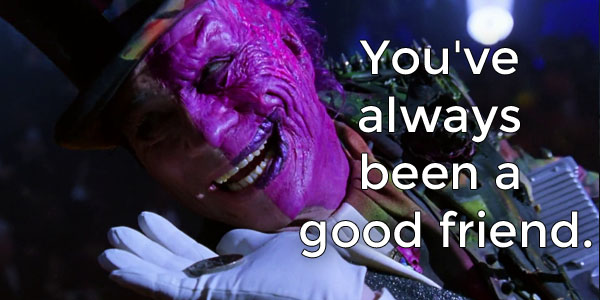
The Line: "Yes of course you're right Bruce. Emotion's always the enemy of true justice. Thank you. You've always been a good friend." How He Dies: He utters the line just before he flips his coin, at which point Batman throws a number of replicas of his coin at him, causing him to slip and fall to his death. Naturally his real coin falls into the palm of his hand as his body sinks below. It is particularly fitting that his death involves the coin, since Schumacher's version of the character abominably had him ignore the ruling of his coin earlier in Batman Forever, much to the disgust of fans.

19. Ward Abbott - The Bourne Supremacy
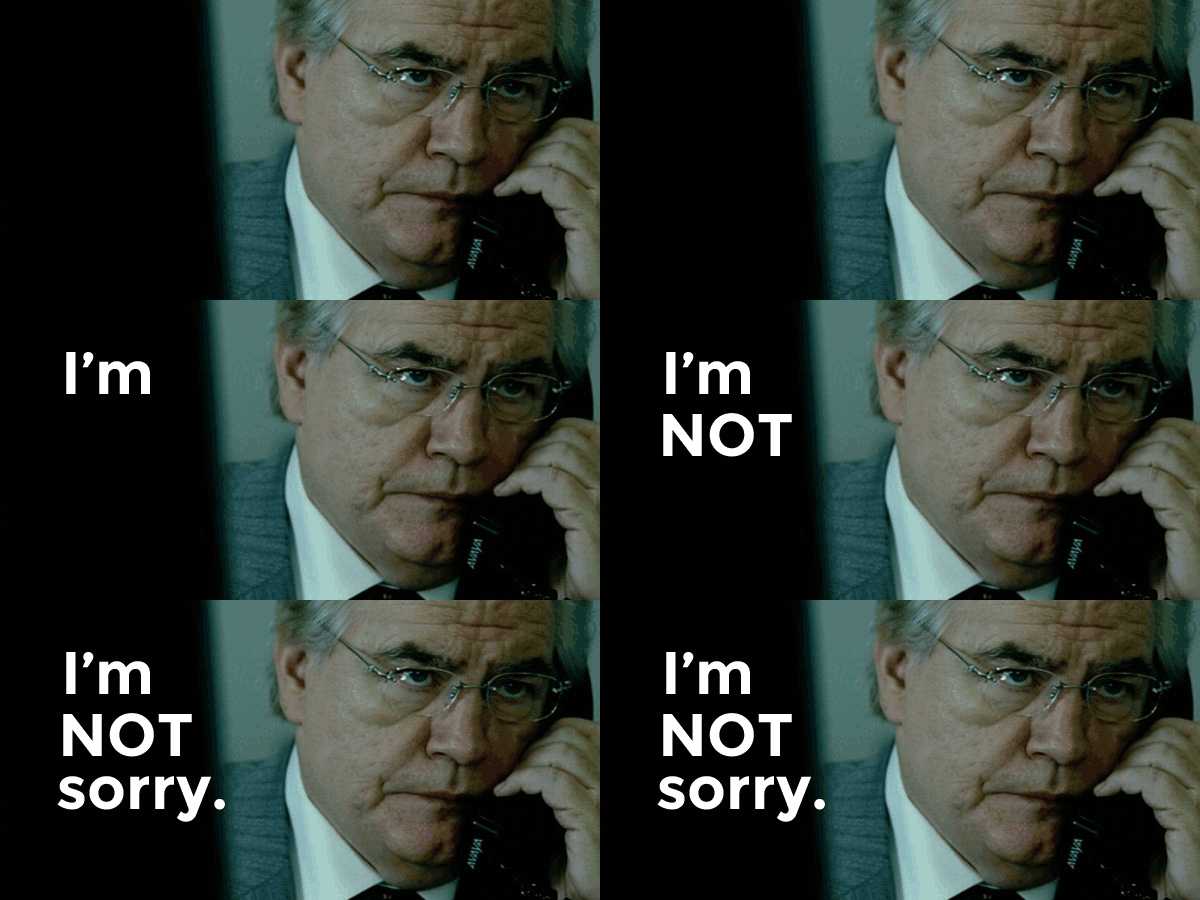
The Line: "I'm not sorry." How He Dies: Cowardly suicide. Too many great villains are undermined horribly by a final moments change of heart, or a death bed attempt to gain forgiveness, when their malignancy would have worked far better without any acknowledgment of their remaining humanity. Audiences occasionally want villains to go down in a blaze of glory, offering a final middle finger to the hero's attempts to bring them to justice, and Abbot's final admission that he isn't sorry for any of his heinous behaviour fits his character perfectly.

18. Ra's Al Ghul - Batman Begins

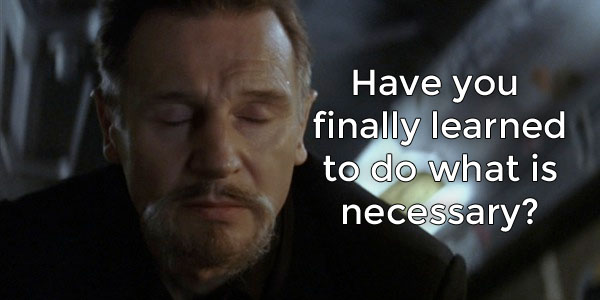
The Line: "Have you finally learned to do what is necessary?" How He Dies: By ploughing head first into the ground, on a train. Though a good deal of Batman fans would have suspected that Ra's' "death" was only permanent, given his penchant for rejuvenation in the comics (and some early rumours that guessed that the Pit was something else entirely), there can be little doubt that the villainous leader wasn't smushed like a beetle when the Gotham train was abruptly halted on its final journey. And though it was a shame that his revival in the follow-up was as a surprisingly helpful ghost who gave Bruce Wayne plot details, his death, and his final words were hugely important to the development of Batman as a character.

17. HAL 9000 - 2001: A Space Odyssey

The Lines: The following creepy, childlike exchange with Dave...
HAL: I'm afraid. I'm afraid, Dave. Dave, my mind is going. I can feel it. I can feel it. My mind is going. There is no question about it. I can feel it. I can feel it. I can feel it. I'm a... fraid. Good afternoon, gentlemen. I am a HAL 9000 computer. I became operational at the H.A.L. plant in Urbana, Illinois on the 12th of January 1992. My instructor was Mr. Langley, and he taught me to sing a song. If you'd like to hear it I can sing it for you. Dave Bowman: Yes, I'd like to hear it, HAL. Sing it for me. HAL: It's called "Daisy." HAL: Daisy, Daisy, give me your answer do. I'm half crazy all for the love of you. It won't be a stylish marriage, I can't afford a carriage. But you'll look sweet upon the seat of a bicycle built for two.
How He Dies: Slowly, singing, as he shuts down. HAL's demise is an oddly appropriate full-stop on the curious life of the sentient, murderous artificial intelligence: following the trend set by other robot-focused films that use the jarring motif of human-like behaviour (and especially infantile characteristics) to reinforce weirdness. There is something delightfully perverse about Dave singing a simple nursery rhyme, especially in conjunction with HAL's acknowledgement of his own mortality.

16. John Doe - Se7en

The Line: "Oh... he didn't know." How He Dies: Brad Pitt shoots him in the head. John Doe's brilliance is not only in the impeccable delivery of Kevin Spacey's performance, but also in the grotesque genius of his Deadly Sins murder plan, and the incredibly tense sequence at the end of the movie, during which it is revealed that he has killed Gwyneth Paltrow and put her head in a box for good measure, is the perfect pay off for both aspects. Spacey is visceral - calm but tangibly evil in his detachment - his ever so slight eyebrow lifts almost imperceptibly selling his suicidal double-dare, and the wounds he quickly opens in Brad Pitt are the perfect pay-off to an incredible performance. And it's only fitting that his final words are a challenge of Mills' intelligence, considering how much of a merry dance he has led the police department on, even when they believed themselves to be closing in on him.

15. Ma-Ma - Dredd

The Line: "You can't afford to take the risk." How She Dies: She's shot, then given some of her own drugs and thrown to her death out of a window by Dredd, after his guilty judgement. Ma-ma effectively dares herself dead, like John Doe: she holds her entire building hostage by revealing that her death would cause a major explosion that would take the building out, and forces Dredd to apply some logical thought and throw her out of a window so she's out of range of the explosives. The most perverse part of her death is her apparent acceptance - she inhales the drug forced upon her casually, and then seems to enjoy the trip down the outside of the building up until the point that her head spectacularly explodes in close-up slow-motion. Part of that comes down to the foundation behind the performance, which Lena Headey revealed in her evaluation of the character:
"I think of her like an old great white shark who is just waiting for someone bigger and stronger to show up and kill her... She's ready for it. In fact, she can't wait for it to happen. And yet no one can get the job done. She's an addict, so she's dead in that way, but that last knock just hasn't come. This big, fat, scarred shark moving through the sea and everyone flees and she's like, 'Will someone just have the balls to do it? Please?'"

14. Bane - The Dark Knight Rises
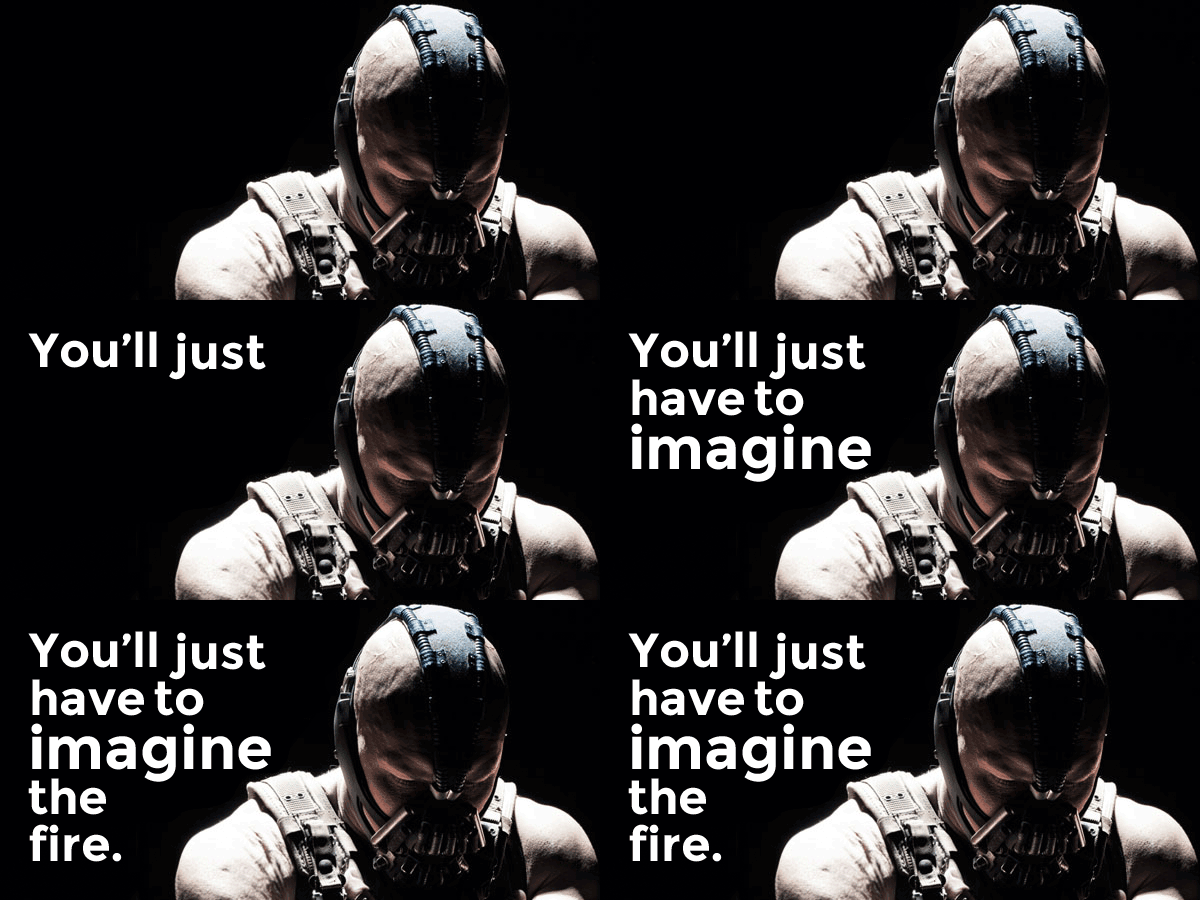
The Line: "We both know that I now have to kill you. You'll just have to imagine the fire!" How He Dies: In possibly the most underwhelming way possible. For all the power of his final words to Batman, Nolan's Bane is horribly undermined by the manner of his death - a coincidental arrival by Catwoman and some heavy artillery later and the single most threatening foe the Dark Knight faced is reduced to a romantic footnote in Talia Al Ghul's story. But at least the final challenge, just as he has physically bested his enemy once more is a fitting epitaph for a character who never once doubted his superiority over Batman, nor wavered from his singular conviction to Talia's instructions.

13. Syndrome - The Incredibles

The Line: "This isn't the end of it! I will get your son eventually! I will get your son...! Oh No!" How He Dies: In both a pleasant call-back and a harrowing pay-off, Syndrome - probably the most evil of Pixar's complex villains considering his motivation (close competitors Lotso was emotionally unhinged and Hopper is simply acting on his natural instincts) - ends up sucked into his own jet engine, and minced. Though it doesn't quite happen on screen, there'e enough there to prove a disturbing moment, especially in something ostensibly marketed as a children's film, but it is exactly what the flame-haired villain deserves. Not only does the manner of his death fit his ego-maniacal personality (he ignores the obvious threat of wearing a cape, despite having exhaustively researched his potential superhero opponents, and presumably their deaths) but the switch from villainous grand-standing to helpless scrabbling for life reinforces the fact that he is only human - another somewhat chilling cap on Pixar's most complex hero/villain dynamic.

In this post: 
Batman
 
First Posted On: 
Contributor
Contributor

WhatCulture's former COO, veteran writer and editor.