5 Biggest Best Picture Oscar Upsets Of The Past 20 Years
 Usually the movie that wins Best Director also wins Best Picture, but it's not always the case. "Argo" didn't win Best Director mostly because Ben Affleck wasn't even nominated. The last time a movie won only one of the two while being nominated for both was "Crash" winning Best Picture while Ang Lee won Best Director for "Brokeback Mountain." It's easier to call out an upset immediately or shortly after the winners are announced. But after time, people will have an epiphany and either downgrade the severity of the upset or determine that it wasn't an upset to begin with. When a movie only wins one, an upset could be accredited to one, both, or neither of the categories. These upsets will only be accredited to the Best Picture category. This list will have upsets that won either both or just Best Picture...
5. The English Patient (1996)
 "The English Patient" won nine of the 12 categories it was nominated for. Anthony Minghella also won Best Director for "The English Patient." What should've won Best Picture was "Fargo." And Joel Coen should've won Best Director as well. It was produced by Ethan Coen, Joel directed it, and both wrote the screenplay. Though technically Joel and Ethan co-directed and co-produced the movie, each only received credit for their respective category. They are the rare breed of auteurs. Anthony Minghella falls a producing credit short. Also, Minghella wrote a screenplay based on a novel while the screenplay written by the Coens was an original story that won Best Original Screenplay (Minghella lost Best Adapted Screenplay to Billy Bob Thornton for "Sling Blade"). That alone is something of an oddity of itself. The movie opens with the disclaimer, "This is a true story. The events depicted in this film took place in Minnesota in 1987. At the request of the survivors, the names have been changed. Out of respect for the dead, the rest has been told exactly as it occurred." But at the end of the post-credits, another disclaimer reads, "The persons and events portrayed in this production are fictitious. No similarity to actual persons, living or dead, is intended or should be inferred." Despite the title being "Fargo," most of the movie takes place in Minnesota, not North Dakota. But "Fargo" is what the Coens know. They did not grow up in Minneapolis, MN. They grew up in St. Louis Park, MN (some of the locals colloquially call it "St. Jewish Park"). Minnesotans are not as nice and dimwitted as they are portrayed by the likes of William H. Macy and Frances McDormand. They may seem that nice in comparison to New Yorkers or Bostonians. But that's essential to the story. "Fargo" could be called the biopic of Minnesota. It is the most accurate portrayal of Minnesota in the winter. Despite the wilderness that can be confused for northern Canada, the metro area of Minneapolis and St. Paul (Twin Cities is a misnomer) is where Minnesota gets its backbone. There can be a foot of snow with subzero temperatures and everyone works just as hard and goes on about their lives as if it were mid-June. Other cities and small towns close schools, shut down public transportation and advise people to stay home. The next day is a little warmer, the roads have been plowed, and people dread the morning commute to their place of work. That's a Tuesday in Minnesota. When temperatures in Los Angeles drop into the 50s and Californians put on winter hats, gloves, and jackets, Minnesotans don't laugh at it. They ignore the absurdity.
4. Titanic
 The story of the Titanic, or any tragedy for that matter, is best told by those who experienced it first hand. Holocaust survivors tell their stories that seem as dim as a dawn when juxtaposed to the events themselves. And the story loses its dimness as it passes on from generation to generation and becomes more anonymous. Details get lost and unknowingly substituted with phony ones. It's like REO Speedwagon said. "Heard it form a friend who heard it from a friend." James Cameron's "Titanic" tells the story of a Titanic survivor telling her story to researchers rather than having the movie be about the voyage itself exclusively, albeit fictional. At the same time, James Cameron is kind of telling the story about himself. About how he dove into the abyss to research the wreckage himself, thus becoming more of an explorer than a filmmaker for the next decade. "L.A. Confidential" is told to the audience first hand, skipping the messenger part. It modernizes the film noir genre as well as anyone else could, something that "Gangster Squad" failed miserably at. Inspired by and mildly based on the crime wave Mickey Cohen brought upon the Pacific coast, it's chronicled with wit more akin to screwball than parody. There are three antagonists, each with something big to lose. Jack Vincennes (Kevin Spacey) has the TV show "Badge of Honor," Bud White (Russell Crowe) has his relationship with Lynn Bracken, and Ed Exley (Guy Pearce) is trying to shake a persona seen as soft by others but virtuous by himself. A police force predominantly corrupt, and it's the integrity of Exley, White, and Vincennes that keeps the investigation of the Nite Owl case and the movie itself firing on all cylinders.
3. Gladiator
 The award for Best Picture went to "Gladiator." But Steven Soderbergh beat Ridley Scott for the Best Director award for his work on "Traffic." He was also nominated for directing "Erin Brockovich." "Gladiator" is an epic film of epic proportions. A general who became a slave. A slave who became a gladiator. A gladiator who rose against the tyranny of a jealous, power-thirsty emperor. Maximus gets the city behind him in hopes of trying to restore the dream of Rome. He has no fear of possibly becoming a martyr. "Traffic" is rawer than Bessie leaving the slaughterhouse. The cinematography by Peter Andrews (Steven Soderbergh) shows how gritty the drug war is, both literally and figuratively. We are given a portrayal of the drug war as close to a first hand observation as possible. The script was presented to the United States' Drug Enforcement Agency merely to point out inaccuracies. Soderbergh wanted to present a story as detailed and accurate as possible. Even cinematography and a script as accurate as it can be doesn't give the full raw power. Steven Soderbergh sent letters out to every US Senator in office at the time, no partisanship on the filmmakers' part. In all, six senators appeared in the film. Current Senate Majority Leader Harry Reid (D-Nevada) didn't like what was written for him to say in his scene at a cocktail party with Robert Wakefield (Michael Douglas). So Douglas stayed in character and stuck to his lines in the script while Reid gave his authentic political opinion on the questions posed to him. Douglas also got access to customs at the San Ysidro Port of Entry on the San Diego-Tijuana border. Douglas, again staying in character, converses with customs agent Rudy Machado about the seizing of drugs. As they are conversing, customs officers are searching cars inside-and-out for concealed narcotics. What we see are genuine officers confiscating heroin from real smugglers. The movie's reflection of the drug war gives an accurate insight into what can and can't be done. A dealer is arrested by the DEA and is given immunity for testifying against his drug lord boss. Corrupt politicians are affiliated with cartels, and assassinations are attempted by rival cartels. It is a war that is corrupt, ongoing, and possibly even endless. It is a war that will never be 100% won by the government. Dealers and users will always find a way around and through the system.
2. Chicago (2002)
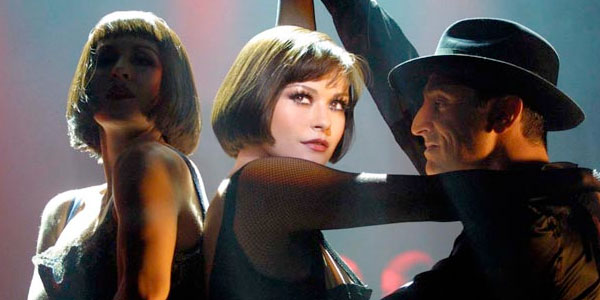 At the 1973 Academy Awards show, "Cabaret" nearly swept the categories it received nominations for. It only lost two awards, Best Picture and Best Screenplay based on material from another medium, both to "The Godfather." Nowadays, more people have seen and still watch "The Godfather." It's more widely praised by audiences. Thirty years later, "Chicago" wins Best Picture, but Rob Marshall loses Best Director to Roman Polanski for "The Pianist." I don't know if Polanski's rape situation persuaded academy voters to not vote for "The Pianist." I doubt it, especially since he won Best Director. "The Pianist" tells the true story of Wladyslaw Szpilman, a Jewish pianist hiding from the Nazis. Adrien Brody won Best Actor for his portrayal of the titular character, becoming the youngest winner in Oscar history. The invasion of the Warsaw ghetto is where the movie starts, and Szpilman turns to family, friends, and strangers throughout the movie for any help he can get. Families are torn apart with some getting on trains not knowing where they're going or if they'll see their family again. One moment that is more disturbing than others was a night scene in the ghetto. A family living in an apartment building across the street from where Szpilman's family is hiding gets rounded up by Nazis. The family is having dinner when the officers enter the room with no warning. They order everyone to stand up. Everyone in the family obliges except for an elderly man in a wheelchair, because he obviously can't stand on his own. I won't say what happens. But Polanski gives you a clean, steady, medium shot leaving nothing to the imagination. Steven Spielberg did an incredible job with "Schindler's List" showing how dark, melodramatic, and disgusting the genocide of innocent Jews was. Though I am not Jewish myself, "The Pianist" truly made me fear the Nazis. Polanski was able to show the true horrors of the Holocaust because he survived it himself.
1. Shakespeare in Love (1998)
John Madden did not win Best Director. Steven Spielberg did for "Saving Private Ryan." There were at least two nominees more deserving of Best Picture: "Saving Private Ryan" and "The Thin Red Line." The one more deserving of the two and thus most deserving of Best Picture was "Saving Private Ryan." Both are World War II movies. But Malick's movie didn't have nearly the amount of grit that Spielberg had in his opus. There's very little grit and bleakness in "The Thin Red Line." Janusz Kaminski rightfully won Best Cinematography. The color saturation was reduced by 60%, making it significantly bleaker than "The Thin Red Line." Scenes not on the battlefield were steady and composed. Amidst gunfire and explosions, Spielberg utilized something better than a shaky handheld camera like Paul Greengrass did in "Green Zone." He attached drills to the side of the camera and turned them on while filming. This allowed the camera to remain mostly steady, but with a rumbling effect that gives the sense of a soldier trembling and falls short of disorienting the viewer. The movie runs a little under three hours. This is very key to telling the story. It starts out in the present day at the Normandy American Cemetery and Memorial in Normandy, France. We are then brought back to June 6, 1944. It's D-Day and American troops land at Omaha Beach for the Invasion of Normandy. After many have been slaughtered by German soldiers, Captain John H. Miller (Tom Hanks) and Charlie Company get past the first line of defense. The movie goes back and forth between intense warfare and the ongoing search of Private James Francis Ryan, with battlefield scenes lasting roughly from five to 30 minutes. Capt. Miller and his group of soldiers assigned to find Ryan consist of an A-list ensemble cast. Other big name A-listers pop up in cameos throughout the movie. This allows the audience to guess which A-list actor would appear at some point to be James Ryan (alive or dead). The group travels by foot, ever so slowly not knowing when or where they would find Ryan, if at all. One shot captures the essence of the story and its mood. After getting some sleep in a church, they leave in the middle of the night. As they walk across a field in single file with bombs flashing miles behind them, nothing is known about what lies ahead. They will stop at nothing and search endlessly, day and night, until either they are all dead or they have located James Francis Ryan, who gets to go home to Iowa.