5 Reasons Leonardo DiCaprio Should Win Best Actor Oscar This Year (And 5 Reasons Why He Won't)
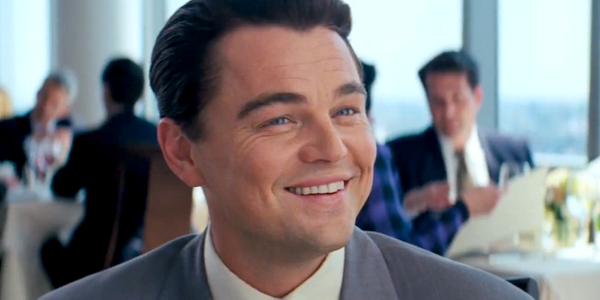
Leonardo DiCaprio wants an Oscar. Badly. In his impeccably calm and confident acceptance speech on Sunday after he received a Golden Globe for his role in The Wolf of Wall Street, DiCaprio focused on his passion for film history, saying that Martin Scorsese (and Bruce Dern) have made their mark in cinema. Leo once again proved that he is a consummate professional, nailing his clearly rehearsed speech with the gravitas that comes with being arguably the biggest movie star in the world. Implicit in his speech was his unending desire to make a similar impact, and something that would cement his standing as one of the best actors of his generation would be an Academy Award for Best Actor. But simply being a great actor isn't enough, as the Academy Awards voting process is highly political. Thus, saying that Leonardo DiCaprio SHOULD win the Oscar for Best Actor this year means not only that he deserves it for his incredible performance, but because he deserves it for the same political reasons other winners had as well. The internet has already banded around his quest for Oscar gold, and his recent nomination has fans salivating. This list is not exclusively an examination of why his performance was better or worse than other probable nominees (that would be a futile exercise in expounding my tastes as superior to the Academy's), but why now is the right time for him to get what he really, really wants. Tides can change before the ceremony on March 2nd, but despite his auspicious Globe win he will probably be edged out by another actor. Here is why he should win, mixed in with reasons why he won't...

5. He IS The Wolf Of Wall Street (He Should)

DiCaprio is great as the high-finance crook Jordan Belfort, but he isn't the same kind of actor as Daniel Day-Lewis or Phillip Seymour Hoffman. Whenever you see a movie with Leo in it, you are going to bring your conceptions about his real-life personality with you. This is not to say that he is a bad actor or even that we see through his performance, it's just that audiences are generally aware of his personality before they watch a movie DiCaprio is in. And let's face it, he is known for having a kind of frat-boy mentality, which plays perfectly into his role in The Wolf of Wall Street. The sort of dissonance between character and actor can be frustrating for certain people who yearn for "accurate portrayals" particularly when it concerns events based in reality, but The Wolf of Wall Street isn't that kind of film. When you see the film you are repeatedly reminded that you are watching a movie. That makes Leo's persona outside the realm of movie-land fair game, and you get the sense that Scorsese is knowingly toying with the perceptions of both the debauchery of the Wall Street lifestyle and DiCaprio's own.

5. Victim Of His Own Critical Acclaim (He Won't)

It seems like consistency from movie stars would be a desirable trait, but past Oscar history points in the opposite direction. DiCaprio has been in solid to great films time and again, which has made it hard to single out an extraordinary performance in his filmography. Even if his movies didn't fare very well (J. Edgar, Revolutionary Road) his performances in them have been critically well-liked. In a weird way, it helps to have a dud or a knowing foray into the world of less-reputable cinema in order to distinguish a performance. Jaime Foxx was in Breakin' All the Rules the same year he was in Ray. Jennifer Lawrence appeared in House at the End of the Street. Monique had her entire filmography before Precious to point out how out of the ordinary and exceptional her performance was in that film. DiCaprio kind of went this way with Inception, but the critical acclaim surrounding that movie yet again cemented the idea that he lacks variety in his performances, and the Oscars like to award performances that take actors out of their comfort zones.

4. The Speeches (He Should)

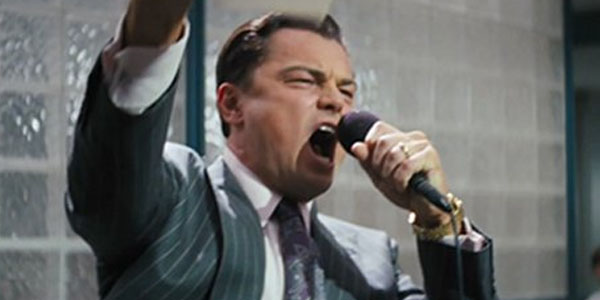
In order to play an ultra-charismatic guy who through the sheer force of his personality illegally profited at the hands of thousand unwitting investors, you have to be an actor who believes in your own charisma. That's a quality that goes unmentioned in most commentary about DiCaprio's acting, his occasionally cocky attitude actually positively impacts his performance. In The Wolf of Wall Street this can be seen clearly in the speeches he gives to rally the troops at Stratton. In the climactic speech he delivers (SPOILERS) when he reneges on his agreement to stop working in the financial industry after a deal with the SEC, DiCaprio/Belfort gives the performance of a lifetime. During the course of the speech he seems to convince himself that he is invincible, that the rules don't apply to him, all while providing his loyal troops with the type of encouragement you see from football coaches at the end of sports movies. DiCaprio is uniquely fitted to give this speech because he seems like the type of person who could be moved by his own sizable sway. This is another way of saying that DiCaprio incorporates positive and negative aspects of his personality in order to fuel his performance, taking from different sources to sublimate his role as multi-layered, engrossing, and believable.

4. It Feels Like He Has Already Won (He Shouldn't)

What differentiates DiCaprio from other well-known actors who surprisingly haven't won before (including Gary Oldman, Johnny Depp, Brad Pitt, Ralph Fiennes, and Joaquin Phoenix) is his willingness to kowtow towards the Academy. Aside from maybe Inception and Shutter Island, DiCaprio's main mode of film he has appeared in for the past fifteen years is commonly referred to as "prestige pictures" (or derisively referred to as Oscar-bait). The aforementioned J. Edgar and Revolutionary Road along with The Aviator, Gangs of New York, and even Django Unchained all had Oscar-tailored performances by Leo. And the internet's obsession with DiCaprio's obsession of getting an Oscar only furthers the idea that he is an actor held in the same esteem as Oscar winners. Ironically, pointing out how strange it is that he hasn't won an Oscar has made it feel like he retroactively has. Sometimes repeated brushes with the Academy fosters repeated success (Meryl Streep, Daniel Day-Lewis), but DiCaprio could become more like the late Peter O'Toole who was nominated for Best Actor eight times but never actually received the award (although he did win an honorary Oscar). Furthermore, Scorsese himself didn't win an Oscar until 2006's The Departed despite multiple nominations. Leo doesn't even have the same cache as his immensely talented favorite director, so it could be a long time before he gets a win too.

3. He Carries The Movie (He Should)

A criticism that has been leveled against The Wolf of Wall Street is that it didn't need to be three hours to get its point across, but that's the point. Do we need eight different office party scenes to understand the debauchery of Wall Street brokers? No, but did they need to waste $2 million on a single soiree? As Elvira Hancock says in Scarface, "Nothing exceeds like excess." In order to be overcome by the consistency of the bad behavior in the film, we get scene after scene of similar set-ups and pay-offs, but despite the repetition in the narrative we aren't bored by the goings on. This is in no small part due to the performance by DiCaprio. In 12 Years a Slave we understand who Solomon Northup is through his interaction with other slaves. In Nebraska, Bruce Dern's old fogey is definitely the primary character in that he drives the narrative and he is who audiences are drawn to, but the film asks you to take the perspective of his put-upon son played by Will Forte. In The Wolf of Wall Street, we are forced to learn who Belfort is through his sheer force of personality. Keeping our attention throughout its long run-time relies on DiCaprio's performance to truly involve the audience as he is in almost every scene. Again, I'm not saying that DiCaprio's performance is definitively better than Chiwetel Ejiofor's or Bruce Dern's, but that his character functions as the sole focal point. The film's success is thus tied directly to DiCaprio's ability to entertain us, and he certainly does that.

3. The Wolf Of Wall Street Is Too Controversial (He Shouldn't)
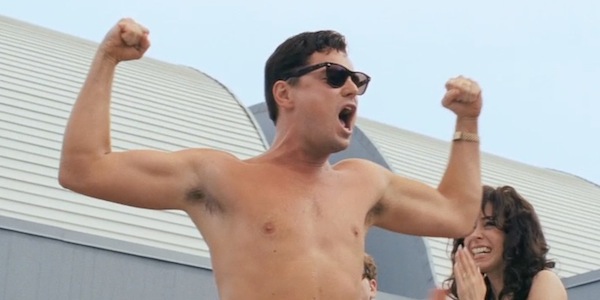
The Academy doesn't typically award films that make a splash if recognizing them could be seen as anything other than a bland political statement. The Wolf of Wall Street garnered controversy for purportedly promoting the lavish lifestyle of Wall Street crooks. It doesn't, in fact it's a pretty startling indictment, but after it has been heavily discussed as a potentially dangerous and subversive film any awards in its favor could be seen as support for bad behavior. Leonardo plays Belfort as a narcissist, delusional, wife-beating misogynist, certainly not a boy scout. The fact that the movie has encouraged legitimate discussion about how we view excess as a benefit of extreme wealth only serves to justify why the movie exists in the first place. Glorifying bad people doing bad things can be a constructive exercise in determining why we value certain beliefs over others, but that isn't even what the movie is. The Wolf of Wall Street warns the audience that revering people who steal from others is a bad thing, and if audiences didn't understand that it is likely a sign of their own confusion over the morality of white collar crime.

2. Utter Physicality (He Should)

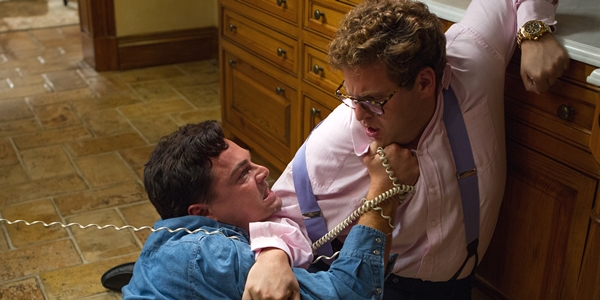
The Academy likes to award actors who are "taken out of their comfort zone" and at first glance it doesn't seem like Belfort breaks new ground for DiCaprio. He's played charismatic con men before (Catch Me If You Can and Inception to a lesser extent), and Matthew McConaughey's transformation through weight loss for his role in Dallas Buyers Club is going to be a tough gimmick to beat. If you're looking for a distinguishable characteristic that sets apart this Leo performance from others, it has to be the physicality he brings to the role. The Lemmon Quaalude sequence where he writhes on the ground in order to get to his car immediately comes to mind, and it's impressive how cartoonishly he can move his body while dancing during the wedding reception. But it's more than just the over-the-top comedic moments that bring his character's movements to mind, he consistently moving his body in a way to assert his dominance over the person he is currently with. His physicality in the movie is incredible, which is another reason why he is worthy of the award.

2. He Wants It Too Much (He Shouldn't)
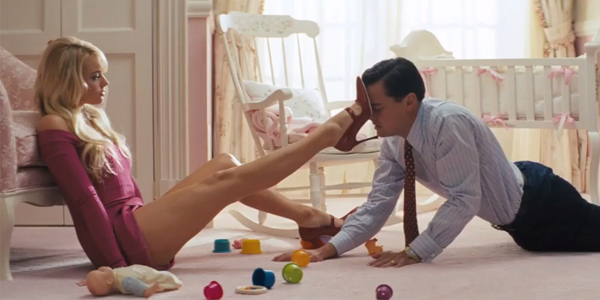
Reverence is key when addressing the members of the Academy, they have to know that you admire and respect the organization before they give you an award. But along with the esteem in which a potential recipient views the history of film (and the supposed expectation that the Academy stands in as the guardians of film history), nominees are almost expected to downplay the awards themselves as further praise that they don't particularly deserve. It's that kind of detachment which allows them to politely continue to applaud when their name isn't announced in their category, but Leo really seems to need the praise of his peers in order to justify his choices when it comes to appearing in films. I know it sounds like a contradiction to say that recipients have to want it enough to campaign, but not enough to campaign enthusiastically, nevertheless that seems to be the way it works. Sean Penn seems like exactly the kind of actor who would pretend to be above the pomp and circumstance of awards show galas, but he has won the Best Actor Oscar twice since 2003. A delicate balance of nonchalance and gratitude is needed, and Leo tends to swing heavily towards the latter which potentially limits his opportunities.

1. A Career Of Great Work (He Should)

Oscars are often given out to actors who don't necessarily deserve the award for the film they worked on, but rather the body of work they have put together over the course of their career. Tommy Lee Jones won an Oscar for his role in 1993's The Fugitive despite the fact that the film isn't necessarily typical Oscar-bait. Jack Nicholson won an Oscar for As Good As It Gets in 1997 because he was already a screen legend at the time. Leonardo DiCaprio hasn't been in the industry as long as Bruce Dern, and he hasn't gone without praise for most of his career like Matthew McConaughey, but he still has a remarkable list of outstanding performances to his name. Calvin Candie in Django Unchained, Howard Hughes in The Aviator, Billy Costigan in The Departed, Amsterdam Vallon in Gangs of New York, and now Jordan Belfort in The Wolf of Wall Street are all great performances from a relatively young actor. I'm not saying that a lifetime achievement award is necessary now, or even that he is unlikely to ever win the award if he doesn't this year, but saying that other actors deserve it more than he does because of other films that they have done essentially undervalues DiCaprio's string of outstanding performances. He's only 39, and presumably has a lot of films left before his status or talent wane, but considering all of the great work he put in to The Wolf of Wall Street and his larger filmography, now should be the time in which he is awarded an Oscar. But...

1. Chiwetel Ejiofor (He Shouldn't)

The number one reason why Leonardo DiCaprio won't win the Best Actor Oscar this year is Chiwetel Ejiofor. It's understandable because Ejiofor gives a great performance as Solomon Northup, and giving 12 Years a Slave multiple awards will assuage the guilt that Academy members have for not allowing more minority voters into their prestigious group. I'm not saying that 12 Years a Slave isn't a great movie (it is) and I'm not saying that Chiwetel Ejiofor winning the award qualifies as some sort of affirmative action, because in almost any other year the award would rightfully belong to him. For the reasons outlined above, I think the award SHOULD go to DiCaprio, but nevertheless this appears to be Ejiofor's year. Bruce Dern is always an outside choice because he is old and may not have the chance to win again, and Christian Bale gives an expert performance in American Hustle, but like McConaughey and DiCaprio, Dern and Bale's films haven't received the same buzz at 12 Years a Slave and don't feel as important to America (and American film). I'm all for 12 Years a Slave winning Best Picture, it brings to light so many important and uncomfortable truths, but I really feel that DiCaprio deserves the Best Actor Oscar this year. It's just too bad he probably won't get it. Long live the Oscarless DiCaprio meme.

Contributor

Bryan Hickman is a WhatCulture contributor residing in Vancouver, British Columbia. Bryan's passions include film, television, basketball, and writing about himself in the third person.