5 Reasons Why Danny Boyle's Sunshine Is Still A Stellar Film
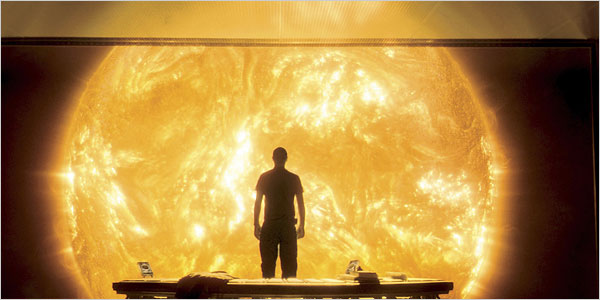 Very rarely do I come across a science fiction film that actually does something outside the norm and presents itself with something entirely new and original. Danny Boyle's 2007 classic "Sunshine" is a fine example of one of those films, succeeding by taking a simple doomsday idea and molding it into a conformity of different ideas and shrouded in moral complexities. For such a simple yet vastly in-depth film, it provides a number of profound and awesome ideas that help the film become one of the better science fiction works to grace the imaginations of audiences everywhere. These profound and awesome scenarios help flesh out "Sunshine" so as to provide as much excitement and intensity as humanly possible in a film which revolves around a team of engineers, scientists, and doctors traveling to our dying sun to reignite it with a nuclear payload that will help create a new sun in the image of the older, dying one. Simple yet familiar, right? You'd be surprised. And surprises come aplenty, I assure you. Out of all the great ideas that were poured into this film, I've narrowed the selection down to five distinct and clever reasons why it stands on its own two feet in the science fiction genre. For those that have seen the film and know of the film's ideas and twists, these may come as no surprise. I'm sure some people weren't as crazy about them as I was, but in a film that is based off a very simple design it sure does accomplish a lot and succeeds at capturing our attention. For those that have not yet witnessed "Sunshine", there are MASSIVE SPOILERS ahead, so I advise leaving this article if you haven't experienced the film for yourself yet.
5. The Human Condition  The brilliant thing about science fiction films is that we, as the audience, get a sneak peek into the minds of individuals of humanity and discover what breaks them down and at what cost. When presented with a difficult situation where there will undoubtedly be consequences or certain death, the gates to the human mind are pulled open, like the latches of the floodgates unlocked, ready for the inevitable flood to pour out. After so much pressure, those latches eventually snap and collapse, and after that.....anything can happen. Such is the human mind, as fragile as it can be in "Sunshine". A central figure of the plot involves a crew of eight teammates in constant contact with one another, locked inside a ship known as the Icarus II for a number of years, on a voyage to restore the sun's power with a massive collection of nukes and creating a new star in its place and save mankind from a dark extinction. So already, there is weight on their shoulders, as they are responsible for our continuation as a species. With a burden of high consequence such as that, the human mind could be pulled in any number of different directions. But, to keep the crew members calm and secure, they have what is known as an Earth Room to help them remember what they are fighting for, to help keep their minds focused on the task at hand. Now speaking off the record here, having the fate of every single human life in the palm of my hands would be, unequivocally, all that I care about. I wouldn't sleep, eat, or make start fights with the other crew members; I would simply be glued to my chair/desk/lab, trying in every way I know to come up with the best possible solution to ease that burden off my shoulders, knowing I could save them. But the question is: would that alone put the rest of my team at risk? Would a lack of communication and going solo drive me crazy? Would it drive others crazy, giving them the impression that I went off the deep end? Or would I begin doubting myself over the course of several months or years after trying out every possible scenario, knowing I couldn't complete my goal and save the human race? That's just me and what would happen if I were in Capa's shoes. Personally, I'd probably muff up somewhere down the line and bring the apocalypse with the smallest of slip-ups. In so many ways we see the crew of the Icarus II ask the questions to which they don't always have the answers to. Are they the team to pull this massive exodus off? Are their calculations scientifically proven (at least in their fictional world) to deliver their payload? Can they trust one another? Better yet, if one of the teammates died saving the others from frying to death because one of the others made a slight miscalculation in shift velocity, would he/she be able to live with it? All these questions and more are presented in very dread and dark fashion to where we, as the audience, start to wonder if they can even save us and make it back in one piece.
 One such teammate named Harvey goes through a dramatic change in emotion simply because he is caught in win/lose situation outside of saving the human race, to where his own life is on the line. When the crew discovers the remains of the Icarus I, the first ship to attempt the salvation of mankind, they board and find out what happened only to suffer an airlock malfunction (or so we think), trapping four of the teammates (Mace, Capa, Searle, and Harvey) on board the Icarus I. In order to successfully make it back to the Icarus II, they must jump into the outer reaches of space and land inside the docking platform of their own ship, with only one spacesuit to work with. One decides to stay behind (Searle), while the other two are wrapped in enough material to protect them from the exposure of space. Capa gets the spacesuit as he is the only one who knows how to operate the payload delivery, so Mace and Harvey take to the wrapping materials, against Harvey's wishes. The small but brief segment of Harvey arguing with Mace reveals to the audience how terrified this man is. After the loss of Kaneda, Harvey was promoted to Captain, so he believes he should be given the right to live since he's in charge, not giving a care in the world that the one person who can save the human race is right in front of him. In the face of certain death, of being lost in space forever, a man can break down and suffer from his own undoing from within. It's a powerful statement knowing that you can lose your life in such circumstances yet still be the person you are. Eventually Harvey agrees to take the material over the suit, but unfortunately suffers when they bump into the side of the Icarus II airlock, sending Harvey out in the the vacuum of space, ultimately freezing from lack of oxygen and meeting his true end by the rays of the sun. "Sunshine" goes further than this in some scenes, but it's Harvey's change in character that shows that when the human mind is met with a situation in which he knows he can easily be picked off for the better part of mankind, even he would rather live than die for the sake of the mission. Like Spock always said, "The needs of the many outweigh the needs of the few."
4. Killer In The Midst

 The third and final element of religious turmoil drives this twist into something that falls in line with the human condition, but at the same time is something else entirely. Pinbacker, a devoted man of a religion unknown in the film, purely based the failure of the mission on the equation of it being God's will. All the seeds of hopelessness planted firmly within the ship were finalized by Pinbacker's ultimate choice to forcefully end the mission per his allegiance with God over his own kind. And after the Icarus II seemed to dock with Pinbacker's ship, he quietly made his way aboard and began anew what God Himself believes was right. That by disabling the Icarus II and rendering the ship incapable of carrying out the payload delivery, he would see mission as Harbinger of Humanity's End done. Let's face facts here: Pinbacker was a nut, and a sick one at that. Adding a slasher element to "Sunshine" seemed to be a smart idea because it ties in well with how the human condition can be broke down and how a man puts his faith and the salvation of God's will before the salvation of those he was sent to save and protect.
3. The Tense Environment
 While the prospect of gliding around in spacesuits seems promising at first glance, the film goes to show that they prove to be the most dangerous gamble when trying to make repairs. But the spacesuits aren't the only danger lurking around in "Sunshine". In fact, the environment as a whole as an everlasting effect on how key events play out in the film.
One of the most familiar aspects of a disaster film that involves saving the world on a spaceship is that something always tends to get broken. It's an easy way of ratcheting up the plot and tension, and puts the entirety of what's at stake at jeopardy. "Sunshine" is has its fair share of moments, and quite early on as a matter of fact. One such event involving the use of the aforementioned spacesuits has one of the crew mates making a slight miscalculation of trajectory with their solar shield, which protects them from the intense heat of the sun. Due to this small but disastrous mistake, the shield ends up damaged and must be repaired manually. So two members of the crew, Capa and Kaneda, don the suits and travel into the outer reaches of space to risk their own lives for the better part of mankind. Things don't go according to plan, and Kaneda meets an unfortunate fate by the flares of the sun.
Another incident involves the loss of their oxygen garden for which another crew member, Corazon, is mainly responsible for. During the damaging of the shield, the heat of the sun manages to sneak past the shield and on to the Icarus itself, laying waste to whatever it touches. They lose their communications (which they could probably live without) and their oxygen garden (which they most certainly can't live without). This untimely event sets up a persisting danger throughout the rest of the film, where a very limited amount of oxygen is left for the crew mates to breathe. Disaster scenario 101: always have a back-up plan in case main source of oxygen is cut off. The environment for which these people are in is all part of the grand setup behind the peril of the film. The fragility of the Icarus II makes even the slightest of touches in engineering turn it into a doomsday device. Accepting the fact that these brave men and women knew what they got themselves into requires the highest level of patience, fortitude, and mental sanity to survive. They must have also been confident enough that they could fix any situation that presented itself, labeling them as the best of the best. But what really makes the environment an enemy of the film is the idea of containment. One major theme of the film is isolation, with each crew mate somehow being in an area that looks and feels so crammed that claustrophobia is only mere seconds away. Being locked inside a spacesuit with a limited amount of air. Walking down miniature corridors for several meters without doors or windows. Sitting inside small cubicles, sending video messages back to Earth. Even having Capa toil around with payload in this vast open area with only your echoing voice, talking to a computer that runs the ship warrants enough isolation. Even though eight crew members share the same ship still makes it somewhat lonely to be on. Take into account the amount of air they have left to breathe, and you have a linear, concealed cage where the mice have nowhere to go but slowly die off one by one.
2. The Moral Decisions

 Mace, after having a disillusioned Pinbacker cause considerable damage to the ship's mainframe, dives into the coolant hold where the mainframe is housed. By doing so he was restoring power to the Icarus, allowing Capa to move forward to activate the payload. After enough dives in the coolant Mace dies, but dies a valiant hero just like Kaneda because they made the moral choice of putting their lives on the line to preserve the mission. Morally these two men symbolize the heroics in humanity, showing that in the darkest of hours there is still a light at the end of the tunnel....even if it requires their own lives to pull the curtain hiding that light.
1. At Its Core, It's Not About The Science
 The culmination of all the heated moments and thematic themes all sum up to one huge revelation in the film: it's not a science fiction film at heart. While I have referred to it as part of the science fiction genre (and it does have a place there), deep down that's not what defines the film. What defines it in the end is the characters, the themes, and the systematic understanding that humanity as a whole is meant for purposes to which we alone are able to figure out. It's essentially one giant character study; I interpret it as a clear understanding into the human mind and a character study into one's beliefs and motives.
Let's recap these ideas:
- A strong, underlying tension where the characters are inexplicably affected by one another and their own separate choices. - A profound look into how the mind works under such high amounts of external pressure and dyer situations. - Putting one's personal beliefs and religion before the objective and mankind itself. - A crowded, claustrophobic environment that gives off a sense of isolation and and dread, where the smallest misstep can lead to utter doom. - When faced with impossible odds, characters that know what's at stake will stake their own lives to preserve the continuation of the mission. All of these elements ultimately collided with each other and merge into one cohesive narrative where science fiction takes a back seat. The scientific equations and calculations presented in the film are obviously present, but it's purely cosmetic. What truly matters is what's at the heart of the film: the human drama. So many complex and exciting parallels are front and center here, allowing for us as the audience to connect and relate to their plight, even if we don't wish to be in the environment that they shared for years on end. This only proves that they, along with the crew of the Icarus I, were the humans for the job that could take on a task of such epic proportions. Their fortitude would be the only thing that stood in the way our humanity's end, but eventually everything snapped under pressure when personal tension, doubts, beliefs, and environmental hazards brought a near-extinction of the human race. The element of human life also plays a major role in how things play out. The gift of life, whether it be giving up your own for someone else or believing what you're doing is for the better part of humanity and for God, takes on a serious precedence when we see most of these characters in their final moments. Kaneda gave his own life to save the crew of the Icarus I; Trey killed himself because he blamed himself for Kaneda's death and the loss of the oxygen garden, which would subsequently kill off the crew; Searle (possibly) chose the easy way out by burning to death instead of dying a slow death by lack of oxygen, wanting to go out with a bang; Mace sacrifices his own life by exposing himself to a high concentration of coolant to ensure that Capa made it to the payload and activated the release; and Capa personally activated the payload inside the sun, witnessing his final moments as the payload created in front of him created a new sun which would glow bright to show humanity that they succeeded. Then there's Pinbacker, who did it all because it was God's will to end humanity and give all their souls to Him. In his mind he believed it was the right thing, even if his methods were brutal and maniacal. There is science fiction to be had in "Sunshine", then there is no science fiction to be had. It comes off strong as a balancing act, balancing human drama and the themes of human life, psychology, mental conditioning, and interactiveness with one another, forming a space opera that forsakes its science fiction license and instead relies on human emotion and what drives our spirits where ever they may end up guiding us. What do you guys think? Would any of these reasons apply with you? Is there something else that caught your eye? By all means, discuss your opinions below.