6 Most Unforgivable Plot Holes In Comic Book Movies

Too dumb to excuse. Too logic-breaking to ignore.
There's something innately conflicted about catching a plot hole in a popular movie that is both annoying and cathartic in equal measure. On one hand, you've beat the writers at their own game; you managed to spot an error, a flaw, a gaping lapse in narrative judgement (whatever you want to call it) that they clearly didn't. On the other hand, you've usurped the internal logic of the film and there's a chance that it might have been spoiled for you as a result; it's never really "fun" when that happens. No genre of films tends to represent this dual love/hate relationship with plot holes than that of the comic book film - as a society, we're seemingly obsessed with trying to find the worst offenders in motion pictures of this particular make-up. It's not that we want to spoil the movies necessarily, but it's more to do with an in-built desire - a very human one - to pick holes in something that so very desperately wants to appear logical. Given that comic books films (especially those of the superhero variety) are usually based in twisted versions of our own reality, they have made themselves ripe for plot holes. There's usually an attempt on the part of the writers to create a world with aspects that are both real and fantastical... and that's a really hard combination to get right. Some plot holes - of the middling kind - can usually be forgiven because meh, who cares? But sometimes a plot hole really does feel like a huge oversight, with the power to unravel the very fabric of the film in question: you know, those of the unforgivable kind...

6. Thor Forgets Loki's Scepter After The Battle Of New York - The Avengers
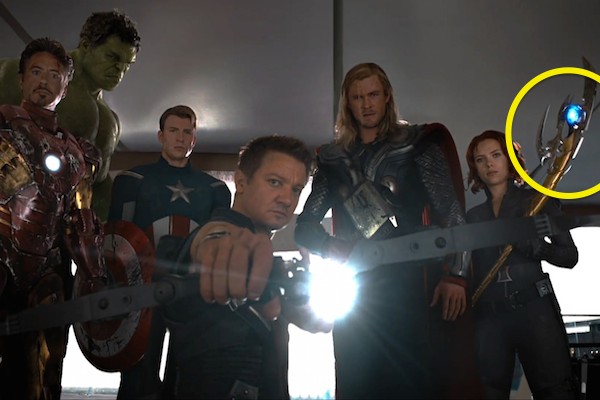
The biggest problem with movies in the Marvel Cinematic Universe is that they like to think they set a standard for continuity, as if to say: "Look at our interconnected movies, man; we really know how to build an expanding world." That's all well and good, but it's not exactly true: things get forgotten all the time, only to be dealt with in awkward ways in later films. One example of this occurs in The Avengers: in the movie, demi-God Loki is sent by galactic overlord Thanos to recover a mystical item known as the Tesseract; to achieve his task, he's given a super powerful scepter (that we later discover, like the Tesseract, is one of the Infinity Stones), which he uses to control and manipulate and do very bad stuff. After an epic battle in New York that pits Loki and his space-based minions against Earth's Mightiest Heroes, Loki is defeated and the Avengers recover the dangerous items - that is, the scepter and the Tesseract. At this point, Black Widow can be seen holding onto the scepter. Then we see that Thor takes the Tesseract back to his home planet of Asgard for safeguarding. Good. And yet - bewilderingly - he leaves the scepter. Why, in Odin's name, would Thor do that? He knows the weapon is super powerful; Loki had it, for God's sake! Instead, it's just ignored and forgotten by the writers, who later pull a sort of retroactive, "Oh, uh, H.Y.D.R.A. have it now," because that's where it appears in Age Of Ultron for some reason - at their base. How did it go from Black Widow's grasp to Hydra's base? And why didn't Thor simply take it back to Asgard with the Tesseract? Priorities!

5. Doctor Octopus Tries To Kill Peter Parker (Despite Needing Him For Information) - Spider-Man 2
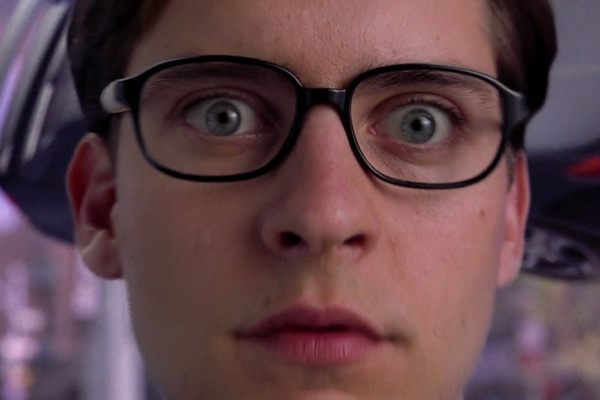
In Spider-Man 2, the evil villain - that is, Doctor Octopus - sets out to find and kill Spider-Man, who he blames for the accidental death of his wife. In an attempt to track down everybody's friendly neighbourhood superhero, Doc Ock learns from Harry Osborn that his friend, one Peter Parker, might know how to get into contact with Spider-Man, him being his "photographer" and all. At this point, Spider-Man unleashes a questionable narrative indulgence that is so misguided that it has to qualify as a plot hole. The scene in which said error takes sees Peter Parker and his love, Mary Jane Watson, sitting in a cafe, when - all of a sudden - a car comes unexpectedly crashing through the window behind them. Peter, imbued with Spidey senses, is able to steer them out of the way, narrowly avoiding death. It's then that a furious Doc Ock interrogates Peter. But think on that for a second: why did Doc Ock try to kill Peter if he needed to pump him for information on Spider-Man? Had Peter not been able to dodge the car using his powers (and remember, Doc Ock doesn't know that he's Spider-Man) he would have certainly been crushed to death. It's a matter of spectacle over logic, and an unforgivable plot hole for the very reason of... well, Doctor Octopus wouldn't have tried to kill Peter in said situation.

4. The Joker's Plan Is Too Intricately Thought-Out To Make Any Sense - The Dark Knight

Christopher Nolan's undeniably brilliant follow-up to Batman Begins, The Dark Knight, is one of the most beloved movies of the last decade - but it isn't without its flaws. You can comb through the length of Nolan's Michael Mann-esque comic book thriller and you'll find a bunch of plot holes, some of which are easy to ignore, whilst others are plainly irksome. But no plot hole in the movie is annoying as the one regarding the Joker's plan to get captured and put in jail cell (and everything leading up to it), thus implementing the infamous moment in which he unveils that crazed Harvey Dent/Rachel bomb scenario. Take for example, the moment in which he shoots a bazooka at the armed truck containing Harvey Dent during the initial chase, and yet somehow knows that Batman will drive in front of the missile to deflect the shot. Had Batman - you know - not done that, Dent would have been killed, and the rest of the plan would have crumbled. Then there's the notion that the Joker needed a cop in his cell with him for his plan to work (in order to secure a hostage), and yet there was no way that such a thing could have been calculated in advance. Once you consider that the Joker somehow knew exactly what was going to happen at every moment, and the plot starts to fall apart. Nobody could have predicted what was about to happen to such a highly specific degree - you'd have to be plainly psychic to do that. The Dark Knight wants to portray the Joker as somebody who is plainly crazy; chaotic, without reason, acts totally on impulse. On the other hand, it also wants to depict him as a super-smart mastermind who premeditates everyone else's reactions to his tricks and then counters them before they have a chance to react. This dual approach to the Joker - wildly random and yet totally prepared - doesn't really work. It's inconsistent. And it's a hole.

3. Tony Stark Randomly Gets His Heart Fixed, Despite That Not Being A Thing - Iron Man 3

One of Iron Man's defining attributes is his shrapnel-embedded heart; it's a reminder of the incident that led him to becoming Iron Man, and a long-standing character trait that makes him the complex guy that we know and love. It's also mentioned, oh, eight or nine times throughout the franchise that, should Tony try to remove the shrapnel from his heart, he would outright die: he needs that arc reactor in his chest to survive. But then - out of nowhere - Iron Man 3 throws an illogical curveball the size of the Avengers tower at the audience: Tony is (for some reason) able to remove the shrapnel from his chest via surgery. All of a sudden, it's taken out and he's plainly fine. It's half-heartedly justified by way of a Chinese doctor, but what gives, Marvel Cinematic Universe? Why didn't Tony just do the same thing years and years ago? You know, when the damn thing was actually poisoning him? You might be thinking: well, this isn't a plot hole, but you'd be wrong on that. After all, this one sequence throws the logic-factor of previous Iron Man movies into the air for the sake of a quick fix - the speed of the reveal is way too lazy to enable audiences to buy into it. Fact is, it makes no sense when viewed in context with everything that came before; essentially, we - as the audience - were told one thing, and then this happened, thus negating what we thought we knew about the nature of the very crux of the Iron Man series. It's essentially like being made to care on false pretences.

2. The Clark Kent Glasses Thing Really Doesn't Work In The 21st Century - Man Of Steel

Man Of Steel was director Zack Snyder's attempt to bring Superman into the 21st century; to inject it with a bit of Christopher Nolan-esque grit (even if it's still a movie about a flying alien from a far-off planet). And whilst he succeeds in that approach to a degree, there is one particularly notable lapse in logic that is just plainly irritating - one that does not gel with the world that Man Of Steel seeks to establish for the length of the film. That's to say, nobody recognises Clark Kent as Superman at the end of the flick. Even in a world similar to our own, with 24-hour-news coverage, YouTube videos and the fact that Superman even lets himself be seen close-up by human people on several occasions, nobody apparently notices the fact that Clark Kent looks exactly like the Son of Krypton. If somebody you worked with looked the spitting image of Superman - the most famous person the planet, mind - a pair of black-framed glasses wouldn't hide it. Yes, it's always been something of an embellishment of the franchise that a pair of glasses stops anyone from realising that humble newspaperman Clark Kent is actually Superman; an easy way to separate the dual sides of the character's persona. But in Snyder's world - the "real' world - it's ridiculous enough to qualify as a full-on plot hole.

1. How The F*ck Is Professor X Alive? Seriously? - X-Men: Days Of Future Past

When it comes to continuity, there's only so long you can go with the "we're not going to explain this" option before it begins to feel like a slap in the face. The X-Men franchise - with its super-messed up, totally incomprehensible excuse for a timeline - has taken this approach on a number of muddled plot points, and for the most part audiences have been forgiving of that. But there is one inexcusable plot hole that has never been addressed properly, presumably in the hope that everyone will just forget about it. Well, they haven't, and it's bloody annoying: how in God's name is Professor X alive? Look, X-Men franchise, we're all really, really sorry that you opted to kill off Professor Charles Xavier in X-Men: The Last Stand. It was a mistake. But if you're going to bring him back you need to offer up an explanation that makes sense. Not just a couple of vague hints like, oh, he transferred his conciousness into another body but somehow still looks like Patrick Stewart; an actual explanation. In X-Men: Days Of Future Past, an admittedly great chapter in the series, Professor X is seen hanging out with the other X-Men as though nothing happened; like he never - you know - died. Until this amazing resurrection is properly explained (and the likelihood is that it never will be given the new timeline), this is to be a considered a fully-fledged plot hole of the highest order: an illogical fallacy that takes the audience for a bunch of outright fools. You killed him off, X-Men franchise, and now he's back: tell us what we want to know. Like this article? Agree or disagree that these plot holes are kind of unforgivable? Let us know your thoughts in the comments section below.

Contributor

Sam Hill is an ardent cinephile and has been writing about film professionally since 2008. He harbours a particular fondness for western and sci-fi movies.