7 Film Remakes That Were Actually Necessary

The originals are good, but the remakes are the ones we remember!

The word €œremake€ leaves a sour taste in everyone€™s mouth these days as more and more classic films are being rehashed for all the wrong reasons, even though that doesn€™t necessarily mean all remakes of classic movies are bad. Scarface, The Departed, and True Grit are considered some of the best remakes of all time, and yes while these movies are in fact great, the original films were also great and didn€™t really need to be remade in the first place. The original and preferred concept for remaking a film is to take an underachieving movie that had great potential and remake it into something great. Two important factors that justify a film being remade are whether or not the original is terribly dated in overall style or the original is relatively unknown. Also, the remake must bring something new while respecting the original. Ever see a film with an overall great concept but it just didn€™t live up to the expectations or flat out failed miserably? Or maybe a decent film that€™s just very dated and hasn€™t aged well over the years? These types of films deserve a second chance and we as an audience should be welcoming to this. Here are the seven remakes that were actually necessary€

7. Invasion Of The Body Snatchers (1978)

Often ranked among the greatest remakes of all time, Philip Kaufman€™s Invasion of the Body Snatchers develops a frightening atmosphere that still holds with today€™s standards. Kaufman€™s version retells the classic story of an alien invasion in which humans are slowly replaced by emotionless duplicates, but the setting is transplanted from a small American town to San Francisco. The original invasion in the 1956 version is an interesting subtext for the U.S. red scare during the 50s, while the remake has a stronger subtext of distrust towards government. The remake was filmed during the Watergate scandal/post-Vietnam war era and paranoia amongst the American people was once again at its height. Why It Outshines The Original: The remake adds the sense of realism that the original 1956 version lacks. Additionally, the strong performances from Donald Sutherland, Brooke Adams, Leonard Nimoy, and Jeff Goldblum carry the film to superiority. Also, this remake is far scarier. The pod people in this version are much more memorable with their pointing and high pitch screaming, while the pod people in the original are drone-like and boring.

6. The Maltese Falcon (1941)

There are in fact three separate adaptations of The Maltese Falcon novel, but only the 1941 version is considered a film noir classic. The first came in 1931 and the poorly received second came in 1936 and was titled Satan Met A Lady. Director John Huston had to deal with the inconvenient circumstances of working under censorship enforced by the Hayes Code, while the original pre-code 1931 version did not. However, Huston was still able to work around this uphill battle and deliver the superior adaptation, thanks to the talented work behind the camera as well as famous performances by Humphrey Bogart, Mary Astor, and Peter Lorre. Why It Outshines The Original: The 1931 version is an early talkie so there is plenty of distracting technical flaws such as the dialogue pacing, so Huston€™s remake is obviously the better film overall. This version is polished and stylistic, but most importantly it's an innovative masterpiece.

5. True Lies (1994)

Most people are unaware that James Cameron€™s action-comedy, True Lies, is in fact a remake of the 1991 low budget French film La Totale! by Claude Zidi. Considered as the most expensive film ever made at the time of release, Cameron€™s $100 million remake went on to earn a whopping $400 million worldwide. Audiences were captivated by the over-the-top set pieces and action sequences as the monstrous budget certainly made an influence. Why It Outshines The Original: True Lies and La Totale! both feature the same basic plot following a typical family man living a double life as a secret agent and both lives consequently get intertwined. Neither film takes itself too seriously, however the most obvious difference between the two are the budget levels, so True Lies is basically a remake on steroids. An action film needs a budget in order to properly execute the big explosions, fights, and car chases, and La Totale! certainly lacks this. The entertainment level is subpar and the acting is average at best. La Totale! is underwhelming and relatively unknown, while Cameron€™s remake is explosively entertaining, over-the-top, and memorable.

4. Ocean's Eleven (2001)

Steven Soderbergh€™s fast-paced heist classic, Ocean€™s Eleven, is a sophisticated popcorn flick loaded with star power and terrific direction. The film follows career criminal, Danny Ocean (Clooney), as he€™s released from jail on probation and immediately plots his next high rolling heist scheme by rounding up a diverse crew of talented thieves through his buddy, Rusty (Pitt). The crew assembles a plan to rob the Bellagio Hotel vault and everything must go according to plan. Why It Outshines The Original: Both versions pretty much feature the same plot but the remake's well-written characters steal the show and the chemistry between the actors is a pleasure to watch. The actors are having fun and so are you. The script is a masterpiece in writing as the dialogue, characters, tension, and comedy all sync together and consistently works from beginning to end. The original 1960 rat pack Ocean€™s Eleven (Frank Sinatra, Dean Martin, Sammy Davis Jr.) is decently entertaining. However, it comes across as very campy and the plot is significantly lacking when compared to Soderberg€™s remake. So basically Soderbergh took a dated rat pack heist film and remade it into a modern day classic and definitely one of the greatest heist films of all time.

3. The Fly (1986)

David Cronenberg€™s sci-fi horror film, The Fly, is best known for its amazing gross-out gore effects that defined 80s horror. The film won an Academy Award for best makeup and Jeff Goldblum gives maybe the best performance of his career playing a brilliant scientist who slowly transforms into a housefly after his own experiment goes amiss. Oh yeah, and it€™s also an emotional love story. Why It Outshines The Original: Cronenberg€™s version ranks above its 1958 predecessor simply because it€™s loaded with more substance and depth, while the original doesn€™t necessary hold up to modern viewings. The original is a classic in its own right, however Cronenburg€™s version blows the competition away due to the unforgettable shocking effects and the disturbing yet satisfying tone.

2. The Thing (1982)

Despite being a travesty at the box office during the summer of €˜82, The Thing is considered one of the greatest entries in both the sci-fi and horror genres as well as among one of the best in John Carpenter€™s storied filmmaking career. Carpenter's remake is based more closely on the famous 1938 short story as the plot follows American scientists being preyed upon by a terrifying shape-shifting extra-terrestrial life form in Antarctica. Why It Outshines The Original: The original 1951 version, known as The Thing From Another World, is arguably a classic, but was simply made too early as the 50€™s era effects were nothing close to being sophisticated enough to deliver real scares or portray realism. Both versions however play on the fears of invasion and paranoia during the cold war era and Carpenter€™s version greatly exceeds this. And besides, would you rather the Thing be a man in a rubber alien suit, or would you rather it be a ridiculously freaky shape-shifting creature topped with amazing gross-out effects?

1. Heat (1995)

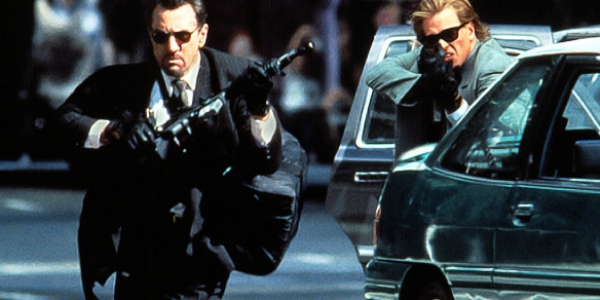
If at first you don€™t succeed, remake your own film with much bigger actors, a much bigger budget, and a refined script. Michael Mann did just that with his second effort of bringing his beloved script to life, which became Heat in 1995. Mann finished his script in the early 80€™s and had tried to get Heat made for nearly a decade before it finally happened in 1989, but it wasn€™t exactly the movie he really wanted to make. This made for TV movie is known as L.A. Takedown, a dumbed down 90-minute version of Heat. Since he was working with such a low budget, Mann had no choice but to cut out important plotlines, so his original 180-page script was shed down to only 110 pages. Mann would later disown the film along with NBC. Six years later Mann had an appropriate $60 million budget and directing freedom to make the movie he originally envisioned. All 180 pages from the script were included which resulted in a 170-minute edge of your seat crime classic with the same central cat and mouse story of a cop (Pacino) chasing a bank robber (De Niro) and his crew. Why It Outshines The Original: Heat is arguably the greatest Heist movie of all time and a perfect example of how to remake a movie. A smart script, an A-list cast, and intense action sequences make this a classic. And don€™t forget about the famous downtown L.A. shootout scene, which is considered one of the best action scenes in the history of American cinema. L.A. Takedown is the prototype of what Mann envisioned and Heat is the polished final draft.

Contributor
Contributor

Current college student and retail slave. Future PR/marketing professional. Also a fan of the movies. Don Draper is my idol.