Django Unchained: 7 Historical Inaccuracies
Inglourious Basterds that Quentin Tarantino doesn't much adhere to real-world history, what with an ending that would make for one hell of a Wikipedia article should it have actually happened. But given that Tarantino unchained Django in his latest spaghetti western homage to get a slavery dialogue going in the first place, we'd probably be right to assume that he considers some aspects of his latest flick to be genuinely sincere. The slavery aspects, at least, have been highlighted with a raw dedication to issues Tarantino firmly believes have been "white washed" by the majority of Americans. And given that it takes place 2 years before the Civil War, we've even got a time-frame. A time-frame for what, you're wondering? Well, the astute amongst you might've noticed that - given the year this thing is set in - some of the historical elements don't exactly fit. Join us, then, as we take a look at 7 historical inaccuracies that we've noticed throughout Django Unchained. It's important to remember that spaghetti westerns were iconically anachronistic, so there's no doubt that many of these inclusions are either purposeful or purposely ignorant of history. We delve in for the sake of pure, adulterated fun, then - because what's more entertaining than condensed history in list format? On second thought, don't answer that.
7. Michael Parks' Straw Hat
 The Movie: Michael Parks, who makes a brief appearance as an ill-fated Australian mining company employee, can be seen wearing a straw hat. The History: In what is perhaps the most uninteresting piece of movie trivia you'll read today (don't worry, they get a lot better!), Parks' character's hat is actually far too modern to have featured in 1858. The hat incorporates eyelet air holes and a practice cord lock on the chin cord. What does that mean? Basically, that style of hat just didn't exist back then. Shame on you, costume department. How could you?
6. "Sold, American!"
http://www.youtube.com/watch?v=K8wyqIKYqxc The Movie: During the auction sequence, Dr. King Schultz yells out, "Sold, American!" The History: Though it's perfectly reasonable that Dr. Schultz might've called out the phrase purely by coincidence, the likelihood is that Tarantino was alluding to a certain piece of pop culture artifice. The line "Sold, American!" was made famous in the 1930s during a Lucky Strike cigarette radio commercial, when auctioneer Lee Aubrey "Speed" Riggs first laid claim to it. The line was used to denote the quality of Lucky Strikes's "American" tobacco. Of course, in this case, it's probably just another cut of idiosyncratic Schultz lingo.5. Weaponry
The Movie: There's one heck of an impressive armoury at work in Django Unchained. Throughout the course of the movie, you'll be able to glimpse both Django and Dr. King Schultz using a Sharps Cavalry Carbine and a Henry 1860. For their secondary weapons, both Django and Dr. King Schultz use Cobra "Big Bore" Derringers to dispatch of their unsuspecting victims. The History: A spaghetti western wouldn't be a spaghetti western without a host of anachronistic weapons at large, and Django Unchained is no exception. None of the aforementioned weapons existed in 1858, the most noteable of which - the Cobra "Big Bore" Derringer - didn't exist in such a form until the 1980s. The Sharps Cavarly Carbine was first produced in 1874, whilst the Henry 1860 - well, you can guess what year that weapon first emerged (it's in the name).4. Nefertiti Bust
 The Movie: The keen-eyed amongst you will have noticed that there's an impressive replica of the world famous Nefertiti Bust visible in the background at Calvin Candie's villa during the Candyland sequences. Quite the collector, that Calvin Candie - and apparently an even better time traveller! The History: Of all the inaccuracies in the film, this one's the most likely to have been an accidental mistake, though it's somewhat surprising that somebody would've got the dates messed up considering the year span, prompting the question: "What's going on?" The actual Nefertiti Bust wasn't discovered until 1912, around 50 years after Django Unchained is set. The best is around 3,300 years old and is made of limestone. Unless Calvin Candie found it and reburied it Thutmose's workshop in Amarna, Egypt, there's simply no way he could have a replica of such a thing. Oops.
3. Dynamite
 The Movie: Django and Dr. King Schultz dispatch their enemies in a whole variety of interesting ways, though there's a certain fondness for the devastating effects that dynamite can produce - especially during the Klan sequence - showcased throughout the course of Django Unchained. The History: Though dynamite was in production elsewhere (in England it had been patented and sold a year earlier than the events depicted in Django Unchained), dynamite didn't explode in America until 1867. It wasn't particularly well-known until chemist Russell S. Penniman invented "ammonium dynamite" - a form of explosive that used ammonium nitrate as a substitute for nitroglycerin. Of course, dynamite is a staple of the spaghetti western genre - how could Tarantino leave it out?
2. Ku Klux Klan
 The Movie: Not only does Tarantino use Django Unchained as a platform for slavery-based historical revenge thrills, he crams in an entire sequence that serves purely to ridicule the notorious Ku Klux Klan. Firstly, in a hilarious bag-head sequence (featuring a cameo from Jonah Hill), he makes them look dumb as hell (that is historical accurate, actually). Secondly, he reduces them to the slaughter, mainly with bullets and explosions. Woo! Just remember that it's 1858... The History: Um, well, the Ku Klux Klan was first formed in 1865 - 7 years after the events depicted in Django Unchained - by six disgruntled Confederate Army veterans. Tarantino's point, perhaps, was to show that lots of folk were ready to take such an extreme stance even before the Klan was "officially formed" - this fore-bearer crew, then, complete with bagged heads and flaming torches, serve to highlight the attitudes that would eventually mark the Klan's coming. Klan members really would ride out into the night as depicted in Django, though, and would attack small towns and rural areas - often their own.
1. Mandingo Fighting
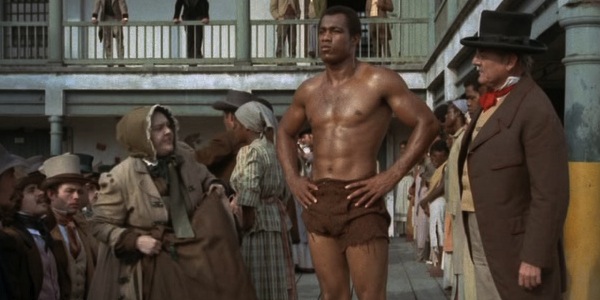 The Movie: One of Django Unchained's most controversial aspects are its "Mandingo" fights, a brutal and bloody ritual which forces two slaves in a gladiator-like battle to the death - purely for betting and entertainment purposes. Leonardo DiCaprio's plantation owner is particularly enamoured with the practice, and considers himself to be an expert trainer in the field. Both Django and Dr. Schultz gain entry into Candyland whilst masquerading as Mandingo trainers. The History: Despite Tarantino's insistence that Mandingo fighting was a real past-time, he's obviously been influenced by blaxploitation films Mandingo and Drum, both of which depict the practice as a vicious bloodsport enjoyed by plantation owners. Truth is, there's no real evidence to support the fact that Mandingo fighting every took place - slave were extremely expensive and destroying your property in such a fashion was not considered good business ethic. Like this article? Spot any historical inaccuracies that we've missed? Let us know in the comments section below.