8 Abandoned Plot Twists That Almost Ruined Famous Movies

A drunken dinner with an apologetic Darth Vader? Say no more.

Implemented with skill and intelligence, a good plot twist can add something special to a motion picture - a sense of complex design that encourages multiple viewings. As far as the movies are concerned, a good plot twist gets people talking; they fill you with a dual sense of shock and awe. And some of the greatest movies of all-time have made use of the plot twist in order to cement themselves as sure-fire classics, of course: Citizen Kane, Psycho, Fight Club... But those are the good plot twists, and for every good one that makes its way into a movie, three really bad ones wind up in other, ultimately more questionable films. Because the device can be easily exploited; a twist thrown in carelessly when the filmmakers are out of ideas in the hope that it'll make a somewhat mediocre film more interesting. When it comes to employing a twist, you have to be really careful. And some very famous movies narrowly avoided featuring some truly insane plot twists that almost certainly would have ruined them had they been included. It's not at all surprising that they were axed...

8. Rita Awakens To Find She's Trapped In Her Own Groundhog Day - Groundhog Day

The plot of Groundhog Day concerns a weatherman named Phil Connors (Bill Murray) who arrives in the town of Punxsutawney to cover the annual Groundhog Day festivities. There, he's teamed with the lovely Rita Hanson (Andie MacDowell), but he's only interested in getting the job done and going home. After a blizzard traps him in town, he wakes up to find he's reliving Groundhog Day all over again! What a bummer! Cue a hilarious comedy as Phil is forced to live the hell of Groundhog Day over and over and... well, you get the idea. The film ends ends happily with Phil waking up next to Rita, the pair both well and truly in love, and Phil having finally learned to appreciate his existence. But that wasn't how things were originally supposed to end. Nope: originally the script called for a horrific plot twist which would have cemented Groundhog Day as the ultimate troll movie, in which Rita - the endlessly kind and gentle and intelligent female lead who did nothing wrong - wakes up and realises that it's her turn to spend an eternity learning to play piano and make ice sculptures. Seriously, Harold Ramis intended for Rita to become trapped in her own endless time loop once Phil's had ended. What a depressing slap in the face that would have been! And good cause for a sequel.

7. Chuckie Is Crushed To Death In A Horrible Construction Accident - Good Will Hunting

Good Will Hunting stars Matt Damon as a lowly janitor named Will Hunting who also happens to be a genius. Instead of realising his potential, though, Will just spends his time sweeping floors in the day and slacking off with his buddy Chuckie (Ben Affleck) at night. Also there's Robin Williams, the affable professor who realises that Will is really smart. The movie is generally regarded to be a pretty awesome one, and that's partly thanks to Gus Van Sant's amicable direction. And yet Gus Van Sant also very nearly ruined the movie with his meddling. That's to say, during the writing and development stages, the director insisted that - for absolutely no reason - Ben Affleck's character, Chuckie, should end up getting killed in a freak and very unexpected accident at the construction site where he works. Affleck and Damon - who wrote the screenplay, by the way - were not impressed, but decided to indulged their director and wrote the requested scene into the script. When it was finished, Gus Van Sant read the new draft - now inclusive of his crazy plot twist - and decided what he had suggested was terrible. Out it went. It would have been terrible, of course, because there is literally no reason for Chuckie to die. Not only would such a death have distracted from the most important part of the story - i.e. Will's development - but it would have added a unnecessarily schmaltzy layer that might have rendered the film as way too sentimental - not to mention depressing.

6. The Chinese Got There First - Interstellar

The plot of Interstellar concerns Matthew McConaughey's loveable hick, Cooper, a former astronaut turned farmer who lives on a not too distant future Earth that is on its way out: crops aren't growing, resources are scarce, and everything is, really, really dusty. Cue a sudden and unexpected plot development, lots of exposition, and a bunch of scenes with Michael Caine, and Cooper is suddenly off on a dangerous mission into the far reaches of space. His goal? To enter a wormhole in order to find a new planet where the inhabitants of Earth can relocate to. In the original film, you'll remember that Cooper investigates a planet before joining another expedition (that goes horribly wrong thanks to a crazy Matt Damon). When he wrote the first draft of the movie back in 2008, however, Jonathan Nolan (Christopher's brother) had a far weirder vision of what should happen to Cooper... That's to say, a mid-film plot twist would have seen Cooper and his companions landing on a planet only to find out that - shocker - Chinese astronauts had already arrived 50 years earlier! Though all the Chinese astronauts have since been killed by radiation poisoning, it's then that Cooper discovers a secret underworld complete with a secure base that - wait for it! - the surviving Chinese robots have built for humans to inhabit. It then turns out that said Chinese robots have been programmed to defend the base at all costs (especially from meddling Americans), and so a large portion of the script is dedicated to Cooper fighting off said Chinese robots in an attempt to escape. Interstellar has its flaws, of course, but you have to be kind of thankful that Nolan decided to discard most of this stuff; none of it really suits the tone of the film, and there was a risk that politicising things with said plot twist might have resulted in much attention being taken away from what really mattered: the wormholes.

5. Ray Survives... Then Commits Suicide - In Bruges

In Bruges tells the melancholic story of two hitmen who escape to Bruges in Belgium after a job goes wrong. The main characters are Ray (Colin Farrell), a naive but otherwise likeable chap, and Ken (Brendan Gleeson), his mentor figure - one who takes the opportunity to absorb some of the cultural sights whilst the pair are holed up in the middle of nowhere. After a number of scenes of the pair hanging out (Ray meets a girl named Chloe who he takes a fancy to), audiences discover that Ray is feeling immensely guilty having accidentally killed a little boy during the botched job. He contemplates suicide (and almost goes through with it), but is stopped by Ken. Ken reveals that he was instructed by their boss, Harry, to kill Ray, but refuses. As a result, Harry comes to Bruges and kills Ken for disobeying him. The movie ends on an ambiguous note after a frantic chase scene, with Harry dead and Ray having been shot to pieces in the town square, tittering on the brink of death. In the original script, though, writer and director Martin McDonagh included a further twist that saw Ray back in London recovering from his injuries. Chloe calls him up from Bruges to invite him back to Bruges, only for Ray to tell her to hang up the phone for "her own good." She asks why, to which Ray replies: "I don't want you to hear the gunshot." Ray hangs up himself at this point, puts a pistol to his head, and... cut to black. It's an odd and unnecessary turn of events, one that doesn't add anything to the movie and only serves to make it a whole lot more depressing than it needs to be. Thankfully McDonagh reconsidered and decided to stick with the more vague scene in which Ray bleeds to death in the square and "really, really hopes" that he doesn't die.

4. Is That Johnny Depp? - Birdman

Birdman tells the story of an actor named Riggan Thomson (Michael Keaton) who attempts to stage a pretentious play on Broadway as a kind of antidote to years of playing superhero movie roles that he deems to be worthless. The movie climaxes with a scene in which Riggan shoots his nose off during opening night with a loaded gun - a statement of true artistry. Birdman then ends with an ambiguous shot of Sam Thomson (Emma Stone), Riggan's daughter, staring at the sky as her father may or may not have somehow managed to fly out of the window. It's a nice ending - hopeful and weird; the kind that gets people talking. But does it have the edge over the plot twist that was originally supposed to mark the film? Yes, probably, because it's downright insane. The original plan, then - according to co-writer Alexander Dinelaris - was for the camera to drift back to the theatre, into the dressing room, only to reveal... Johnny Depp? Yes, Johnny Depp putting on a wig similar to the one Riggan wore whilst on stage, surrounding by a bunch of Pirates of the Caribbean posters, only for him to say - in Jack Sparrow's voice, mind you - "What the f*ck are we doing here, mate?" The point? Well, they wanted to imply an "endless" loop - another actor made famous through playing the same character over and over again, attempting to make amends - and gain some credibility - through the act of theatre. This would have been a funny twist, of course, but it would have also cheapened the film somewhat. Also: Disney didn't allow it.

3. Darth Vader Apologises Unexpectedly Over An Awkward, Drunken Dinner - Star Wars: The Empire Strikes Back
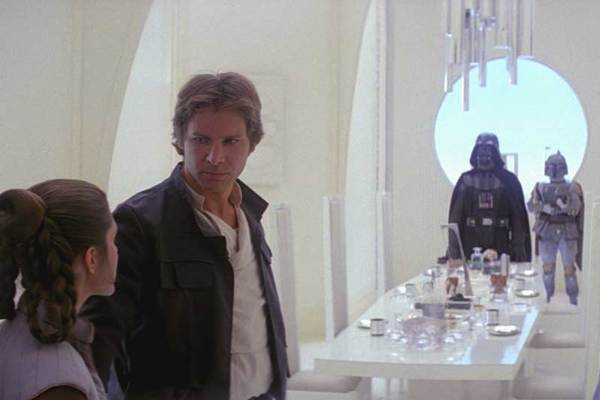
Who could forget that unbelievable moment when Darth Vader reveals that he is, in fact, Luke Skywalker's father? Whilst that twist is a stroke of genius, there's another great twist in Empire, too: the one that sees Lando Calrissian turning on his old buddy Han Solo when he first arrives at Cloud City. Lando leads Han, Leia and Chewbacca into a room, of course, only to find Darth Vader is already there waiting for them. To quote one Admiral Ackbar: "It's a trap!" Han tries to shoot Vader, but Vader blocks the blast and the gang are captured. But what if that didn't happen? What if, as outlined in screenwriter Leigh Brackett's original script, the gang arrived in Cloud City, were betrayed by Lando and... were treated to dinner? Uh-huh. In the first draft of The Empire Strikes Back, the script calls for the ultimate twist - one more unexpected than Vader turning out to be Luke's dad. Yes, Vader sits down to a meal with Han, Leia and Chewie, sort of apologises to Leia for being a d*ck on the Death Star, whilst Han watches on and glugs down glasses of wine. Vader still wants to use Leia as bait to trap Luke, but he also agrees to let them roam Cloud City at their will. So Vader was pretty chill in this original version. It's probably a good thing that Brackett's script was rewritten to feature an antagonist who was actually scary, and not one that... you know, preferred to host dinner parties and make amends. After witnessing Darth Vader's cruelty in the original movie, it would have been a super out of place to witness a sudden plot twist that saw him acting so... casual?

2. The Alien Bites Ripley's Head Off & Imitates Her Voice - Alien

Alien, Ridley Scott's unabashed sci-fi masterpiece, tells the ill-fated story of the crew of a space-cruiser called the Nostromo, who touch down on a strange planet after responding to a distress signal and inadvertedly bring an alien creature on board their ship that proceeds to kill them off, one by one, in increasingly gruesome ways. At the centre of this chilling horror nightmare is one resourceful heroine named Ellen Ripley (Sigourney Weaver), the only crew member who survives the ordeal and - after a long stretch of near-death experiences - manages to fire the creature into the cold depths of space. Then, left with no choice, she records a final log and places herself into cryosleep. One of the inherently great things about Alien happens to be that it features a female lead who faces a mighty challenge and overcomes the odds, of course. And yet it very nearly didn't happen that way, because the original script called for a downright awful moment that would have seen Ripley killed for literally no reason. And not just killed, mind; the plan was for the alien to bite her head off in the escape shuttle and then - in the weirdest plot twist ever known to man - sit down in a chair and record a message on the log whilst imitating her voice perfectly, which is... well, what is that, exactly? This ability wouldn't have been mentioned beforehand, by the way. Shock factor intended. It was supposed to be crazy and completely out of nowhere; a plot twist nobody could have ever seen coming. It would have also ruined everything that is great about Alien, and killed the franchise dead for the sake of a talking Xenomorph.

1. It Was All A Dream - Legend

There is arguably no worse a plot twist than that of "it was all a dream." Not only does this type of ending cement a film as entirely pointless, it almost never, ever enhances the story. Legend, the 1985 fantasy flick starring Tom Cruise and directed by Ridley Scott, originally toyed around with the idea of going for an ending of this variety, though, for no other reason than: "How else should we end it, then?" Legend - which was Scott's follow-up to Blade Runner, by the way - features Tom Cruise in one of his earliest roles, a fantasy film that was intended to start a new wave of similarly-minded magical blockbusters but failed spectacularly in the process. In recent years, the film has received something of a re-appraisal and has amassed a cult following amongst Scott fans and people who like Labyrinth. It's good, not great... but it might've been worse. Cruise plays a boy of the forest named Jack, then (a sort of Link from The Legend of Zelda character), who is tasked with saving his home, a princess (Mia Sara) and stopping the bad guy (Tom Curry) from covering the land in darkness. It's not a particularly original plot, and for the most part the movie relies on scenes featuring Tim Curry and its splendid visuals to keep you invested (but those Tim Curry scenes are really, really worthwhile). The normal version of Legend culminates with Cruise's woodland lad recovering a ring and using it to revive the princess after she's knocked out by darkness, and the two go off into the sunset and it's happily ever after. An unused ending (one which was filmed), however, throws in the most arbitrary plot twist imaginable: it was all a dream. Scott shot this ending, which has the lovers going their separate ways, complete with implied "wake up" sequence for Jack. What, really, would have been the point in that?

Watch Next


Contributor

Sam Hill is an ardent cinephile and has been writing about film professionally since 2008. He harbours a particular fondness for western and sci-fi movies.