8 Famous Movie Directors Who Pushed Their Luck (And Paid The Price)
 Some movie directors seem to crack the formula for success from the get-go: with every movie that they add to their filmographies, they employ the same tropes and themes and stylistic choices, only to find that the public are happy to lap it up, time and time again, because, hey, it works, and why deprive them of what they want to see? But how long can a movie director repeat or recycle themselves before people start to get bored? Before people start to notice that, wait a minute, haven't we seen this before?And, hey, when are you going to do something different? This time period varies depending on the director, of course, though it almost always happens eventually: a director will push their luck, or get lazy, or make a movie that highlights all their worst traits at their most excessive, unnecessary and indulgent. Take the directors I've assembled for inclusion on this list, then, all of whom were at the top of their game until they pushed their luck at little bit too far, churning out motion pictures that made us feel like we were watching them on autopilot, or coasting on formulas that we'd already been exposed to years earlier... The lesson? You can't keep doing the same thing for too long, 'less you're prepared for the backlash...
8. Quentin Tarantino - Death Proof (2007)
 Quentin Tarantino stunned audiences with his first two movies, Reservoir Dogs and Pulp Fiction, and ushered in a new age of slick gangsters who talked about everyday things, awesome soundtrack cues, and scenes of humorous violence. For his follow-up, Jackie Brown, people were more underwhelmed, despite its standing as Tarantino's most mature (and potentially greatest) movie ever. Kill Bill showed Tarantino exploiting his influences to a more noticeable level, and though it was certainly more unrealistic and cartoony than his previous films, fans got on board. And then there was Death Proof, a movie which allowed audiences to send Tarantino a very important message: you've gone too far. Yes, although it's filled with some great moments and an awesome car cash sequence, Death Proof saw Tarantino indulging himself to new heights. The movie exposed a side of the director's trademark dialogue scenes in a new light, too: in the wrong context, they could be near-on unbearable, as witnessed here in what felt like a never-ending talkathon. As a result, Death Proof lost money at the box office, and is even considered by the man himself to be his worst movie. There's a limit to how Tarantino even Tarantino can be.
7. M. Night Shyamalan - The Village (2004)
 M. Night Shyamalan started a new trend (one that we're still suffering from) when he shot to international fame as the writer and director of The Sixth Sense, which seems like such a long way from movies like Lady In The Water and The Last Airbender that it feels like they were created by two different people. After Sense, Shyamalan released Unbreakable, a far quieter movie with a twist ending that wasn't quite so twisty - this was probably a smart move, given that trying to top the shocking finale of Sense would have been almost impossible. Still, although Unbreakable (and its follow-up Signs) both embrace low-key twists and were better for it, The Village was the movie that pushed things a bit too far: I feel sorry for Shyamalan as it is, given that the studios likely pressured him to write movies built around twists, perhaps even if he didn't want to write them, but The Village shows the writer/director genuinely clutching for straws. The end of the movie embraces a naff twist for the sheer sake of it, and audiences - once enamoured with this "new Spielberg" - had had enough. The Village made money, but Shyamalan is considered to be something of a laughing stock today. How far he has fallen.
6. Woody Allen - Stardust Memories (1980)
 It's no secret that Woody Allen's work has been heavily influenced by some of the greatest European directors, especially those of Ingmar Bergman and Federico Fellini. After the success of his romantic comedy masterpiece Annie Hall, Allen created with is quite obviously a homage to the works of Bergman (it received mixed reviews, with most critics complaining that Allen had just tried to make a Bergman film), and once he was done with his other masterpiece, Manhattan, he set out to do the same thing with Fellini: thus, Stardust Memories was born. Essentially, Stardust Memories was Woody Allen's 8 1/2, a dramatic comedy about a filmmaker whose fans only want him to make movies in the vein of his "earlier, funnier ones." As a result, this wasn't Allen's most accessible movie, nor was it one that his fans wanted in the wake of Manhattan - they'd already put up with Interiors, after all. So of course Stardust Memories flopped at the box office, barely making back its $10 million budget. Though the film isn't bad, it - like Interiors - feels like Allen pushing his luck, needlessly remaking the films of his idols.
5. Richard Kelly - Southland Tales (2006)
 When Donnie Darko suddenly hit the big time out of nowhere and became everyone's new favourite movie, the world looked to its young writer/director, Richard Kelly, to create his next work of genius, preferably in the science-fiction genre. Kelly, presumably blinded by the amount of recognition that he had received for his awesome debut feature, thought that he could create just about anything he wanted to for his follow-up, and his loyal fans would praise him in the same vein regardless. Unfortunately, he decided to create Southland Tales. Southland Tales feels like the movie that a director might make with just a few weeks to live - it's like a hodgepodge of absolutely every single idea that was working its way around Kelly's brain at the time, and it feels like the director wrote a script that he felt would encapsulate everything he had to say about the world, ever, as if he might never be given the chance to make another movie again. But cramming so much into one movie - especially since his debut flick was made on such a small-scale - defined "pushing your luck," - it felt like he was trying to be too smart for his own good. The movie flopped, raking in less than $1 million on a $17 million budget.
4. Gore Verbinski - The Lone Ranger (2013)
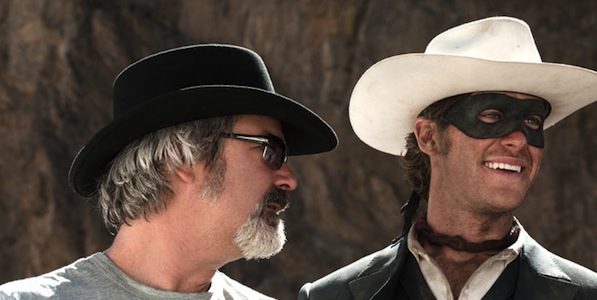 When the first Pirates of the Caribbean movie hit theatres worldwide, confused movie-goers stepped into the light, scratching their heads with massive frowns stuck upon their faces: how had somebody crafted a genuinely good picture (and such a fun one at that) using a theme park ride as source material? It made no sense, and yet we can applaud director Gore Verbinski for making that happen when Curse of the Black Pearl, became the phenomenon that it did back in 2003 (oh, and Johnny Depp - well done, you, too. Jack Sparrow is awesome). Two more Pirates movies followed, which was bound to happen, and although those CG-heavy abominations should have flopped at the box office, they made billions of dollars instead, despite the fact that they were both rubbish. Verbinski and Depp should have counted their blessings there and then, though: instead they decided to re-team again for another picture in the same vein, except this time it's The Lone Ranger. More money. More CGI - what could go wrong? Everything. It's currently the biggest flop of all-time, proving that Verbinski should have jumped ship when he had a chance, and that Disney-Depp doesn't always mean result in box office gold.
3. Zack Snyder - Sucker Punch (2011)
 If you quickly glance through Zack Snyder's filmography, you'll notice that every year, his movies get more and more CGI-heavy. It's no surprise, then, that Dawn of the Dead - which is relatively CG-free - is still his most accomplished work to date, and Man of Steel, his recent reboot of the Superman franchise, directed under the wing of Christopher Nolan, is one of his lesser efforts. After Dead, Snyder made 300, which was a huge success at the box office, a movie that had a genuine cultural impact, and marked the director as somebody to watch. Watchmen came next, a solid effort, but nothing to write home about, giving Snyder's obvious intention to stick to the source material as closely as possible. His next live-action feature (if you can call it that), however, was a step too far - and one in entirely wrong direction. Whereas 300 made sense of its visuals whilst clinging to an interesting story, and Watchmen used just the right amount of CGI, Sucker Punch was an exercise in indulgence, a good-looking but ultimately hollow product, lacking story and worthwhile characters. No surprise, then, that at this point audiences had become sick of Snyder's schtick - it flopped, making a mere $7 million profit.
2. Steven Spielberg - Hook (1991)
Having captured the attention of pretty much everyone, ever, by the time the '90s came around, Steven Spielberg was just about the most famous director in the world, and his name had become synonymous with Hollywood pictures built with quality, assurance and heart. Simply put, the man was King of Tinseltown. And although Spielberg sought to shake things up with more personal projects like The Colour Purple and Empire of the Sun in the mid to late '80s, he eventually found himself going back towards safer box office ground with Hook. Big mistake, Senior Spielbergo. Hook is, without a doubt, the singular movie in Spielberg's entire filmography that showcases the director indulging his worst traits: messy, overtly sentimental and filled with so many lazy sequences, this movie saw the director trying to recapture the magic of earlier movies like E.T., but instead putting out a product that feels as though it was directed on autopilot. Reviews were negative, of course, and the movie failed to make as much as was expected at the box office: audiences expected more than a half-assed theme park ride from Mr. Spielberg.
1. George Lucas - Star Wars: Episode I - The Phantom Menace (1999)
 No director has pushed his luck to such an extent as former geek God George Lucas, who single-handily destroyed the integrity of his beloved Star Wars franchise when he decided to create a prequel trilogy. You can't blame Lucas for trying, I suppose: the fans wanted it, after all, and although we complain now about the quality of the new trilogy, at the time fans couldn't have been more excited. Maybe Lucas should have known better, though, or at least brought in other people to help work through his naff dialogue cues and lame storylines. To be fair, though, even Lucas couldn't have been prepared for the backlash that came his way when The Phantom Menace failed to enchant almost everyone who saw it. What presumably failed to register with the formerly great director, though, was that he was pushing his luck on such heightened levels when he decided to go back and tell a story that didn't really need to be told. At least, characters like Darth Vader were better-realised when they were left alone to be mysterious. Sure, Lucas made billions of dollars in the end, but at what true cost? Like this article? Who have we missed? Let us know in the comments section below.